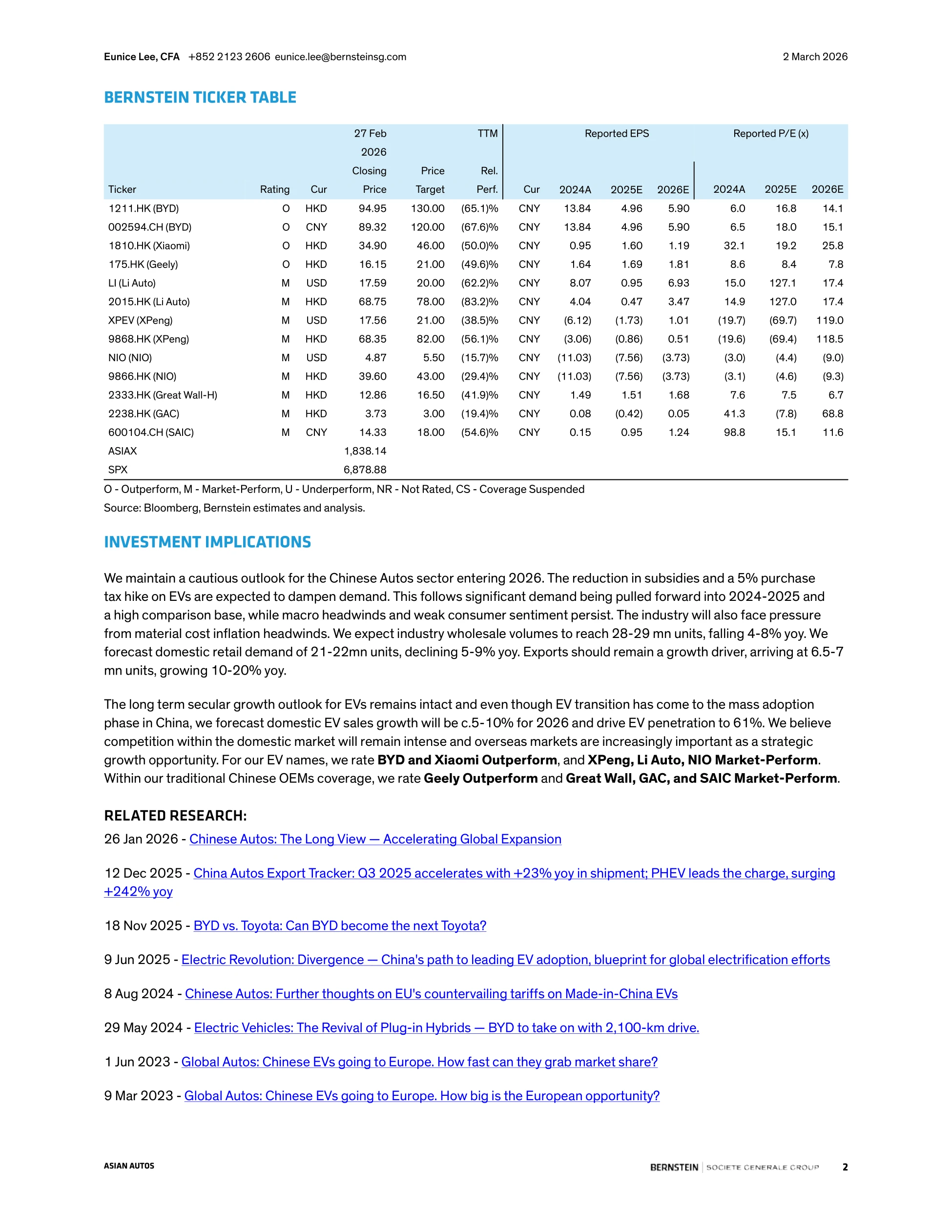
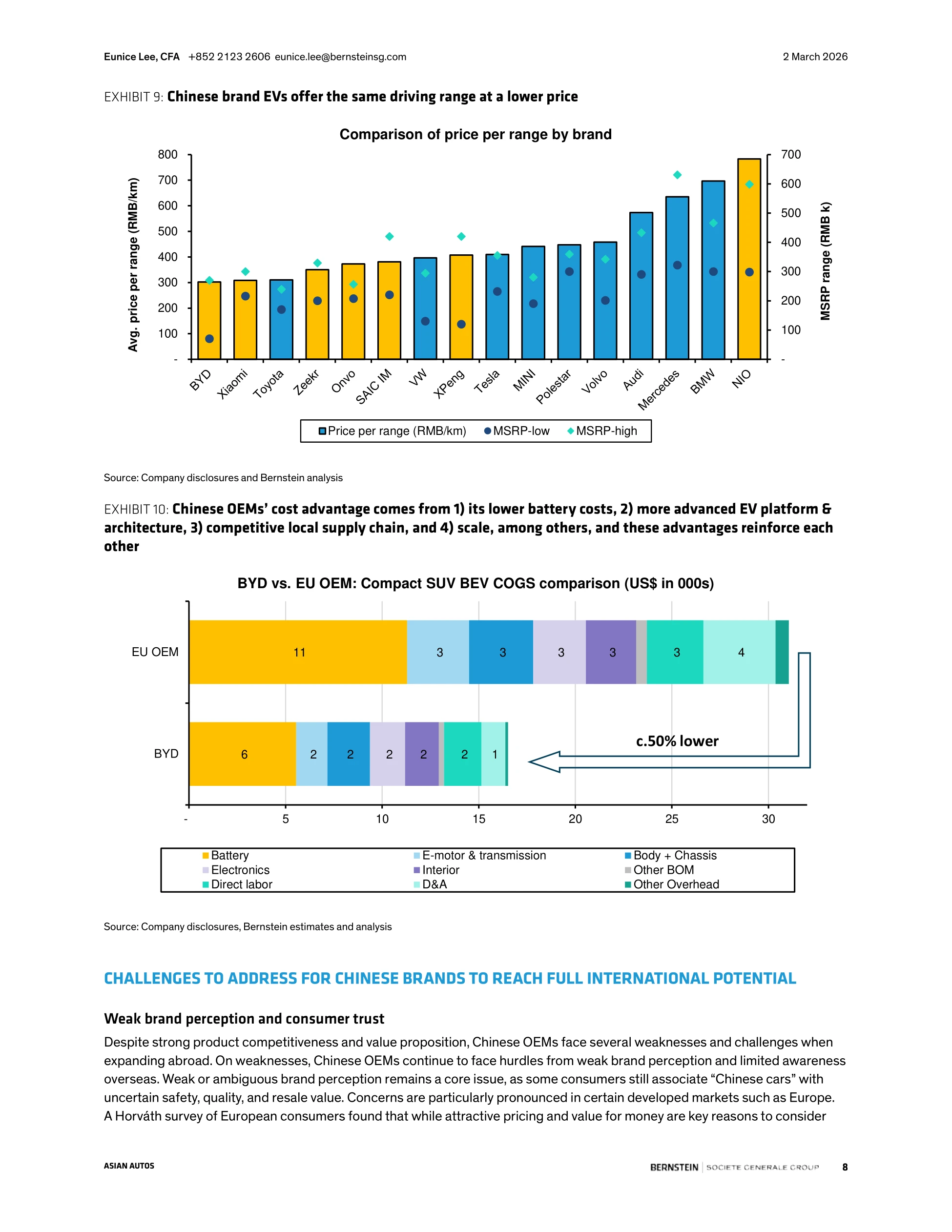
2 March 2026Asian AutosChinese Autos: Accelerating Global Expansion—What’s holdingthem back?Eunice Lee, CFA+852 2123 2606eunice.lee@bernsteinsg.comMika Fu+852 2166 4805mika.fu@bernsteinsg.comEthan Xu+852 2123 2634ethan.xu@bernsteinsg.comOverseas expansion has become a top strategic focus for Chinese OEMs as domesticdemand softens and competition intensifies. In our recent report (LINK), we assess the scaleof opportunities across key regions. Chinese OEMs’ significant strengths in scale, technology,and cost structure have made China a global EV leader. However, they must still overcomeseveral challenges to realize their full potential, as discussed in this report.Chinese OEMs benefit from scale advantage, technology leadership, and costcompetitiveness. China’s EV penetration reached 53% for full year 2025 and approached60% by year-end, far ahead of Europe at c.25% and the U.S. at c.10%, and accounted for64% of global EV sales. Chinese EVs lead in range and efficiency, and operate with a coststructure roughly half of Western OEMs. These advantages have allowed Chinese OEMs tobring highly competitive products to global markets at compelling prices.But Chinese OEMs still face several challenges abroad. Brand perception and lowawareness remain major hurdles, as some consumers—especially in developed markets—still question the safety, quality, and resale value. International management capability isalso limited, with decision-making remaining too China-centric and sometimes too slow forfragmented, fast-changing overseas markets. Distribution and after-sales networks are stillimmature. Competition is intensifying both from incumbents and fellow Chinese players. In2025, Chinese brands reached 9% market share in Europe, but across 20 brands backedby 13 OEMs, compared with Japanese’s 11% share (across 8 brands) and Korean’s 7% (3brands). Finally, geopolitical and regulatory risks—from tariffs to heightened scrutiny of dataprivacy and cybersecurity in connected vehicles—continue to add uncertainty. (LINK)Stronger brand equity and operational execution are crucial. Brand building mustbe a top priority. This includes a coherent long-term brand strategy, locally tailoredmarketing, and disciplined pricing. Empowering strong local management teams enablesfaster decisions. Local production and localized design will help Chinese OEMs bettermeet local expectations, as proven by the Japanese and Korean brands. Equally importantis building robust distribution partnerships and after-sales networks. Unlike in China—where OEMs often hold greater leverage—other markets operate with more balanceddealer relationships. A strong finance ecosystem is critical; for e.g. ASEAN buyers prioritizefinancing options, where Japanese OEMs excel. Finally, navigating local regulatoryframeworks and cultural norms is essential.BYD is best positioned to be the global EV champion. The company benefits fromsignificantly stronger bran...










































