
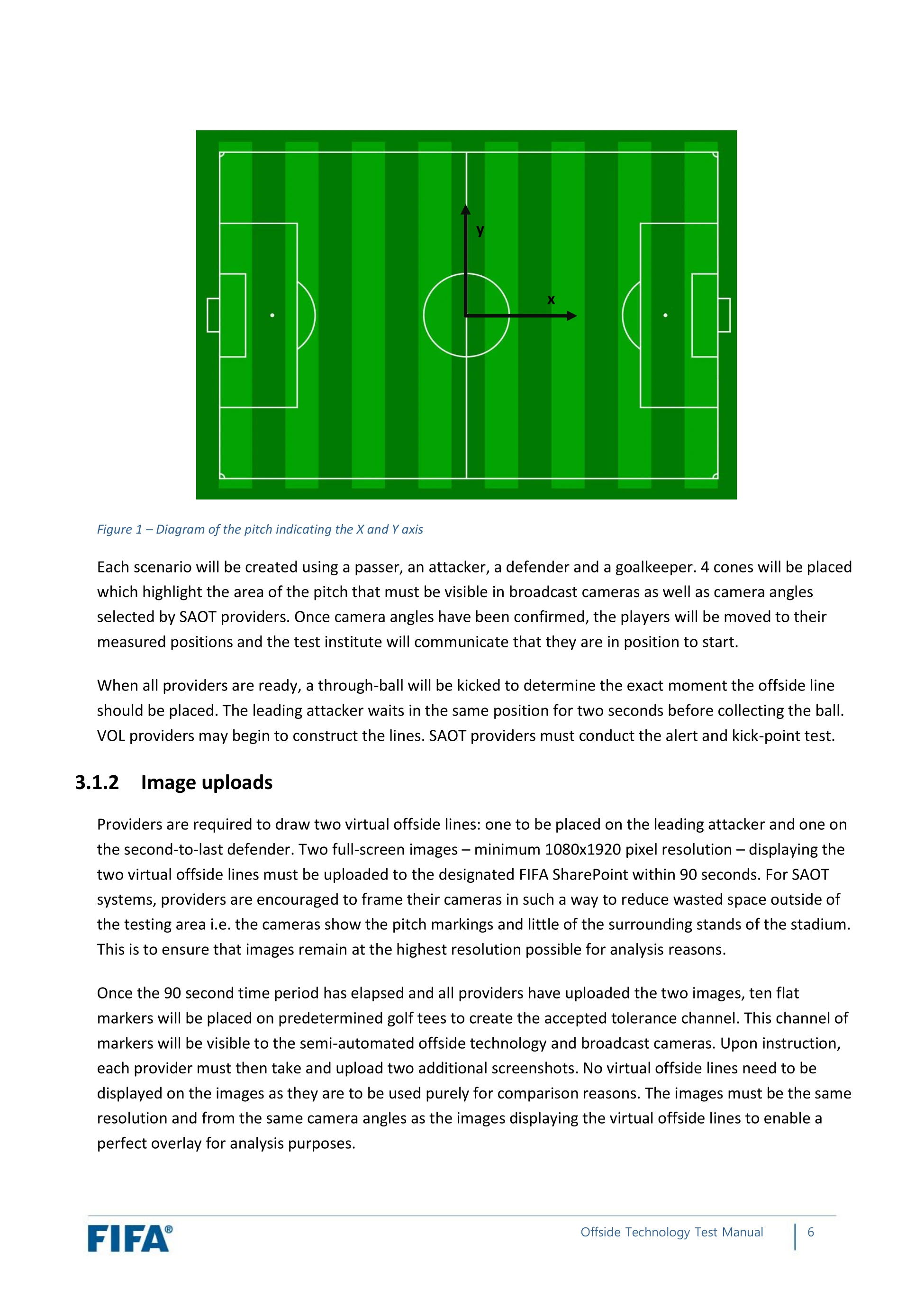
Offside Technology Test Manual Version 2; February 2023 Offside Technology Test Manual 1 Introduction Various offside technologies are now available to competition organisers as a means to aid video assistant referees (VARs) in making accurate offside decisions. There are two main categories of systems that are currently available. The first of those is the virtual offside line (VOL) which is the system that many football stakeholders have become accustomed to using since the inception of VAR in 2018. The system uses an operator who, with support from the VAR team, manually selects the moment the ball is played, the leading goalscoring coordinate of the attacker and the coordinate of the second-to-last defender closest to their own goal. Two VOLs are generated and, based on the proximity of each line to the goal line, the offside decision is made. The second system available to competition organisers is called semi-automated offside technology (SAOT). This system is capable of tracking multiple skeletal points on each player as well as the ball in order to automatically select the moment the ball is played and the coordinates of both the attacker and defender. This data-driven decision is then communicated to the VARs through a combination of alerts and visualisations. The major benefits of this system are that the time taken to reach a decision is reduced and that virtual-reality replays can be generated to assist in the visualisation of the decision. Whilst the system itself is automated, VARs are needed to check the results of the system and to interpret specific edge cases, hence the name “semi-automated”. This Test Manual outlines the full requirements for both a standard VOL system and SAOT system. The full component tests are listed in the Semi-Automated Offside Technology Component Testing Overview document. Offside Technology Test Manual 2 1. Concept The accuracy of offside technologies is tested through a combination of image processing and data analysis. Both analysis methods are made possible using a quantity surveying tool called a total station. This device allows for locations to be measured extremely accurately and marked on the pitch before being used for comparison by using the offside technology. The core test methodology is based on 30 assessed offside scenarios that are simulated at known locations on the pitch. For each scenario, the provider must generate manual or automated VOLs on agreed camera feeds. A high-quality image is uploaded to a FIFA file storage space (MS SharePoint) within a set time limit. Once the image is received from each provider, a channel of flat markers is placed in known locations relative to the offside. Once the markers are in position, the providers must screenshot and upload a second reference image that contains the view of the markers without the VOLs. Both VOL and...










































