

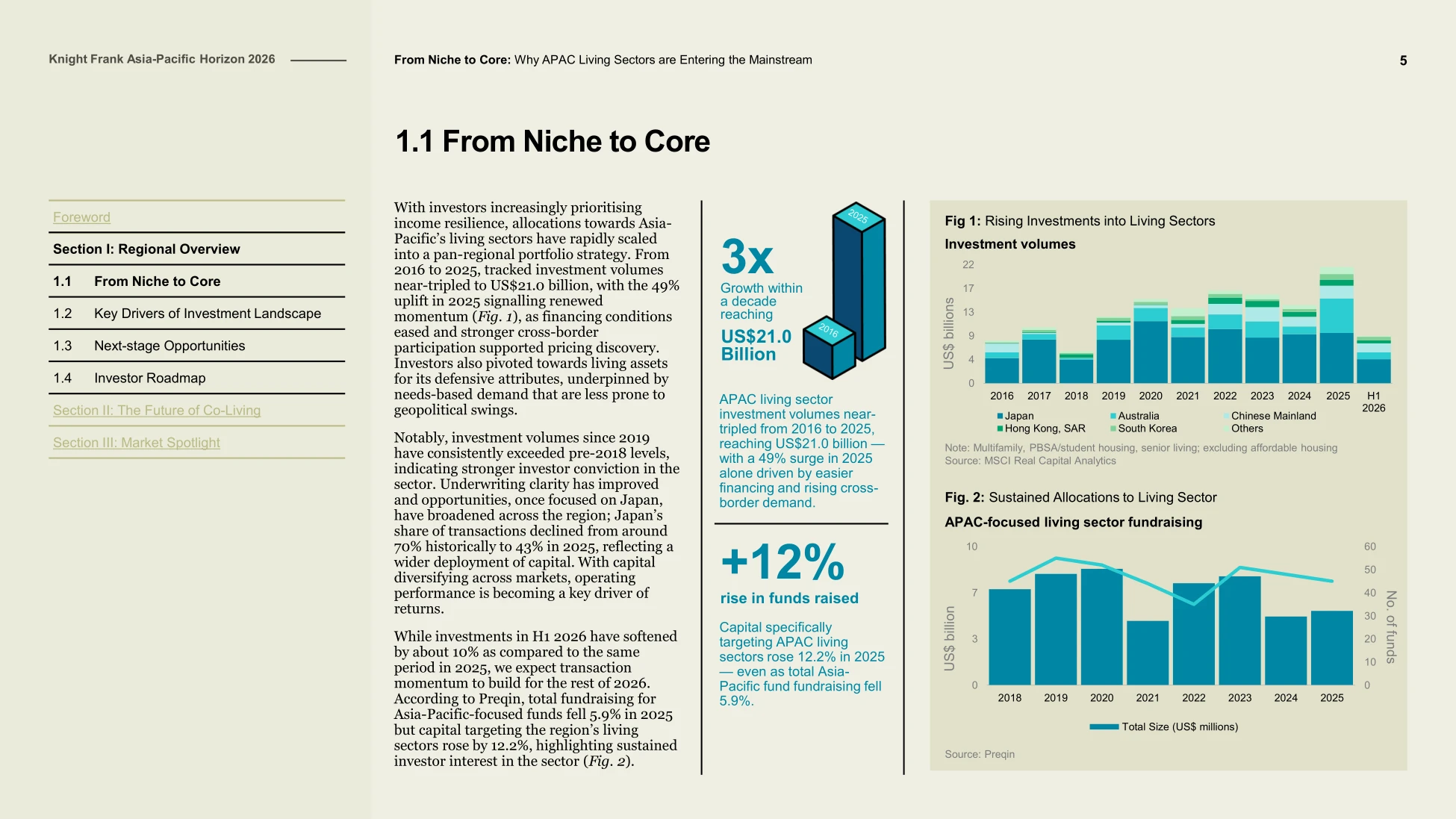
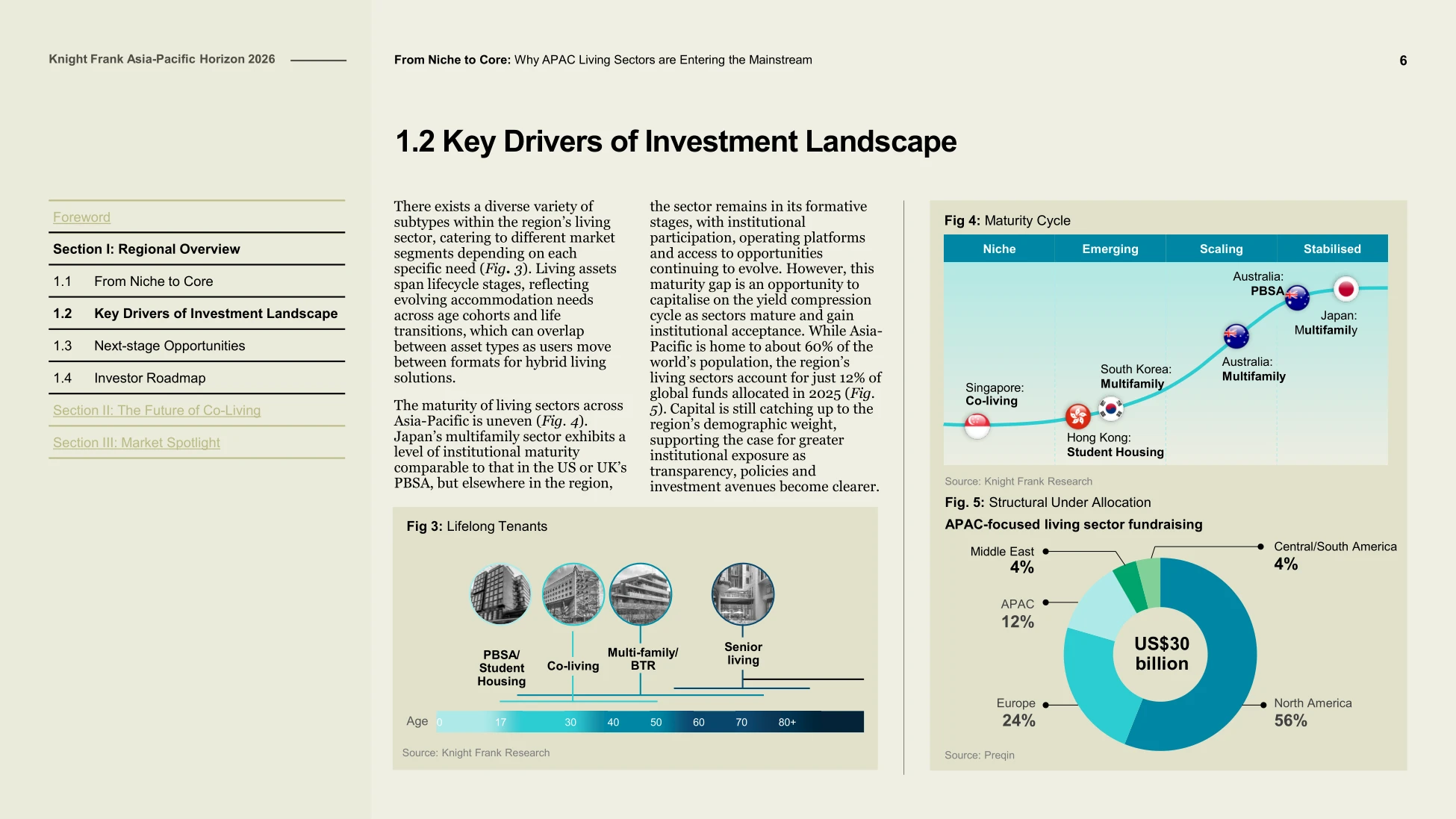
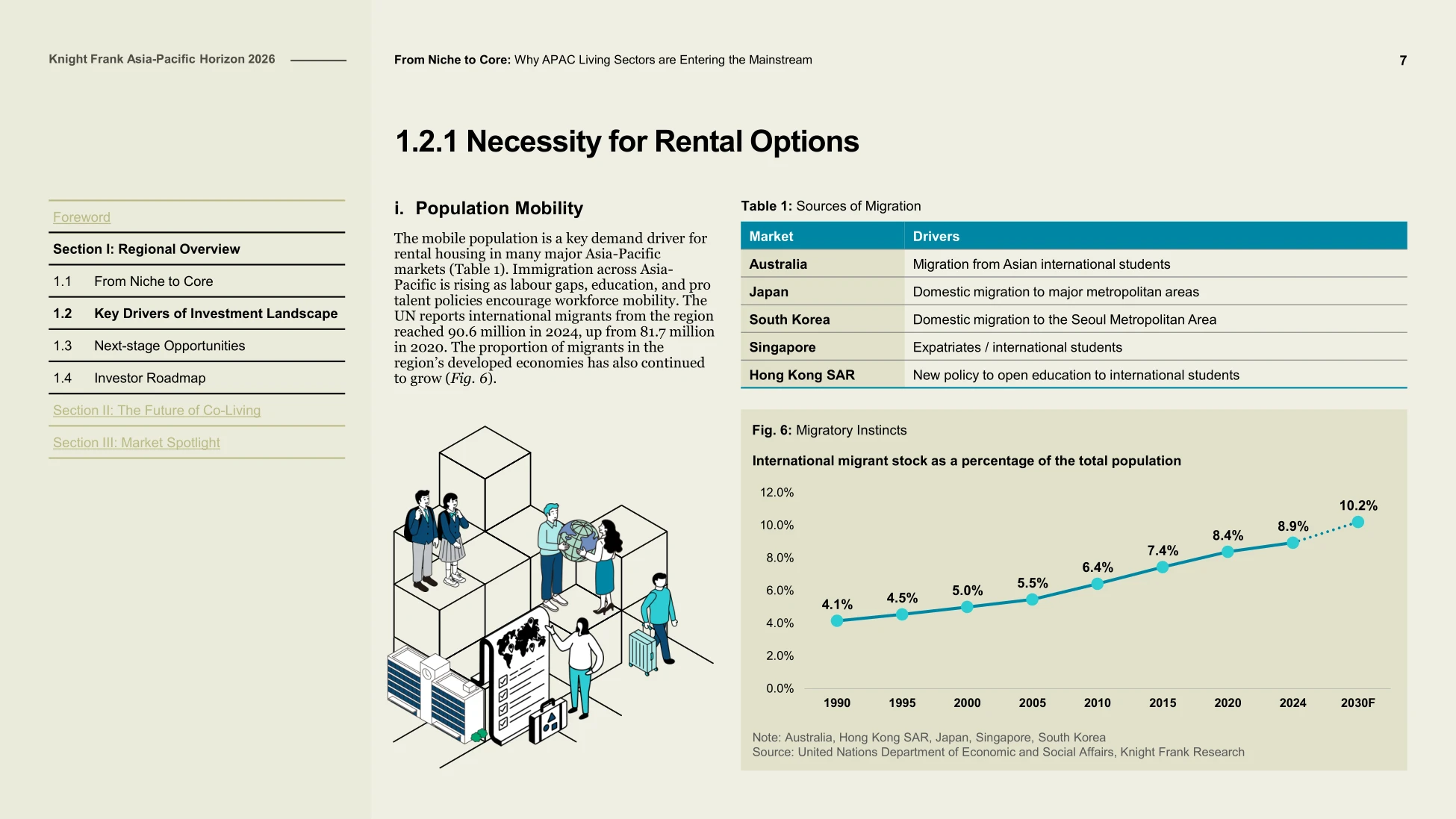
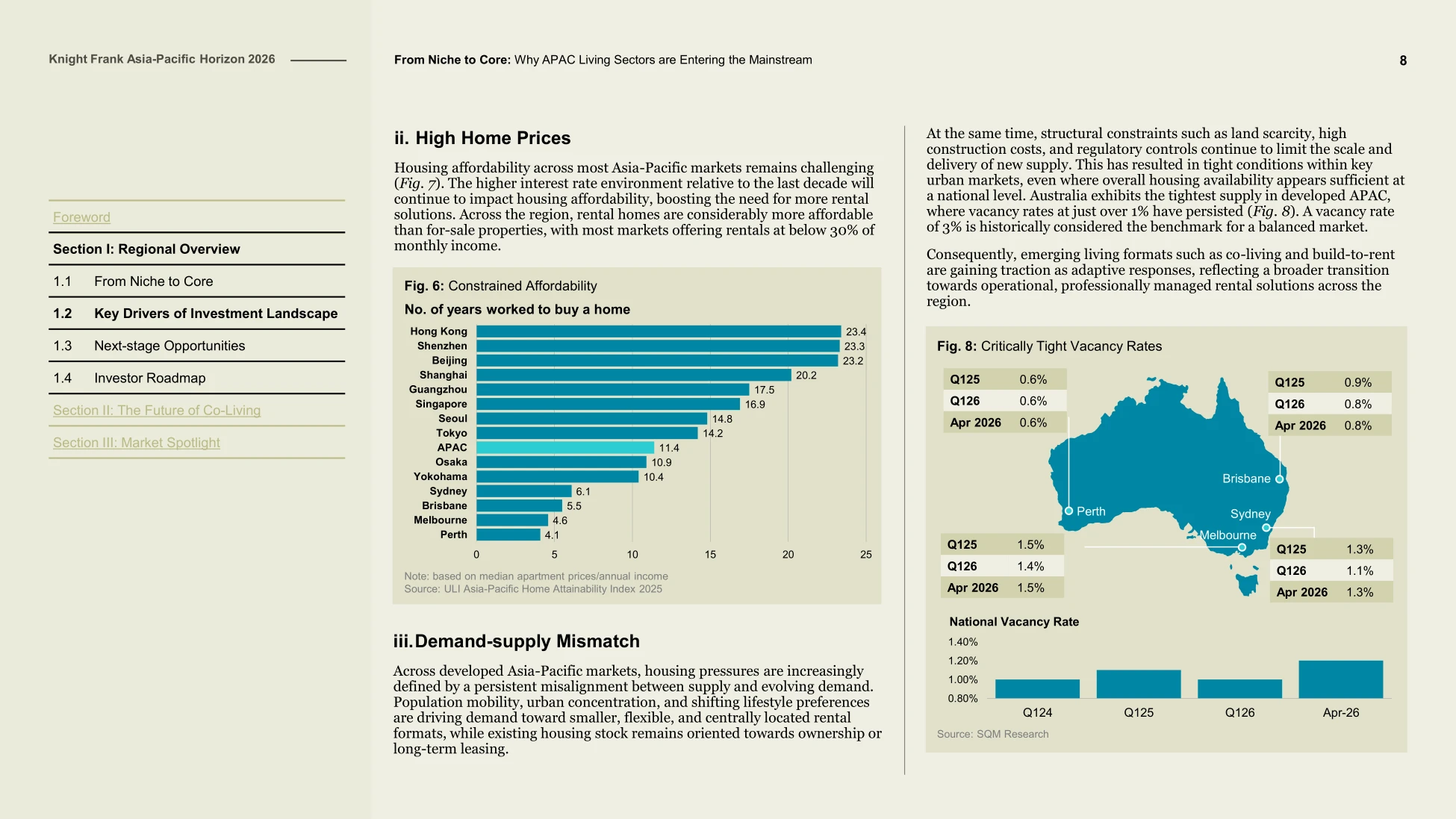
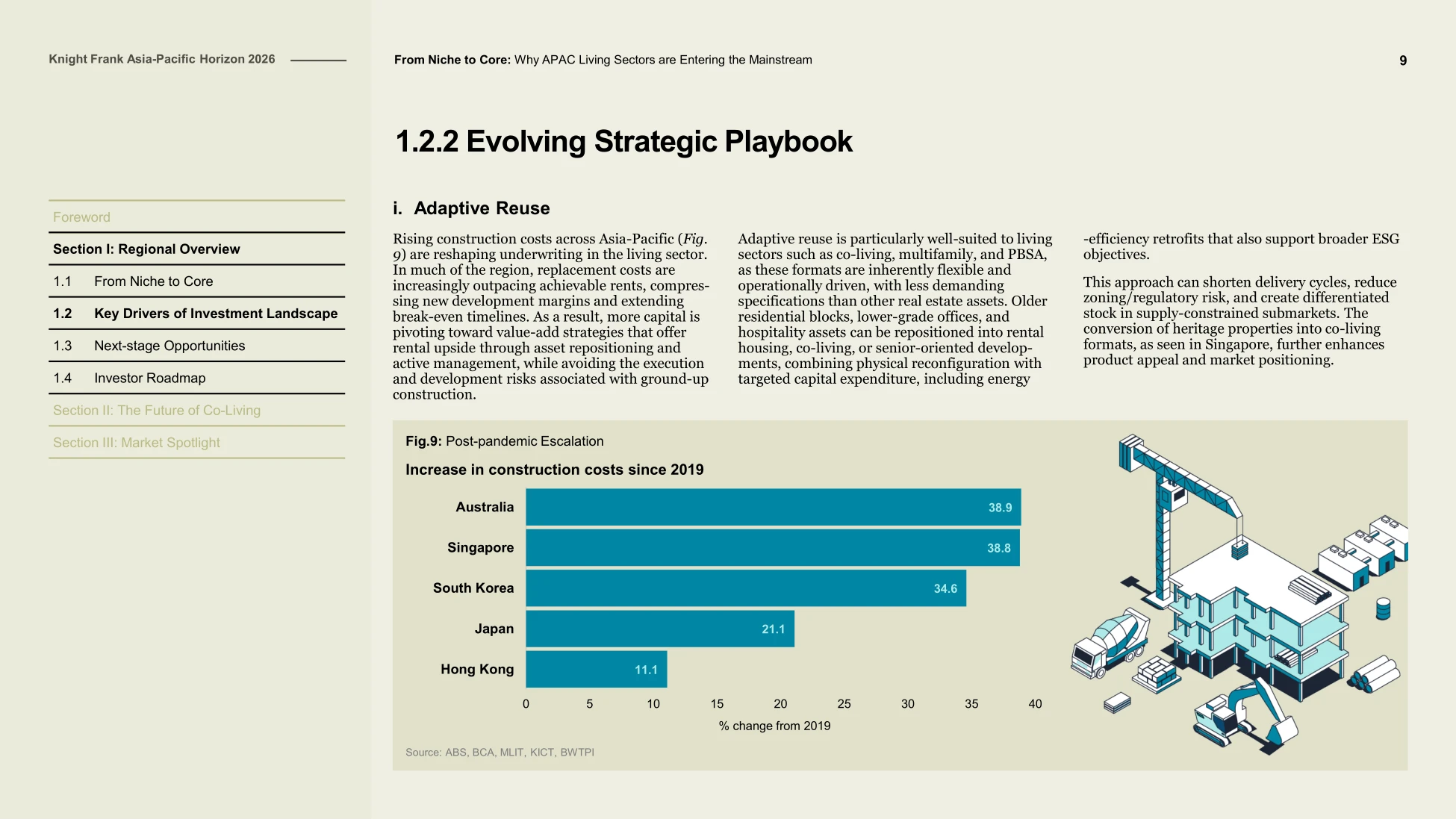
From Niche to Core: Why Asia-Pacific Living Sectors are Entering the Mainstreamknightfrank.com/researchThis report examines the growing market for Living Sectors in the Asia-Pacific.July2026Knight FrankAsia-Pacific HorizonKnight Frank Asia-Pacific Horizon 20262From Niche to Core: Why APAC Living Sectors are Entering the MainstreamContentsJune 2026Section I: Regional Overview1.1From Niche to Core051.2Key Drivers of Investment Landscape061.2.1Necessity for Rental Options07i.Population Mobilityii.High Home Pricesiii.Deman-supply Mismatch1.2.2Evolving Strategic Playbook09i.Adaptive Reuseii.Owner-Operator Platformsiii.Blurring Between Formats1.3Next-stage opportunities 121.3.1Co-living: The Alternative for Millennials and Beyond121.3.2Senior housing: A Growing Supply Gap131.3.3India: The New PBSA Frontier141.4Investor Roadmap151.4.1Market Gap15Section III: Market Spotlight3.1Australia: Investors Ramp Up BTR Pipeline 223.2The Future of Student Living in Hong Kong SAR 243.3Japan Multifamily: From Tailwinds to Tail Risks 283.4South Korea’s Rental Revolution303.5Co-living in Singapore: Gaining Momentum Beyond Niche Demand 333.6Malaysia: PBWA Sector Attracts Institutional Capital as Market Transitions35Section II: The Future of Co-Living2.1A Conversation with Mr Kelvin Lim,Executive Chairman, LHN Limited, and Executive Chairman and CEO, Coliwoo Holdings Limited18Foreword03Knight Frank Asia-Pacific Horizon 2026The living sectors in Asia Pacific are moving into increasingly sharper focus for many global real estate investors. What was once a Japan-dominated market has evolved in recent years into a more diversified, regional opportunity characterised by increasing liquidity, strong institutional interest and operational sophistication. Today, APAC’s living sectors are emerging as a core, long-duration allocation across the whole region.This shift is underpinned by strong and consistent fundamentals. Demand for rental housing across APAC remains underpinned by needs-based drivers – including urbanisation, demographic shifts and ongoing affordability constraints. In today’s more unpredictable macro-geopolitical landscape, these characteristics are reinforcing the sector’s role as a defensive, income-generating asset class for investors.At the same time, investor strategies are evolving. There is a clear shift away from viewing the living sectors in isolation, and instead investors are building integrated platforms that span PBSA, BTR, co-living and seniors housing. This holistic approach allows investors to drive performance through operational synergies and more efficient capital deployment. In many ways, APAC’s living sectors landscape presents a similar profile to Europe 10 or 15 years ago – it is a market that is still in the early stages of institutionalisation, but one that also offers a compelling combination of growth potential and yield advantage. As transparency improves and operating models continue to matur...










































