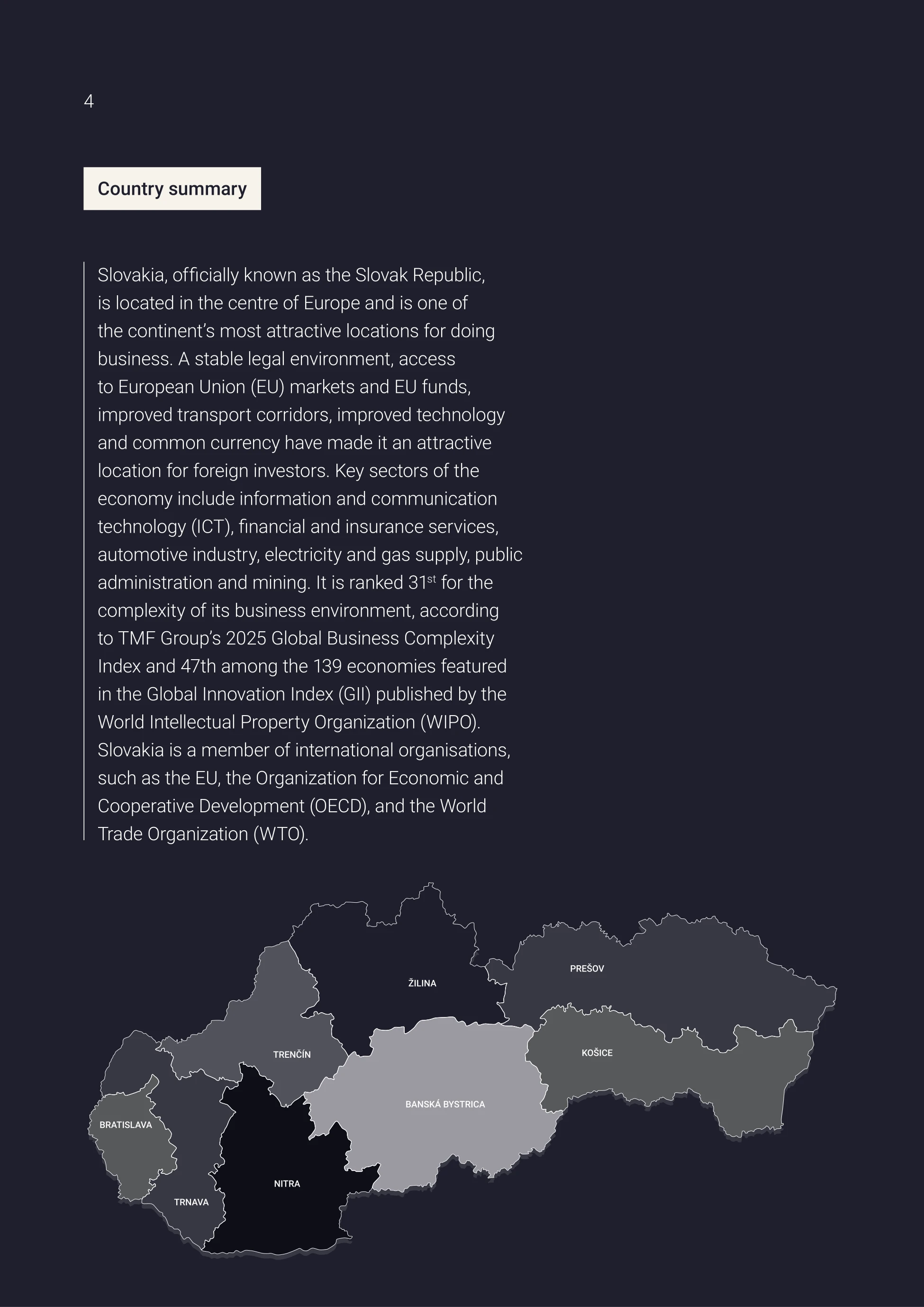
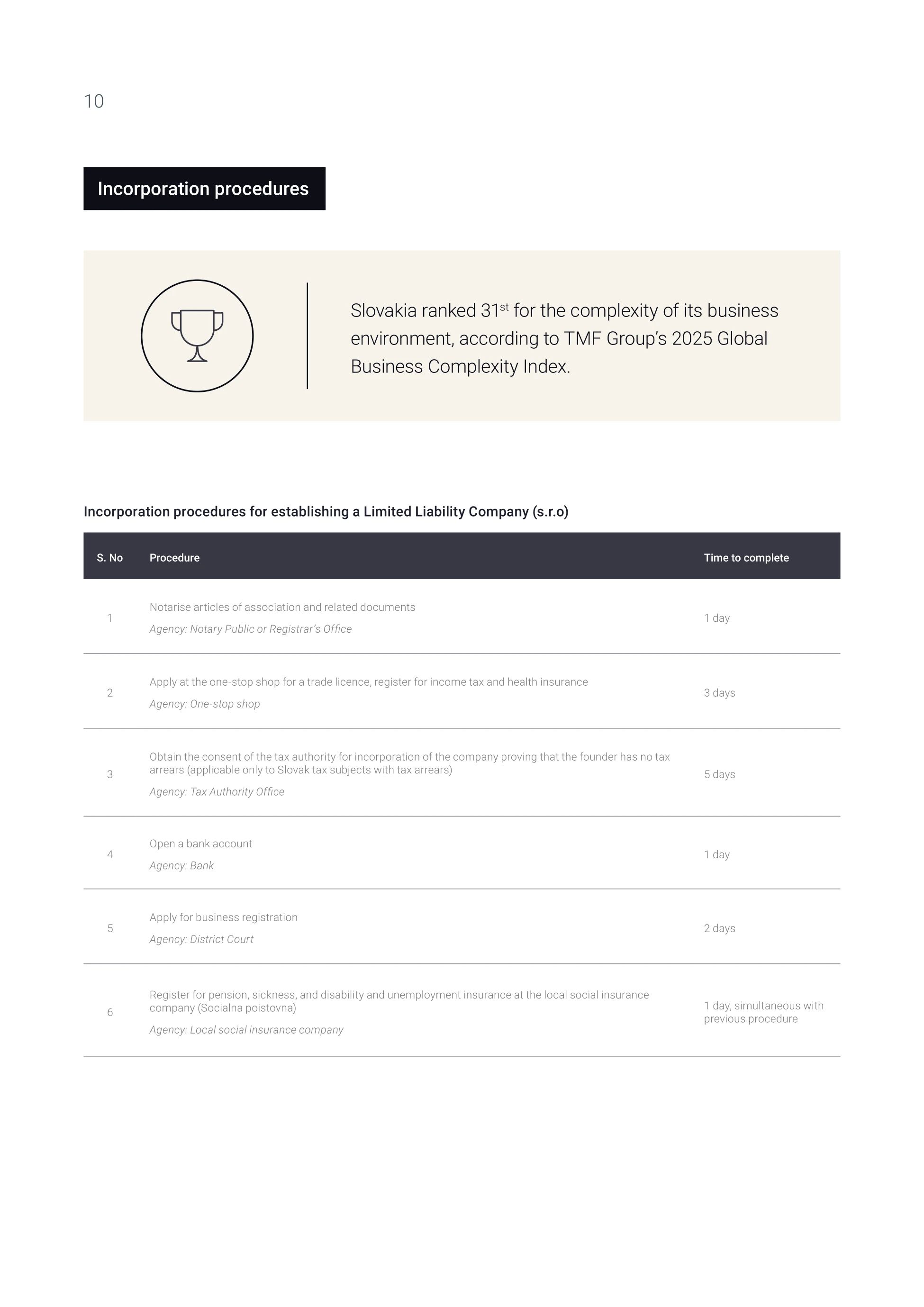
Doing business in Slovakia2026Country profileSlovakiaCountry summary4Legal structures8Incorporation procedures10Ongoing obligations12Tax implications14Labour environment18Compliance requirements22Contents4Slovakia, officially known as the Slovak Republic, is located in the centre of Europe and is one of the continent’s most attractive locations for doing business. A stable legal environment, access to European Union (EU) markets and EU funds, improved transport corridors, improved technology and common currency have made it an attractive location for foreign investors. Key sectors of the economy include information and communication technology (ICT), financial and insurance services, automotive industry, electricity and gas supply, public administration and mining. It is ranked 31st for the complexity of its business environment, according to TMF Group’s 2025 Global Business Complexity Index and 47th among the 139 economies featured in the Global Innovation Index (GII) published by the World Intellectual Property Organization (WIPO). Slovakia is a member of international organisations, such as the EU, the Organization for Economic and Cooperative Development (OECD), and the World Trade Organization (WTO).Country summary1.1 Legal structures• A limited liability company, or branch office are the most common forms of business entities used by foreign investors.• In an LLC, a minimum capital of €5,000 is required and there should be at least one member and at most 50 members.• Legal entities including Joint Stock Company, Simple Joint Stock Company, General Partnership, Limited Partnership and Cooperatives are also used in Slovakia.1.2 Incorporation procedures• Every company incorporated in Slovakia must be registered with the Slovak Commercial Register.1.3 Ongoing obligations• All listed companies in Slovakia must have their financial statements audited by an independent auditor.• Financial statements are required to be prepared in accordance with Slovak Accounting Regulations (Act on Accounting, Commercial Code and decrees issued by the Ministry of Finance). Consolidated financial statements shall be prepared in accordance with International Financial Reporting Standards (IFRS).• Financial statements have to be filed with the register of financial statements, within six months of the end of the financial year at the latest, by the date on which the entity files the income tax return. The financial statements have to be approved within one year of the reporting period. Annual reports should be filed with the register of financial statements within one year of the reporting period. Preparation of an annual report is mandatory only for entities that are required to have their financial statements audited.• The audit of financial statements must be performed, and the annual report must be verified by an auditor within one year of the end of the accounting period...










































