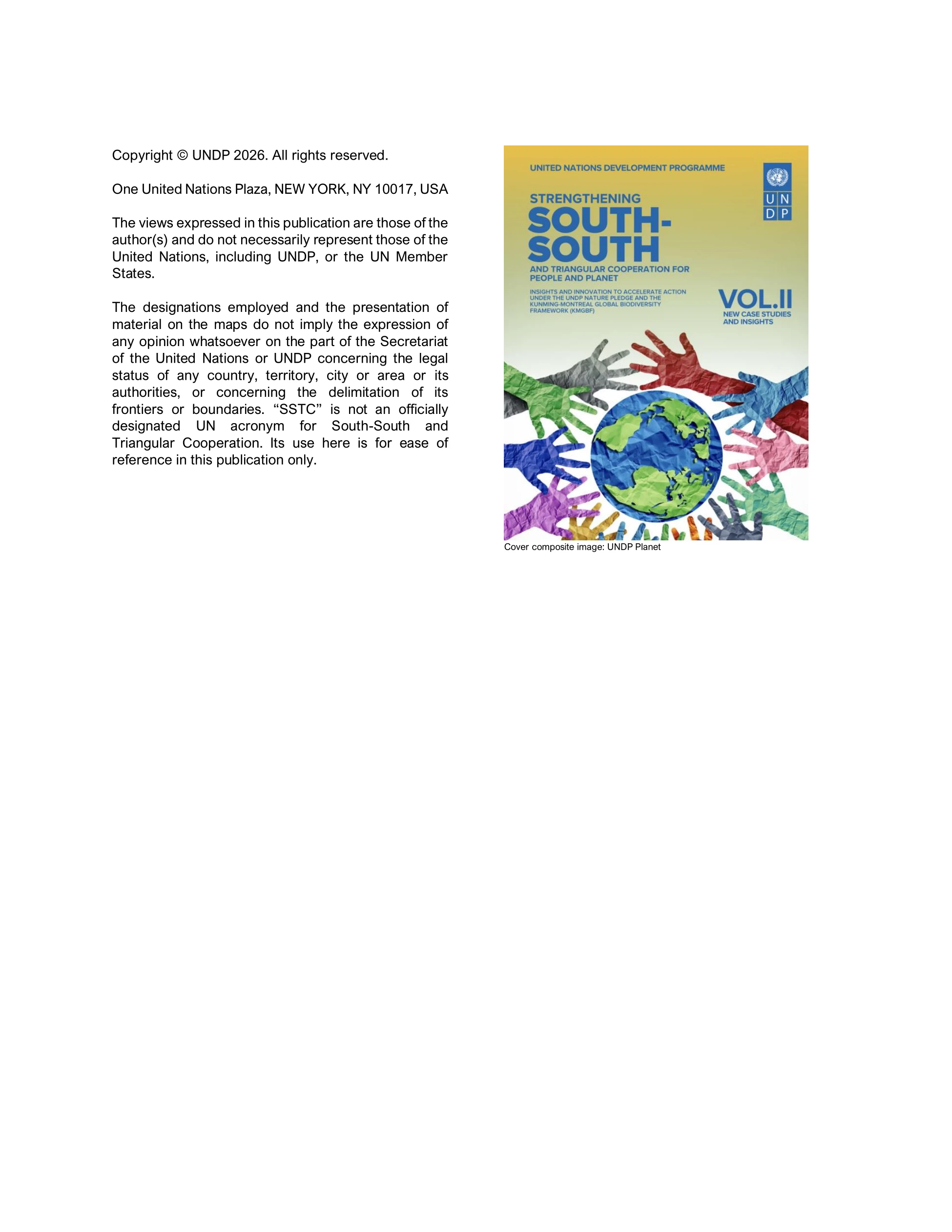
UNITED NATIONS DEVELOPMENT PROGRAMMESOUTH-SOUTH AND TRIANGULAR COOPERATION FOR PEOPLE AND PLANET INSIGHTS AND INNOVATION TO ACCELERATE ACTIONUNDER THE UNDP NATURE PLEDGE AND THEKUNMING-MONTREAL GLOBAL BIODIVERSITYFRAMEWORK (KMGBF)STRENGTHENING NEW CASE STUDIESAND INSIGHTS VOL.II . Copyright © UNDP 2026. All rights reserved. One United Nations Plaza, NEW YORK, NY 10017, USA The views expressed in this publication are those of the author(s) and do not necessarily represent those of the United Nations, including UNDP, or the UN Member States. The designations employed and the presentation of material on the maps do not imply the expression of any opinion whatsoever on the part of the Secretariat of the United Nations or UNDP concerning the legal status of any country, territory, city or area or its authorities, or concerning the delimitation of its frontiers or boundaries. “SSTC” is not an officially designated UN acronym for South-South and Triangular Cooperation. Its use here is for ease of reference in this publication only. Cover composite image: UNDP Planet Table of Contents I. About This Publication II. UNDP Nature Pledge III. The Role of South-South and Triangular Cooperation in Advancing the Nature Pledge IV. South-South and Triangular Cooperation Solutions: South-South in Action 1 Tiny but Mighty: How Bees Are Helping Local Communities Build Resilience in SIDS 2 Combating Illegal Wildlife Trade and Trafficking in East Africa 3 Strengthening Protected Area Management Through Regional Knowledge Exchange 4 Transboundary Cooperation for Snow Leopard Conservation in Central Asia 5 BES-Net Trialogues: A Bridge for Nature Positive South–South Knowledge Exchange 6 Accelerating Gender-Responsive Biodiversity Action Through NBSAPs 7 Digital Traceability for Deforestation-Free Commodities 8 Indonesia–China Exchanges on Green Finance and the Circular Economy V. Forward Looking Takeaways About This Publication As the world confronts the interconnected crises of climate change, biodiversity loss, pollution, and rising inequality, the importance of South-South and Triangular Cooperation (SSTC) has never been greater. By drawing on knowledge, experience, and innovation from across the Global South, SSTC empowers countries to co-design, share, and scale solutions that are grounded in local realities while addressing global environmental challenges. This cooperation modality strengthens national leadership, deepens regional solidarity, and accelerates collective action—core principles which are the heart of the UNDP Nature Pledge, Climate Promise, and UNDP’s Strategic Plan. The UNDP Nature Pledge reflects the organization’s commitment to support over 140 countries to achieve the ambition of the Kunming-Montreal Global Biodiversity Framework (GBF). Delivering this ambition requires transformation across three interconnected shifts—a Global Value Shift, an Economic and Finance...










































