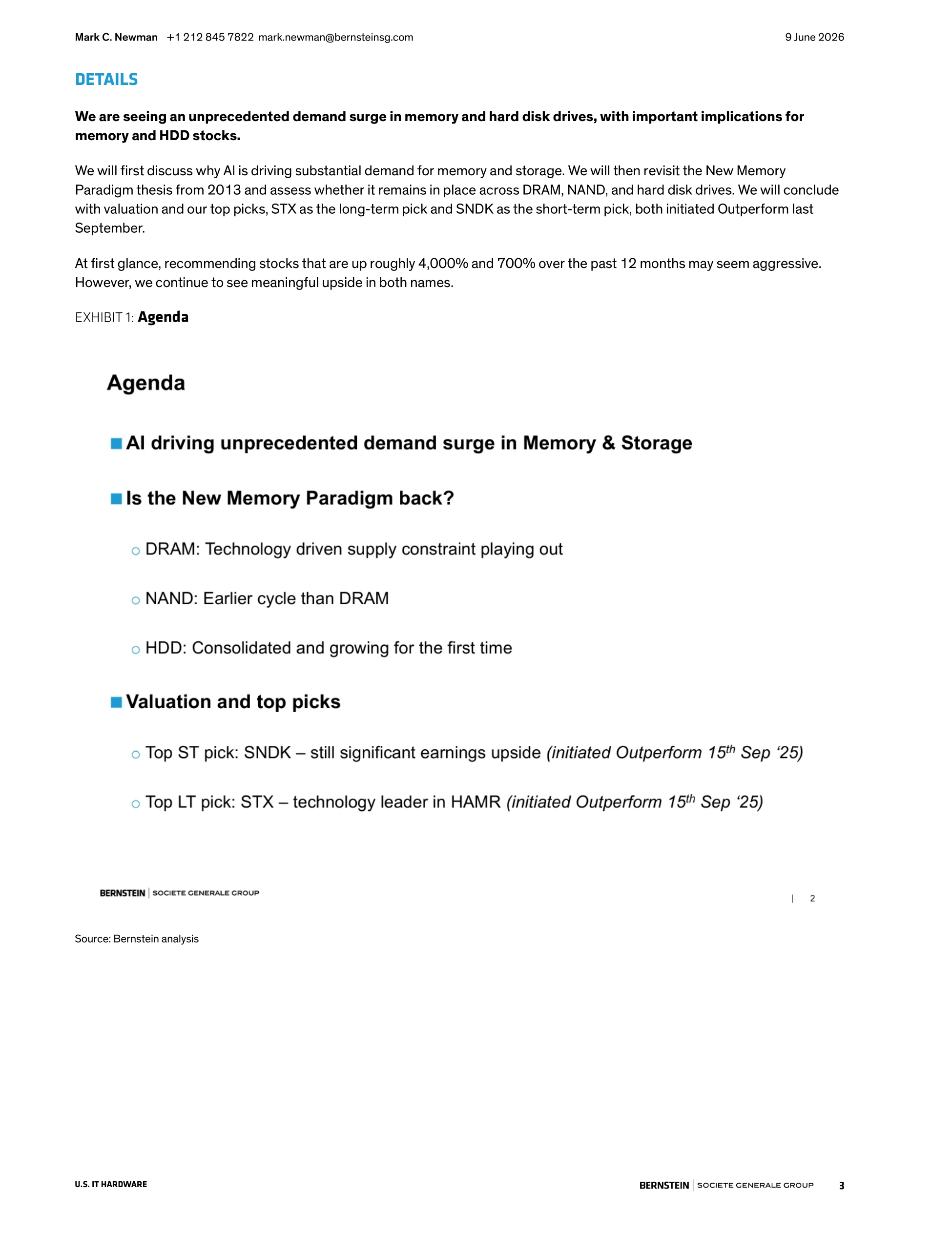
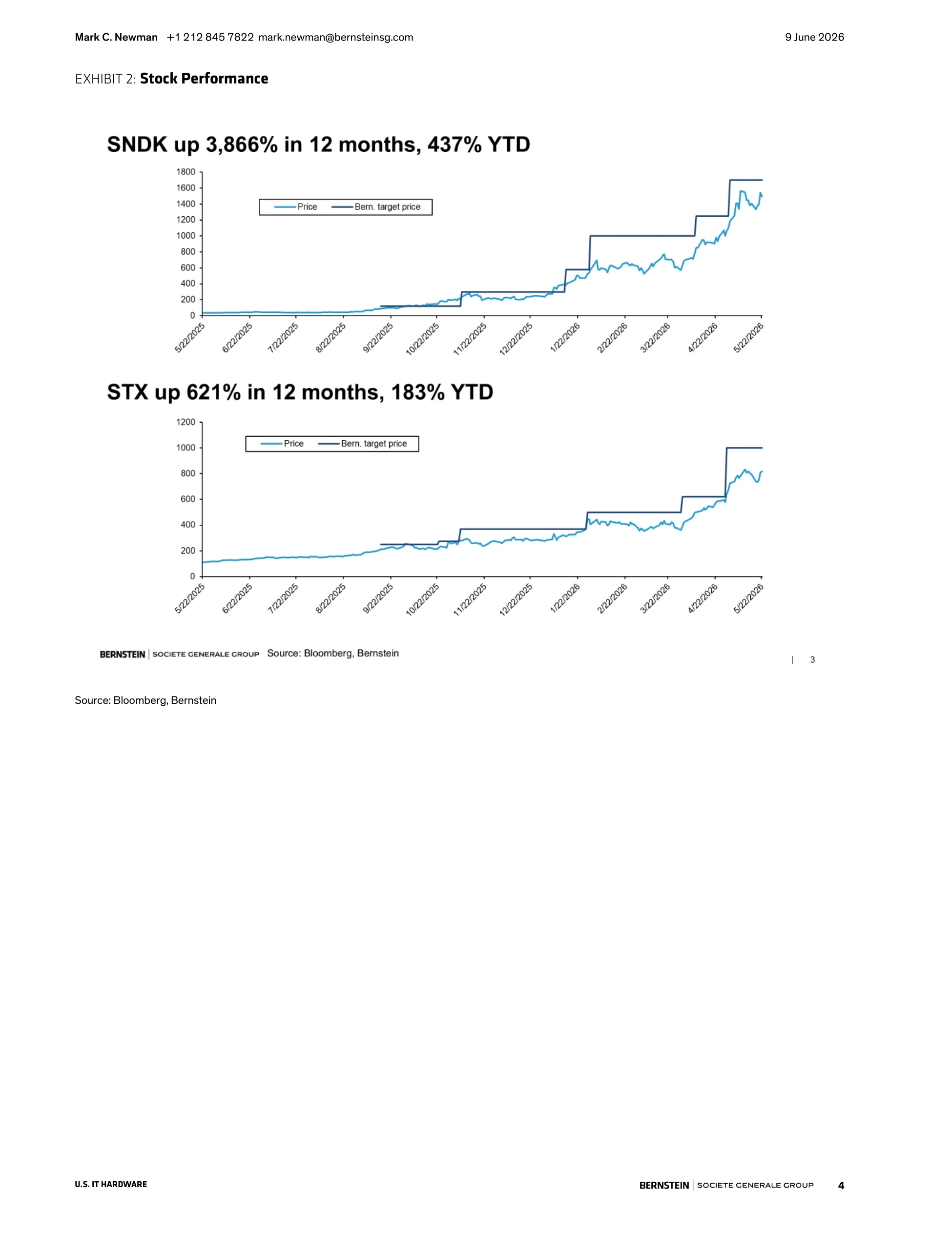
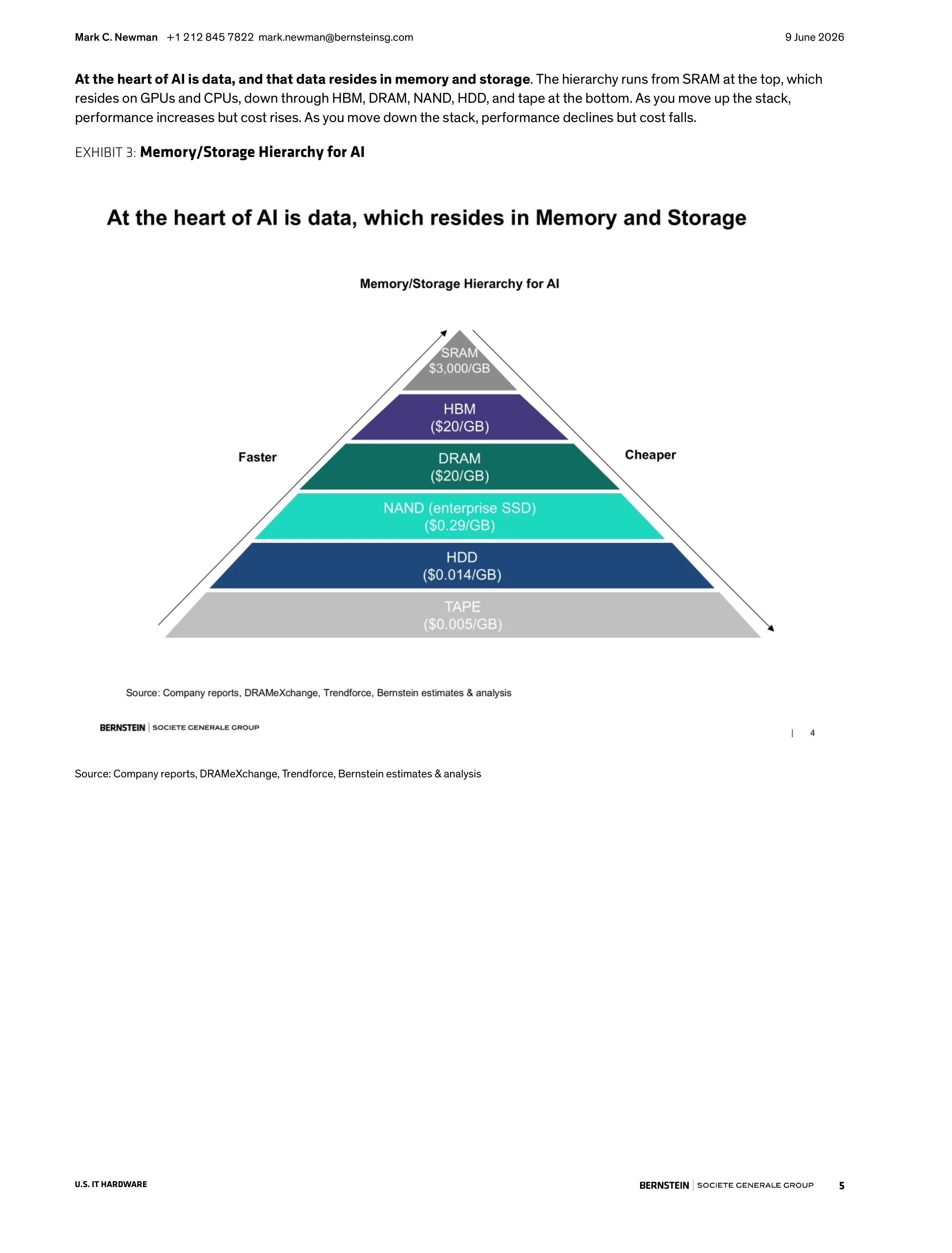
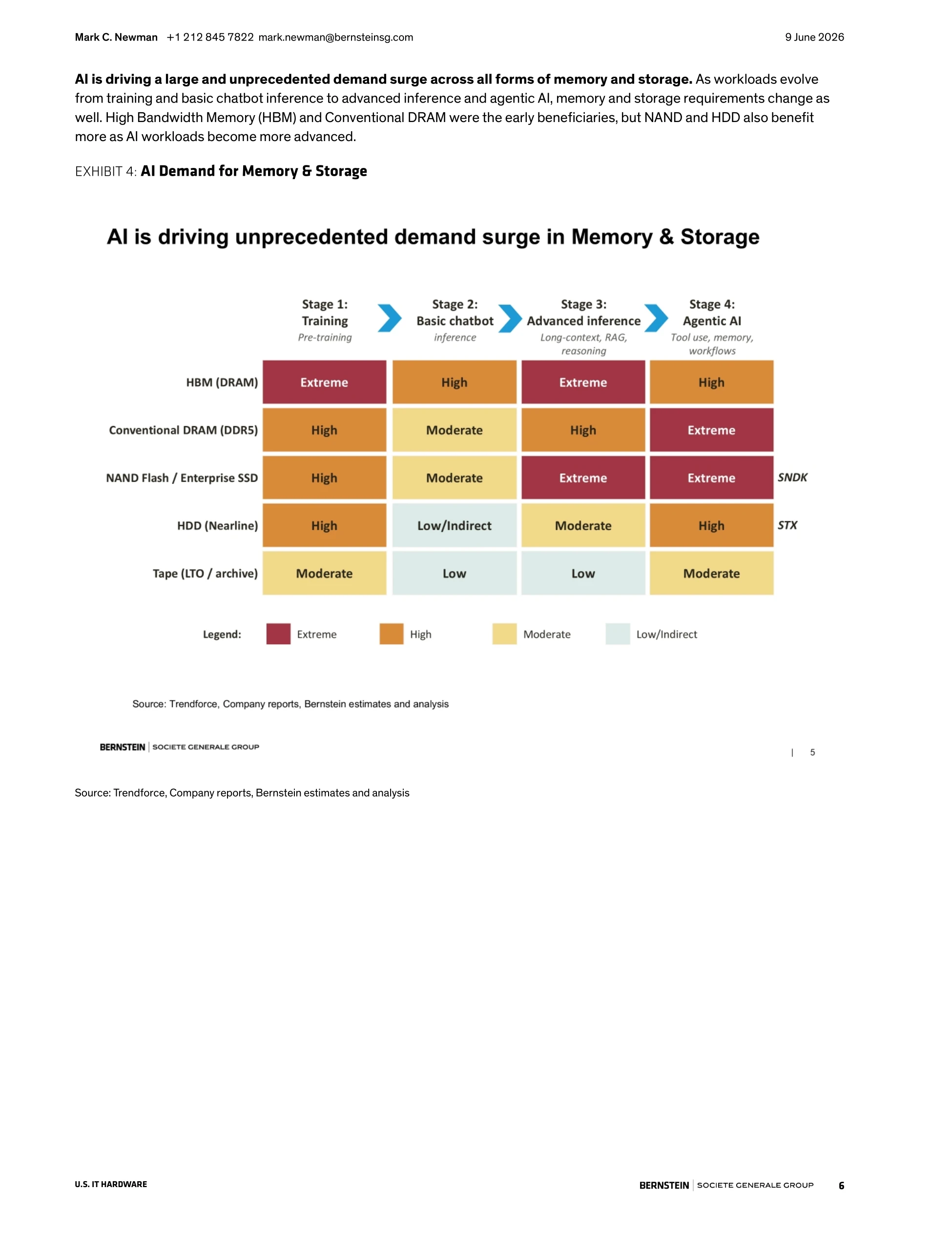
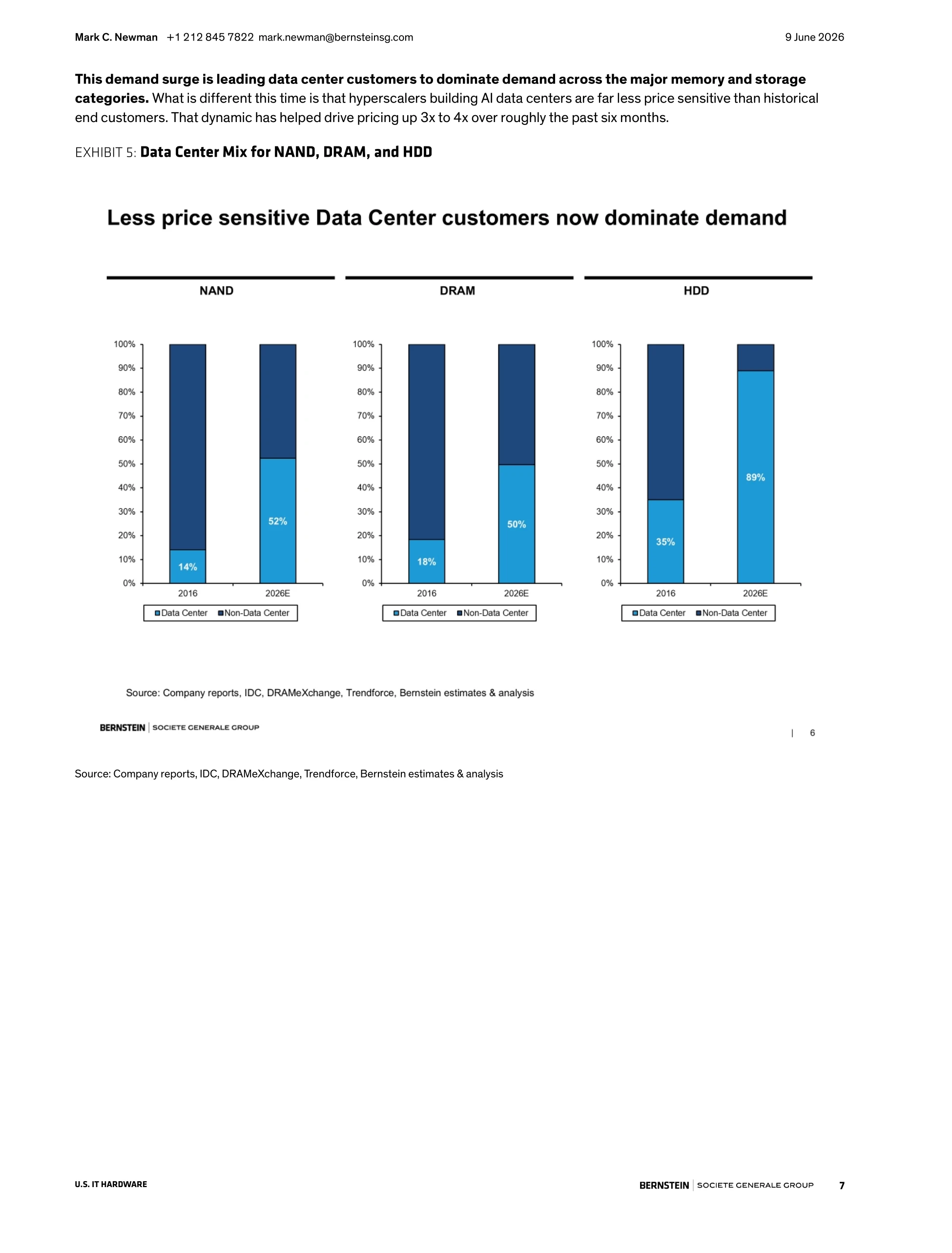
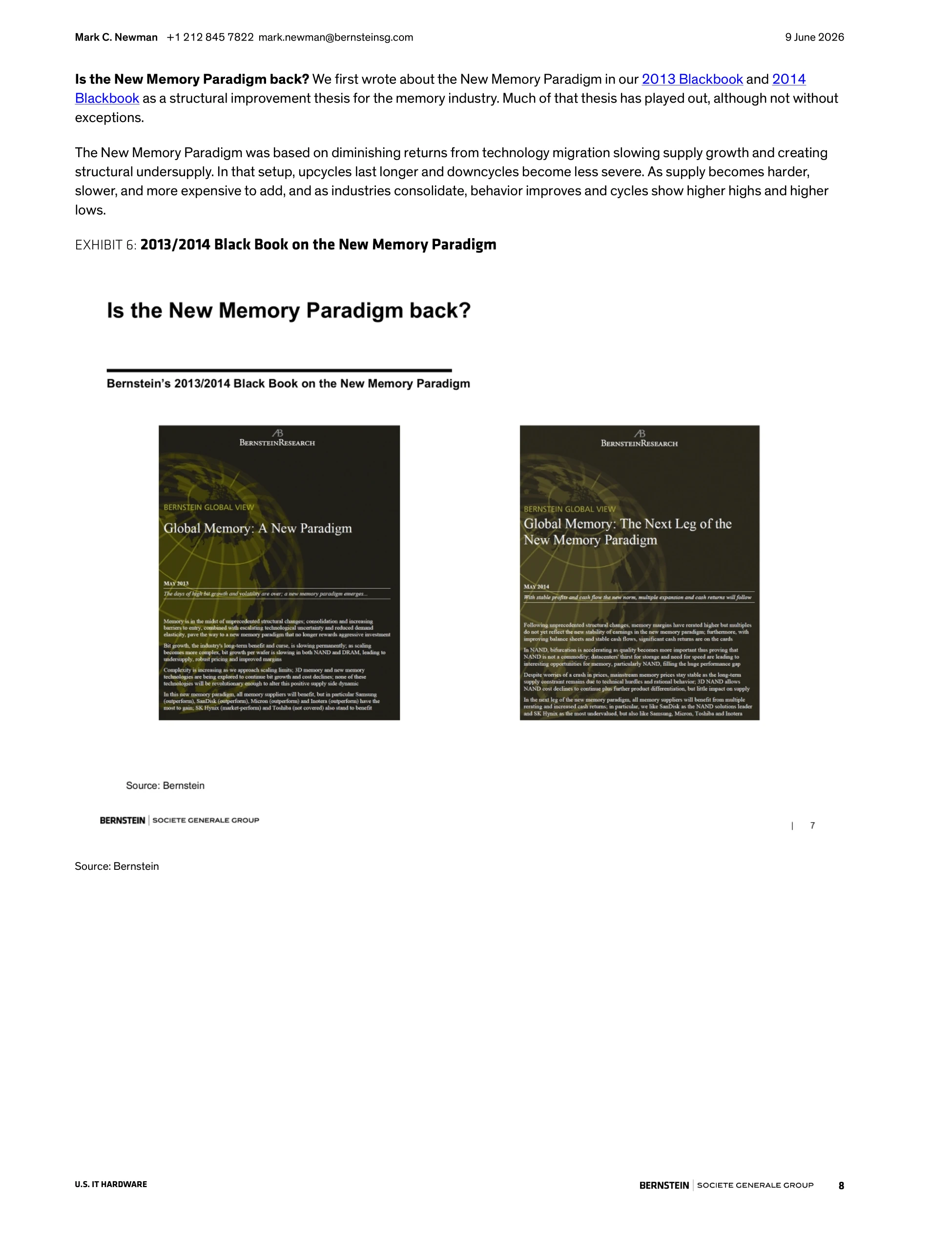
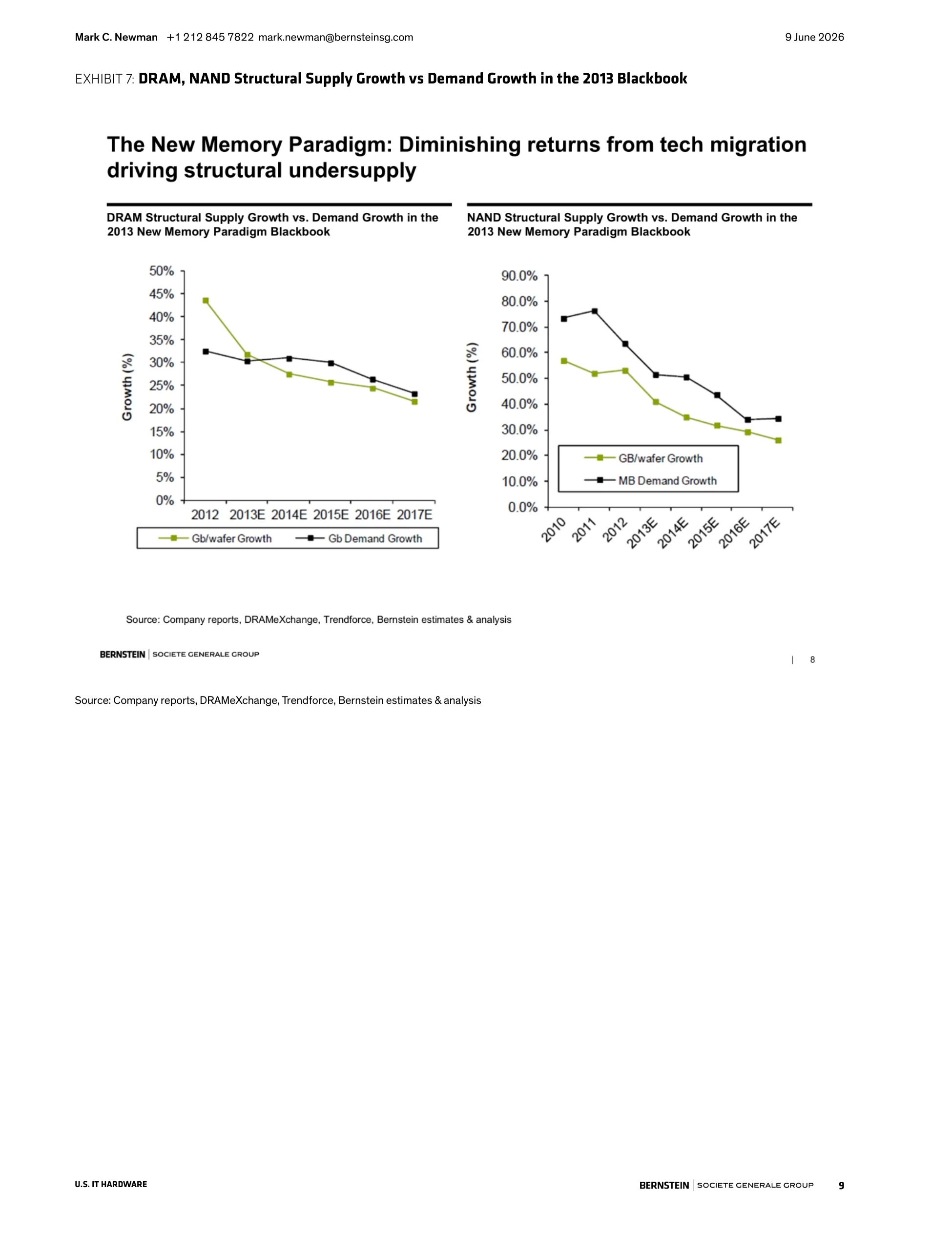
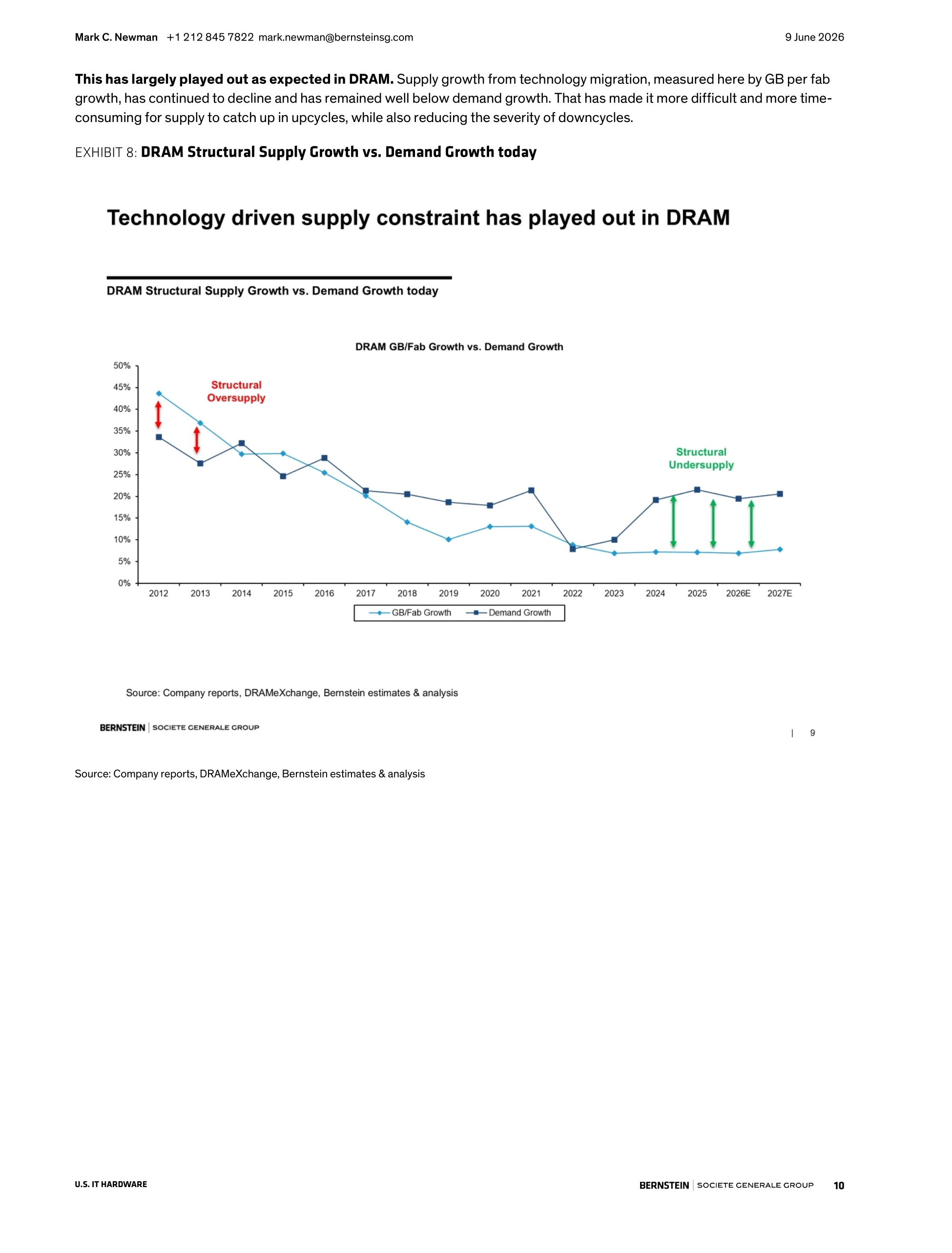
9 June 2026U.S. IT HardwareMemory & Storage: Is the New Memory Paradigm back? Best IdeaPresentation from Bernstein's Strategic Decisions ConferenceMark C. Newman+1 212 845 7822mark.newman@bernsteinsg.comApril Li+1 917 344 8339april.li@bernsteinsg.comPhoebe Sun+1 917 344 8481phoebe.sun@bernsteinsg.comAt Bernstein’s 42nd Strategic Decisions Conference, we pitched Memory and Storage as ourbest idea, where we brushed off our New Memory Paradigm thesis from a decade ago andaddressed where we got things right and wrong and further upside from here. Enclosed arethe presentation slides with key points from the speech.AI is driving a large and unprecedented demand surge across all forms of memoryand storage. As workloads evolve from training and basic chatbot inference to advancedinference and agentic AI, memory and storage requirements change. HBM & DRAM wereearly beneficiaries, but NAND & HDD also benefit as AI workloads become more advanced.Data center customers now dominate demand in DRAM, NAND and HDD and are lessprice sensitive, which is supporting much stronger pricing than in prior cycles.Is the New Memory Paradigm is back? We first wrote about the New Memory Paradigmin our 2013 Blackbook and 2014 Blackbook as a structural improvement thesis forthe memory industry. Much of that thesis has played out as slower tech-driven supplygrowth and greater industry consolidation are creating stronger upcycles and less severedowncycles, which in turn creates higher highs and higher lows.This has largely played out as expected in DRAM. Supply growth from technologymigration has continued to decline and has remained well below demand growth. That hasmade it more difficult and more time-consuming for supply to catch up in upcycles, whilealso reducing the severity of downcycles.In NAND, the structural supply constraint thesis was delayed by the 3D NAND supplyexpansion. Planar NAND had followed a pattern similar to DRAM, with GB per fab growthfalling sharply as planar NAND approached its technical limits. The transition to 3D NANDcreated a one-time step-up in GB per wafer and GB per fab. However, 3D NAND is nowalso beginning to face diminishing returns. NAND is also earlier in the cycle than DRAM,which suggests greater upside potential from current levels.HDD is also seeing a meaningful structural change, as this is the first time in historythat the industry is both consolidated and growing. Since consolidation in 2012, theHDD industry had been shrinking because of aggressive NAND cannibalization. Thoseheadwinds are now largely exhausted. What remains is the business-critical, or nearline,segment, which is fundamentally a capacity market where NAND cannot compete.Long-term agreements are becoming more favorable for suppliers, with pricing,prepayments, and take-or-pay terms helping reduce cyclicality.Overall, we continue to like the sector and see further upside. SNDK is our...