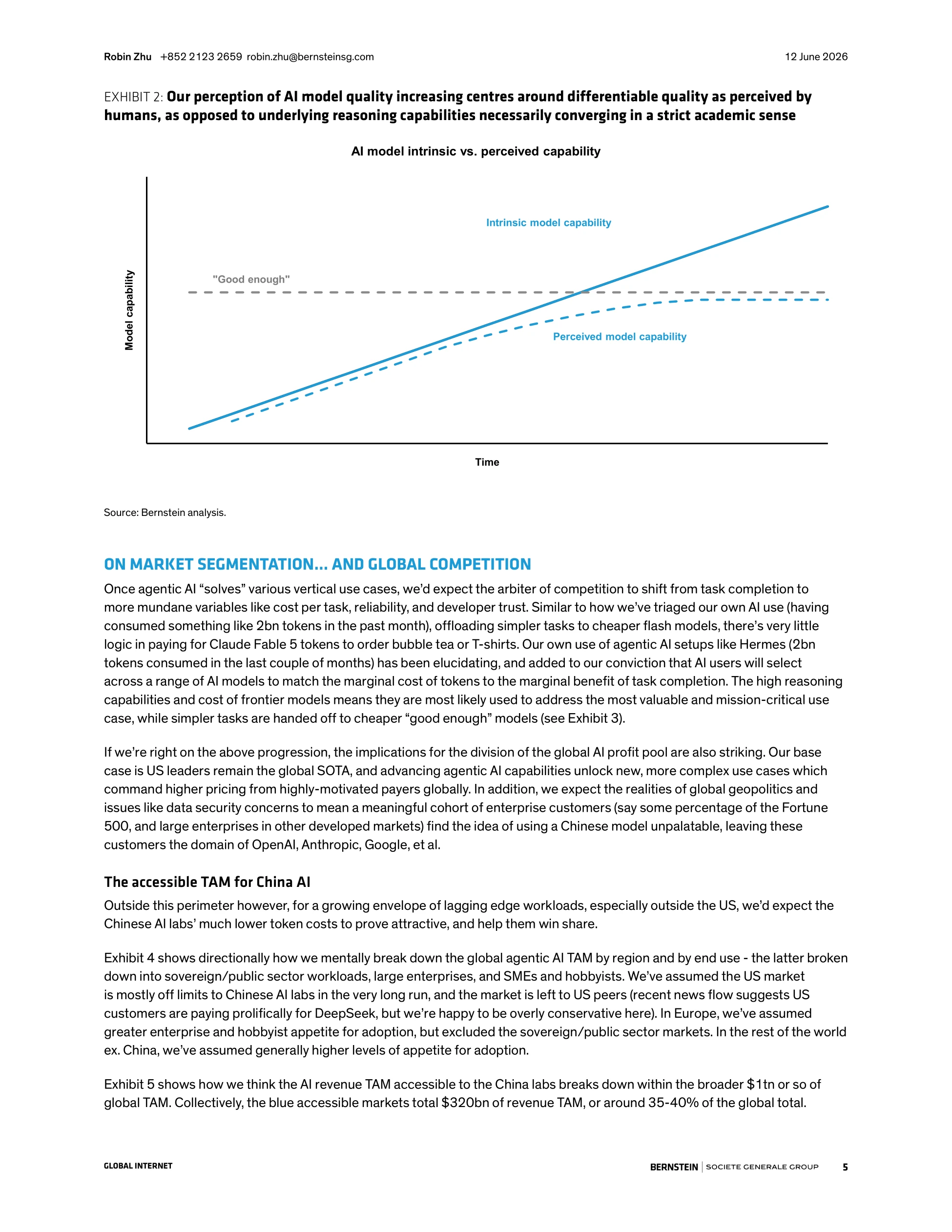
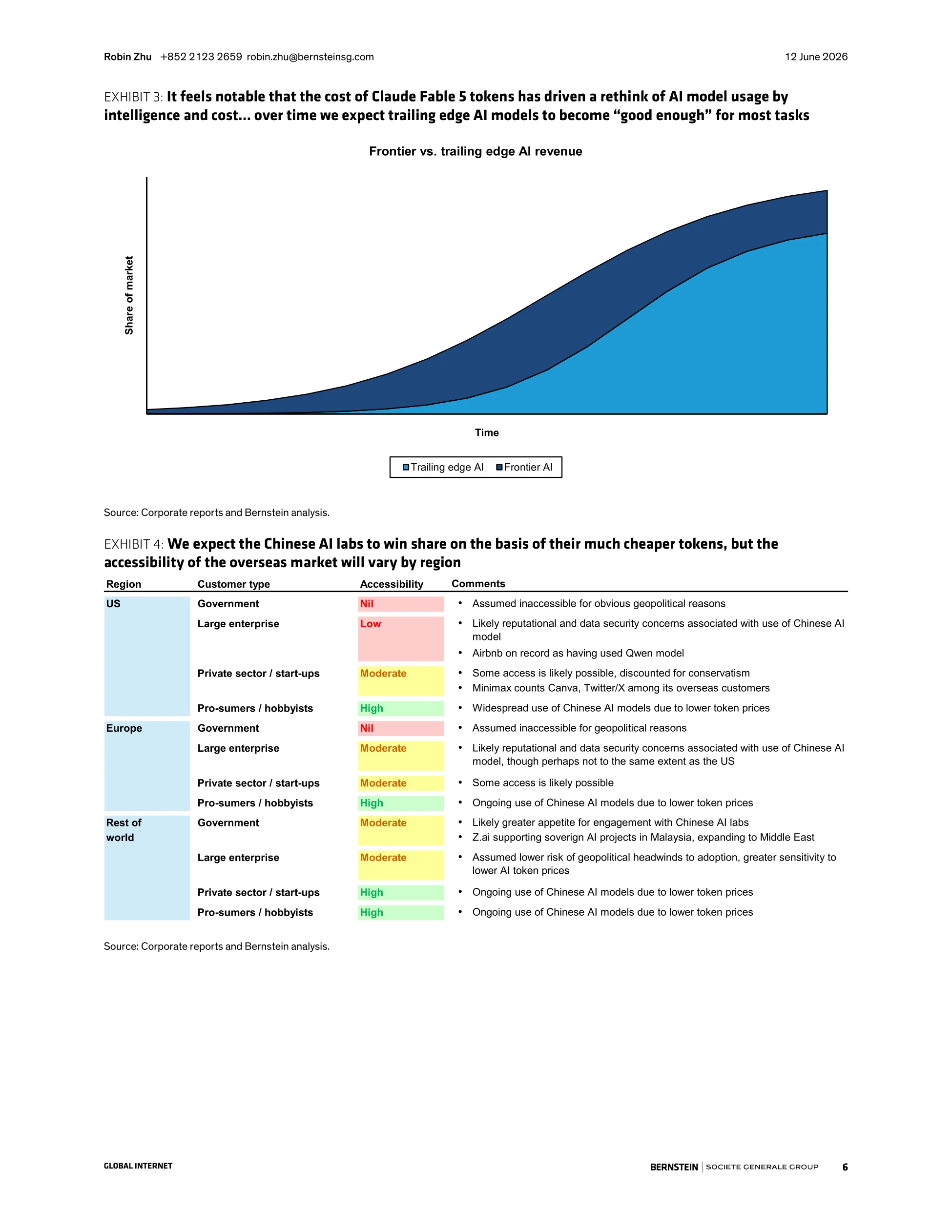
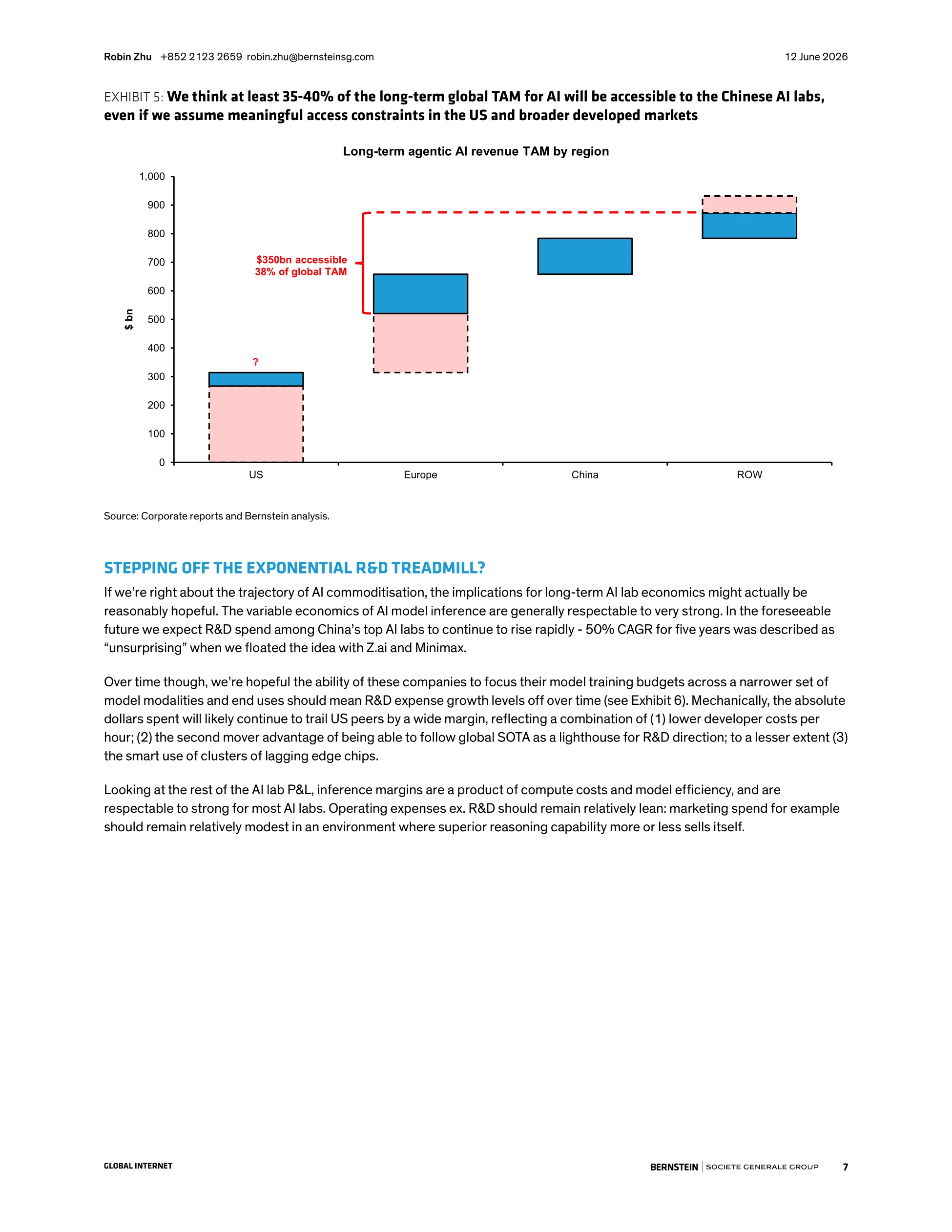
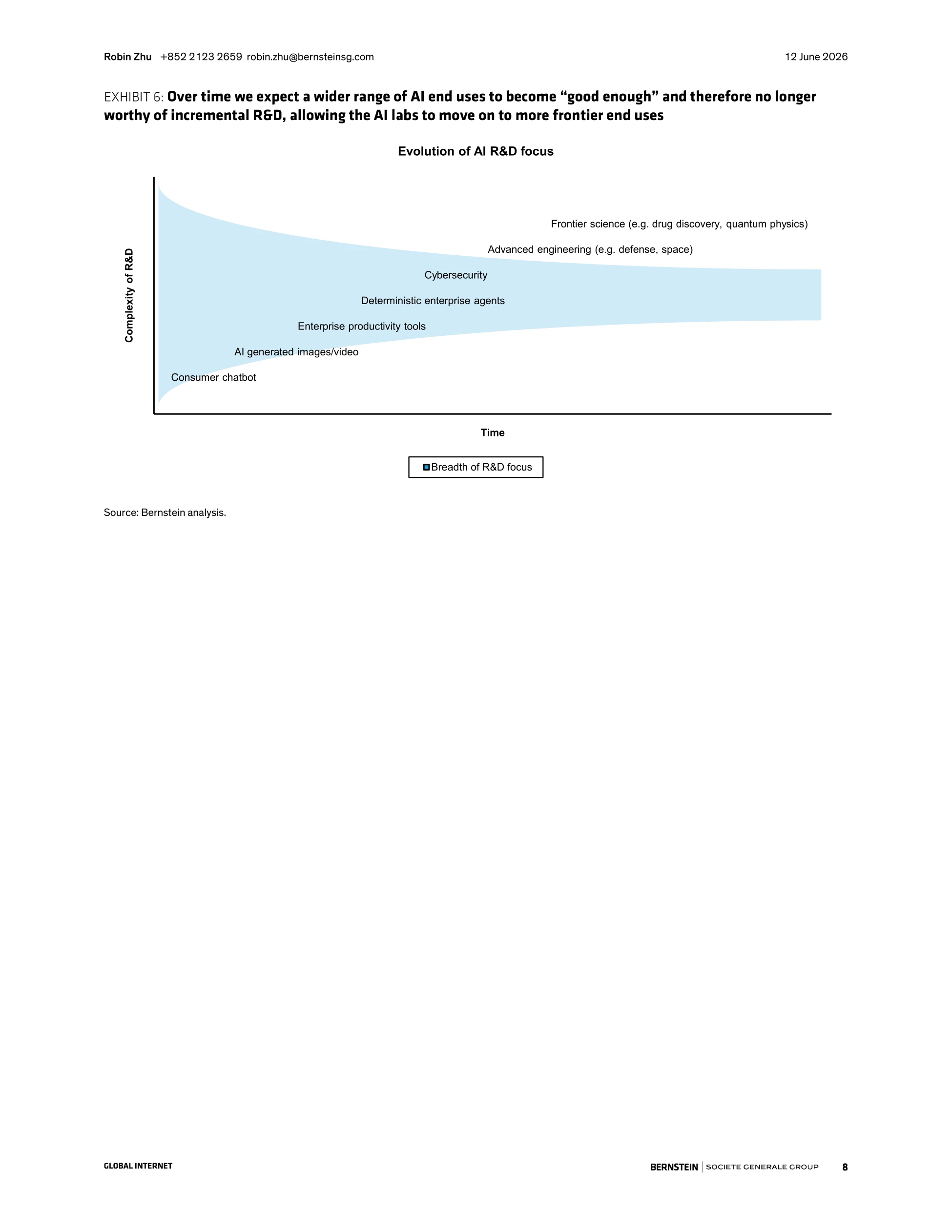
12 June 2026Global InternetGlobal Internet: A framework for AI model commoditisation, andmarket segmentationRobin Zhu+852 2123 2659robin.zhu@bernsteinsg.comMark Shmulik+1 917 344 8508mark.shmulik@bernsteinsg.comCharles Gou+852 2123 2618charles.gou@bernsteinsg.comMin-Joo Kang+852 2123 2644minjoo.kang@bernsteinsg.comHyrum Caesar+81 3 6777 6979hyrum.caesar@bernsteinsg.comWenhuan Chang+1 917 344 8546wenhuan.chang@bernsteinsg.comDeeksha Pandey+1 917 344 8447deeksha.pandey@bernsteinsg.comA shift in the AI zeitgeist? We’re long-term AI bulls, and have increasingly built agenticAI into our day-to-day workflows. That said, several recent events strike us as beingnoteworthy as far as AI competition and ROI is concerned. The high cost of Anthropic’sClaude Fable 5 pricing causing devs to ration usage feels like a notable development. Seealso headlines pointing to OpenAI potentially cutting prices to win share, and large AI users(e.g. Tencent, Microsoft) doing a double-take on the costs of token-maxxing.An alternative mental model for AI model commoditisation. Rather than modelintelligence necessarily converging, we increasingly think AI model commoditisation willbe driven by human user perception across various end uses, and the timeline on whichcompeting models become “good enough”, and reliable at scale. We’ve long argued thatconsumer-focused AI (ordering bubble tea, booking hotel rooms) will commoditise relativelyquickly. Enterprise use cases like coding and Excel work are more complex, and will takelonger to solve. Solving frontier science (e.g. defence, healthcare, nuclear fusion, spacetravel) likely merits the use of frontier AI more or less ad infinitum.The implications for AI market segmentation… and competition. Once theAI supporting a given use case becomes “good enough”, we’d expect the arbiter ofcompetition and market share to shift from reasoning capabilities to availability and price.Our base case is the US frontier labs continue to unlock new model capabilities thatcommand a rising price premium among increasingly specialised customers. Data securityconcerns and global geopolitics likely prevent some US and European enterprises fromdeploying Chinese models. But elsewhere we’d expect the Chinese AI labs to take share,serving “good enough” reasoning capabilities at significantly lower prices.Chinese open source models as the value option. Hardware advancements will makeit cheaper for the US frontier labs to serve tokens, and drive Jevon’s Paradox. Nonetheless,it would surprise us if trailing edge AI didn't become another sector where Chinesecompetition takes market share, in part thanks to a willingness to accept lower prices andmargins. The ability to follow global SOTA as a lighthouse for R&D direction means theChinese AI labs need to do less exploratory research. Our market segmentation suggeststhey should be able to access 35-40% of the global AI TAM - even taking geop...










































