
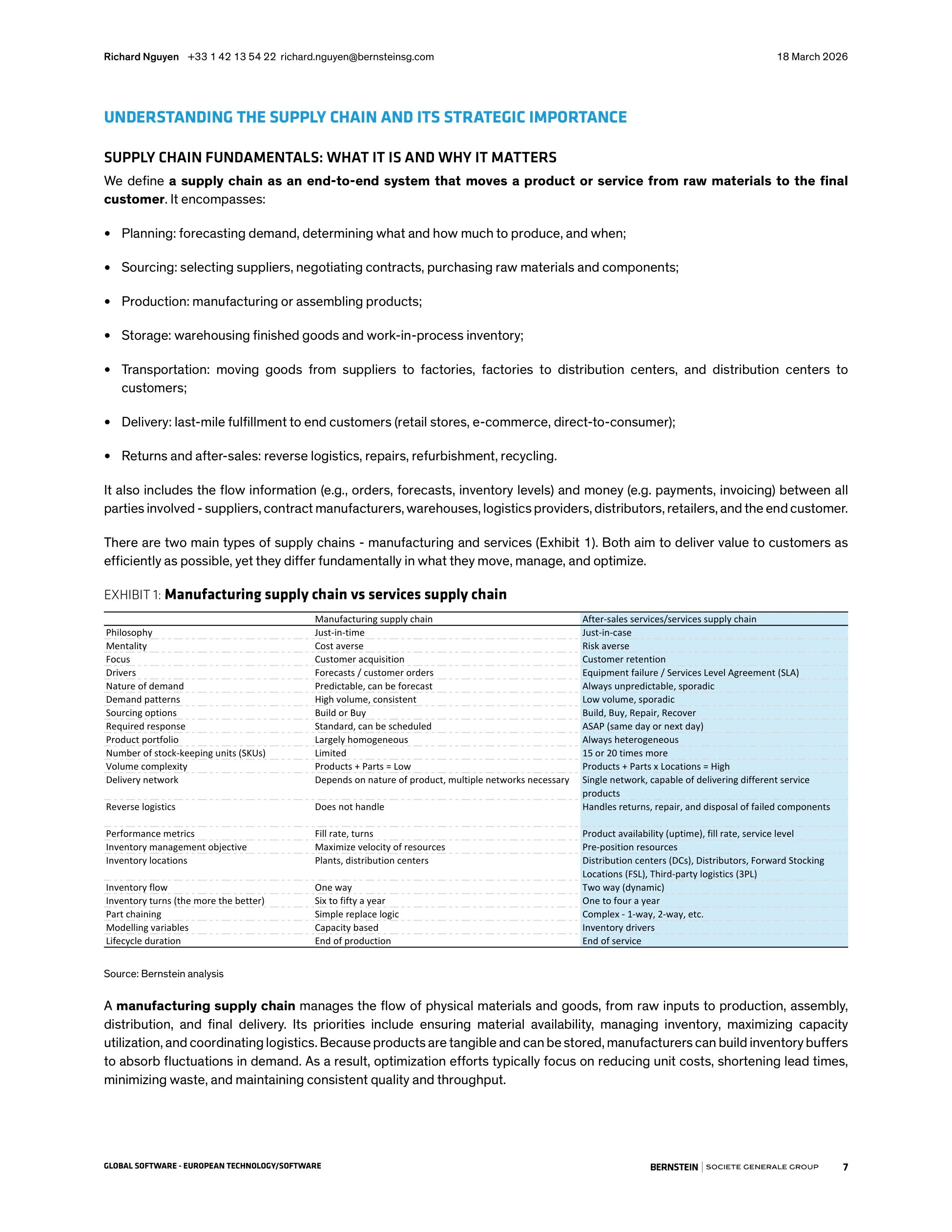
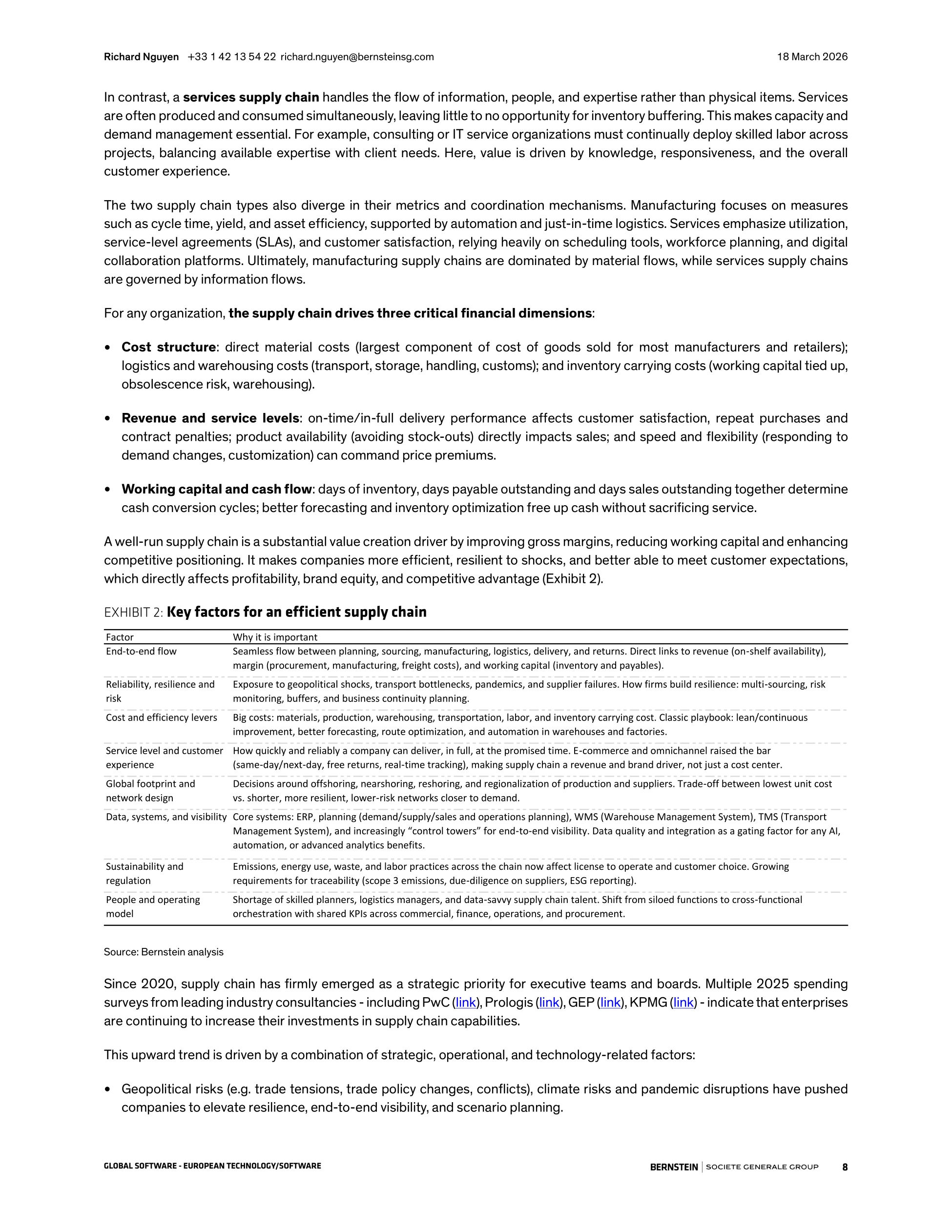
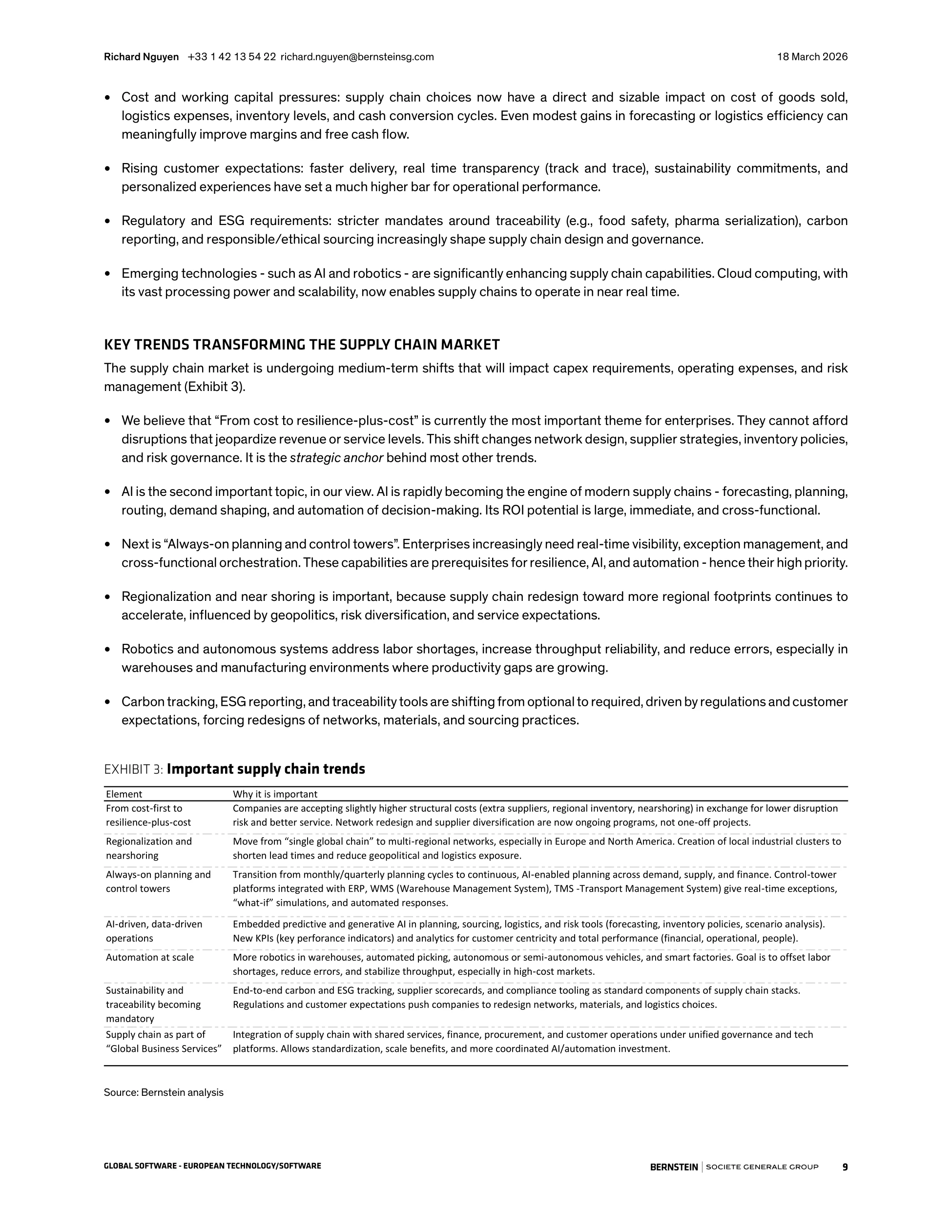
PRIMER18 March 2026Global Software - European Technology/SoftwareGlobal Software: The coming AI supercycle in Supply ChainSoftwareRichard Nguyen+33 1 42 13 54 22richard.nguyen@bernsteinsg.comMark L. Moerdler, Ph.D.+1 917 344 8506mark.moerdler@bernsteinsg.comDerric Marcon+33 1 58 98 06 30derric.marcon@bernsteinsg.comFiroz Valliji, CFA+1 917 344 8316firoz.valliji@bernsteinsg.comShelly Tang, CFA+1 917 344 8342shelly.tang@bernsteinsg.comSpecialist SalesKiran Shah+44 20 3547 1533kiran.shah@bernsteinsg.comKeith Murray+1 917 344 8435keith.murray@bernsteinsg.comWe view supply chain software as one of the most compelling multi-year investmentthemes. Global supply chains are being rebuilt in real time in response to geopolitical shocks,inflation, ESG requirements, and rising customer expectations. Supply chain management(SCM) software has become the digital backbone of this redesign, and AI is accelerating theshift from modernization to full-stack reinvention - driving strong growth across software,services, and cloud infrastructure.SCM is among the fastest-growing enterprise software categories, set to double from$33bn in 2024 to $66bn in 2029 (CAGR +c.15%), creating $217bn of cumulative revenueopportunity over 2026–29.AI is emerging as the new operating system for supply chains. By ingesting real-timesignals - from macro trends to logistics data - AI enables increasingly autonomous planning,inventory, and transport decisions. Financial gains are significant: lower working capital,higher service levels, and fewer disruptions. By 2030, c.80% of SCM spend is expected tobe AI-enabled. Deep integration and high switching costs reinforce this as a durable, high-return category.Cloud migration adds another structural tailwind. With SaaS growing c.23% annually,cloud penetration is set to rise from 52% in 2024 to 74% by 2029 - one of the largestremaining upgrade cycles in enterprise software and a major monetization vector for AI.The market remains fragmented (Top 3: 38%; Top 5: 45%) with meaningfulconsolidation potential. SAP leads with c.25% share, more than 2.5x Oracle. M&Amomentum is building as vendors move toward end-to-end platforms and seek differentiatedAI capabilities.Pricing models are evolving as outcome-based approaches link revenues directly tomeasurable value creation - such as reduced inventory or transport spend. This acceleratesAI monetization and expands the addressable market, though it introduces revenue variabilityand near-term margin pressure. Hybrid models (subscription + success-fee) provide balancein revenue predictability, and support stronger retention and long-term profitability.Within this landscape, we view SAP as the best-positioned beneficiary, supported by itsend-to-end suite, deep ERP integration, and the S/4 migration acting as a built-in SCMupsell engine. High switching costs and long-standing customer relationships reinforce itsleadership.Oracle offers, in our view, underappreciated A...










































