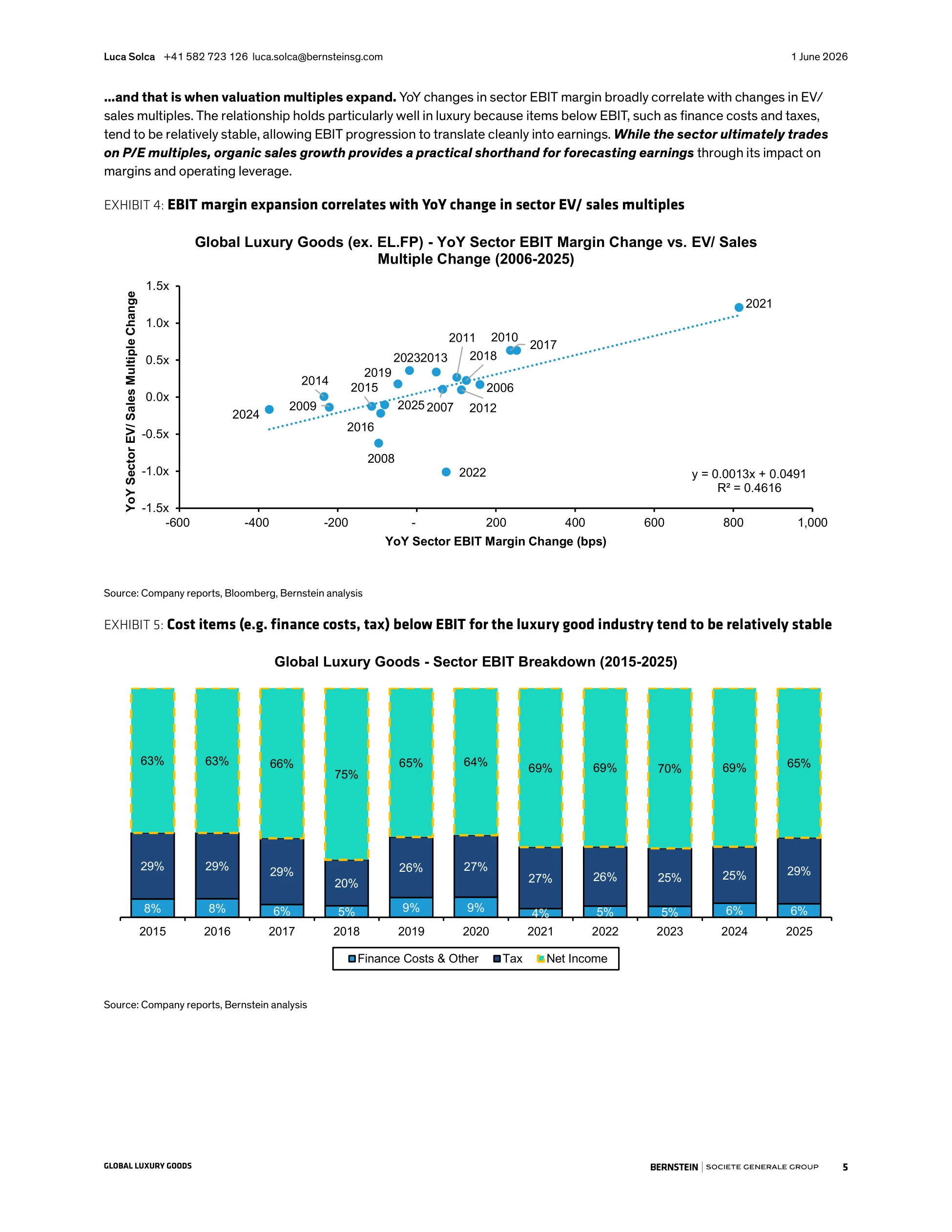
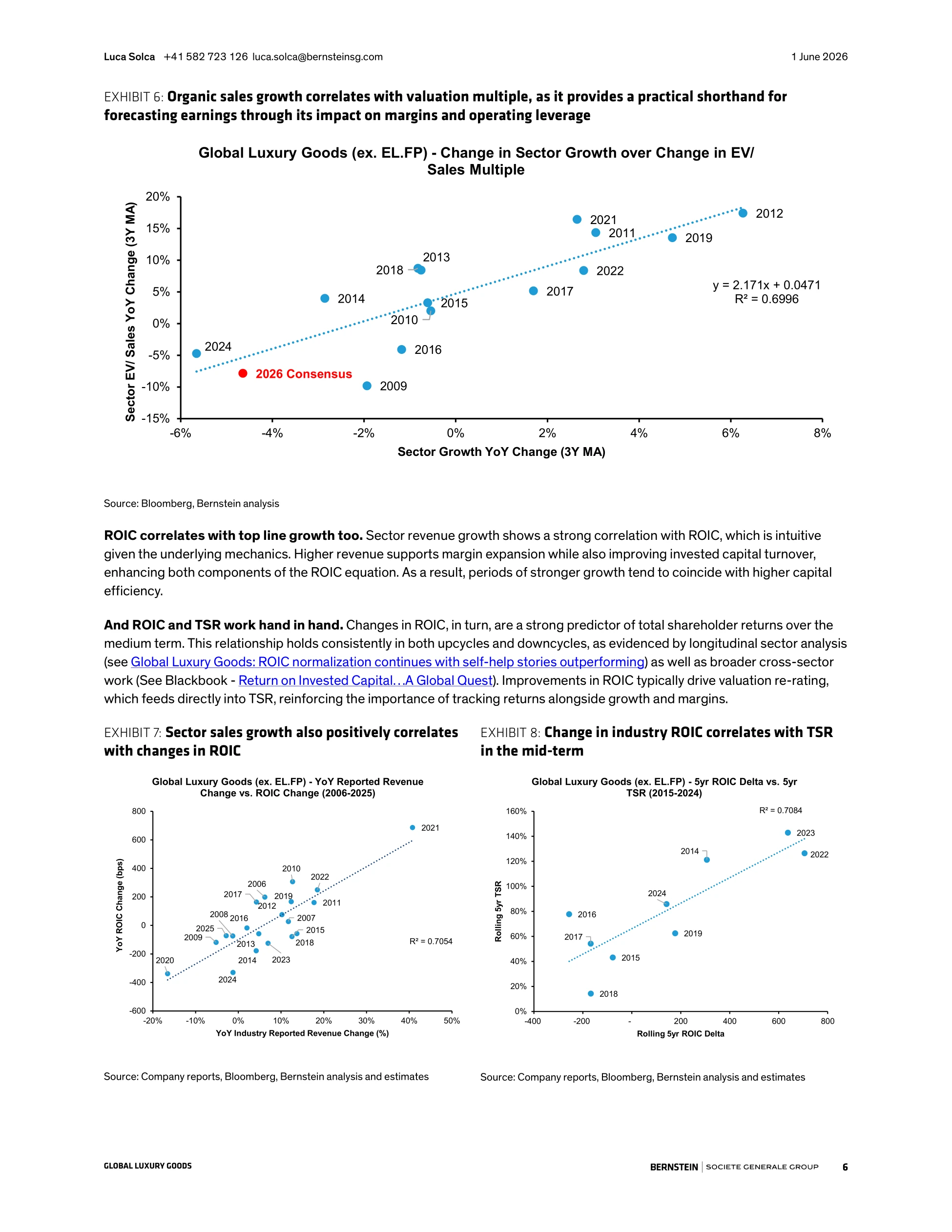
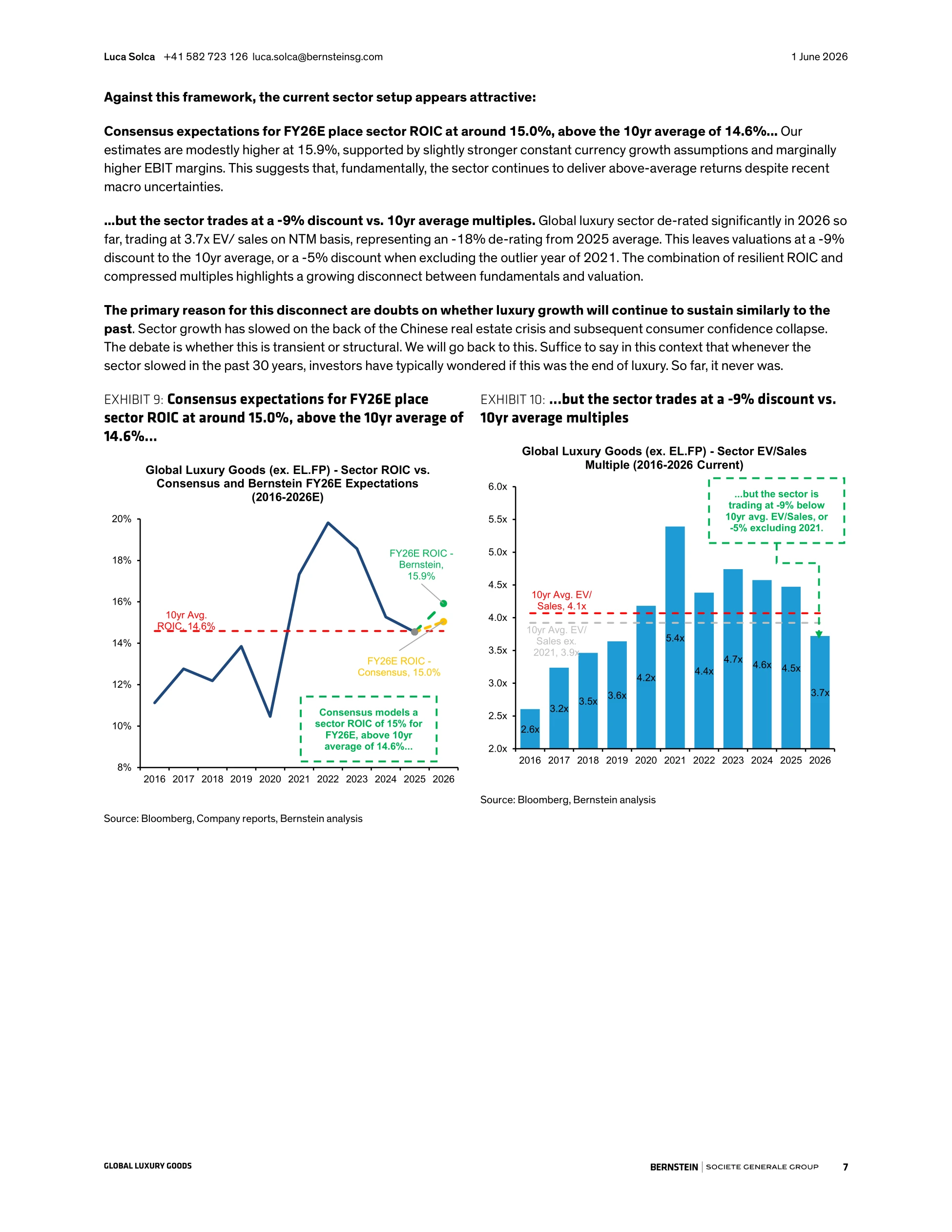
1 June 2026Global Luxury GoodsGlobal Luxury Good: The Triple Whammy RuleLuca Solca+41 582 723 126luca.solca@bernsteinsg.comMaria Meita+44 20 7170 0540maria.meita@bernsteinsg.comEric Chen, CFA+852 2123 2628eric.chen@bernsteinsg.comYi-Peng Khoo, CFA+44 20 7676 6822yi-peng.khoo@bernsteinsg.comSpecialist SalesAlix Turner+44 20 7762 4044alix.turner@bernsteinsg.comWe go back to our research on economics & valuation. We update top line, EBIT, TSR andROIC correlations.Luxury stocks trade on top line growth surprises. This reflects the fundamental appealof the sector: sustained growth. Over the past 20 years, global luxury has delivered c. +8%CAGR, roughly 3x global GDP growth. Investors enter the sector for this growth premium,and valuation frameworks are anchored accordingly. As a result, deviations in top-linegrowth versus expectations remain the most important near-term driver of share priceperformance.This is because luxury is a fixed cost industry… Gross margins are structurally high at70-80%, as input costs are only a small portion of retail prices, and operating expenses arelargely fixed, concentrated in retail store leases, sales associates and communication costs.Scale is a significant competitive advantage: larger brands can spend a smaller portionof sales, while smaller brands compete for similar locations, customers, and talent. Thiscreates a virtuous cycle, where scale drives efficiency and competitive strength (Video -Global Luxury Goods: Charts of the Month – 11. The mega-brand Virtuous Cycle)....faster top line growth produces operating leverage… As organic sales increase,absolute marketing communication rises, store productivity improves and fixed costs areabsorbed across a larger revenue base, driving EBIT margin expansion. In this way, top-linegrowth becomes the critical transmission mechanism through to profitability. The sector’searnings are therefore highly sensitive to revenue momentum....and that is when valuation multiples expand. YoY changes in sector EBIT marginbroadly correlate with changes in EV/sales multiples. The relationship holds particularlywell in luxury because items below EBIT, such as finance costs and taxes, tend to berelatively stable, allowing EBIT progression to translate cleanly into earnings. While thesector ultimately trades on P/E multiples, organic sales growth provides a practicalshorthand for forecasting earnings through its impact on margins and operatingleverage.ROIC correlates with top line growth too. Sector revenue growth shows a strongcorrelation with ROIC, which is intuitive given the underlying mechanics. Higher revenuesupports margin expansion while also improving invested capital turnover, enhancing bothcomponents of the ROIC equation. As a result, periods of stronger growth tend to coincidewith higher capital efficiency.And ROIC and TSR work hand in hand. Changes in ROIC, in turn, are a strong predictorof total shareholder returns ov...










































