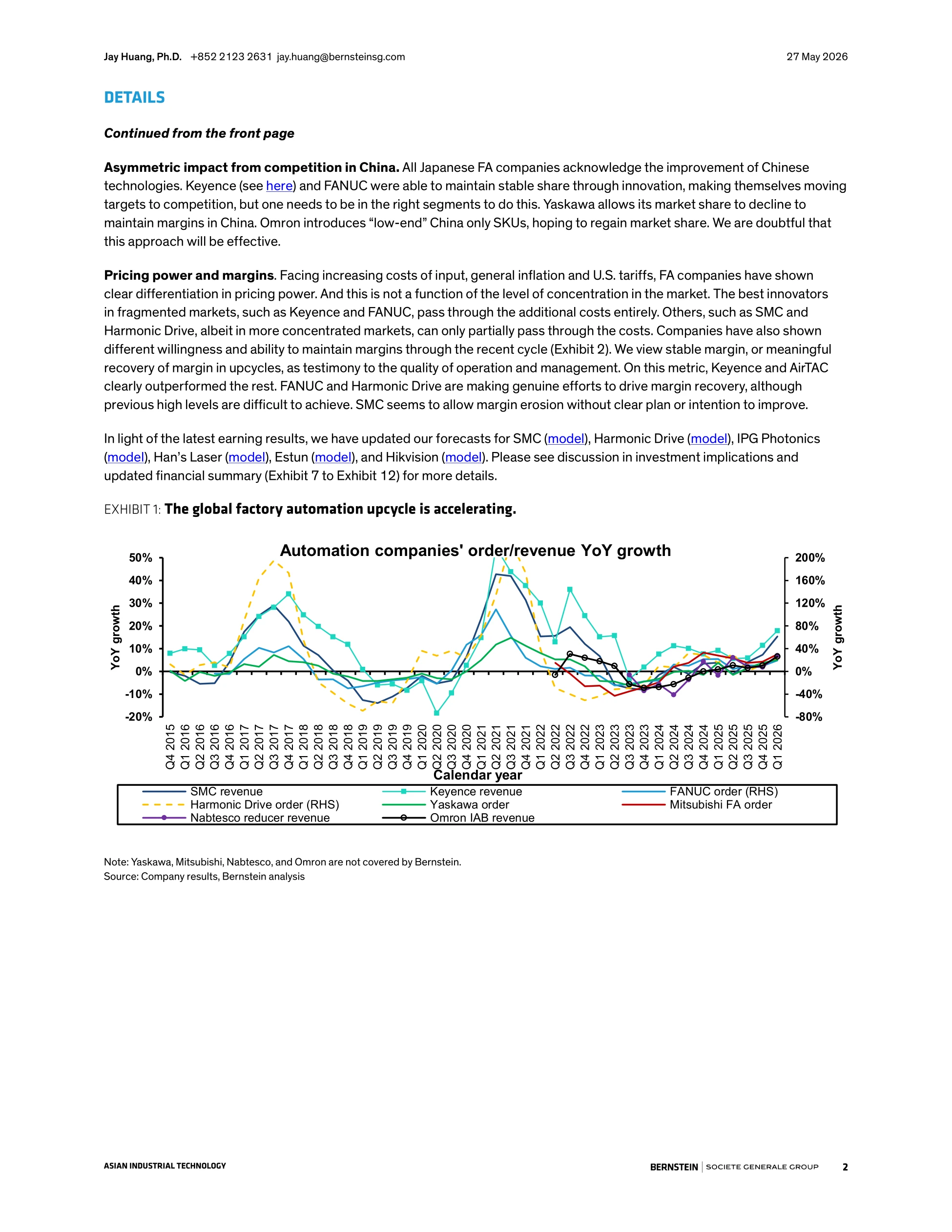
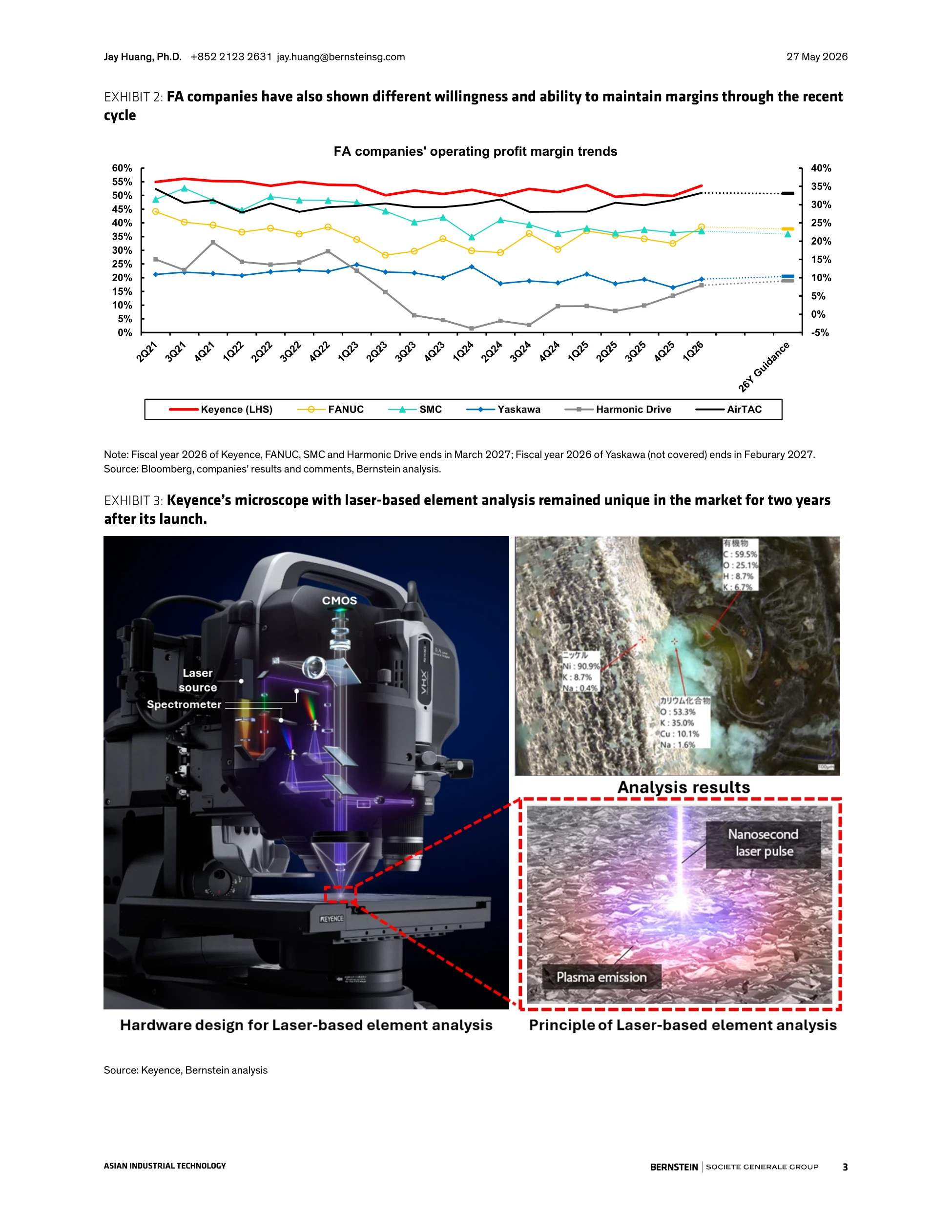
27 May 2026Asian Industrial TechnologyGlobal Automation: 2026 Asia Automation tour takeawaysJay Huang, Ph.D.+852 2123 2631jay.huang@bernsteinsg.comWeibin Liang, Ph.D.+852 2123 2666weibin.liang@bernsteinsg.comDien Wang, Ph.D.+852 2123 2622dien.wang@bernsteinsg.comWe visited 14 automation companies in China and Japan in our annual tour this month,including publicly listed Inovance, Leader Drive, MOONS’ Electric (not covered), Keyence,FANUC, SMC, DMG Mori (not covered), Yaskawa (not covered), Omron (not covered), THK(not covered), Nabtesco (not covered), and private companies Mech-Mind, Fourier, andOYMotion. We summarize the key takeaways below and update company models post thetour and recent earnings results.Confirmation of broad-based global FA upcycle. By region, in China, both Inovance(April orders +40% YoY) and Japan FA companies confirmed continued strengthdespite weak April FAI data. RoW growth is accelerating (Exhibit 1). By end industry,semiconductors and AI-related investments lead the growth, but they typically only accountfor 5-25% of automation demand. All other verticals, including automotive, are alsorecovering at different paces. FA companies in general have not seen abnormal “advanceorders” from customers, indicating that current demand is largely not due to customers’inventory buildup. Our view is that peak growth is 1H26 in China and 1Q27 globally, withthe upcycle lasting >1 year after the peak.Physical AI differentiation. Many companies talk the talk, but FANUC really walks thewalk. It received orders of thousands of units a few months after its debut last December,compared to ~200 units by Yaskawa 2.5 years after the initial announcement. We analyzedFANUC’s unique strengths in Physical AI previously (here), and another important differenceis that all of FANUC’s robots, rather than a specific line (e.g. Yaskawa’s Motoman Next), canbe used in Physical AI platforms such as those from Nvidia and Google (both covered). Likeus, FANUC sees Physical AI not as a disruptive technology or near-term growth multiplier,but a complementary technology to continuously expand the scope of robotic applications(see here), and to allow inexperienced customers to adopt existing robotic applications withease.Toward the first commercial adoption of humanoid robots. There has been generalexcitement about humanoid robots becoming useful beyond entertainment and research.First killer applications are emerging in warehouses and factories for various types ofmaterial handling (see here and here). Humanoid volume growth is 200%+ YoY based oncomments from players in China. In plant visits, we further confirm that humanoid robots areto complement rather than replace industrial robots. Even in the world’s most automatedfactory, where FANUC robots are making their own copies, human workers are still presentfor packaging, loading/ unloading, inspection and testing, and harness installation...