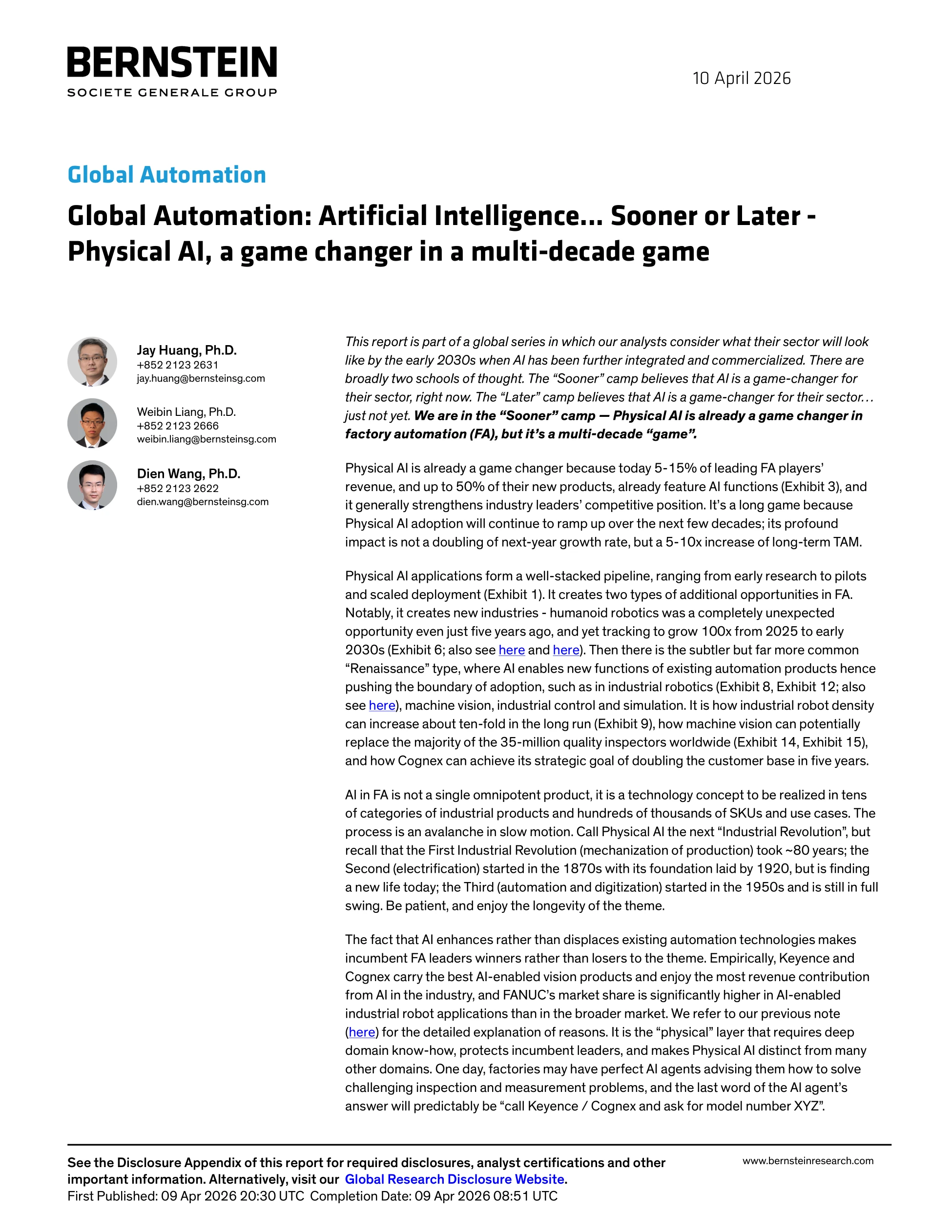
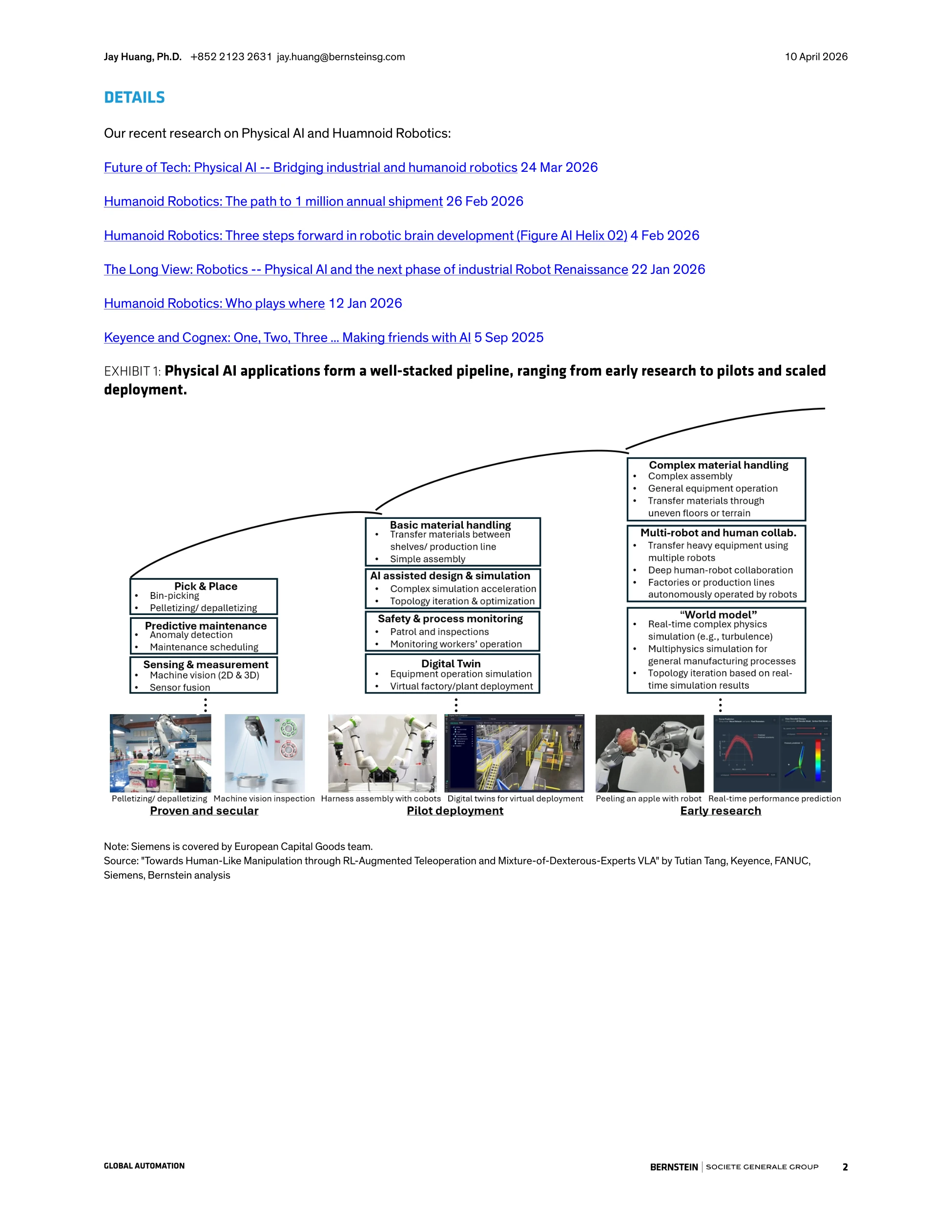
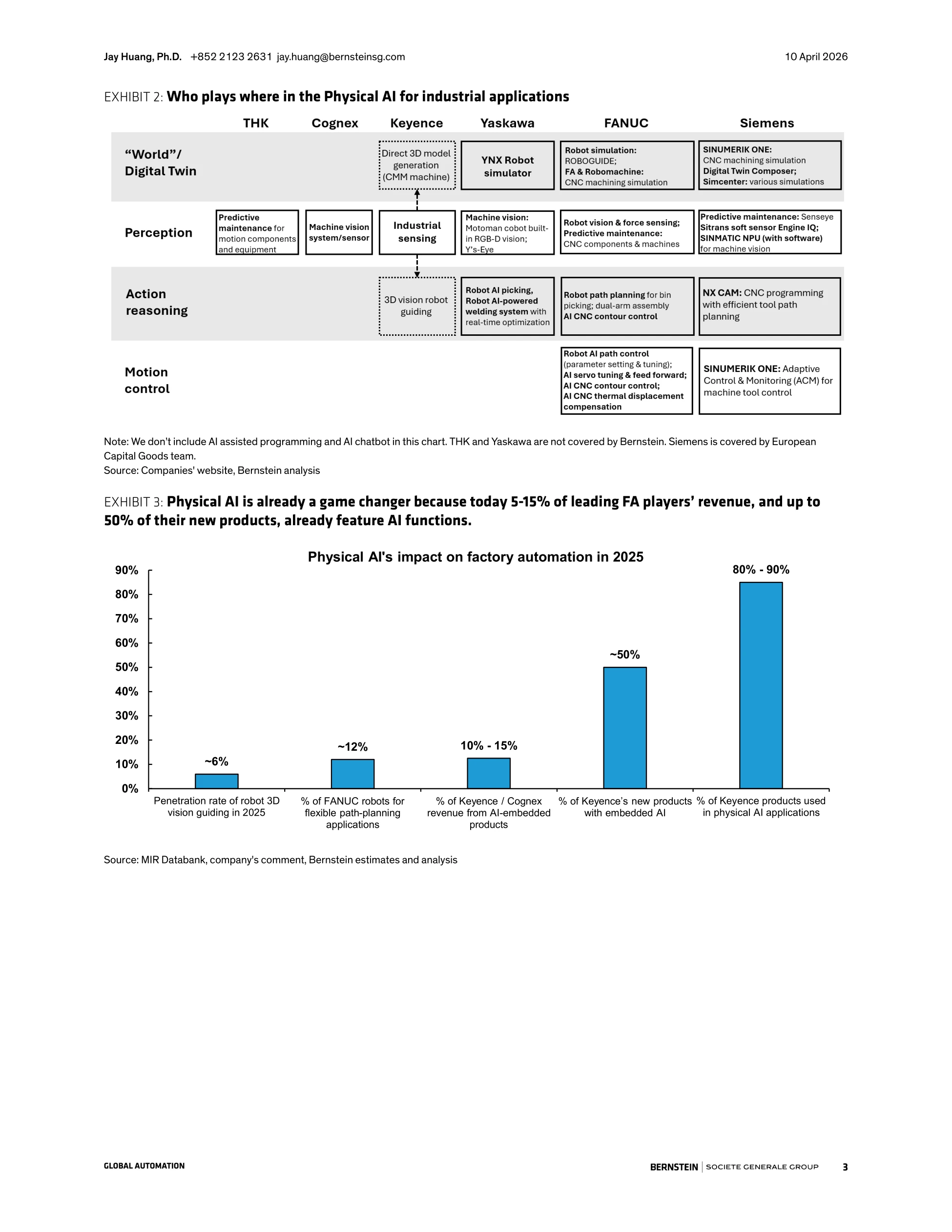
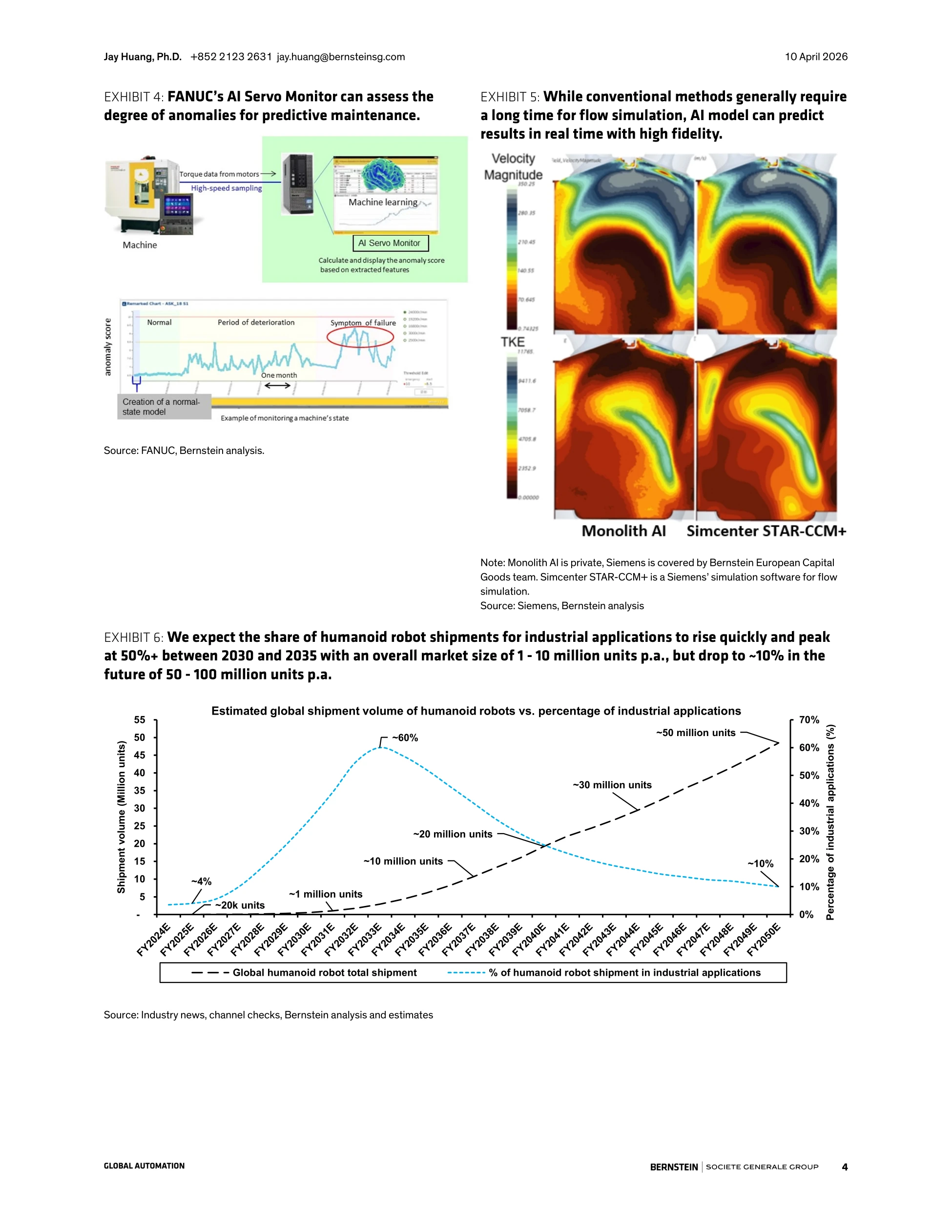
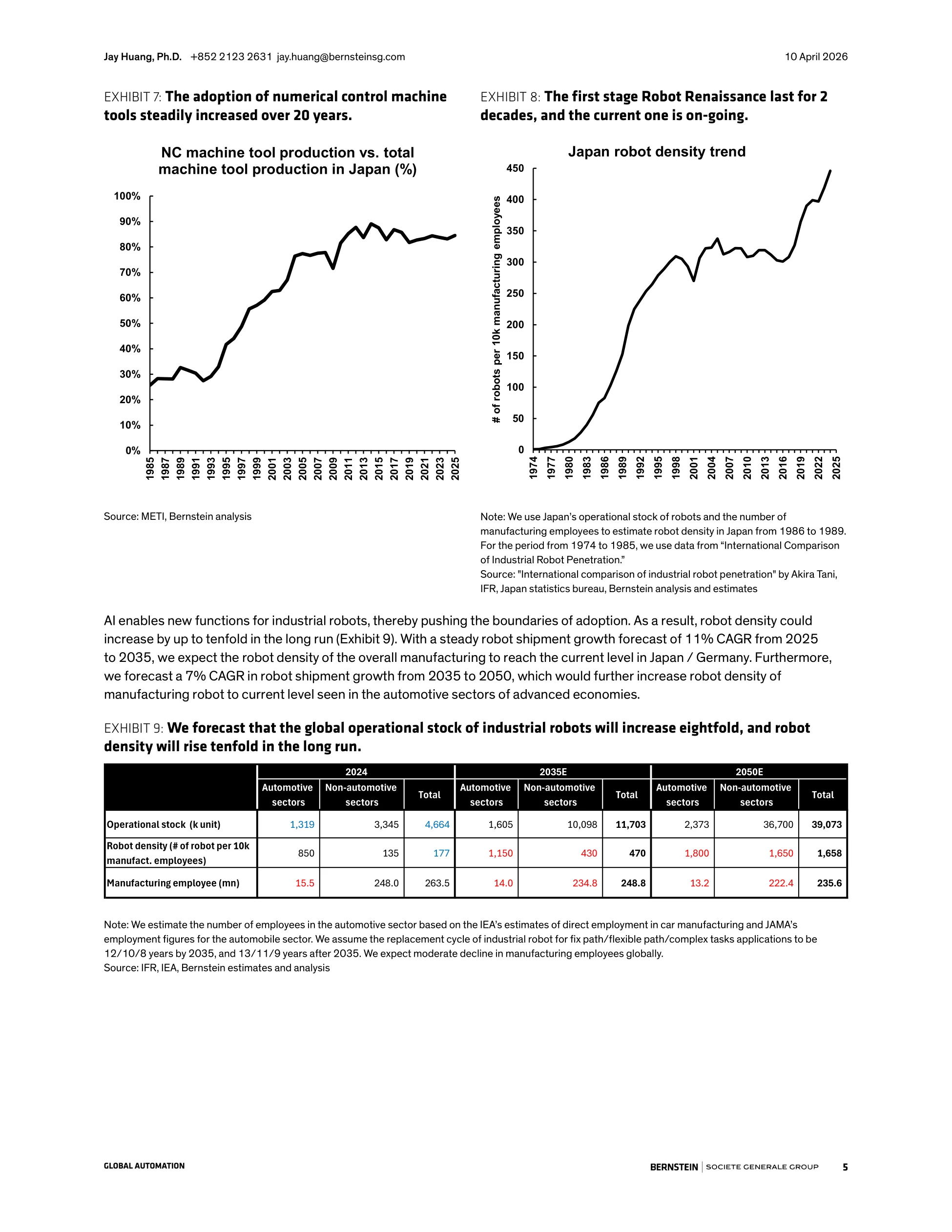
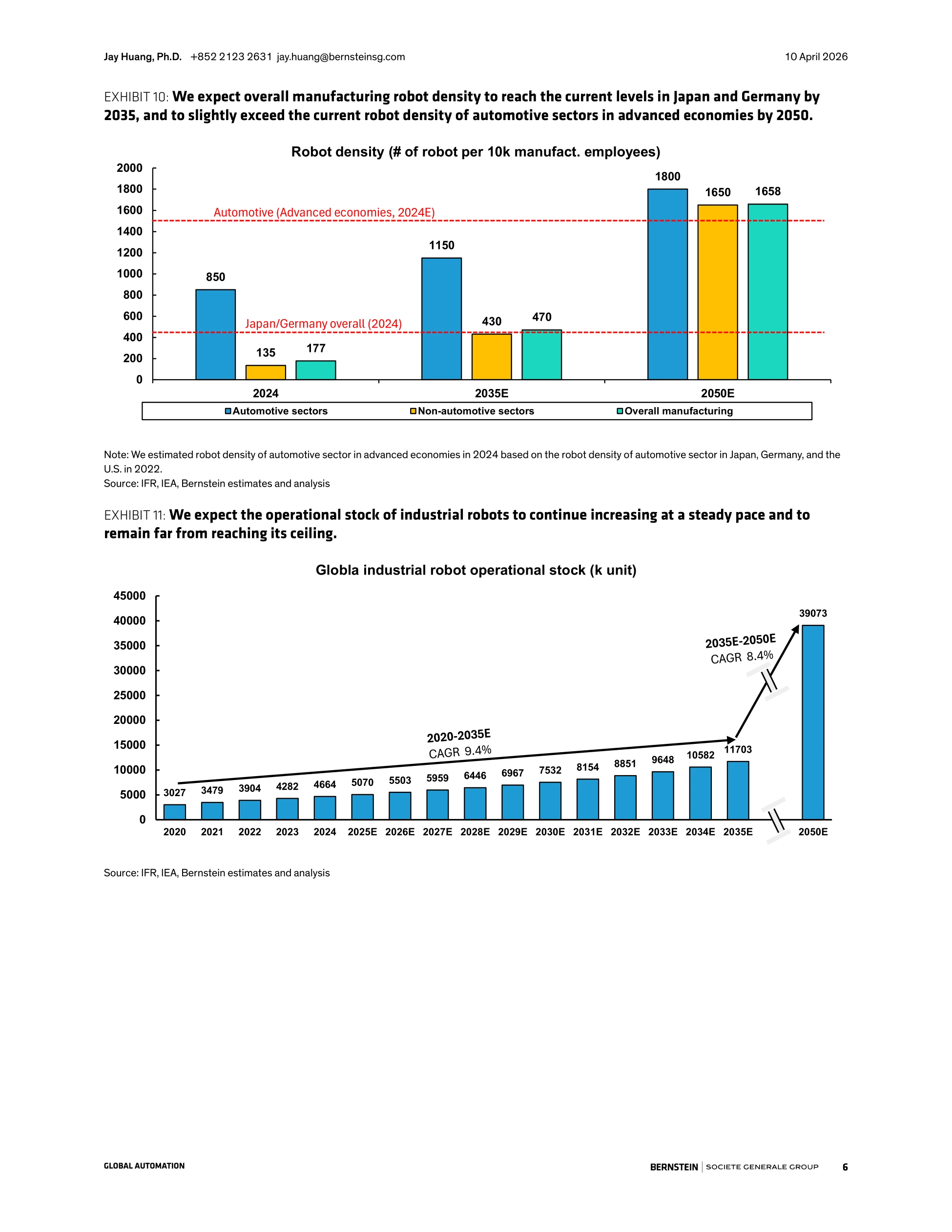
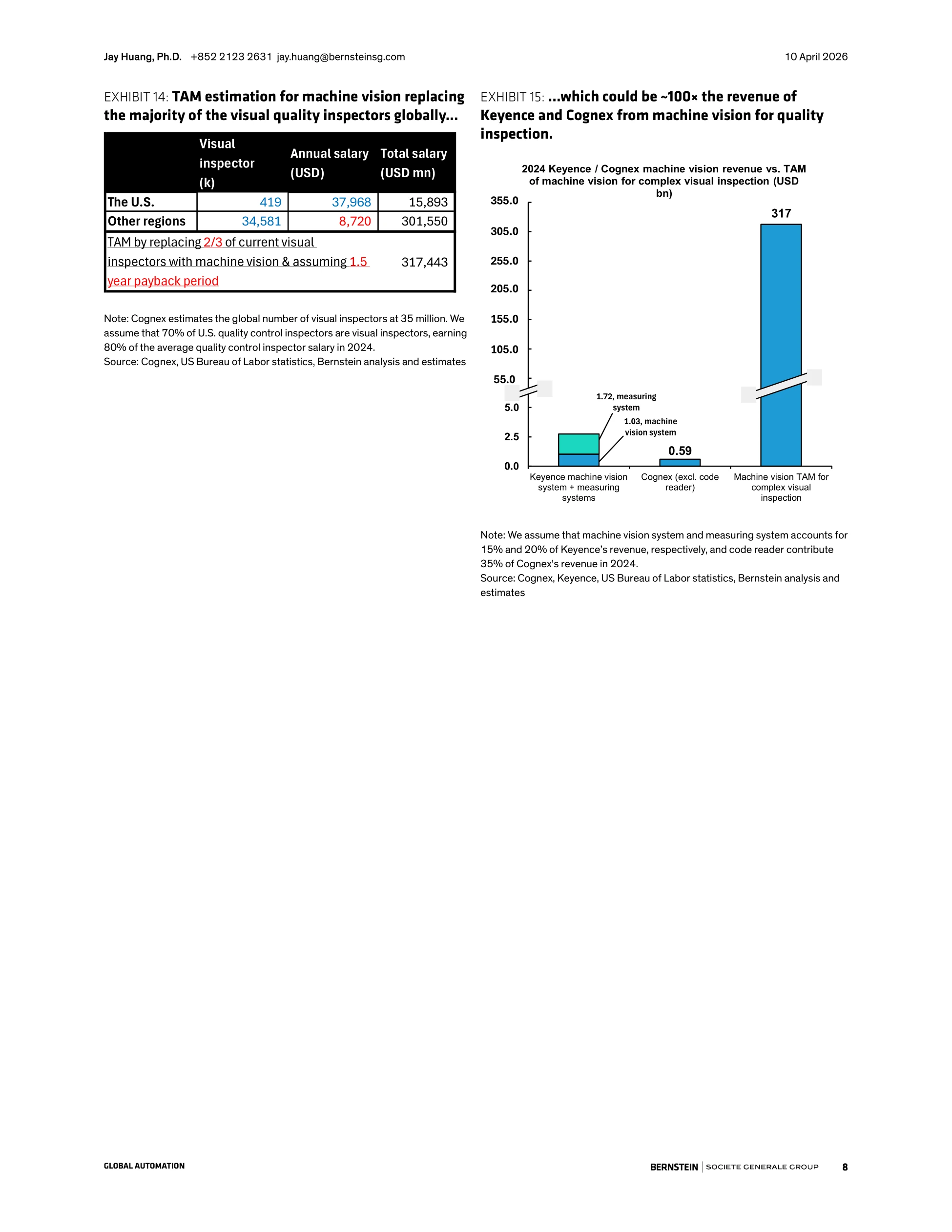
10 April 2026Global AutomationGlobal Automation: Artificial Intelligence... Sooner or Later -Physical AI, a game changer in a multi-decade gameJay Huang, Ph.D.+852 2123 2631jay.huang@bernsteinsg.comWeibin Liang, Ph.D.+852 2123 2666weibin.liang@bernsteinsg.comDien Wang, Ph.D.+852 2123 2622dien.wang@bernsteinsg.comThis report is part of a global series in which our analysts consider what their sector will looklike by the early 2030s when AI has been further integrated and commercialized. There arebroadly two schools of thought. The “Sooner” camp believes that AI is a game-changer fortheir sector, right now. The “Later” camp believes that AI is a game-changer for their sector…just not yet. We are in the “Sooner” camp — Physical AI is already a game changer infactory automation (FA), but it’s a multi-decade “game”.Physical AI is already a game changer because today 5-15% of leading FA players’revenue, and up to 50% of their new products, already feature AI functions (Exhibit 3), andit generally strengthens industry leaders’ competitive position. It’s a long game becausePhysical AI adoption will continue to ramp up over the next few decades; its profoundimpact is not a doubling of next-year growth rate, but a 5-10x increase of long-term TAM.Physical AI applications form a well-stacked pipeline, ranging from early research to pilotsand scaled deployment (Exhibit 1). It creates two types of additional opportunities in FA.Notably, it creates new industries - humanoid robotics was a completely unexpectedopportunity even just five years ago, and yet tracking to grow 100x from 2025 to early2030s (Exhibit 6; also see here and here). Then there is the subtler but far more common“Renaissance” type, where AI enables new functions of existing automation products hencepushing the boundary of adoption, such as in industrial robotics (Exhibit 8, Exhibit 12; alsosee here), machine vision, industrial control and simulation. It is how industrial robot densitycan increase about ten-fold in the long run (Exhibit 9), how machine vision can potentiallyreplace the majority of the 35-million quality inspectors worldwide (Exhibit 14, Exhibit 15),and how Cognex can achieve its strategic goal of doubling the customer base in five years.AI in FA is not a single omnipotent product, it is a technology concept to be realized in tensof categories of industrial products and hundreds of thousands of SKUs and use cases. Theprocess is an avalanche in slow motion. Call Physical AI the next “Industrial Revolution”, butrecall that the First Industrial Revolution (mechanization of production) took ~80 years; theSecond (electrification) started in the 1870s with its foundation laid by 1920, but is findinga new life today; the Third (automation and digitization) started in the 1950s and is still in fullswing. Be patient, and enjoy the longevity of the theme.The fact that AI e...










































