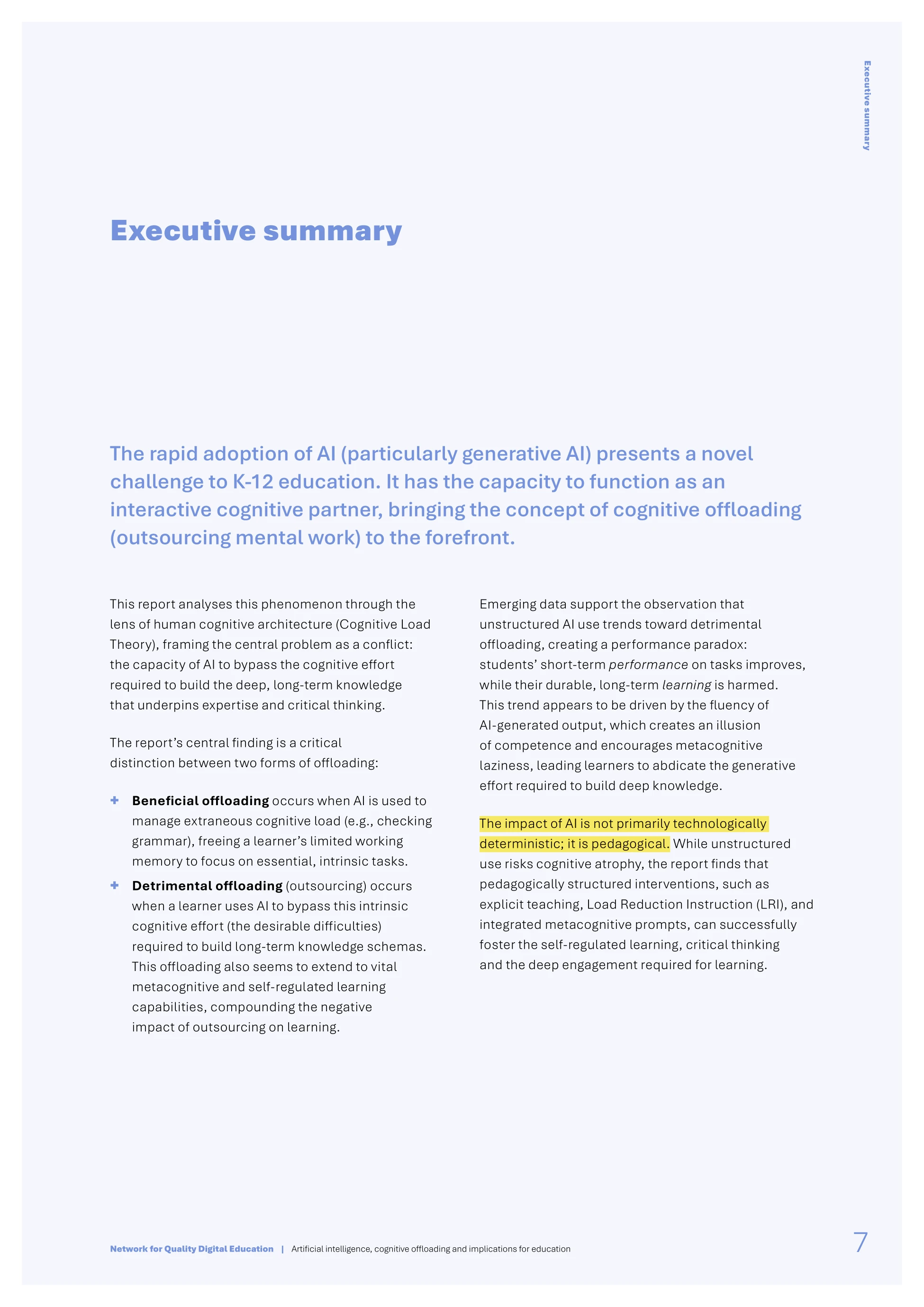
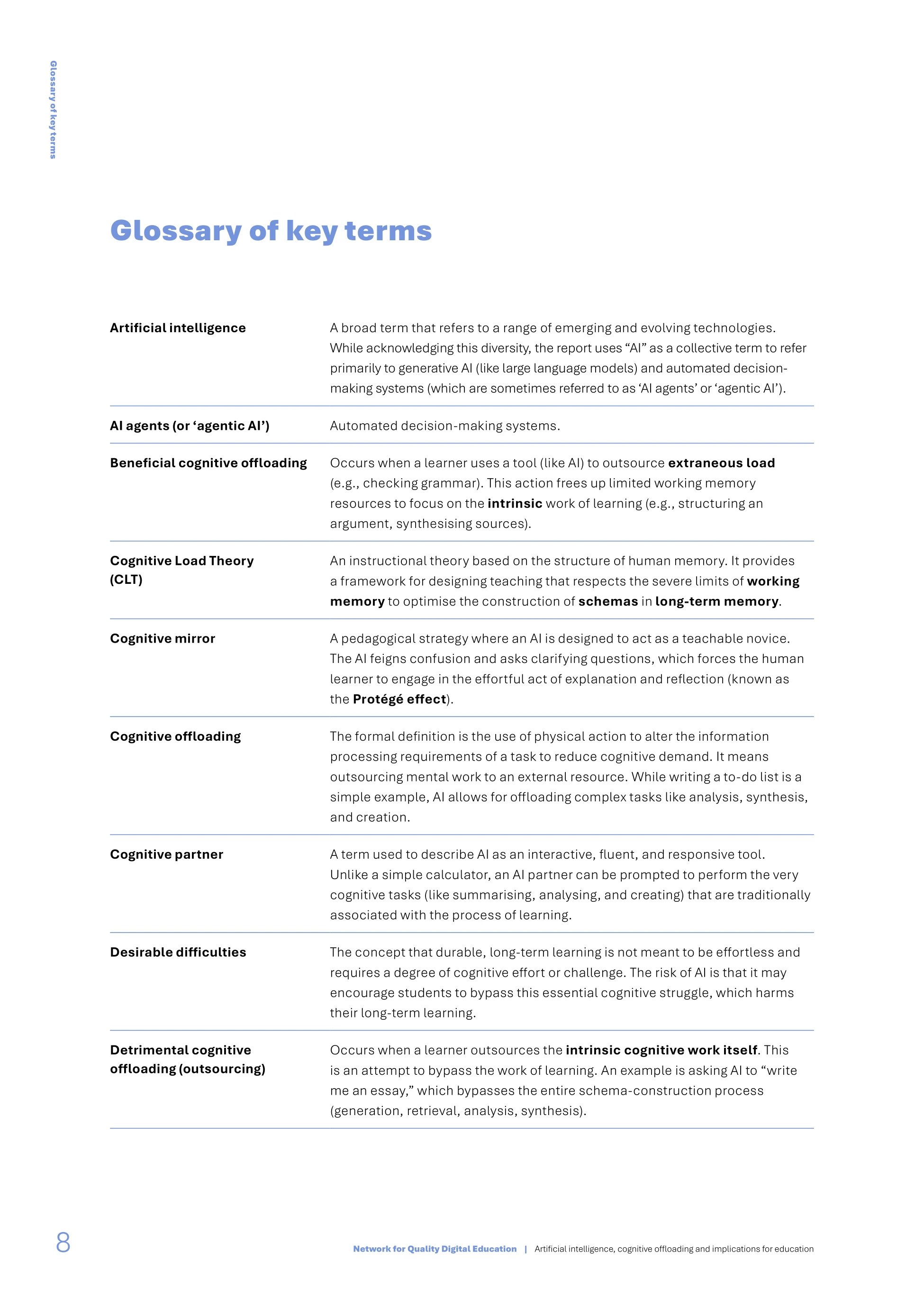
Network for Quality Digital Education | Artificial intelligence, cognitive offloading and education 1Artificial intelligence, cognitive offloading and implications for educationMarch 2026Prof Jason M. Lodge and Prof Leslie Loble AMNetwork for Quality Digital Education | Artificial intelligence, cognitive offloading and implications for education This report forms part of the work program supporting the Australian Network for Quality Digital Education. The Network brings together leaders from across education, industry, social purpose and philanthropic organisations, government and research, in the common purpose of ensuring that all Australian students benefit from the best educational technology (edtech), and the benefits of edtech are leveraged to tackle the persistent learning divide. Members of the Network have provided valuable engagement, input and feedback as part of the report’s development, though the report does not represent a consensus or endorsed Network view. The Network is chaired by Leslie Loble AM, who is Industry Professor at the UTS Centre for Social Justice and Inclusion (socialjustice.uts.edu.au). Professor Jason M. Lodge is Professor of Educational Psychology and Director of the Learning, Instruction, and Technology Lab in the School of Education, The University of Queensland. How to cite this reportLodge J. M. and Loble L (2026). Artificial intelligence, cognitive offloading and implications for education, University of Technology Sydney, doi:10.71741/4pyxmbnjaq.31302475.Copyright informationThis report is published by the University of Technology Sydney © University of Technology Sydney 2026. With the exception of the UTS branding, content provided by third parties, and any material protected by a trademark, all material presented in this publication is licensed under a Creative Commons Attribution — Non Commercial, Derivative Works 4.0 (CC BY-NC-ND 4.0) licence. The full licence terms are available at: creativecommons.org/licenses/by-nc-nd/4.0. Any enquiries about or comment on this publication should be directed to edtechnetwork@uts.edu.au.Accessibility This report is partially conformant with WCAG2.1 level AA. Known limitations and alternatives are listed below: +Image descriptions — images and graphs do not have long image descriptions because we have retrofitted accessibility requirements onto an existing template and layout. +Main body text does not meet requirement of 12-point size because we have retrofitted accessibility requirements onto an existing template and layout. Alternatives are to zoom in or use a screen reader. Acknowledgements The authors are grateful that the Australian Network for Quality Digital Education is hosted by theUTS Centre for Social Justice and Inclusion, and supported by the Paul Ramsay Foundation. The authors appreciate the valuable expertise and guidance of the Network members and others, which has enhanced t...










































