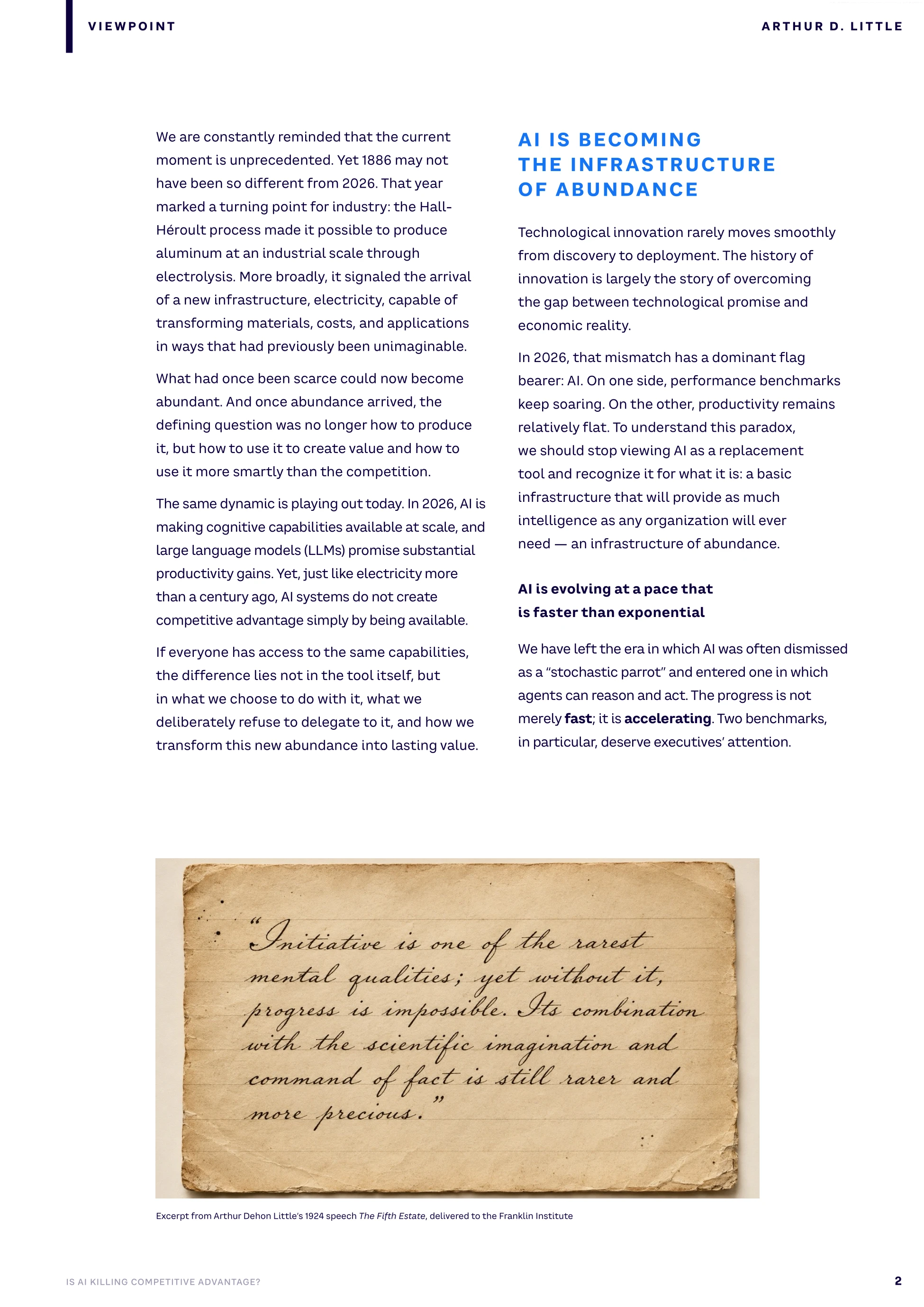
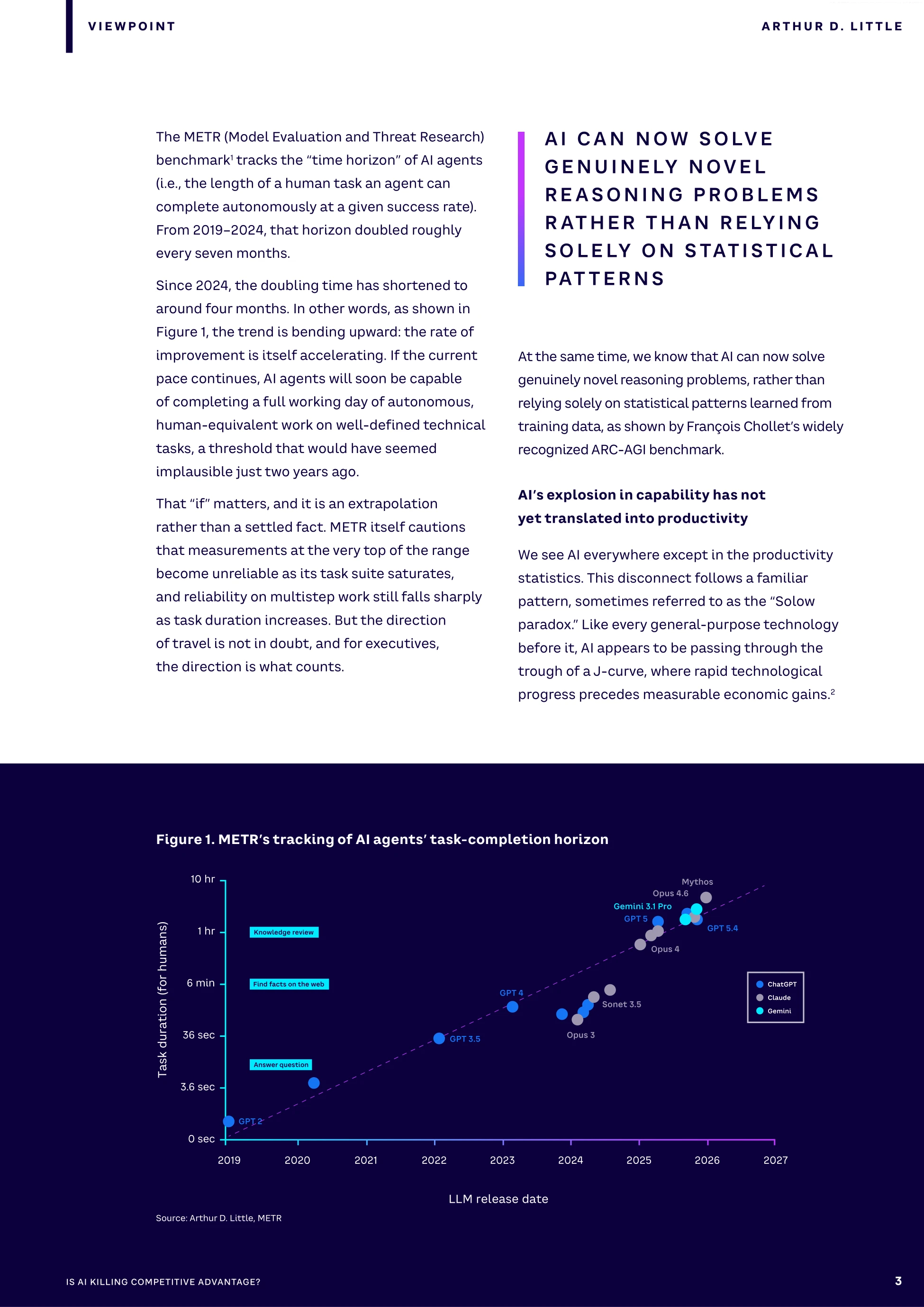
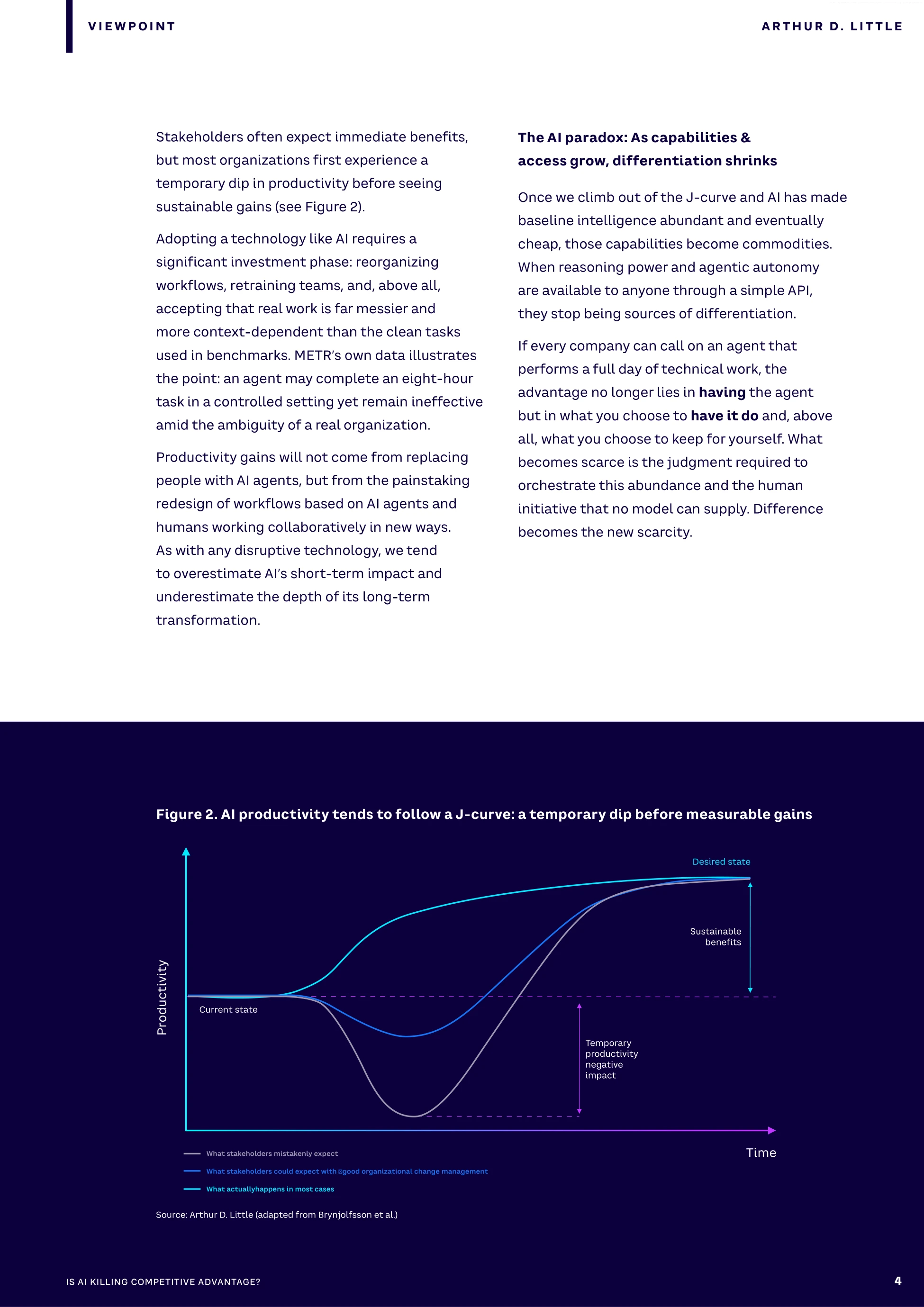
来源:发现报告(www.fxbaogao.com/view?id=5740260)| 引用请注明出处IN_ACKNOWLEDGMENT Ted quassedia con rest exped modi nimodit. Andiani vendent am, tempor am, iunte plani veribus ut eum re es et pernatem aut poribusdae magnis ani veribus ut eum re es et pernatem aut roqui ent.2026IS AI K ILLING COMPE TITIVE ADVANTAGE?In a world of abundant intelligence, advantage comes from differenceIs 2026 the new 1886? As we mark the 140th anniversary of Arthur D. Little, it’s natural to reflect on our origins. Arthur Dehon Little, our founder, pioneered the field of management consulting. Much has been written about the firm’s early years and its growth over the decades. More interesting is the question of how well our founder’s philosophy — centered on initiative and problem solving — continues to resonate today.AUTHORSDr. Albert MeigeIgnacio García AlvesRick EagarVIE WP OINT来源:发现报告(www.fxbaogao.com/view?id=5740260)| 引用请注明出处IS AI KILLING COMPETITIVE ADVANTAGE?AI IS BECOMING THE INFRASTRUCTURE OF ABUNDANCETechnological innovation rarely moves smoothly from discovery to deployment. The history of innovation is largely the story of overcoming the gap between technological promise and economic reality. In 2026, that mismatch has a dominant flag bearer: AI. On one side, performance benchmarks keep soaring. On the other, productivity remains relatively flat. To understand this paradox, we should stop viewing AI as a replacement tool and recognize it for what it is: a basic infrastructure that will provide as much intelligence as any organization will ever need — an infrastructure of abundance.AI is evolving at a pace that is faster than exponentialWe have left the era in which AI was often dismissed as a “stochastic parrot” and entered one in which agents can reason and act. The progress is not merely fast; it is accelerating. Two benchmarks, in particular, deserve executives’ attention.We are constantly reminded that the current moment is unprecedented. Yet 1886 may not have been so different from 2026. That year marked a turning point for industry: the Hall-Héroult process made it possible to produce aluminum at an industrial scale through electrolysis. More broadly, it signaled the arrival of a new infrastructure, electricity, capable of transforming materials, costs, and applications in ways that had previously been unimaginable.What had once been scarce could now become abundant. And once abundance arrived, the defining question was no longer how to produce it, but how to use it to create value and how to use it more smartly than the competition.The same dynamic is playing out today. In 2026, AI is making cognitive capabilities available at scale, and large language models (LLMs) promise substantial productivity gains. Yet, just like electricity more than a century ago, AI systems do not create competitive advantage simply by being av...