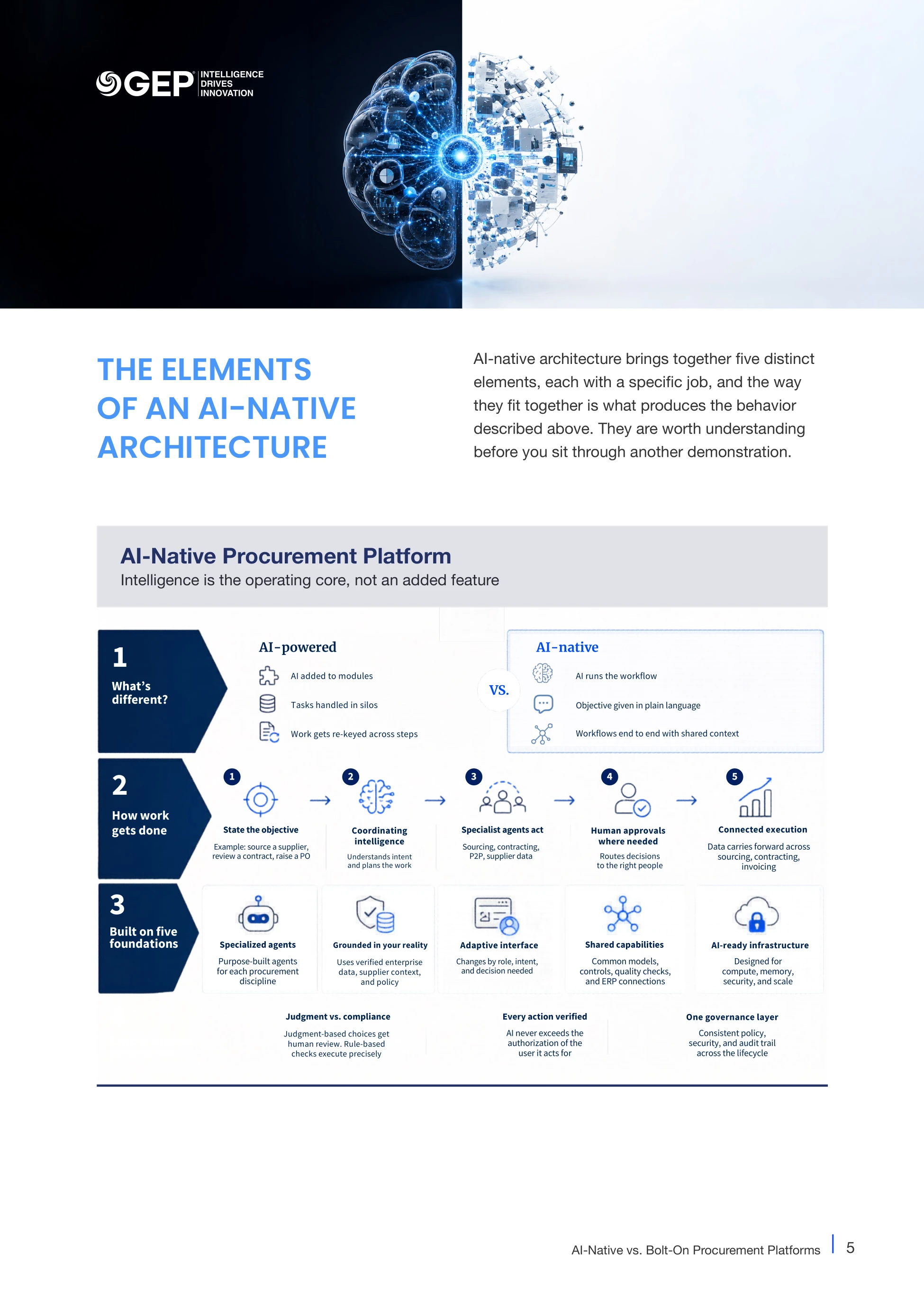
1AI-Native vs. Bolt-On Procurement PlatformsAI-Native vs. Bolt-OnProcurement PlatformsWhat’s the Difference, and Why It Matters to YouAI-Native vs. Bolt-OnProcurement Platforms2AI-Native vs. Bolt-On Procurement PlatformsEvery procurement software vendor now markets AI, and the demos increasingly look alike. Behind the similar language, two genuinely different kinds of product are being sold, and the distinction is not cosmetic. It determines how much work the software takes off your team, how cleanly it holds up in an audit, and whether it keeps pace with a technology that is moving faster than any annual release cycle. For a procurement leader choosing a platform now, understanding that distinction is the difference between buying a capability and buying a maintenance burden.The divide has a name. Platforms designed around AI from the ground up are called AI-native. Platforms built for a traditional, screen-and-form way of working that later had AI added to them are, whatever the marketing says, AI-powered. The label a vendor prefers matters far less than which of these two things you are actually looking at.The stakes are not abstract. The Hackett Group projects procurement workloads climbing roughly 10% in 2025 against about 1% budget growth, a gap it expects AI to help close, and reports that 64% of procurement leaders believe AI will transform how their teams work within five years.1 The platform you standardize on now will decide how much of that gap you actually recover.3AI-Native vs. Bolt-On Procurement PlatformsWHAT ACTUALLY SEPARATES THE TWOThe difference is structural. It comes down to where the intelligence sits and what it is allowed to do.In an AI-powered platform, the software is designed for fixed, rule-based workflows, and AI was layered on afterward as a set of features. A model sorts your spend. A tool summarizes a contract. A chatbot answers questions about a requisition. Each feature is useful inside its own module, but it serves a process that a person still drives manually, and it cannot reach across the system, because the system underneath was never built to be driven by anything other than a user clicking through screens. This category is broad and, for now, the market default.The Hackett Group found that about 47% of organizations already rely on AI embedded in existing procurement software.2 It is also where most of the marketing noise sits: Gartner has named the pattern agent washing — the rebranding of assistants, robotic process automation, and chatbots as agentic AI without the underlying capability — and estimates that only about 130 of the thousands of vendors claiming agentic AI are genuine.3None of that is worthless. Classification that once cost an analyst a week might now take an afternoon, and a contract summary can save real reading time. But the help stays small and local. Each feat...