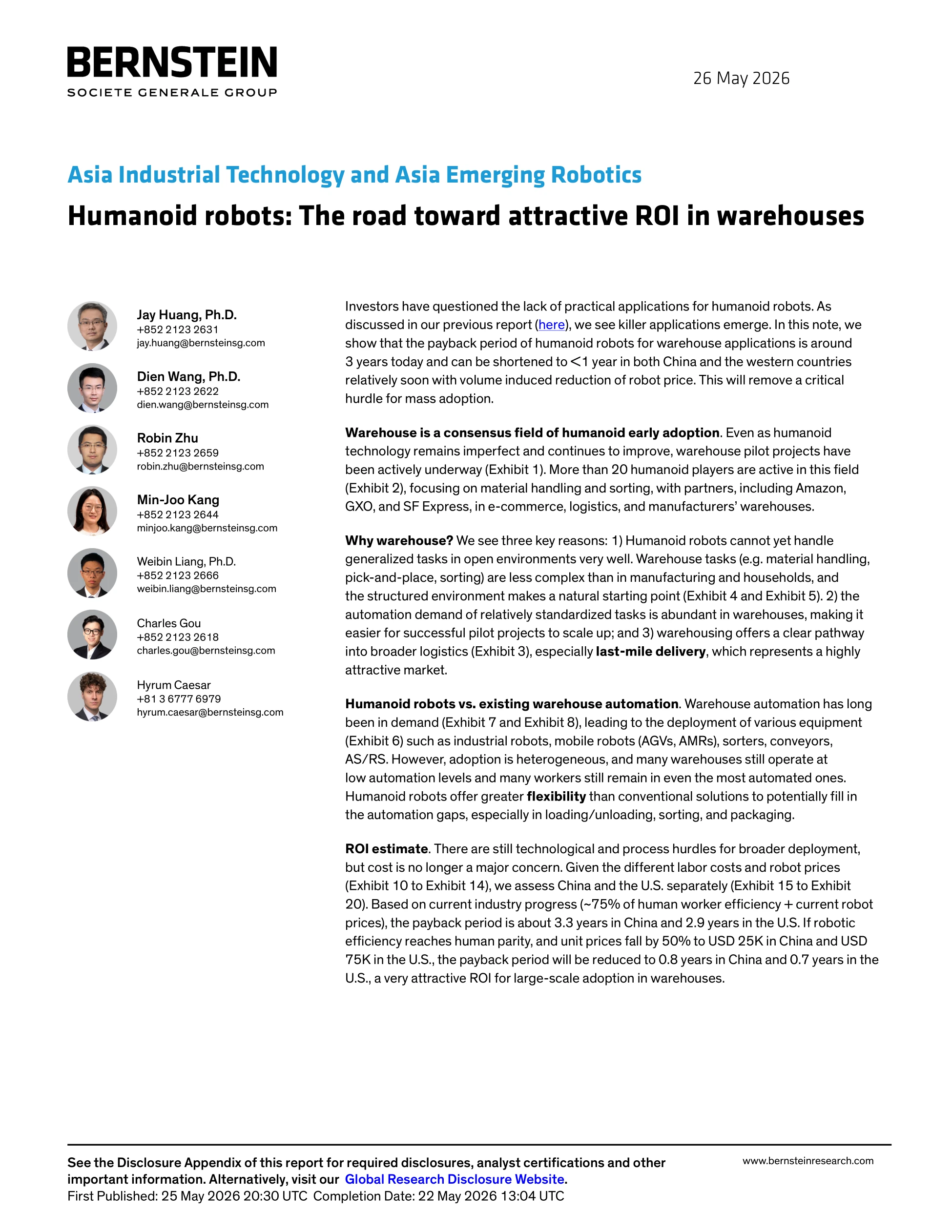
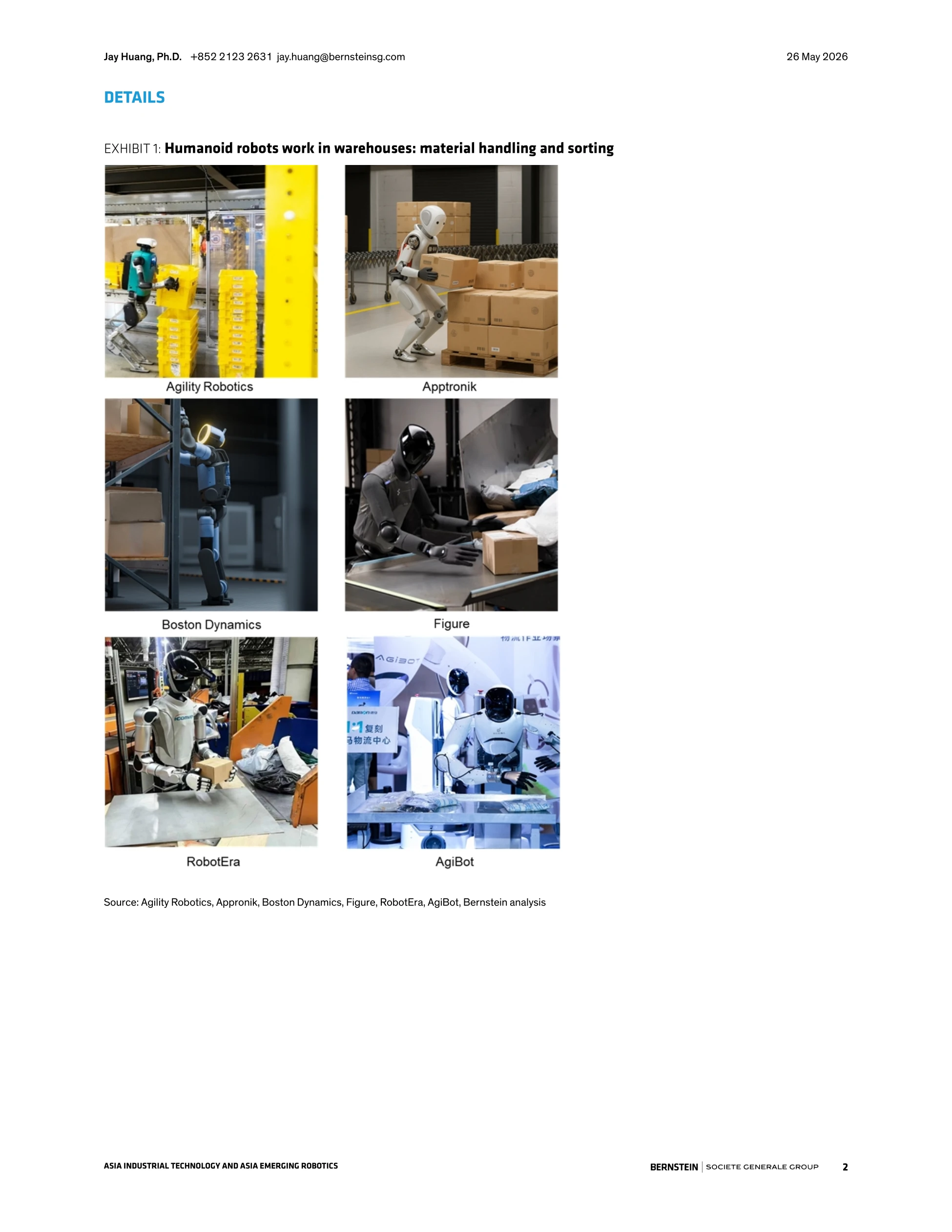
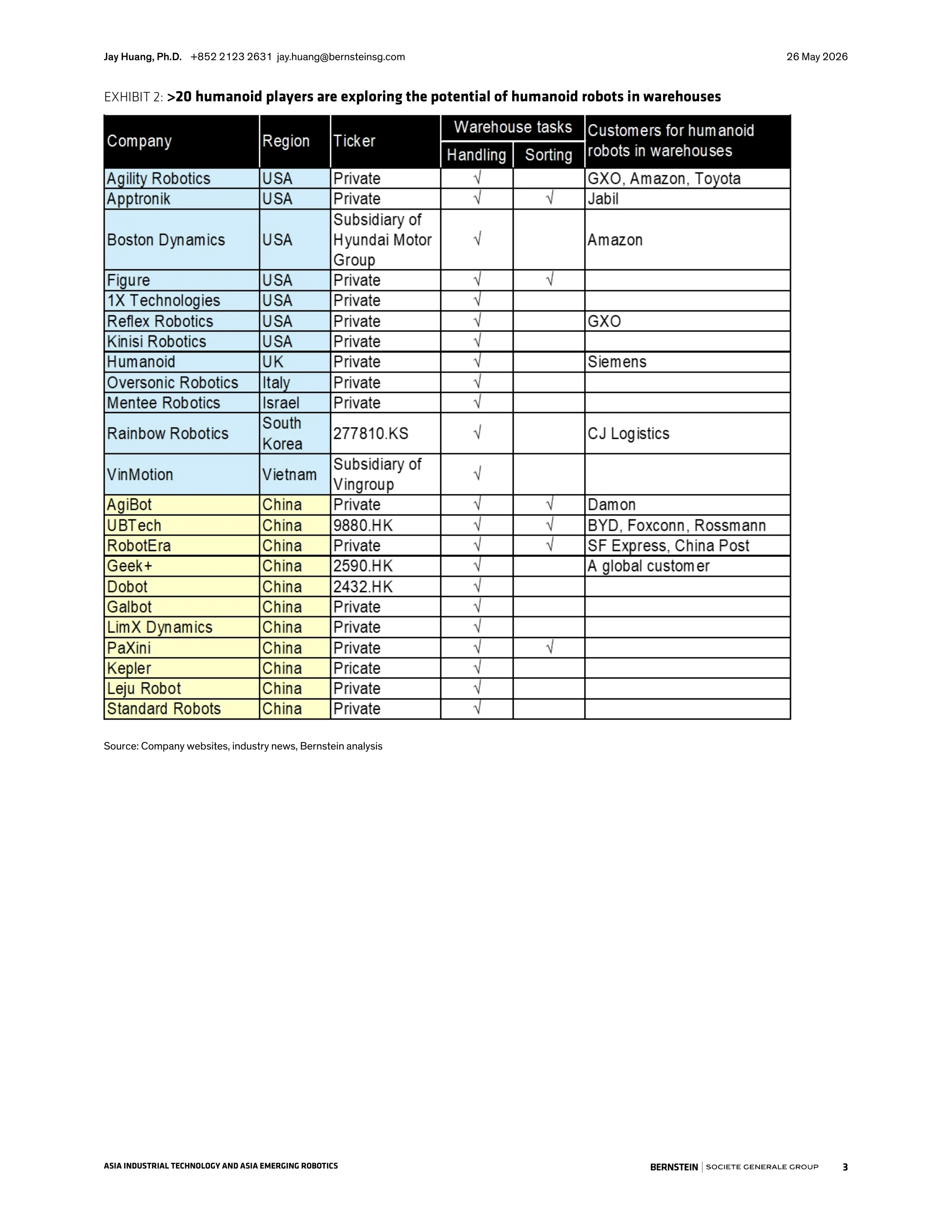
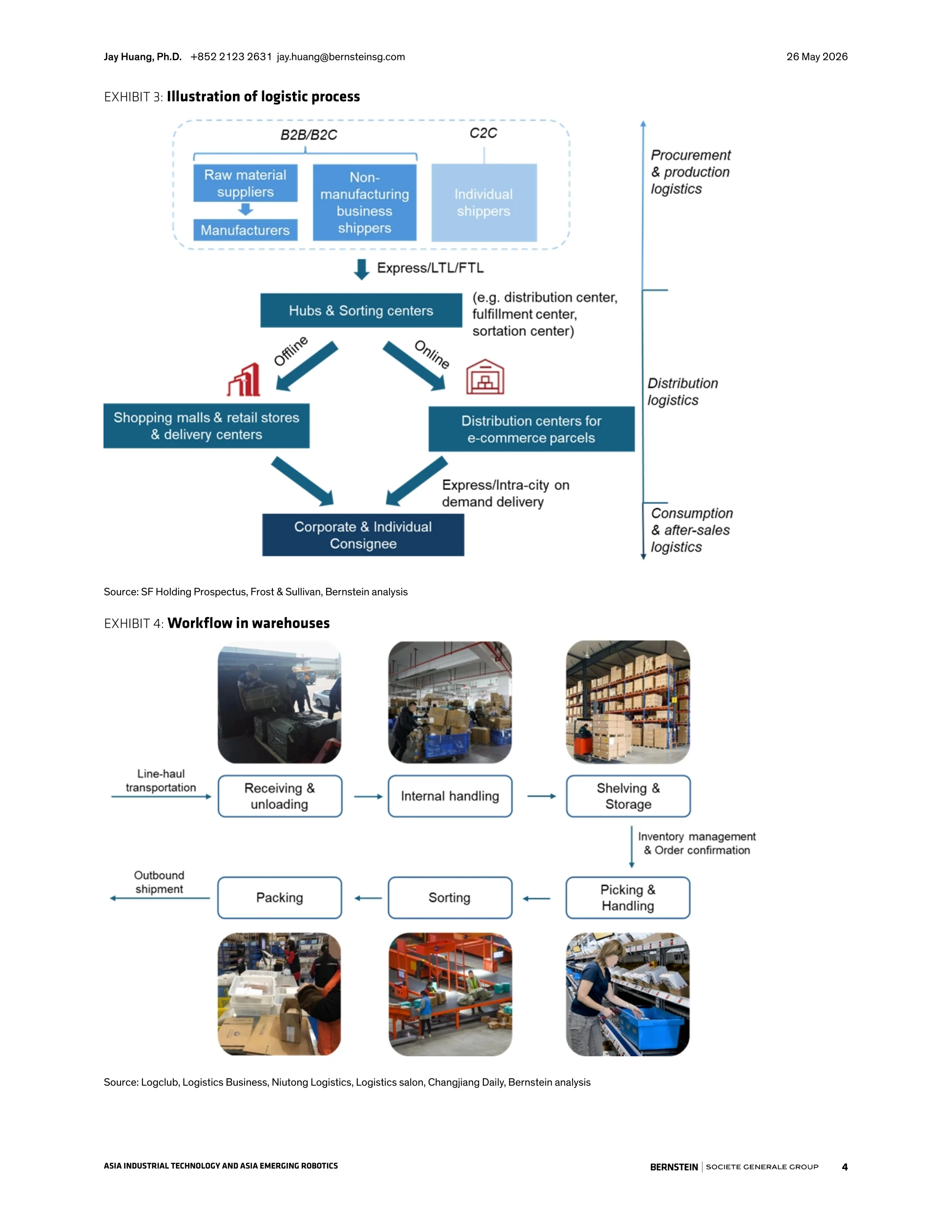
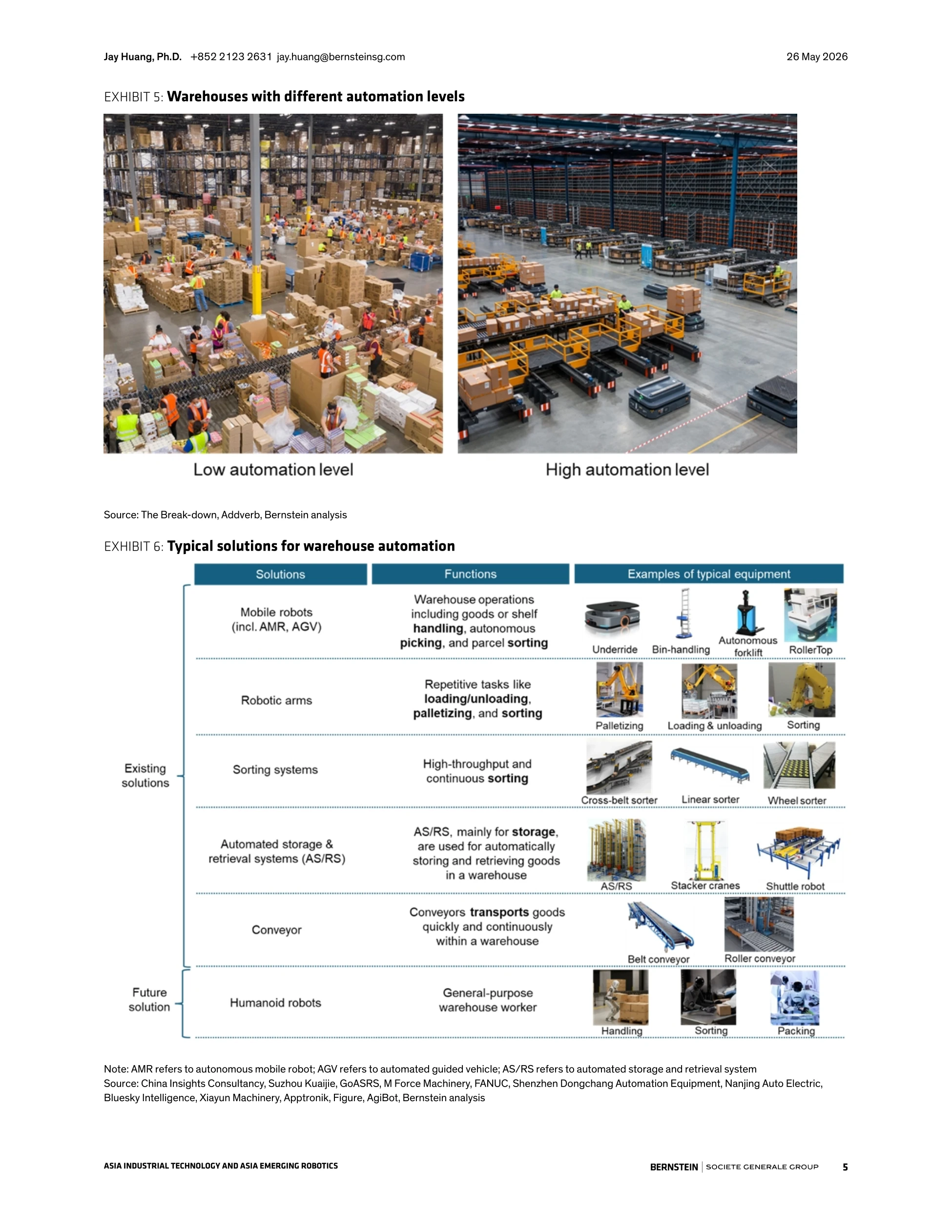
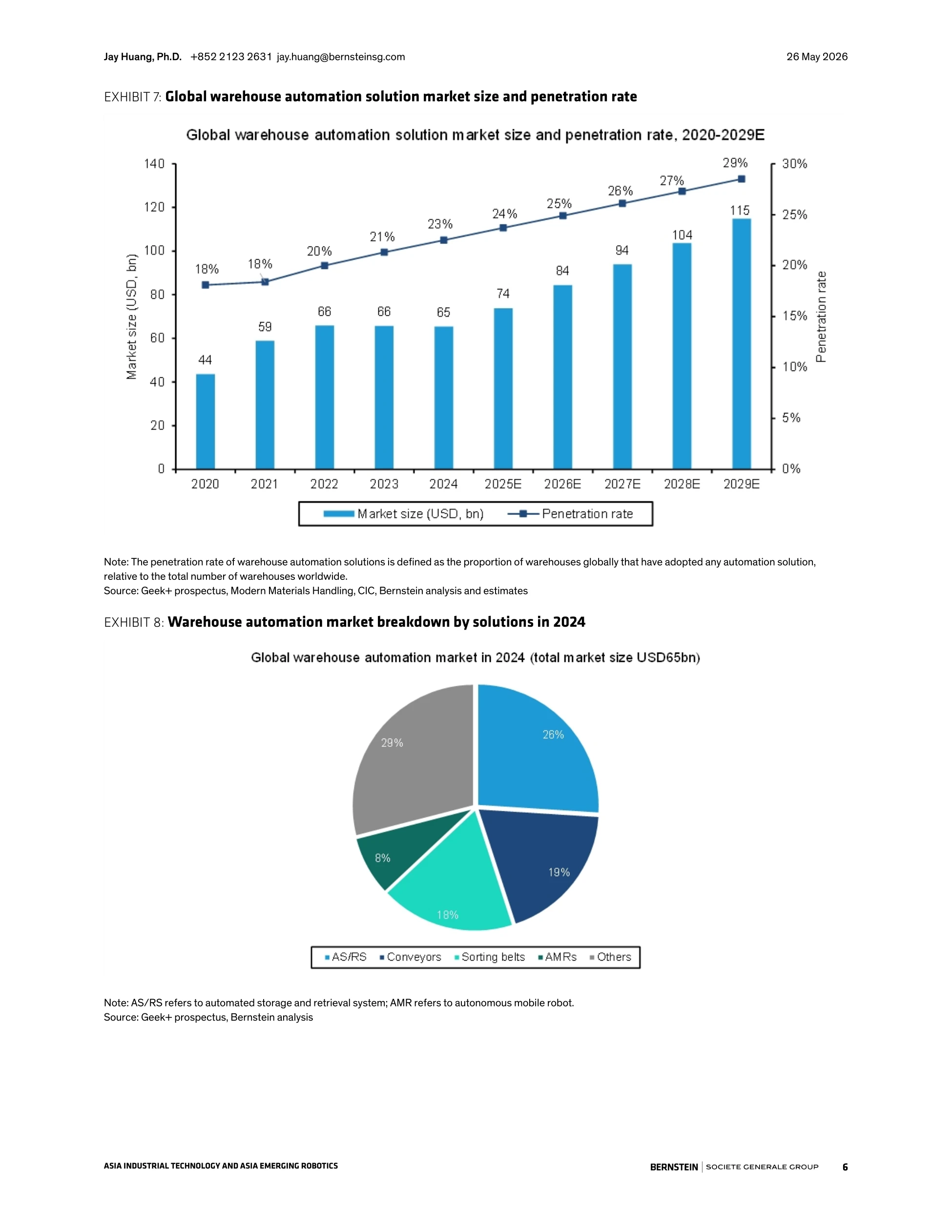
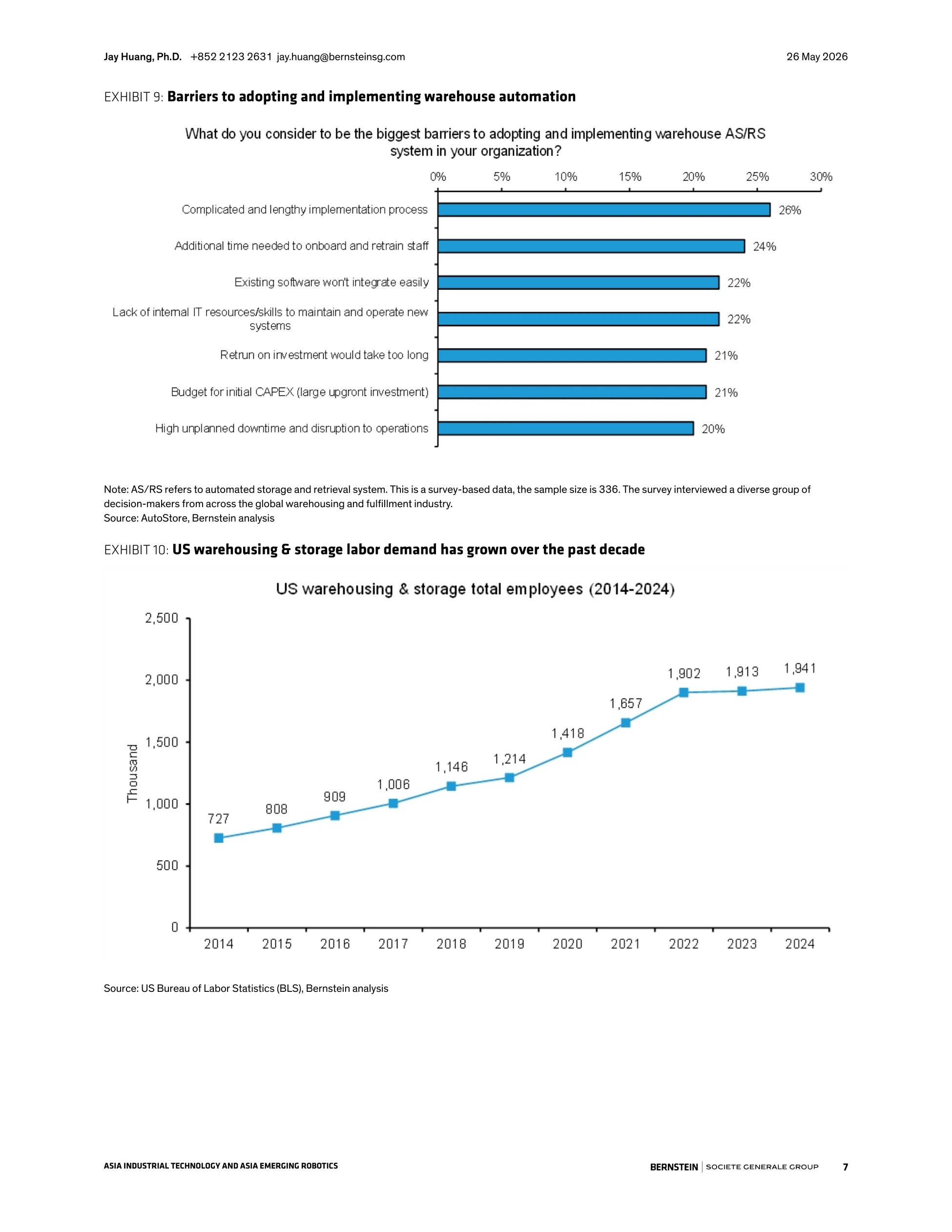
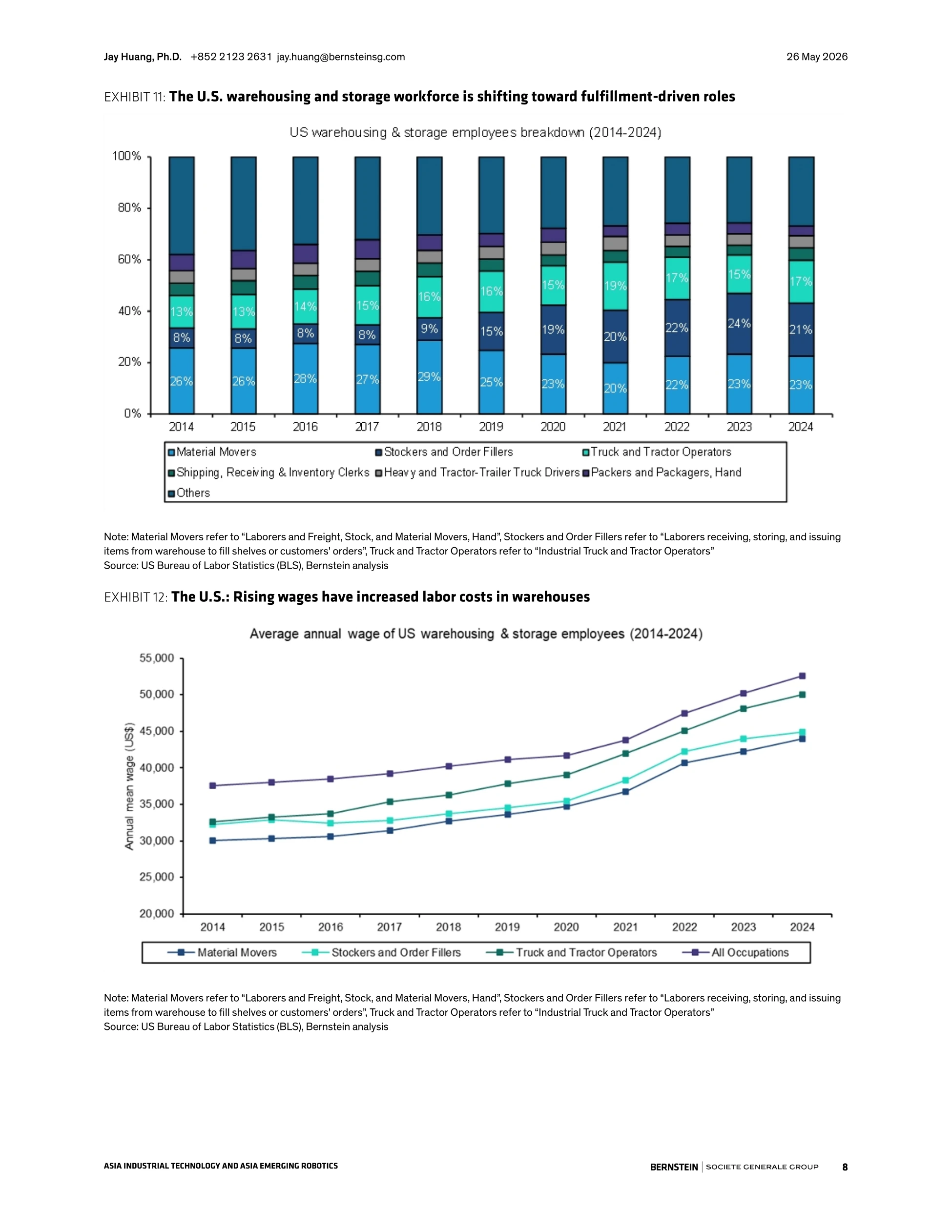
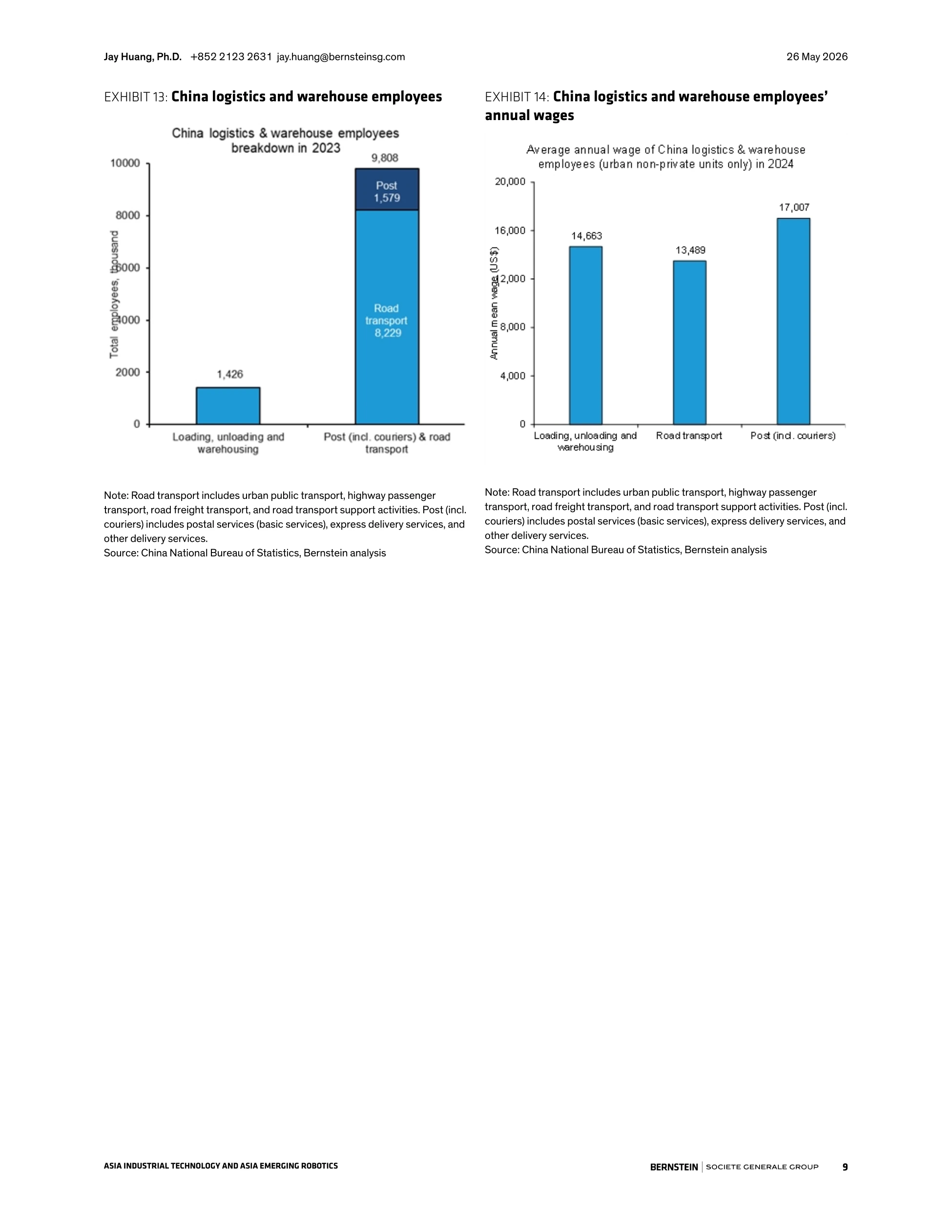
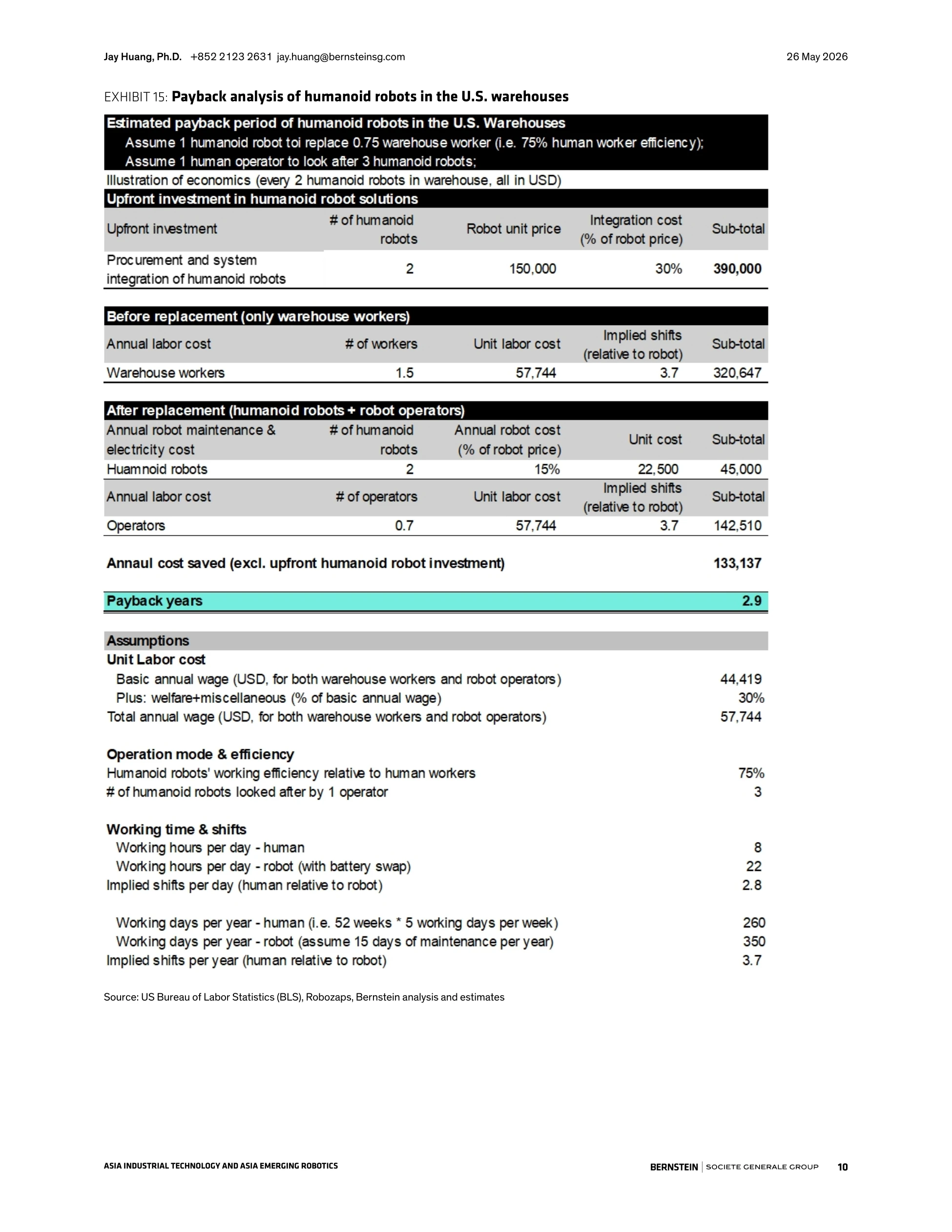
26 May 2026Asia Industrial Technology and Asia Emerging RoboticsHumanoid robots: The road toward attractive ROI in warehousesJay Huang, Ph.D.+852 2123 2631jay.huang@bernsteinsg.comDien Wang, Ph.D.+852 2123 2622dien.wang@bernsteinsg.comRobin Zhu+852 2123 2659robin.zhu@bernsteinsg.comMin-Joo Kang+852 2123 2644minjoo.kang@bernsteinsg.comWeibin Liang, Ph.D.+852 2123 2666weibin.liang@bernsteinsg.comCharles Gou+852 2123 2618charles.gou@bernsteinsg.comHyrum Caesar+81 3 6777 6979hyrum.caesar@bernsteinsg.comInvestors have questioned the lack of practical applications for humanoid robots. Asdiscussed in our previous report (here), we see killer applications emerge. In this note, weshow that the payback period of humanoid robots for warehouse applications is around3 years today and can be shortened to <1 year in both China and the western countriesrelatively soon with volume induced reduction of robot price. This will remove a criticalhurdle for mass adoption.Warehouse is a consensus field of humanoid early adoption. Even as humanoidtechnology remains imperfect and continues to improve, warehouse pilot projects havebeen actively underway (Exhibit 1). More than 20 humanoid players are active in this field(Exhibit 2), focusing on material handling and sorting, with partners, including Amazon,GXO, and SF Express, in e-commerce, logistics, and manufacturers’ warehouses.Why warehouse? We see three key reasons: 1) Humanoid robots cannot yet handlegeneralized tasks in open environments very well. Warehouse tasks (e.g. material handling,pick-and-place, sorting) are less complex than in manufacturing and households, andthe structured environment makes a natural starting point (Exhibit 4 and Exhibit 5). 2) theautomation demand of relatively standardized tasks is abundant in warehouses, making iteasier for successful pilot projects to scale up; and 3) warehousing offers a clear pathwayinto broader logistics (Exhibit 3), especially last-mile delivery, which represents a highlyattractive market.Humanoid robots vs. existing warehouse automation. Warehouse automation has longbeen in demand (Exhibit 7 and Exhibit 8), leading to the deployment of various equipment(Exhibit 6) such as industrial robots, mobile robots (AGVs, AMRs), sorters, conveyors,AS/RS. However, adoption is heterogeneous, and many warehouses still operate atlow automation levels and many workers still remain in even the most automated ones.Humanoid robots offer greater flexibility than conventional solutions to potentially fill inthe automation gaps, especially in loading/unloading, sorting, and packaging.ROI estimate. There are still technological and process hurdles for broader deployment,but cost is no longer a major concern. Given the different labor costs and robot prices(Exhibit 10 to Exhibit 14), we assess China and the U.S. separately (Exhibit 15 to Exhibit20). Based on current industry progress (~75% of human worker efficiency + current robotprices...










































