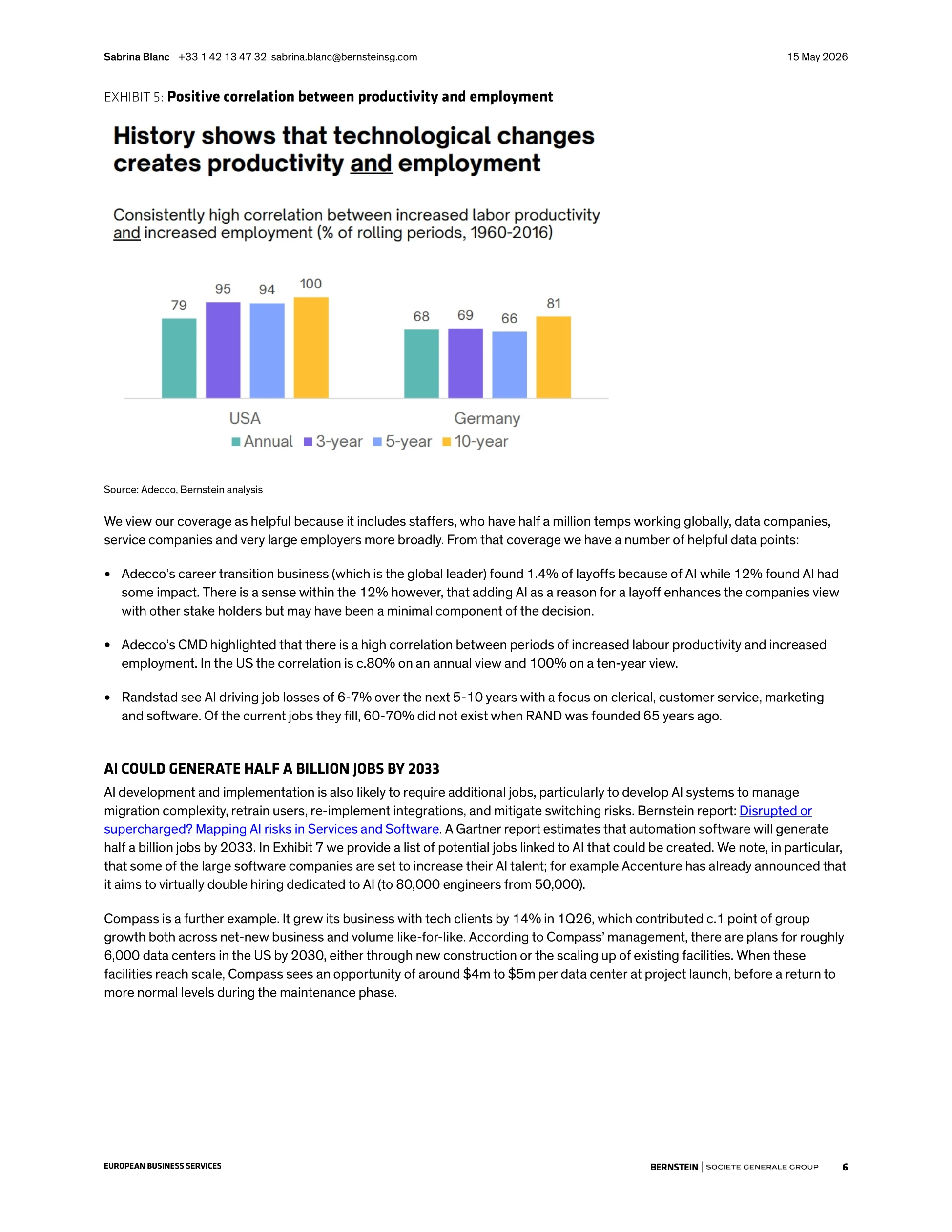
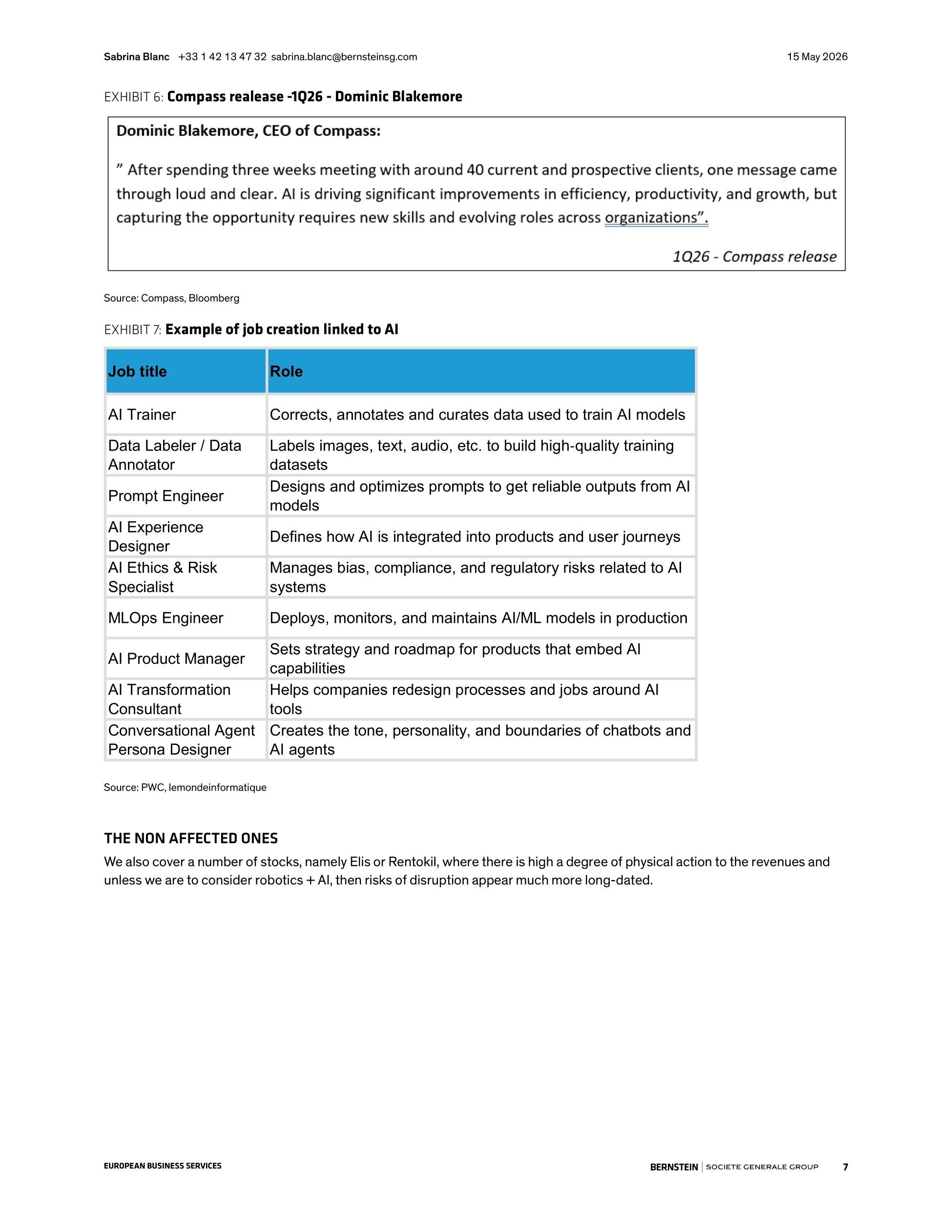
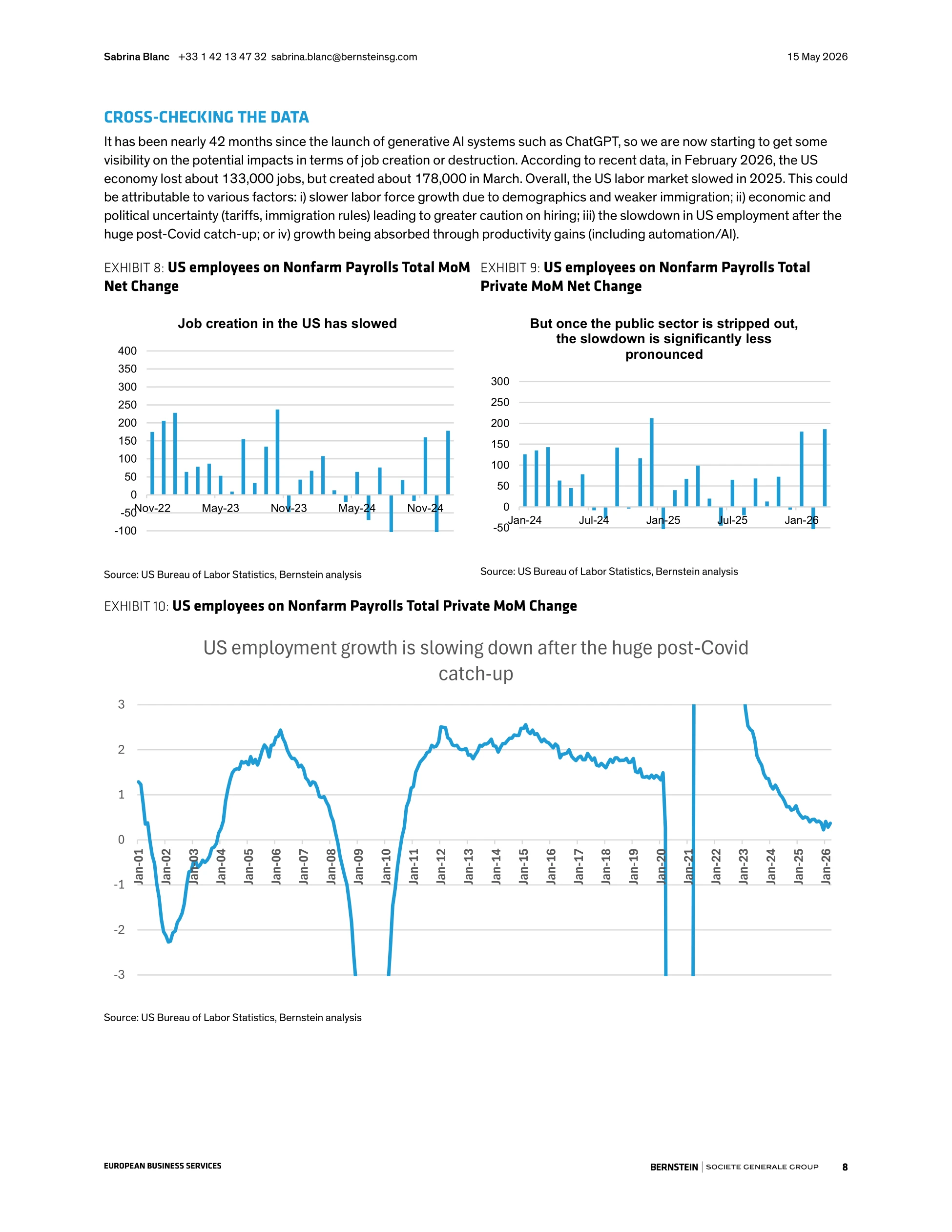
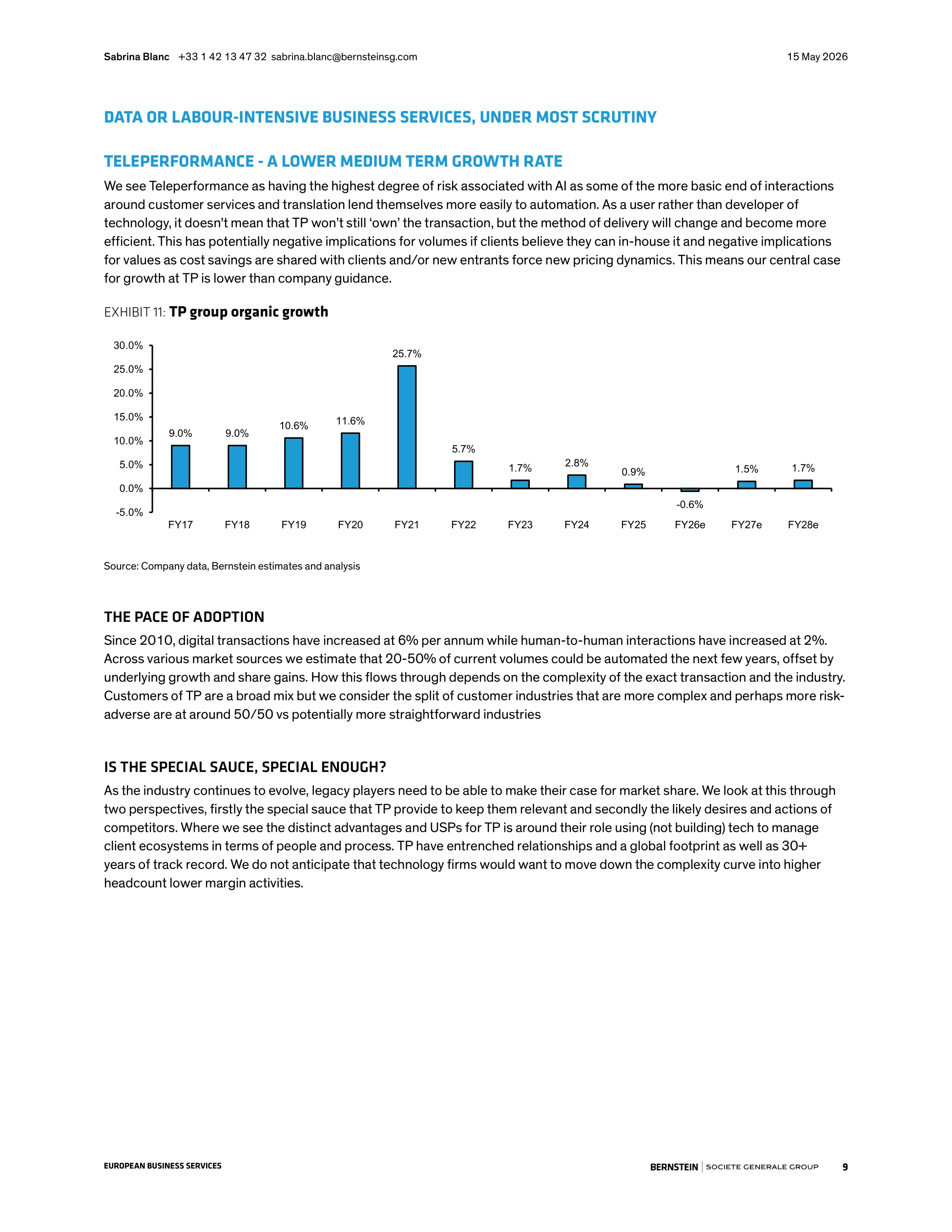
15 May 2026European Business ServicesAI for Business Services: From job fears to productivity on a plateSabrina Blanc+33 1 42 13 47 32sabrina.blanc@bernsteinsg.comWill Kirkness+44 20 7676 8355will.kirkness@bernsteinsg.comFilippo Giardini+44 20 7762 4723filippo.giardini@bernsteinsg.comThis is part of a series of reports on AI disruption. Business services and catering stocks havebeen hard hit by fears of significant job destruction. While we acknowledge the importance ofthe shift induced by AI, we are convinced that its impact will not necessarily be negative for thetwo sectors. A long-term decline in employment seems unlikely, in our view, as we see clearsigns of these companies leveraging AI to increase productivity and efficiency. In this report,we address two key questions: i) What will these two industries look like when AI has been fullyintegrated? ii) How might estimates change to reflect the impact of AI?Market sentiment has cooled recently on AI-exposed names, amid either white-collarjob loss fears at catering or structurally lower barriers to entry for some business servicesnames (EXPN, TEP, staffers). Some argue that job destruction could outpace job creation,particularly for white-collar workers, as AI automates an increasing share of cognitive tasks.This reinforces the view of AI as primarily a major economic disruptor in its own right, ratherthan merely an efficiency tailwind.History suggests reallocation, not collapse. Past technological shocks (electrification,IT, the internet) resulted in reallocation of jobs and lifted employment over the long term,as noted by Adecco. Generative AI could accelerate the automation of certain white-collartasks, and thus render some roles obsolete, but it is also likely to drive demand for newcapabilities, such as development of AI systems to manage migration complexity, retrainusers, re-implement integrations, and mitigate switching risks. Disrupted or supercharged?Mapping AI risks in Services and Software. McKinsey’s 2030 scenario projects that c.30% ofwork hours will be automated across Europe and the US, reducing headcount in canteens andrestaurants (non-cooking roles) and in back-offices, which are core exposures in the Business& Industry segment, while boosting demand in healthcare and STEM fields.In European business services we differ from consensus opinions on key stocks: 1) forExperian (U), AI is a contributory factor to our lower medium term organic growth estimates,2) likewise at TP (OP) we see lower organic growth vs medium term expectations as higherautomated volumes = lower price, 3) for staffers, we are more optimistic than consensus,we think the incumbents are primed to deliver efficiencies from AI tooling and the nature ofrevenues - blue collar temp focused placements - are well-placed.We estimate that for catering operators, AI-linked operational gains couldultimately offset most of the demand risk...










































