

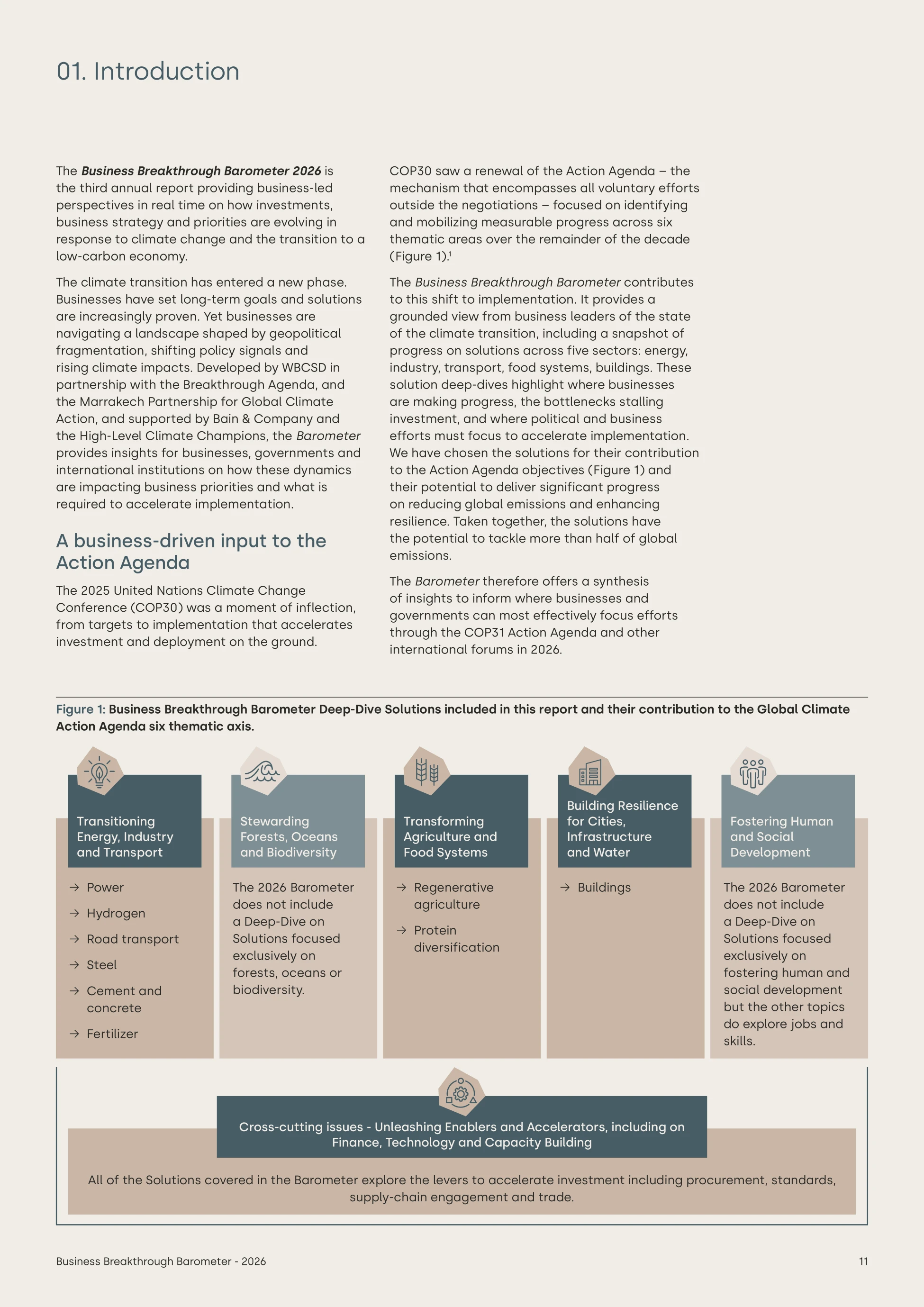
In partnership withSupported by → The annual pulse check from business on the pace of the climate transition Business BreakthroughBarometer 2026Business Breakthrough Barometer - 20262Business Group participants and reviewers3Business Breakthrough Barometer - 2026WBCSD Global Network PartnersCollaborating organizations & experts5Business Breakthrough Barometer - 2026ExecutiveSummary 0801.ContentsIntroduction 10Forewords 06Solution Deep Dives 36Global BusinessSentiment 13Methodology and Glossary 12304.03.05.02.COP Action Agenda Axis 1: Transitioning Energy, Industry and Transport 37 Power 38Hydrogen 49Road transport 60Steel 70Cement and concrete 79Fertilizer 87COP Action Agenda Axis 3: Transforming Agriculture & Food Systems 98 Regenerative Agriculture 99Protein Diversification 106COP Action Agenda Axis 4: Building Resilience for Cities 113Buildings 114Section 1: Sustainability strategies are a source of resilience and competitiveness 14Section 2: Growing risks of a disorderly transition 20Section 3: Businesses urge predictable policy strengthening 25Section 4: What the Barometer insights mean for accelerated implementation 33References 35Methodology | Overview 124Glossary 1256Business Breakthrough Barometer - 2026ForewordsIs sustainability over? It’s a question I’ve been asked repeatedly over the past year, as economic pressure, geopolitical uncertainty and competing business priorities intensify. My answer is always the same, ‘no,’ but with the caveat that sustainability is changing.The Business Breakthrough Barometer 2026 shows that the era of sustainability driven primarily by ambition is coming to an end. What is emerging is a new, more durable phase, where sustainability is increasingly paying its way as a source of resilience and competitiveness.Almost all business leaders expect sustainability to deliver competitive advantage over the next decade. The vast majority continue to maintain or increase their investments. Companies are scaling solutions including clean energy, electrification, circularity and regenerative agriculture because they can deliver lower costs, secure supply-chains and improve business resilience. Yet even as these solutions prove their worth, businesses are facing a growing storm of increasing climate costs, supply chain shocks and policy reversals. Signals of a disorderly transition are intensifying, with concerns that without stronger coordination and consistent signals from governments and policymakers, these pressures will only intensify, resulting in higher costs for businesses and consumers. This is why the message from businesses from this year’s Barometer is clear: strengthening policy and action now is preferable to delaying the harder choices.We need a renewed long-term focus, and work collectively, recognizing that sustainability is a core driver of competitive advantage, of growth opportunities and improving our future resilience. This is where the ...










































