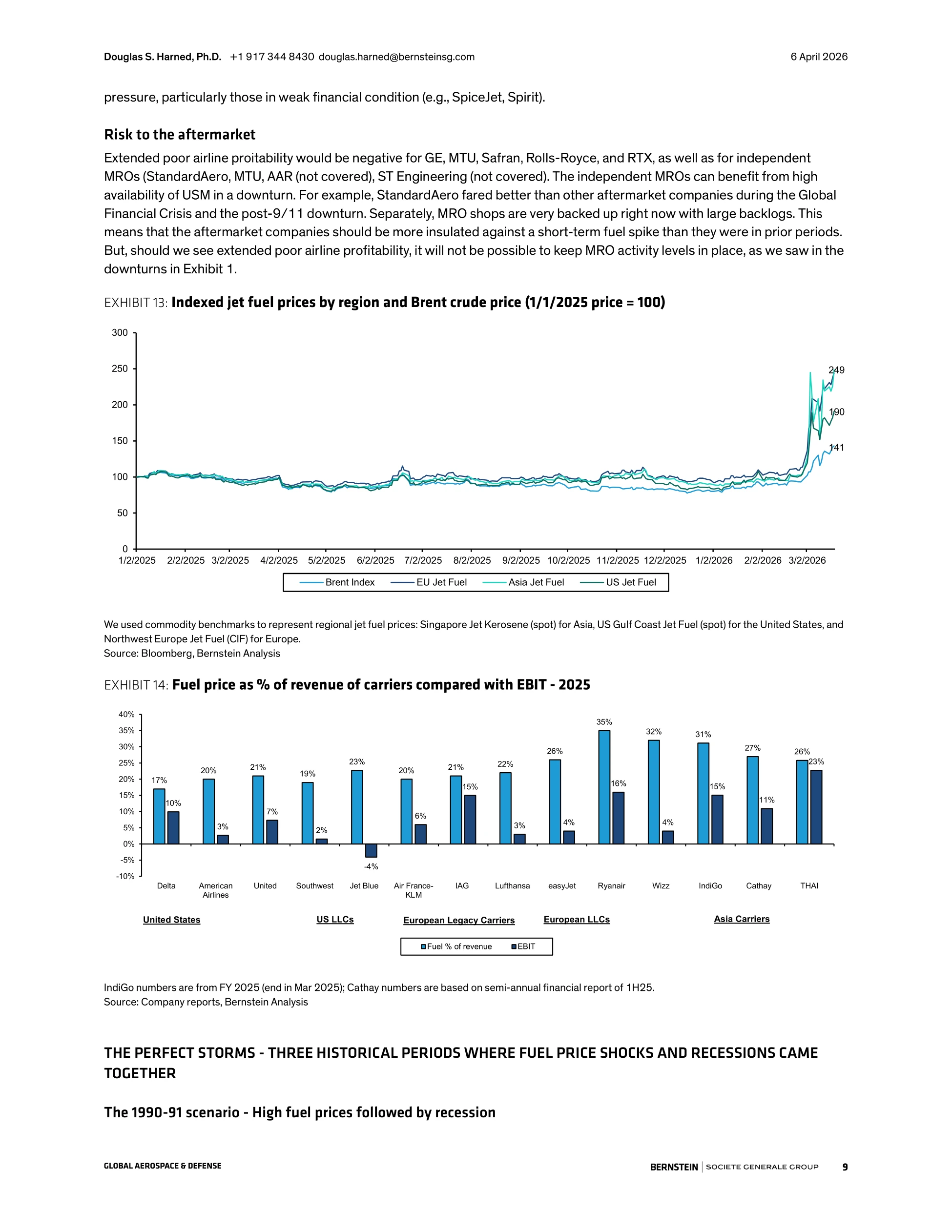
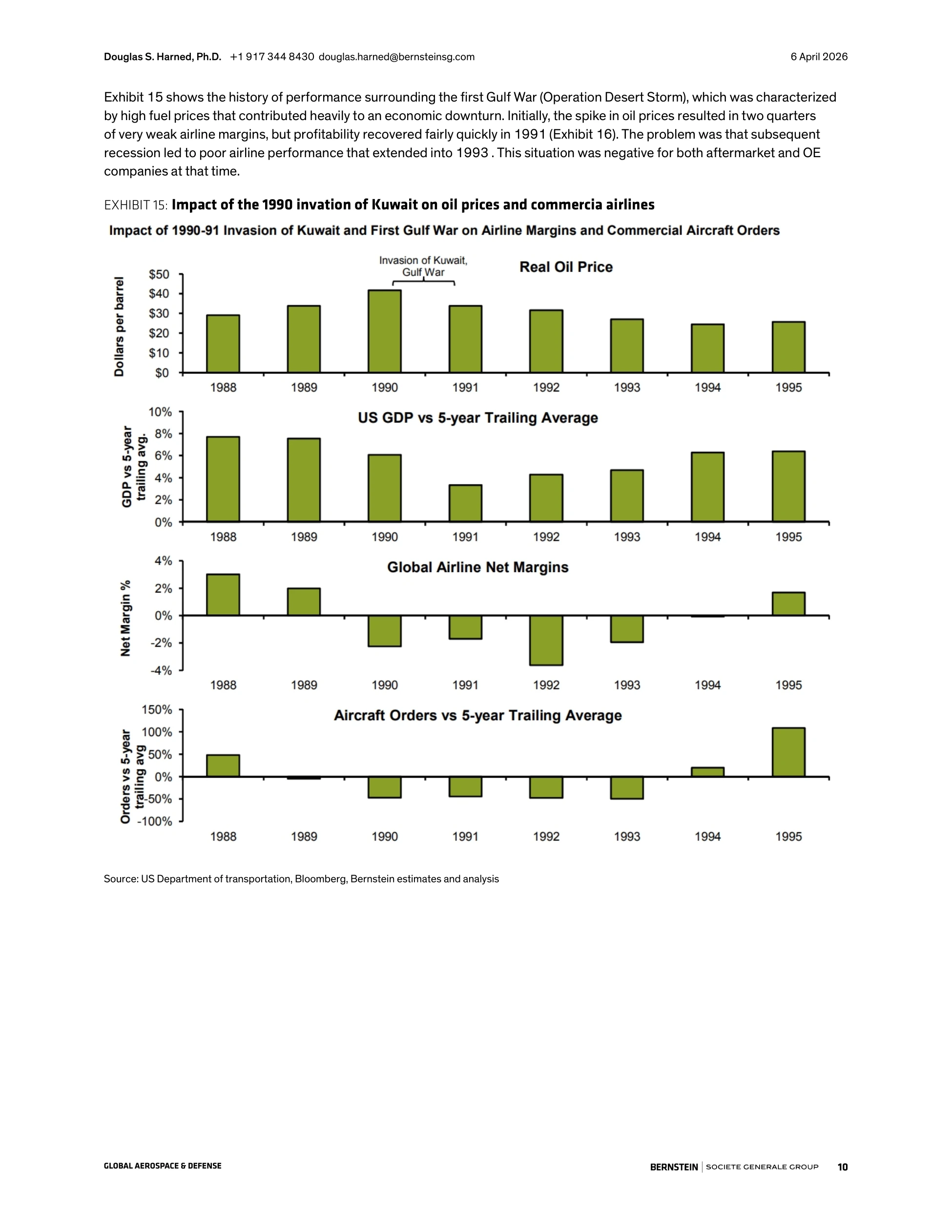
6 April 2026Global Aerospace & DefenseCommercial Aircraft: Fuel price driven downturn? Will perfectstorms of the past reappear and kill the market? What to watchDouglas S. Harned, Ph.D.+1 917 344 8430douglas.harned@bernsteinsg.comAdrien Rabier+44 20 7676 6820adrien.rabier@bernsteinsg.comJennifer Ma+1 917 344 8408jennifer.ma@bernsteinsg.comCyriaque Blanchet+44 20 7676 7342cyriaque.blanchet@bernsteinsg.comSpecialist SalesSteve Song+1 917 344 8401steve.song@bernsteinsg.comJames Brady+44 20 7762 5272james.brady@bernsteinsg.comWe have not seen a fuel price driven downturn in commercial aircraft in over 30years. But, that is now a possibility. It all comes down to global airline profits, which linktightly to global GDP trends - i.e., not just fuel prices. Past history shows three periods whensuch a scenario did happen (1990-91, 1974-75, 1979-80), with very negative impact. Adifference today is that we would only expect the impact to be on aftermarket and not OEperformance. With extraordinarily high backlogs, Airbus and Boeing deliveries should beunaffected. The greatest fear is that we repeat those old scenarios: perfect storm ofhigh fuel prices and global recession.The war in Iran has provided a shock to the commercial aircraft industry at a timewhen all segments were booming. There appeared to be no negative catalysts on thehorizon. We have now seen a sharp drop in Middle East traffic and sharp rise in jet fuelprices. March traffic in the Middle East fell by 56%. But, global traffic in March was downjust 1%. April schedules suggest recovery outside the Middle East, so that this impactshould be limited, particularly if Middle East traffic recovers later in the year.The leading concern is soaring fuel prices, with jet fuel now more than double its2025 average. High fuel prices become a problem when airlines cannot pass throughcosts to customers through higher fares. LCCs in Asia and Europe appear most exposed.This is why the GDP outlook is critical. If fuel prices rise because of high demand (e.g.,2006-8, 2011-12), it is possible to pass through the costs. Even a supply shock (e.g.,Russia invasion of Ukraine) can be offset by strong economic growth.The keys to watch here are GDP trends, along with fuel prices, combined into airlineprofitability. Remember, this is global, with Asia-Pacific profits particularly important.When airlines are cash strapped, they cut MRO spend and attempt to push back newdeliveries. With high fuel prices, MRO spend is cut by parking older aircraft - especiallythose in need of near-term overhauls (low engine green time). This can affect shop visitswithin six months, although backlogs are currently so high, that shop visit schedulesshould be better insulated (potentially 12 months). On new deliveries, there should belittle effect, given the extreme supply/demand imbalance.With Strait of Hormuz closure, jet fuel prices are currently highe...










































