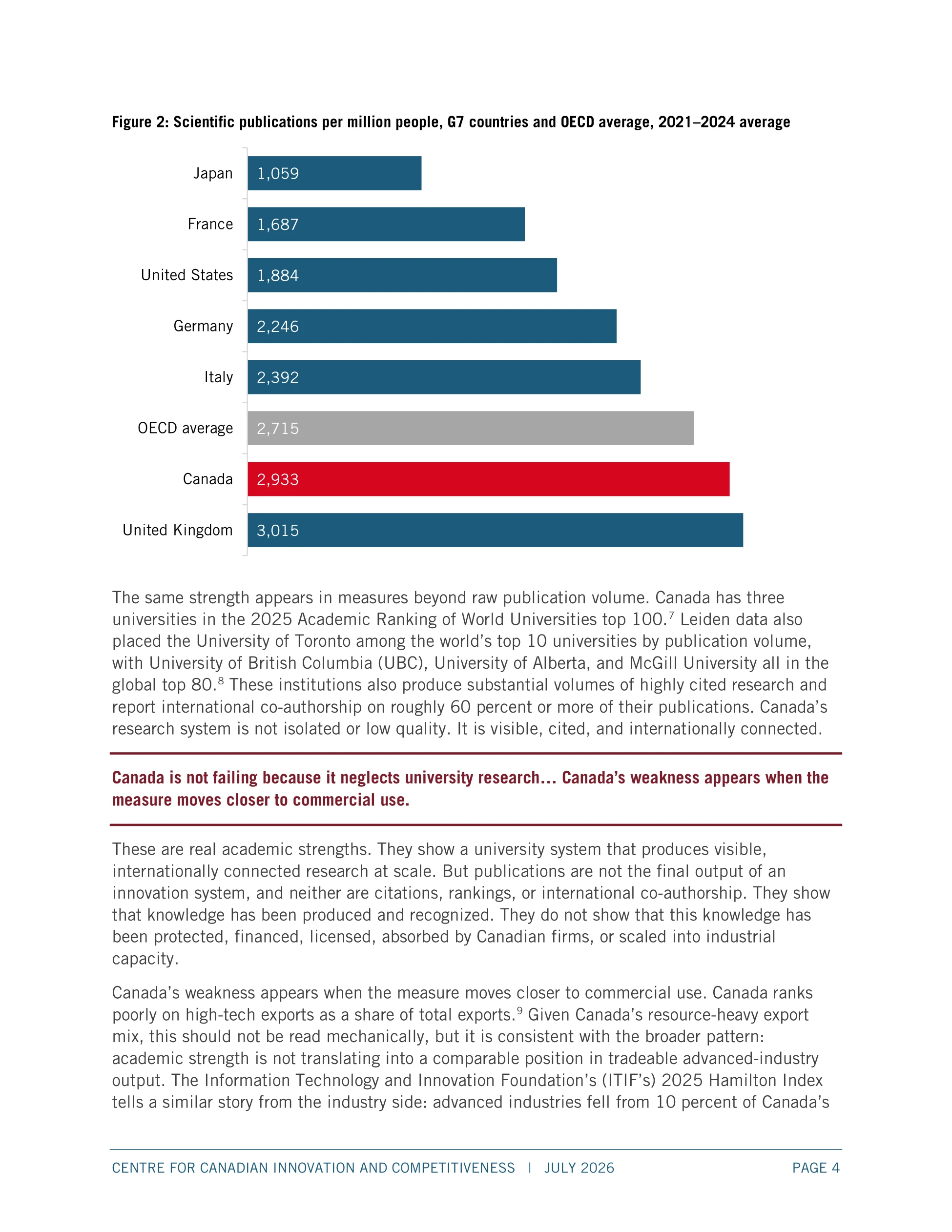

innovationpolicy.ca Paying for Outcomes: Tying University Funding to Commercial Results LAWRENCE ZHANG | JULY 2026 Canada funds university research but gives universities too little reason to turn that into Canadian firms, patents, and industrial capacity. To better align their incentives with national goals, funding should flow in part on standardized commercialization outcomes, with universities left to decide how to deliver them. KEY TAKEAWAYS Canada performs strongly on university research but weakly on converting that research into firms and output. The university commercialization problem is mainly an incentives problem, not a research quality problem. Universities are funded on inputs, so commercialization remains peripheral. Canadian universities produce strong research, but it is often not aligned with national needs and the system does not push them to connect that work to areas where Canada has, or is trying to build, industrial capacity. The right policy lever is to tie a meaningful share of public funding for research-intensive universities to commercialization outcomes rather than layering on more marginal programs. Governments should not prescribe IP ownership models or internal university structures. They should set outcomes and let institutions choose how to meet them. The federal government should require universities receiving federal research funding to publicly publish their own institutional-level commercialization data with standardized definitions. CENTRE FOR CANADIAN INNOVATION AND COMPETITIVENESS | JULY 2026 PAGE 2 CONTENTS Key Takeaways ................................................................................................................... 1 Introduction ....................................................................................................................... 2 The Commercialization Gap ................................................................................................. 3 How Universities are Currently Funded ................................................................................. 7 The Limits of IP Reform .................................................................................................... 10 Setting Outcomes Without Dictating Operating Models ......................................................... 11 Standardized Reporting..................................................................................................... 13 Provincial Funding as the Main Lever ................................................................................. 14 International Comparisons ................................................................................................. 15 Objections ....................................................................................................................... 16 Recommendations ............................................................................................................ 18 Conclusion ...................................................