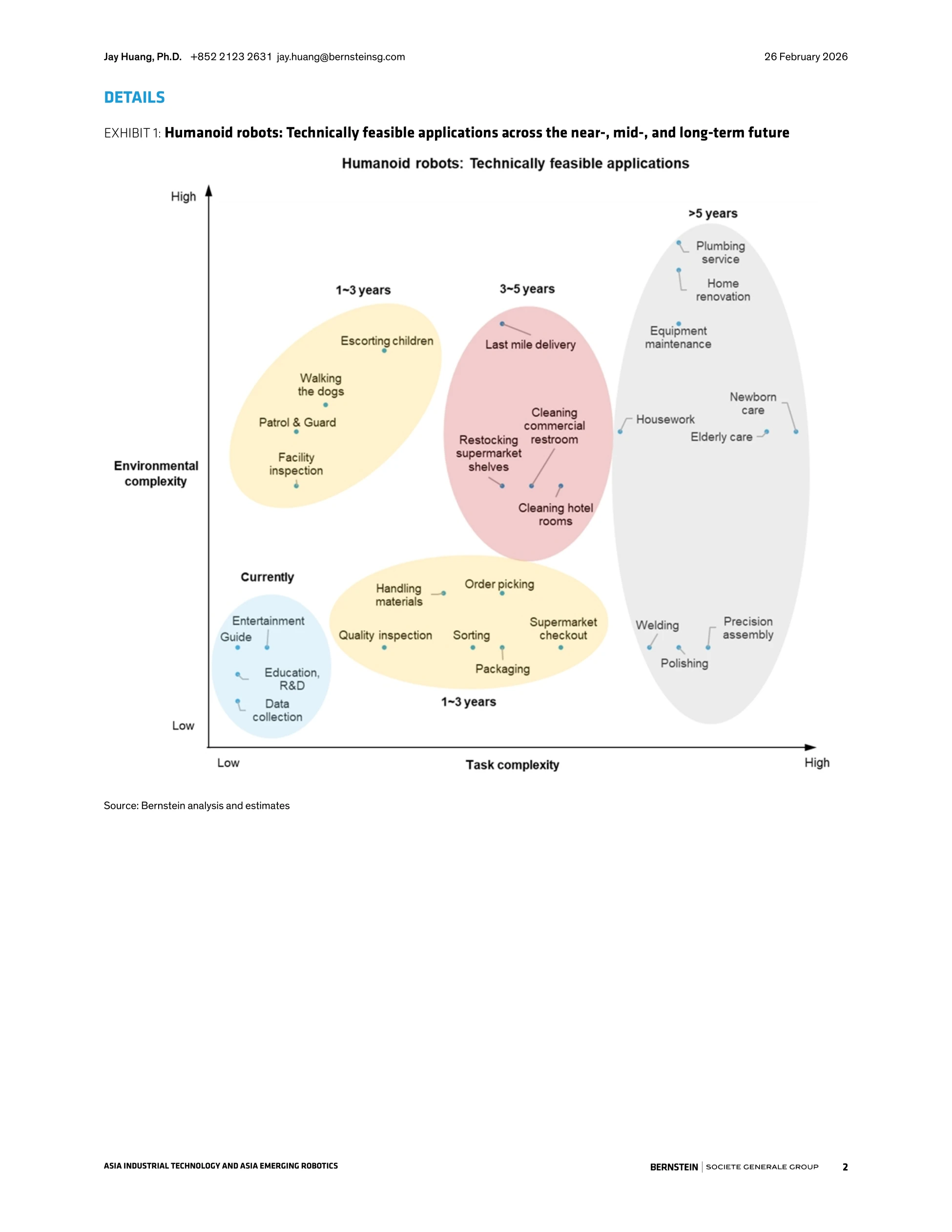
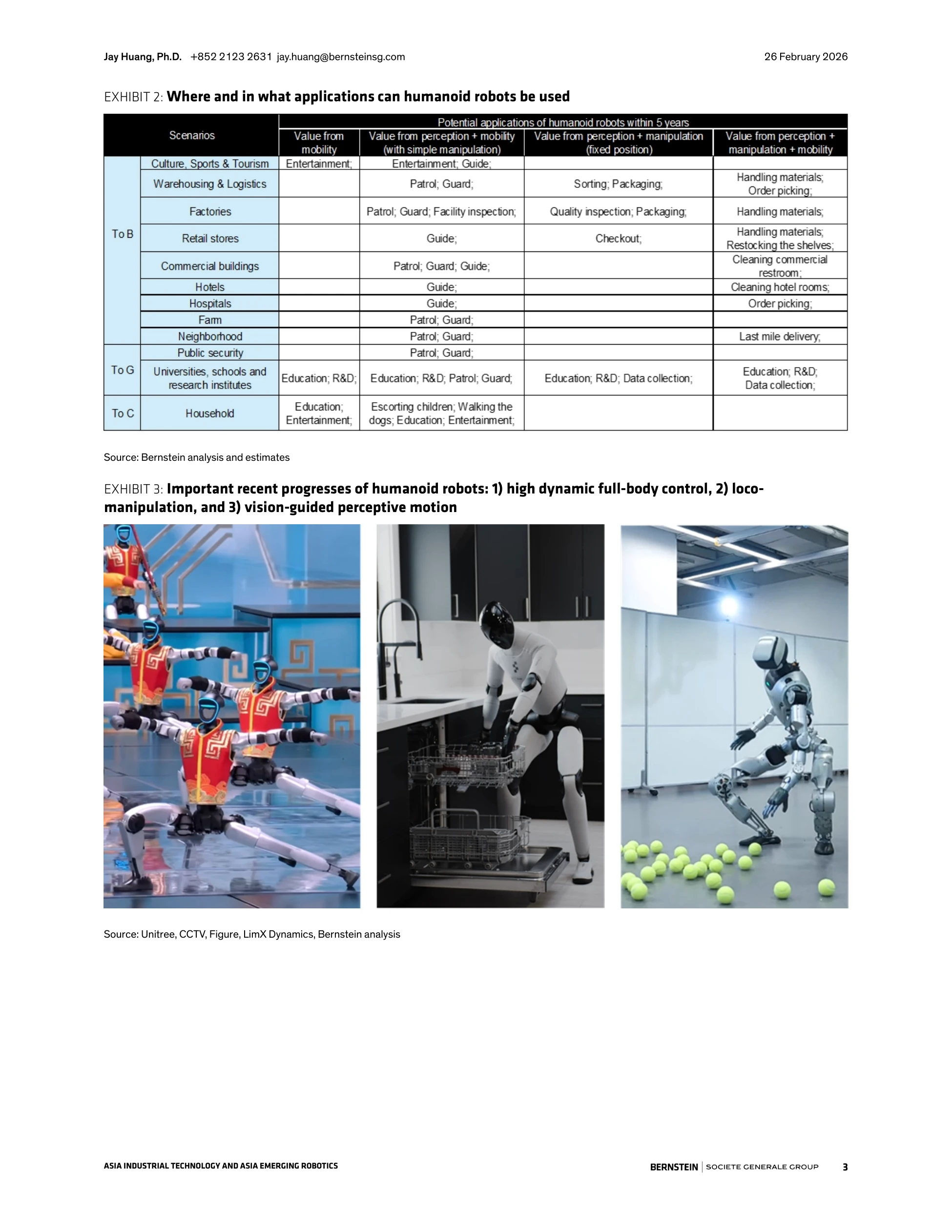
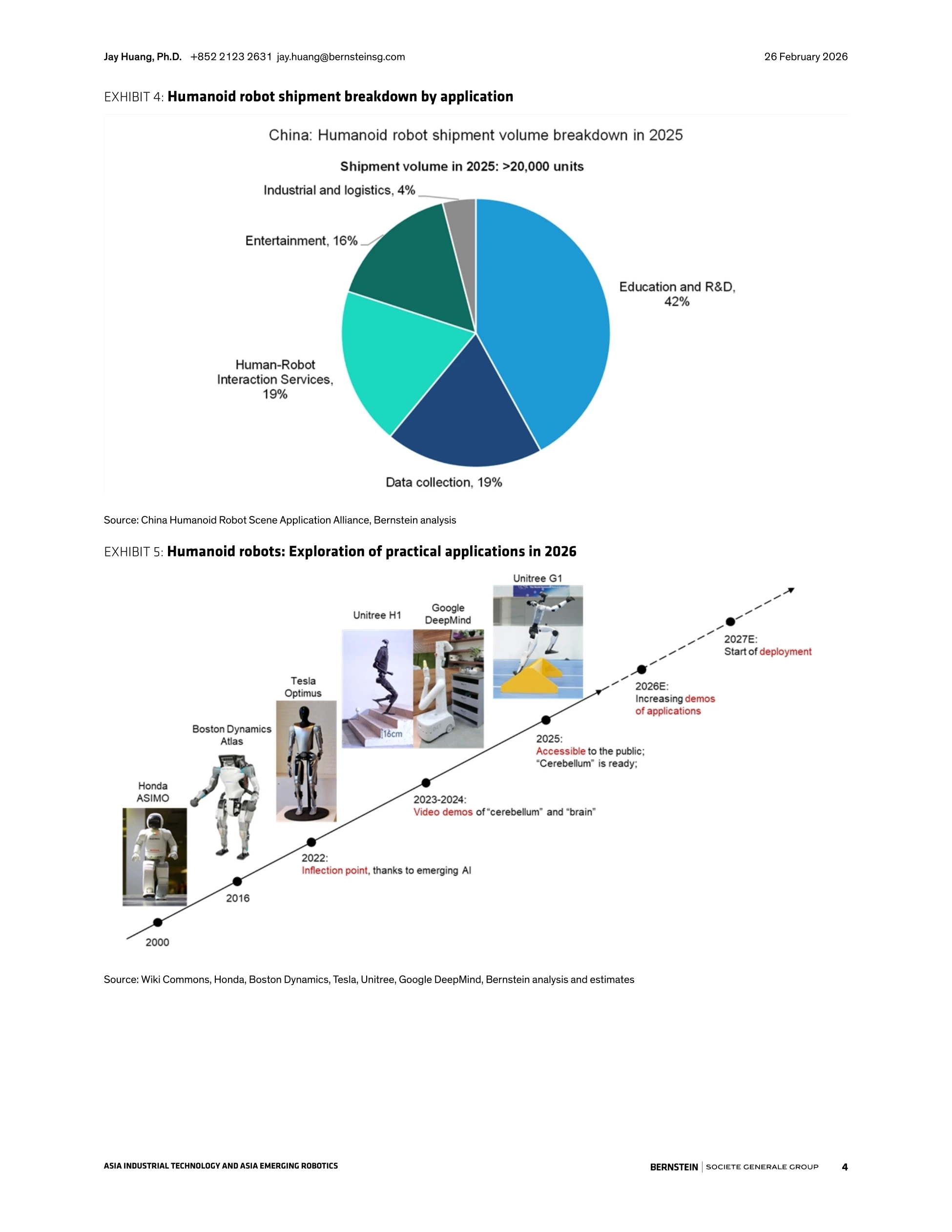
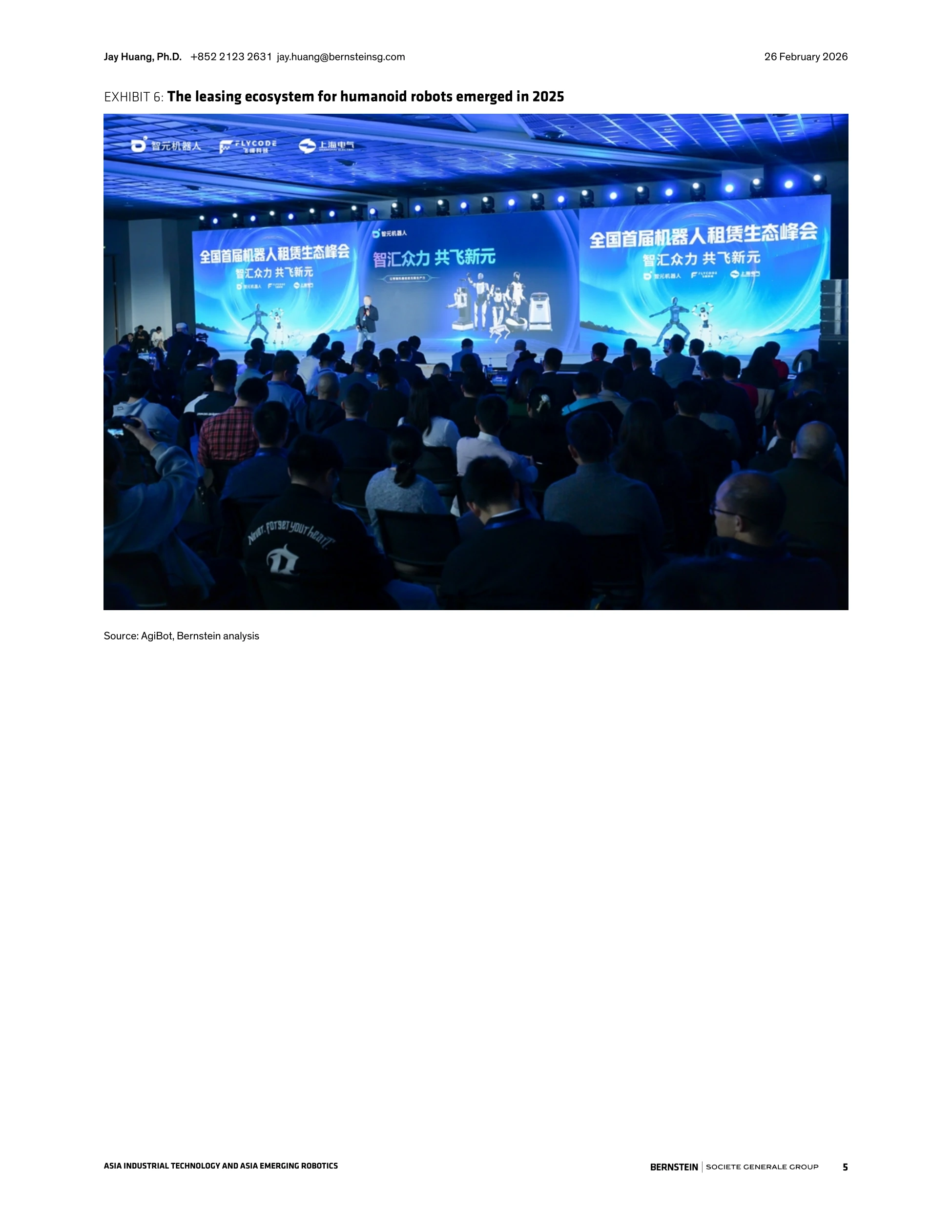
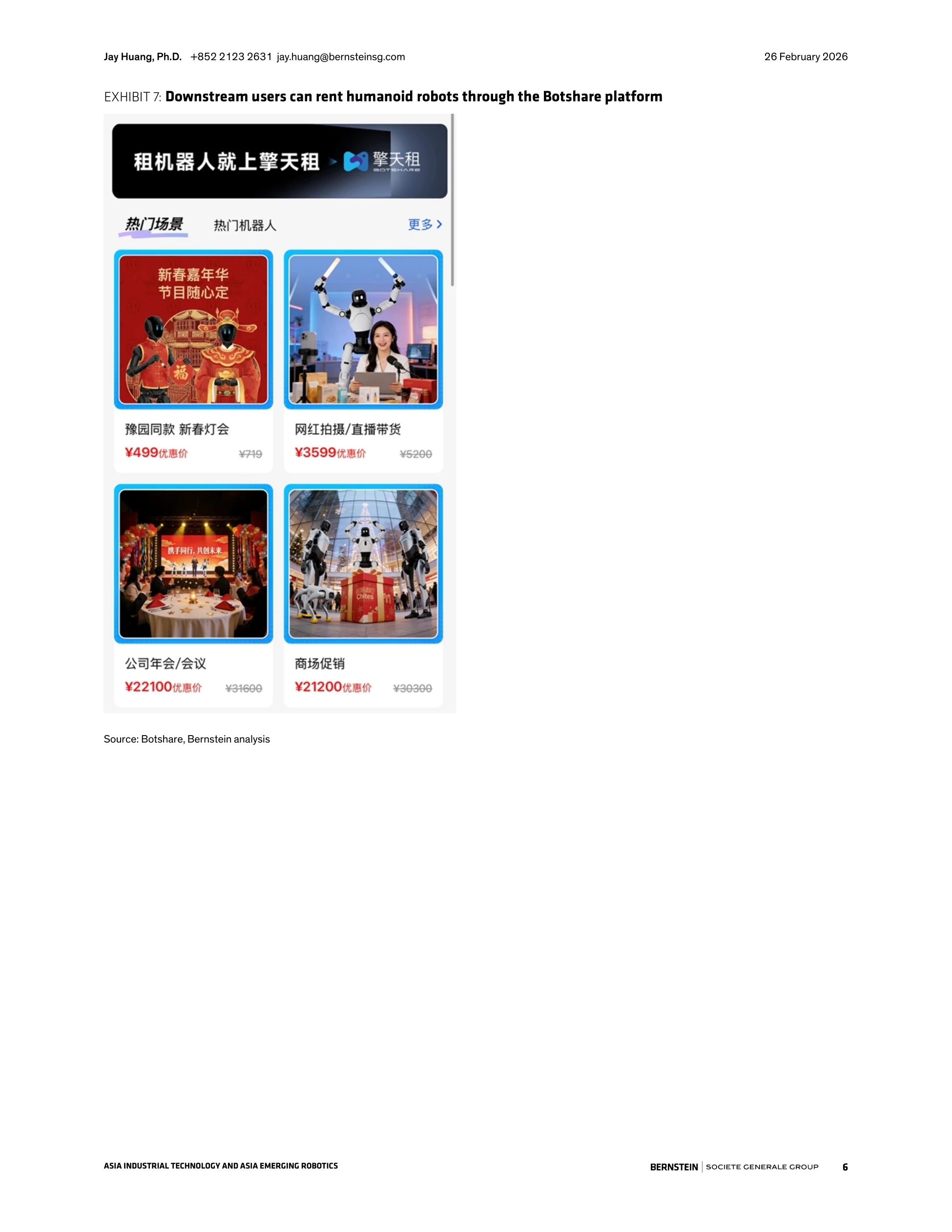
26 February 2026Asia Industrial Technology and Asia Emerging RoboticsHumanoid Robotics: The path to 1 million annual shipmentJay Huang, Ph.D.+852 2123 2631jay.huang@bernsteinsg.comDien Wang, Ph.D.+852 2123 2622dien.wang@bernsteinsg.comWeibin Liang, Ph.D.+852 2123 2666weibin.liang@bernsteinsg.comHumanoid robot performance continues to impress (Asia Emerging Robotics: Key surprisesfrom the 2026 Spring Festival Gala), but investors also continue to challenge its actualuse and path to commercialization. We see 2025-2026 as an exciting milestone, whenhumanoid robot killer applications start to emerge.A solid foundation of commercialization is the development of VLA and perfection oflocomotion. Important progresses in 2025 included: (1) high dynamic full-body controlby bridging motion tracking and sim-to-real, (2) from locomotion to loco-manipulation(see here), and (3) vision-guided perceptive motion, liberating robots from pre-definedmotion sequences (Exhibit 3). On the commercial side, humanoid robots have becomemore accessible to the public (Exhibit 4 and Exhibit 5). For example, a leasing ecosystemfor humanoid robots begun to emerge (Exhibit 6 and Exhibit 7). This allows more users toactively explore commercial potential on their own.The missing layer in the humanoid ecosystem. For industrial robots, dedicatedsystem integrators link robot suppliers with end-users by delivering turnkey solutions.For humanoid robots, a similar layer is needed for application development, training, anddeployment, but remains largely missing (Exhibit 8). We expect this layer to soon emergeand drive scalable commercialization.Technically feasible applications in five years. Humanoid robot applications can besegmented by task complexity and environmental complexity (Exhibit 1). Performing simpletasks in controlled environments (e.g., entertainment, R&D, education) is the low‑hangingfruit already commercialized. In this framework, in the next 1–3 years, we expect newapplications in two distinct directions: (1) “forward”, to higher task complexity while theenvironment remains controlled, such as material handling in factories and warehouses and(2) “upward”, to higher environmental complexity and low task complexity, such as patroland facility inspection. In 3–5 years, we hope to see the coupling of the two directions andnew applications such as hotel room servicing and last mile delivery. These applicationsshow good potential across a broad set of scenarios (Exhibit 2).Killer applications and TAM benchmarks. We identify three groups of applicationsthat can be technically ready in the near term and scaled up rapidly by system integrators(Exhibit 9): 1) Value from robotic mobility (e.g., entertainment, education, R&D). A usefulbenchmark is Apple’s Vision Pro (annual shipments ~400k units), with overlapping usescenarios. 2) Value from mobility + perception (e.g., patrol, guard, facility inspection).Security service w...










































