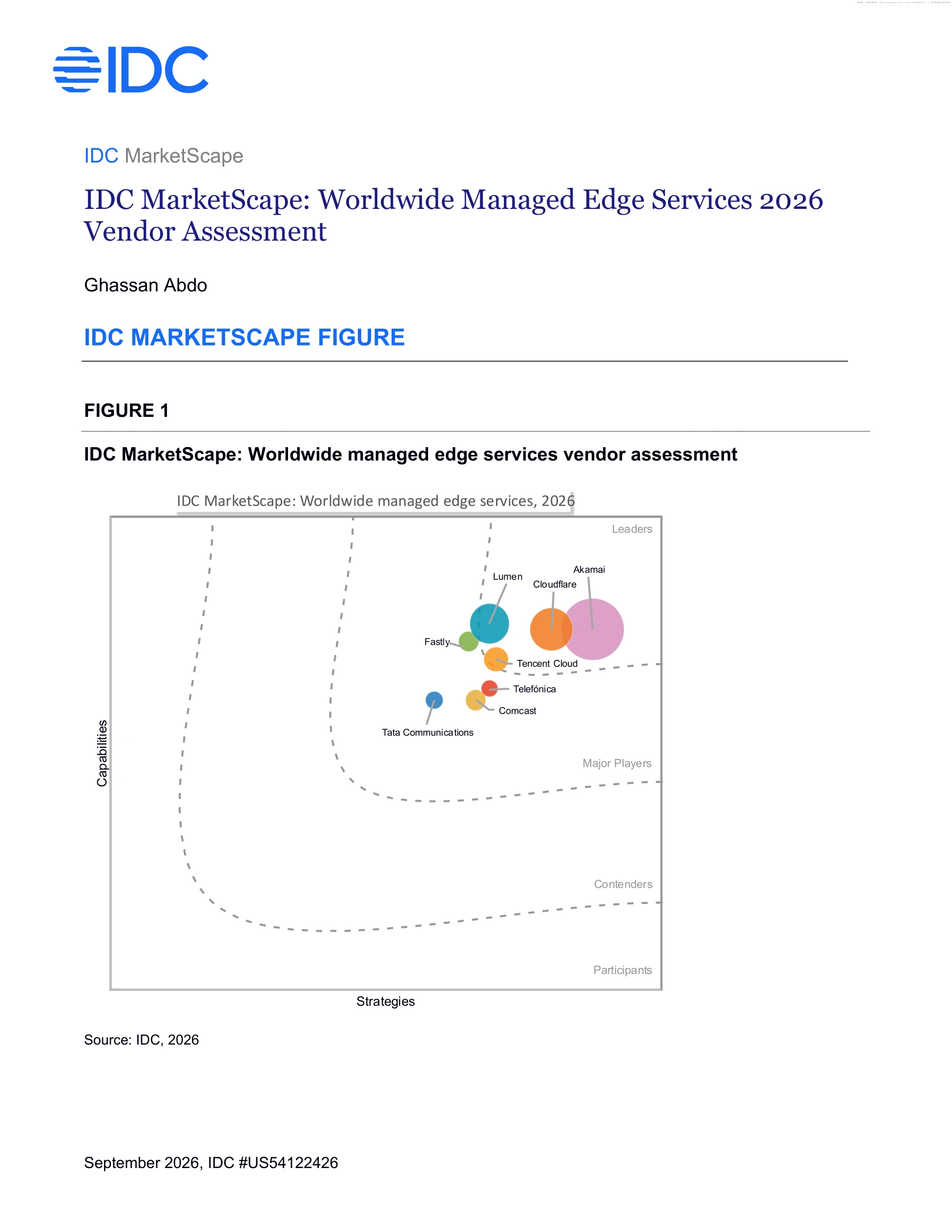

来源:发现报告(www.fxbaogao.com/view?id=5698743)| 引用请注明出处 September 2026, IDC #US54122426 IDC MarketScape IDC MarketScape: Worldwide Managed Edge Services 2026 Vendor Assessment Ghassan Abdo IDC MARKETSCAPE FIGURE FIGURE 1 IDC MarketScape: Worldwide managed edge services vendor assessment Source: IDC, 2026 来源:发现报告(www.fxbaogao.com/view?id=5698743)| 引用请注明出处©2026 IDC #US54122426 2 Please see the Appendix for detailed methodology, market definition, and scoring criteria. IDC OPINION This study utilizes the IDC MarketScape methodology to evaluate eight global service providers offering managed edge services. The managed edge services market is undergoing a structural transformation driven by three converging forces: the emergence of AI inference workloads that demand low-latency and high-performance distributed compute infrastructure, the growing enterprise and regulatory pressure for data sovereignty and geographic control over where workloads execute, and the rising cost and complexity of centralized public cloud architectures, which are pushing enterprises to reexamine where compute, storage, and application logic should reside. Together, these forces are elevating managed edge services from a performance optimization tool into a core strategic infrastructure decision for distributed enterprises across every major vertical. Key takeaways from this study include: ▪ The managed edge market has entered its AI-defined phase. Content delivery performance and network proximity — the traditional value propositions of managed edge — are now baseline expectations rather than differentiators. The competitive frontier has shifted to AI inference at the edge, where vendors are being evaluated on GPU availability, model deployment tooling, inference latency, and the ability to reduce token costs versus centralized cloud AI services. ▪ No single vendor architecture dominates across all use cases. This IDC MarketScape reflects a market served by three structurally distinct vendor types — content delivery network (CDN), telco, and cloud providers — each with genuine structural advantages in specific deployment contexts. CDN providers offer superior global scale, developer programmability, and security-plus-delivery convergence. Telco providers offer network-integrated latency, mobility-aware orchestration, and single-vendor connectivity-plus-compute accountability. Cloud providers offer unified public cloud and edge compute under a single control plane optimized for regulated and sovereign workloads. ▪ AI inference economics are reshaping the build-versus-buy calculus for distributed enterprises. The cost of running high-volume AI inference workloads on centralized public cloud infrastructure is driving a meaningful shift of inference compute to edge and on-premises environments. Managed edge vendors that can demonstrate documented cost reduction versus centralized cloud inference — ...