
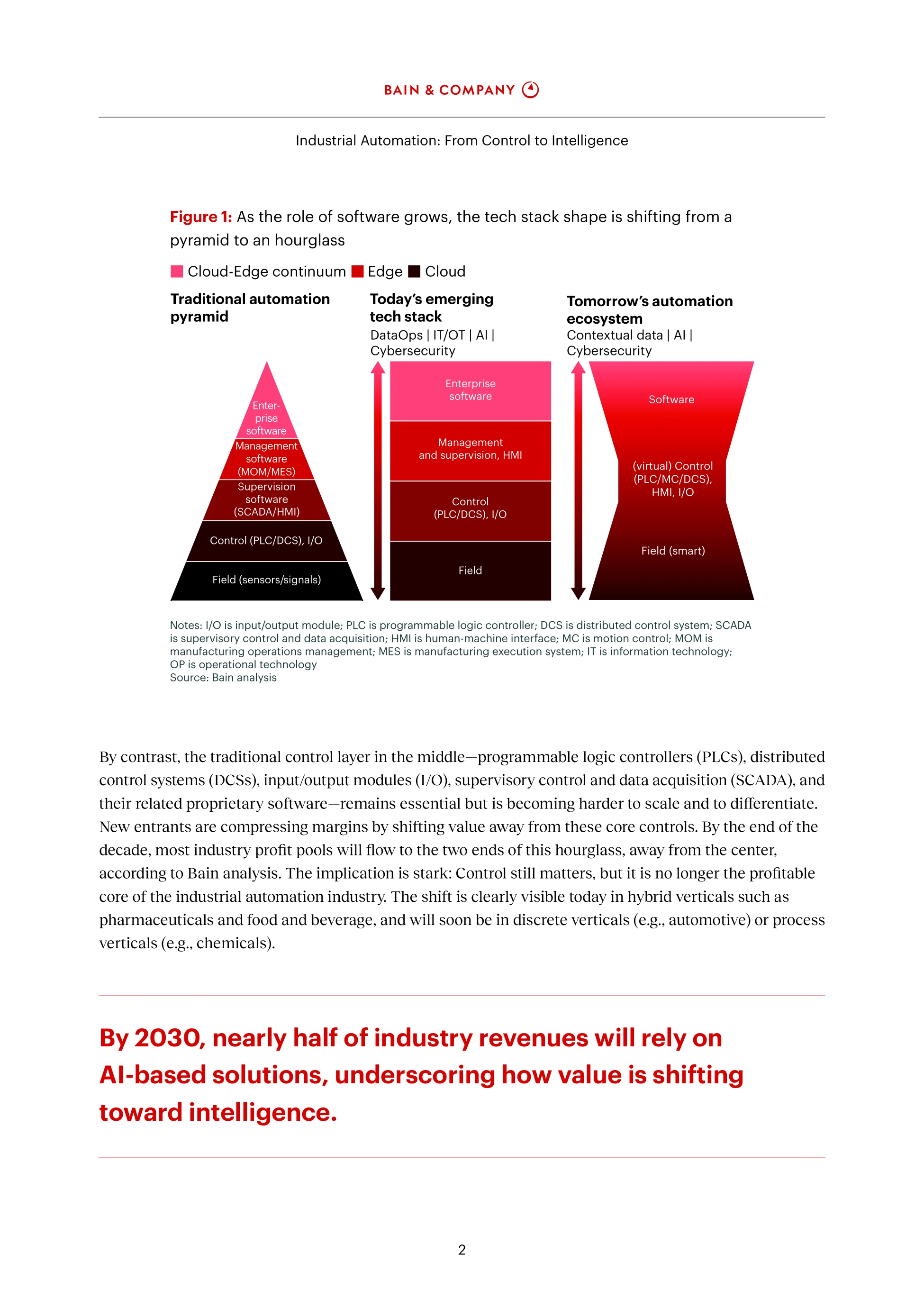
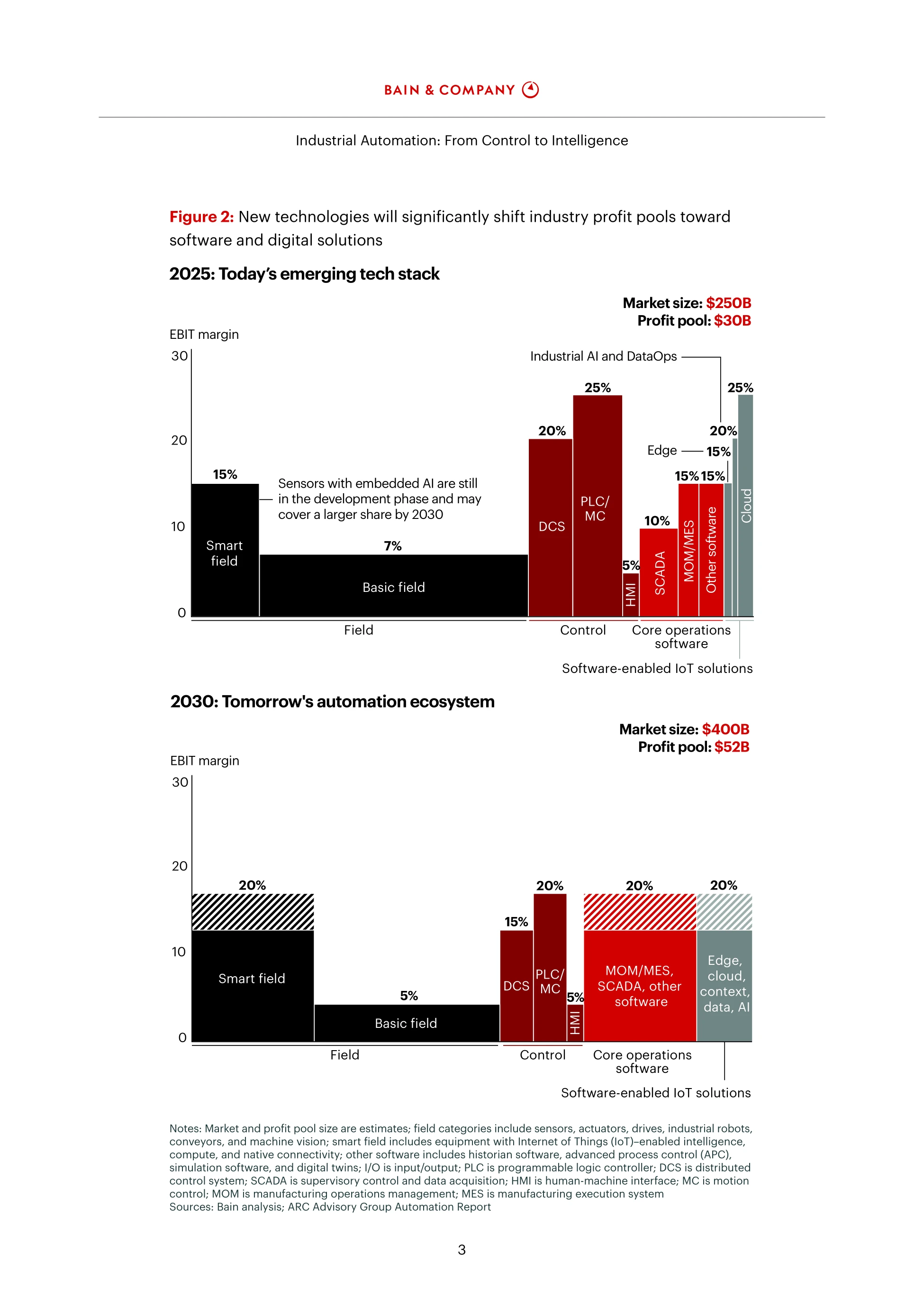
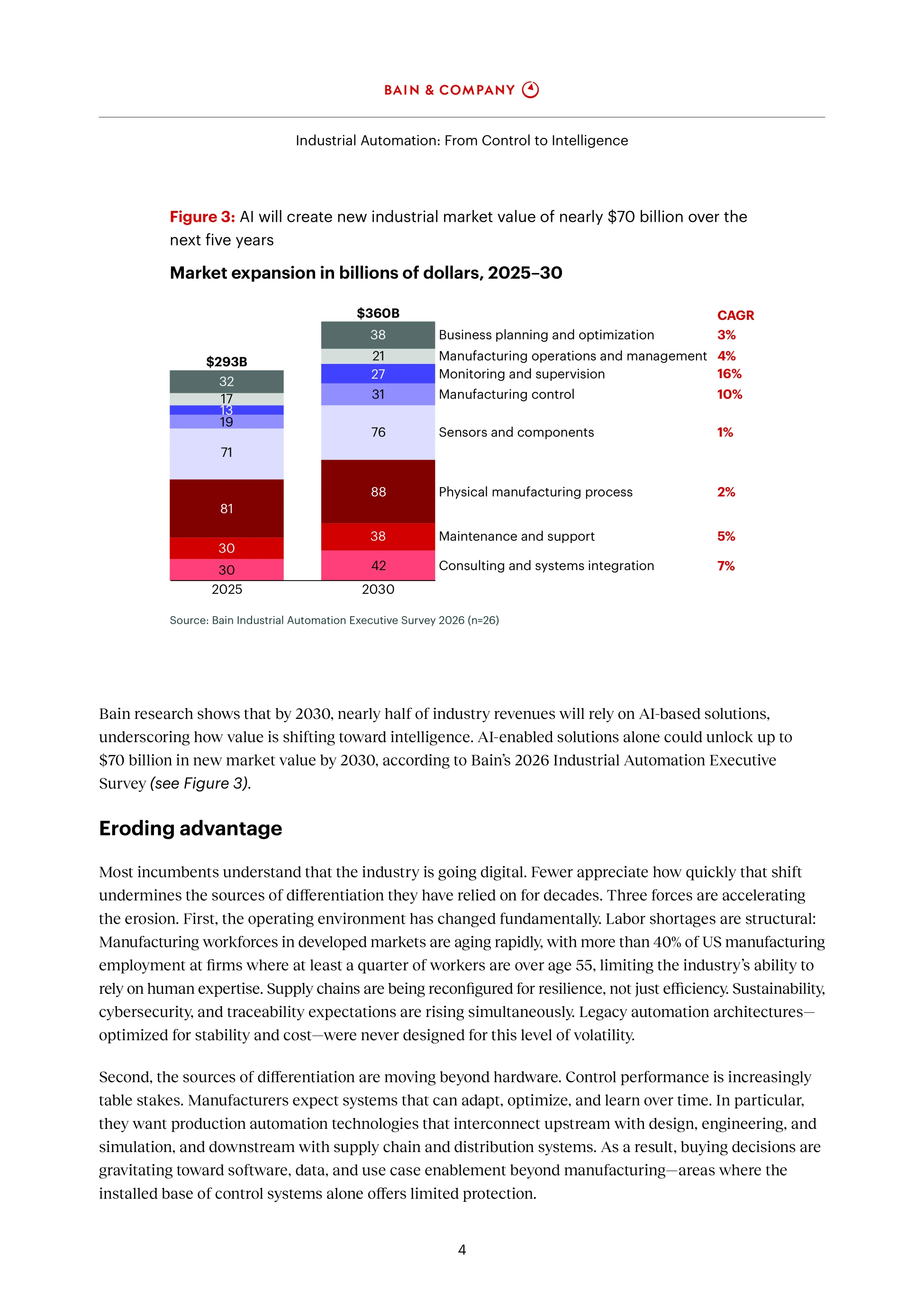
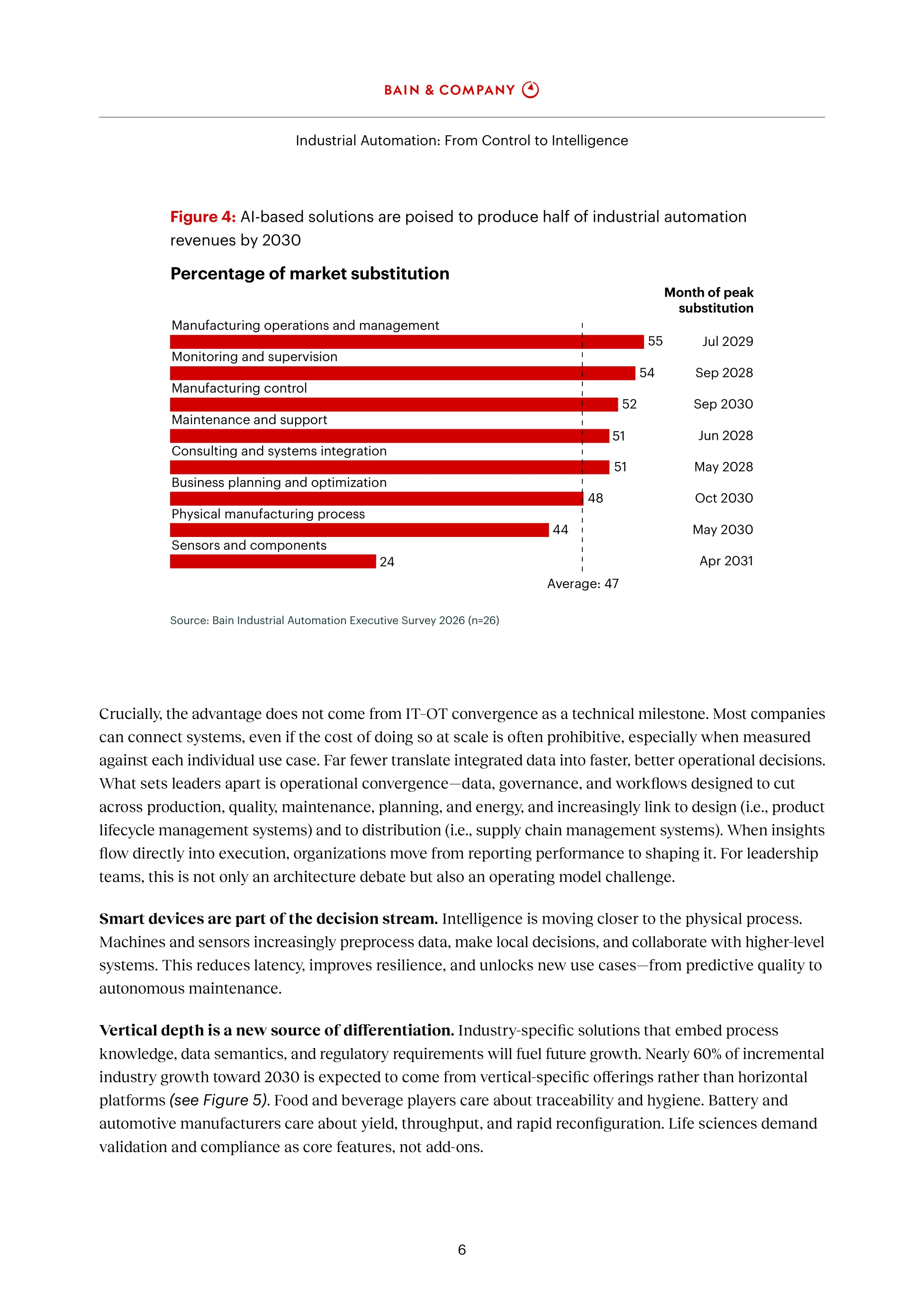
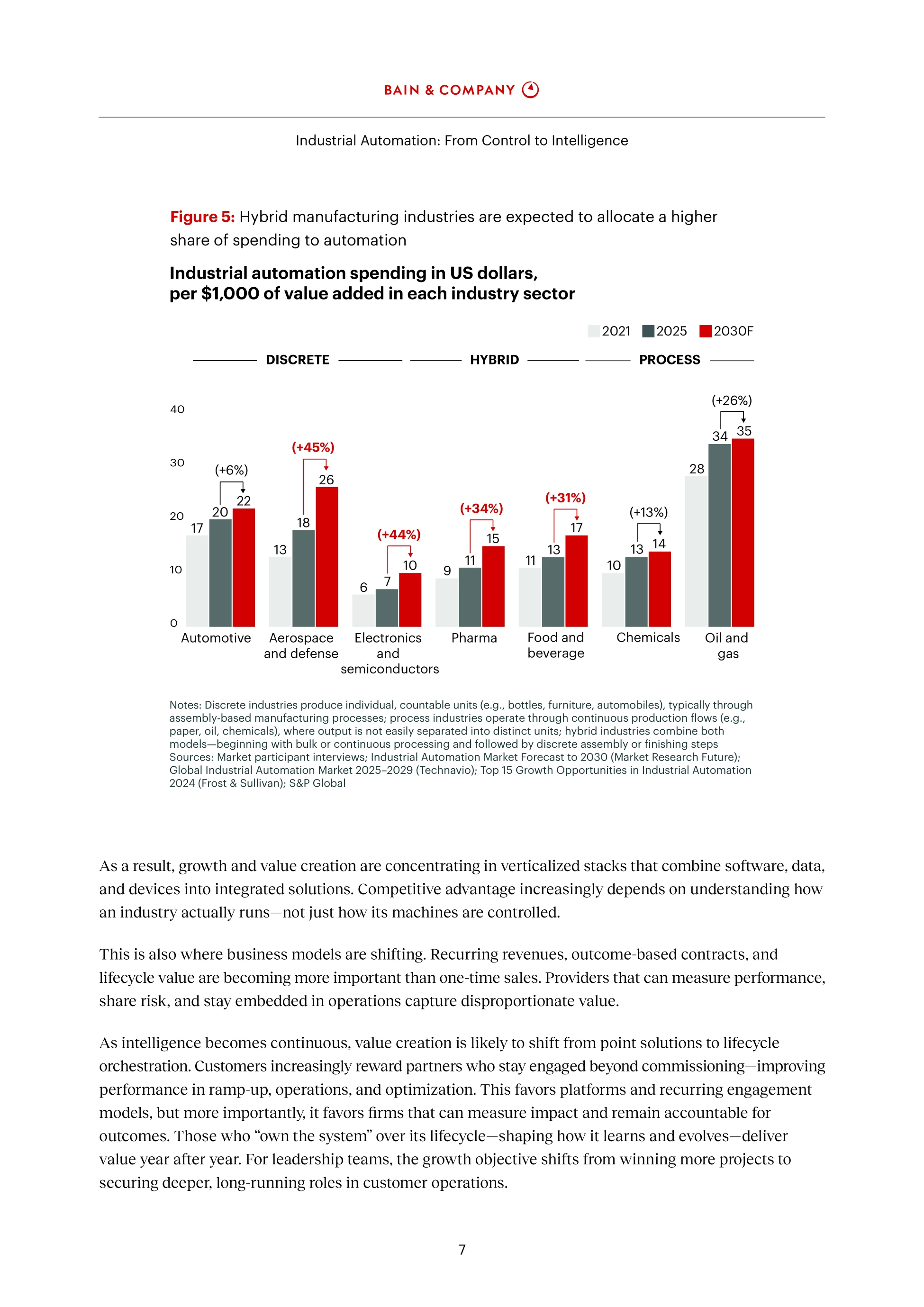
Industrial Automation: From Control to IntelligenceAI is reshaping the automation value pyramid into an hourglass.By Michael Schertler, Neil Malik, Adrien Bron, Scott Duncan, and Mike CoxonCopyright © 2026 Bain & Company, Inc. All rights reserved.Industrial Automation: From Control to Intelligence1At a Glance `Industrial automation has begun a structural shift: Value is moving away from control and toward intelligence. `Profit pools are moving to the top (software, data, AI) and bottom (smart devices) of the stack—leaving the core control technologies in the middle under pressure. `Legacy advantages are eroding faster than most incumbents expect. `By 2030, nearly half of industry revenues are expected to rely on AI-enabled offerings.Industrial automation is no longer about controlling machines—it’s about orchestrating intelligence.For decades, industry leaders followed a clear logic: Improve production and manufacturing efficiency, quality, and safety through increasingly sophisticated control systems. The economics were obvious. Value sat in proprietary high-performance controllers, tightly integrated systems, and the services and upgrades wrapped around a large installed base.What’s changing is not just automation technology, but where economic value is created in the market.That logic is now reaching its limits. What’s changing is not just automation technology, but where economic value is created in the market. What once looked like a pyramid—value concentrated in control hardware and systems—now looks more like an hourglass, with the middle shrinking and the ends growing (see Figure 1). By the end of the decade, more than 80% of industry profit pools are expected to sit at the two ends of the hourglass, with software and data-driven layers accounting for more than half of the total industry profit pool, and smart field devices capturing an additional 25% to 30% (see Figure 2).At the top of the stack, value is concentrating in software, data platforms, and AI-enabled workflows. These layers scale faster, carry higher margins, and compound in value as data and use cases accumulate. They increasingly act as the “brain” of industrial operations, translating raw signals into decisions and outcomes. At the bottom, value is reemerging in smart field devices. Sensors, such as machine vision technology, and actuators, such as variable-frequency drives, are no longer passive endpoints. With embedded intelligence, connectivity, and edge computing, they generate data, execute decisions, and continuously improve performance.Industrial Automation: From Control to Intelligence2By contrast, the traditional control layer in the middle—programmable logic controllers (PLCs), distributed control systems (DCSs), input/output modules (I/O), supervisory control and data acquisition (SCADA), and their related proprietary software—remains essential but is becoming harder to s...










































