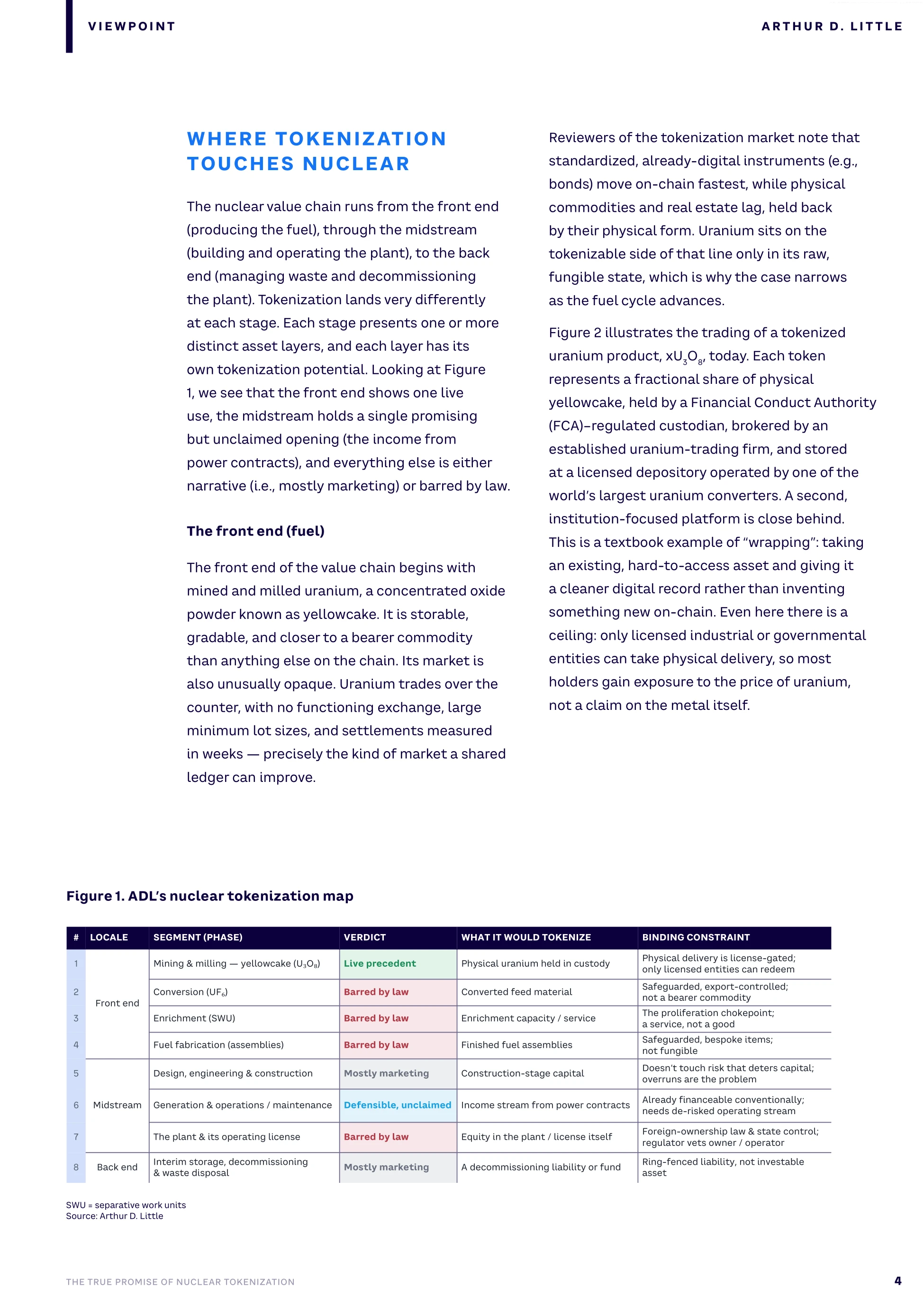
来源:发现报告(www.fxbaogao.com/view?id=5754840)| 引用请注明出处2026AUTHORSMichael KruseArjun Vir SinghTHE TRUE PROMISE OF NUCLE AR TOK ENIZ ATIONFinance’s newest idea can help with nuclear’s oldest problem — just not where expectedBetween growth of modular reactors, upgrades to aging reactors, and new builds of large plants, around US $6 trillion is expected to be invested in nuclear by 2050, according to the World Nuclear Association, provided plans to triple global nuclear capacity remain on track. In the midst of this renaissance, tokenization is being pitched across industries to unlock liquidity, democratize access, and open pools of capital. This Viewpoint explains that — in the nuclear industry — some of these promises lack substance while others can help solve a thorny financial problem.VIE WP OINT来源:发现报告(www.fxbaogao.com/view?id=5754840)| 引用请注明出处THE TRUE PROMISE OF NUCLEAR TOKENIZATIONFINANCING HAS ALWAYS BEEN THE INDUS TRY’ S BIG GES T PROBLEM , AND IT IS THE RE ASON MANY PRO JEC T S NE VER BRE AK GROUNDThe common thread in these trends is money. Nuclear plants cost enormous sums up front, take years to produce revenue, and are notorious for running over budget. The industry continuously embeds safety innovation into its thinking, and modern plants have reached safety levels that place the likelihood of a major failure at the extreme margin of probability — but safety comes at a cost.Financing has always been the industry’s biggest problem, and it is the reason many projects never break ground. Enter tokenization, the practice of representing an asset (or a claim on future money) as a digital token on a shared ledger. There has been a great deal of hype around tokenization (see sidebar); this Viewpoint aims to clarify what it genuinely does, what it doesn’t do, and what this all means for the nuclear industry. THE NUCLEAR RENAISSANCEThe nuclear industry needs to complement large nuclear power plants (NPPs) with smaller, more advanced modular reactors (and, eventually, fusion) while also assessing funding approaches and strategizing about nuclear-asset delivery. An energy transition without nuclear energy is unlikely, and the energy system of the future will combine renewables, nuclear, and storage. As provocative as it sounds, tokenization adds a fresh angle to the bankability debate and can help stimulate innovative thinking in the sector.After two decades of stagnation across much of the West, nuclear is being built, restarted, and planned again. Three forces have converged. First, AI data centers are creating enormous, round-the-clock electricity demand that only firm, low-carbon power can reliably meet. Second, governments have put nuclear back at the center of both decarbonization and energy security — a shift that is accelerating in Europe following recent fuel and gas supply shocks. Third, a new g...