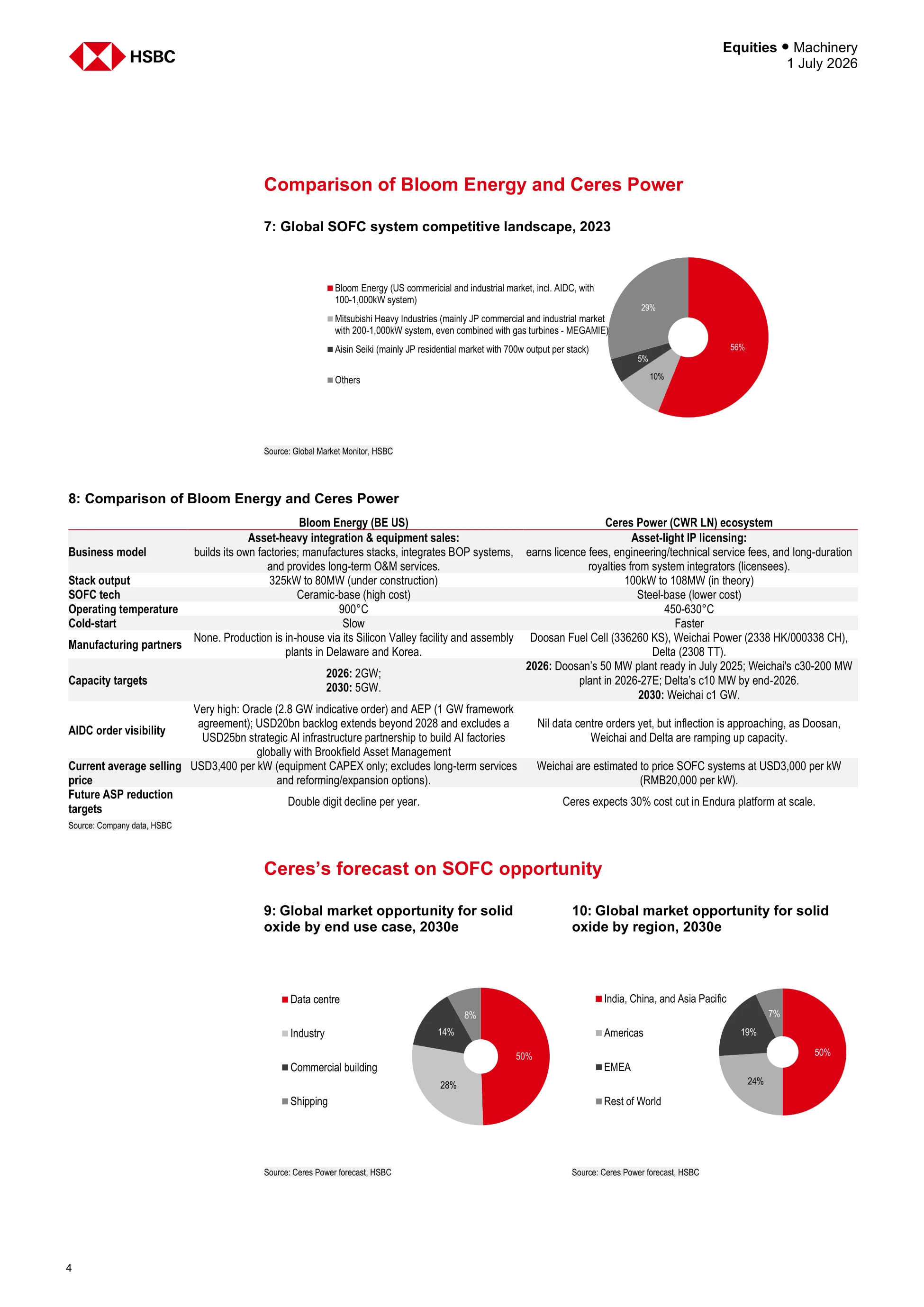
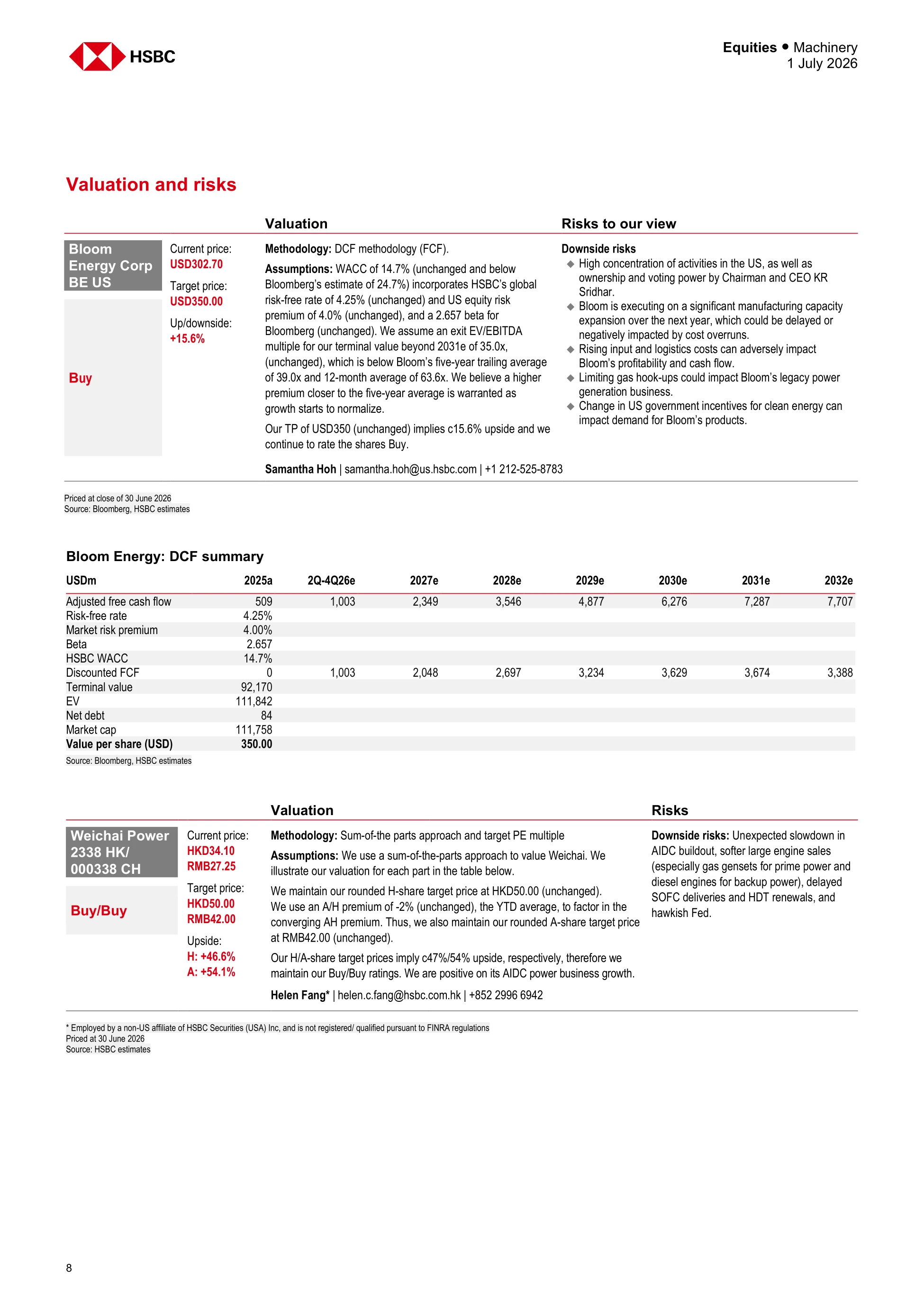
Disclosures & Disclaimer This report must be read with the disclosures and the analyst certifications in the Disclosure appendix, and with the Disclaimer, which forms part of it. Issuer of report: The Hongkong and Shanghai Banking Corporation Limited View HSBC Global Investment Research at: https://www.research.hsbc.com ◆ SOFC penetrates AIDC BTM prime power due to 3-4 month lead times, zero-NOx operation, and efficient native-DC output ◆ US/Korea/Taiwan/EU driving adoption; by 2030: capacity is scaling up to 5GW+; DOE targets at USD900/kW system cost ◆ We like Buy-rated Bloom (global SOFC leader) and Weichai (gas/diesel engine; SOFC capacity ramping) SOFC is penetrating AIDC for “behind-the-meter” prime power (ex. 2), despite high CAPEX and recurring 5-7 years’ stack replacement costs, due to: 1) shorter lead time of 3-4 months vs 1-2 years for engines, 3-5 years for turbines; 2) clean with no NOx emission via electrochemical reactions versus combustion; 3) efficient high electrical efficiency (55-65%), native direct current eliminating costly AC-DC conversion losses. Aligning 800V HVDC architectures is a next-gen approach that reduces USD1-2bn of BOP conversion equipment and improves token/kW. Beyond the US and AIDC: Ceres estimates SOFC TAM will reach 22GW by 2030. Apart from 24% US market and c50% DC usage, other highlights include: 1) South Korea: Utility scale commercialization is supported by National Clean Hydrogen Portfolio Standard; 2) Taiwan: grid fragility, stringent RE100 requirements for semi fabs and subsidies accelerate localized microgrid deployments; 3) EU: carbon pricing and marine propulsion decarbonization drive broader SOFC adoption. Scale-up and cost-down pathway: Bloom targets 2GW before YE-2026 and possibly 5GW by 2030, while Ceres’s partners (Weichai, Doosan, Delta) targets c100MW by end 2026 and c1GW by 2030. Key bottlenecks include the supply of Scandium, ceramic electrolytes, and Balance of Plant components (c70% of system cost). Economies of scale and lower-temperature metal-supported architecture will drive cost reduction in longer term. We believe Bloom has largely de-risked its expansion plans while management’s double-digit annual cost-down target will be aided by Moore’s Law. Rystad estimates SOFC system costs will fall 20-25% by 2030, vs DOE total system CAPEX of USD900/kW by 2030e (from USD3,000/kW). Related companies along the value chain include Ceres (SOFC tech developer), Doosan Fuel Cell (SOFC leader in South Korea), Delta (SOFC leader in Taiwan), Three-Circle (BE’s key electrolyte supplier), Kaori (BE’s hot box supplier). We like Buy-rated Bloom (global SOFC leader) and Weichai (gas/diesel engine; SOFC capacity ramping). Key downside risks include slower AIDC buildout, elevated SOFC capital costs, and quicker capacity ramp of gas turbines and gensets. Our global coverage of companies that provide SOFC...










































