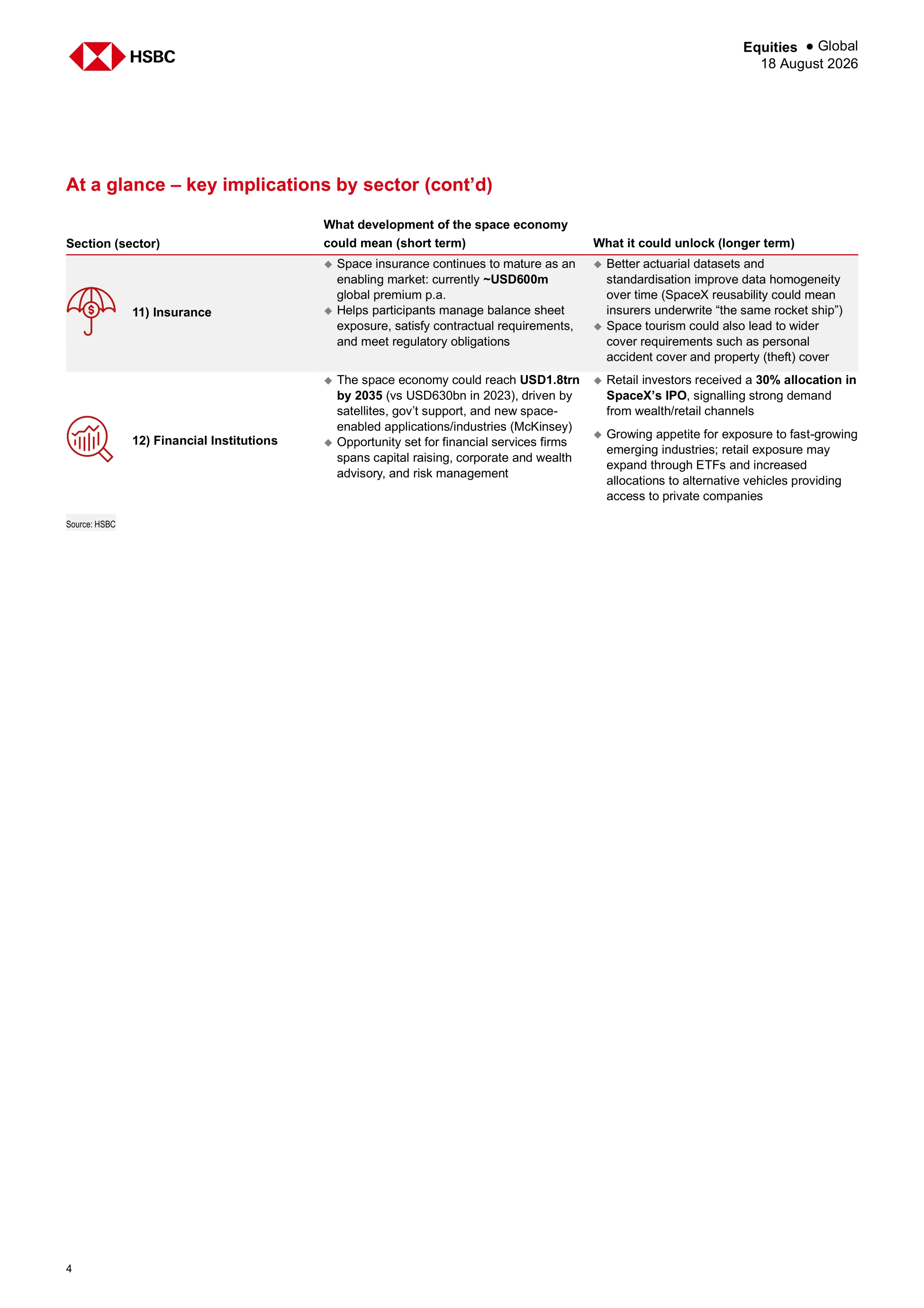
Disclosures & Disclaimer This report must be read with the disclosures and the analyst certifications in the Disclosure appendix, and with the Disclaimer, which forms part of it. Issuer of report: HSBC Bank Middle East Limited, Dubai branch View HSBC Global Investment Research at: https://www.research.hsbc.com AI megadeals and the restClick to viewHSBC Funding the Future Survey ◆ Private-sector companies have far-reaching ambitions to pioneer a new wave of economic activity in space ◆ But the journey isn’t just about space – it’s about space-driven discovery that expands addressable markets on Earth ◆ Many “in-space” ambitions remain constrained by launch economics, autonomy, and hardware readiness The next phase of the space economy won’t begin with asteroid mining or orbital data centres. It begins with a set of terrestrial developments that (1) create immediate commercial value on Earth, (2) industrialise the enabling supply chains, and (3) pull forward the technology stack – particularly power, semiconductors, and robotics – that later migrates into orbit. In this edition of Global Sector Analyst, we bring together views from HSBC equity analysts on what the development of the space economy could mean for the sectors under their coverage, as well as the opportunities – and challenges – it could create, with the spotlight on SpaceX following its recent IPO. Change is already underway. Starlink is at decent scale with ~10,200 satellites and ~12.0m broadband subscribers across 167 markets (30 June 2026). Space-based connectivity is becoming baseline infrastructure for multiple sectors, supporting better tracking for shipping and aircraft, more accurate remote operation (e.g., in mines), and better targeting of resources in precision agriculture, where adoption benefits are cited as +22.3% ROI and +18.5% net profit. The build-out of AI data centres is already driving increased terrestrial power needs as well as demand for renewables and grids. Next-generation solar could play a role in planned orbital data centres – but if the latter take off, they could prove a headwind for terrestrial gas and nuclear generation. Many space ambitions are ultimately constrained by two things that have to mature through mass deployment on Earth. To transform satellites from being “pipes” to “intelligent nodes” calls for new “low earth orbit-optimised” semiconductors able to operate in challenging conditions, edge-AI inference accelerators (allowing computing to take place in space), and high-performance optical chips enabling rapid data transfer between networked satellites. Advanced robotics is vital to enable on-orbit servicing (repair/refuel/upgrade/debris removal), support future in-space manufacturing, and achieve longer-dated ambitions including lunar infrastructure build-out and asteroid mining. This is not just a space story. Investments in thes...










































