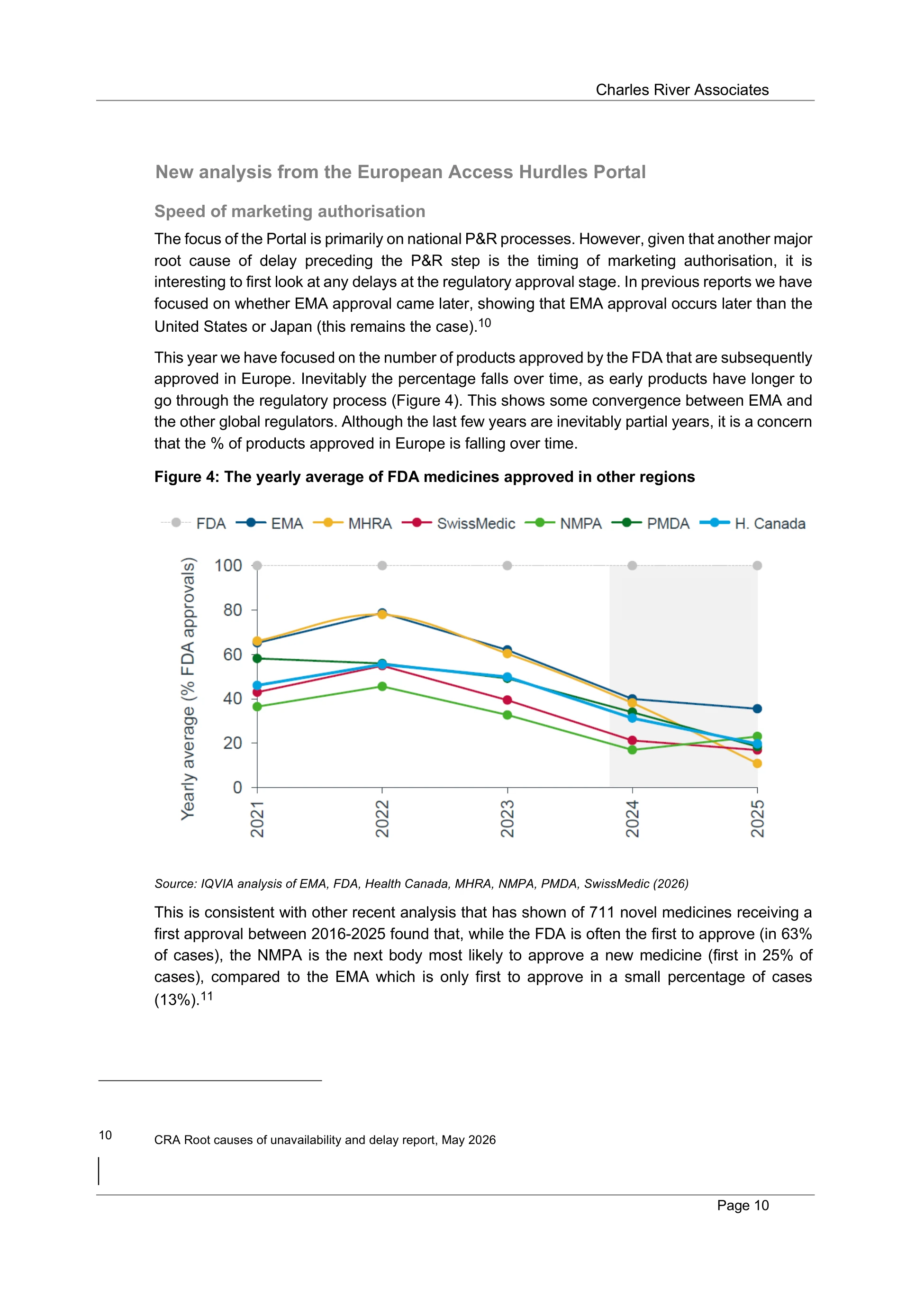
Page 1 European Access Hurdles Portal: Results from the fourth year of data collection May 2026 Final report Executive summary In April 2022, EFPIA and its members committed to a series of actions designed to reduce disparities in access across Europe. The European Access Hurdles Portal (the “Portal”) was launched then as an industry-led initiative to increase transparency regarding the root causes of unavailability of innovative medicines in Europe—a key issue affecting patient access to innovative medicines. It is intended to identify and report on the multifactorial root causes of delays in pricing and reimbursement (P&R) filing or the reimbursement decision-making process for European Union (EU) centrally approved medicines in their first indication. This allows data on delay and lack of availability to be put into context and thereby supports a shared understanding of these root causes and the collective responsibility to address these issues. The Portal can be used to support a multi-stakeholder dialogue to devise solutions that can address these challenges holistically. This is the fourth report using evidence from the Portal. The Portal now includes data collected on medicines that received marketing authorisation in their first indication between January 2022 and June 2025. The data continue to mature over each iteration of the Portal, allowing us to validate results from previous reports, undertake more granular analysis and begin to assess trends in accessibility of innovative medicines over time. Transparency: There is a commitment to providing more transparency on the root causes of unavailability and delay, with 100% participation from EFPIA member companies with eligible products. As a result, the Portal now contains a total of 91 products that were approved between January 2022 and June 2025 in their first indication (representing nearly one-half of all products approved by the European Medicines Agency (EMA) in this period). The Portal is similar in size to last year (reflecting that 21 new products have been included in the data base but the first cohort has now been removed). Filing, availability and accessibility: As we gain more data in the Portal, the complex interaction between filing, availability and accessibility is becoming more apparent. There is a distinction between products being available (included in the national reimbursement list) and patients having access to them. We find the following: • To understand if products are accessible to patients, we need to consider filing, availability (inclusion of a centrally approved medicine on the public reimbursement list in a country) and whether patients have the possibility to access products through Charles River Associates Page 2 alternative access schemes (AAS).1 On average across European countries, 69% of products have either been filed for P&R (including ...