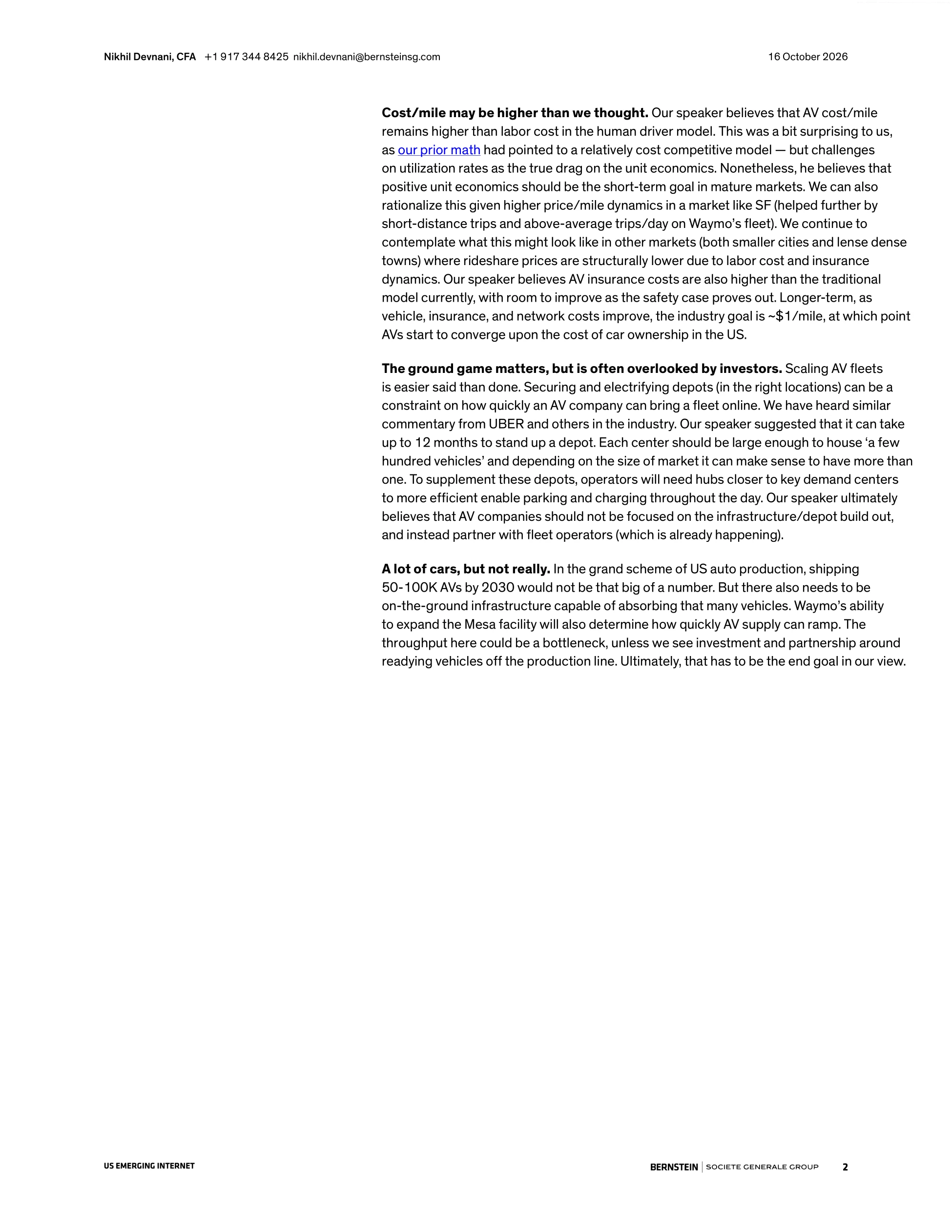
来源:发现报告(www.fxbaogao.com/view?id=5777932)| 引用请注明出处16 October 2026US Emerging InternetUBER and LYFT: Takeaways from a former Waymo executiveNikhil Devnani, CFA+1 917 344 8425nikhil.devnani@bernsteinsg.comNathan Gee+1 917 344 8573nathan.gee@bernsteinsg.comAjeya Patil, CFA+1 917 344 8467ajeya.patil@bernsteinsg.comLast week, we hosted an expert call with a former Waymo (Alphabet) executive. Our speakerspent 6 years at the company and held critical operational roles, working closely with seniorleadership. He was involved in Waymo’s go-to-market strategy across fleet deployment,market expansion, and rideshare partnerships. He left Waymo a couple of years ago, but wasnonetheless able to provide helpful commentary and his own opinions on how the AV marketcould shake out, both near-term and long-term. Our focus was on the US business.Waymo’s strategy of breadth over depth. Waymo is active in 15 US markets today, withmore cities on the come — despite having a relatively small fleet of ~4.1K vehicles. Breadthover depth makes sense for two reasons: (1) unlike an independent company, Waymodoesn’t need to demonstrate economics/scale in a market to raise capital; and (2) it enablesWaymo to improve the tech, learn new environments, build a brand, and establish trust withlocal regulators. Waymo is in a unique position on the first point — we suspect competitorsmay have to opt for going deeper in a few markets first to further raise capital. All the morereason for UBER to work with multiple providers to reach scale.Waymo’s lead — both sides. Our speaker was bullish on Waymo’s first mover advantageand lead, but cognizant of future competition, which leaves us with a mixed reaction onthe implications for UBER/LYFT. More AV competition is better for the rideshare networks.Zoox and Telsa were the two competitors our speaker acknowledged as being in the race.Externally, we should be evaluating each company’s ability to deploy in a market — but moreimportantly, their ability to open up a commercial service for riders and scale the offeringto incremental ODDs and cities. If AV companies can shrink the window from test fleet tolaunch to 3-5 months, that would be a true signal of tech generalizability, which is the holygrail for scalability into new environments. Commercial operations reinforce the flywheelwith data collection and revenue to fund further R&D. 2027 will be telling on whether thepace of AV scaling/expansion has accelerated from Waymo’s early deployments.Rideshare partnerships are not DOA. Our speaker was also optimistic on the possibilityof deeper/incremental Waymo partnerships with UBER/LYFT. Given the reportedweakening relationship between UBER and Waymo, this is a counter-consensus take thesedays (less so for LYFT). Nonetheless, he believes: (1) near-term friction could simply reflectnegotiation dynamics and game theory; (2) the utilization up...