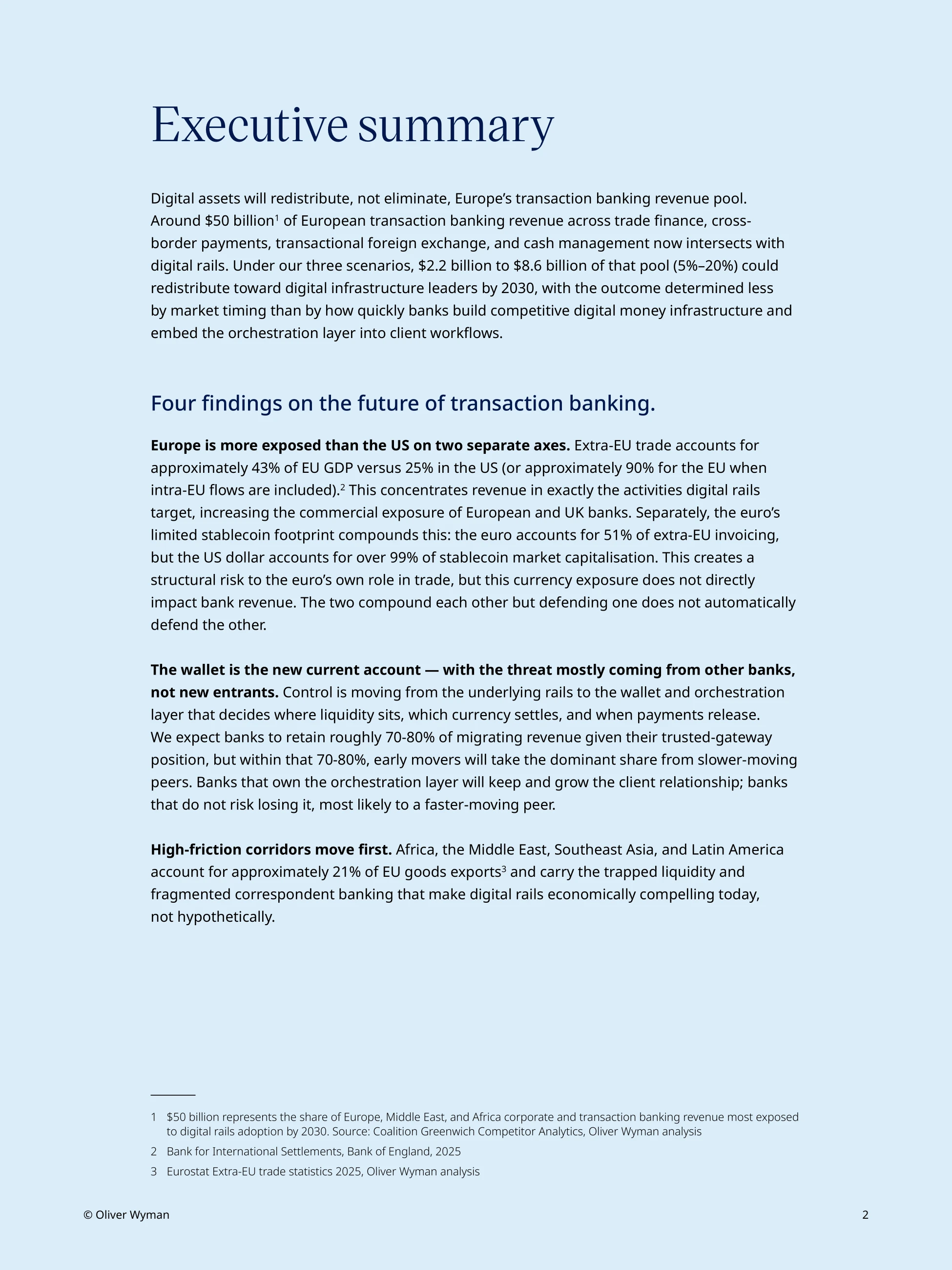
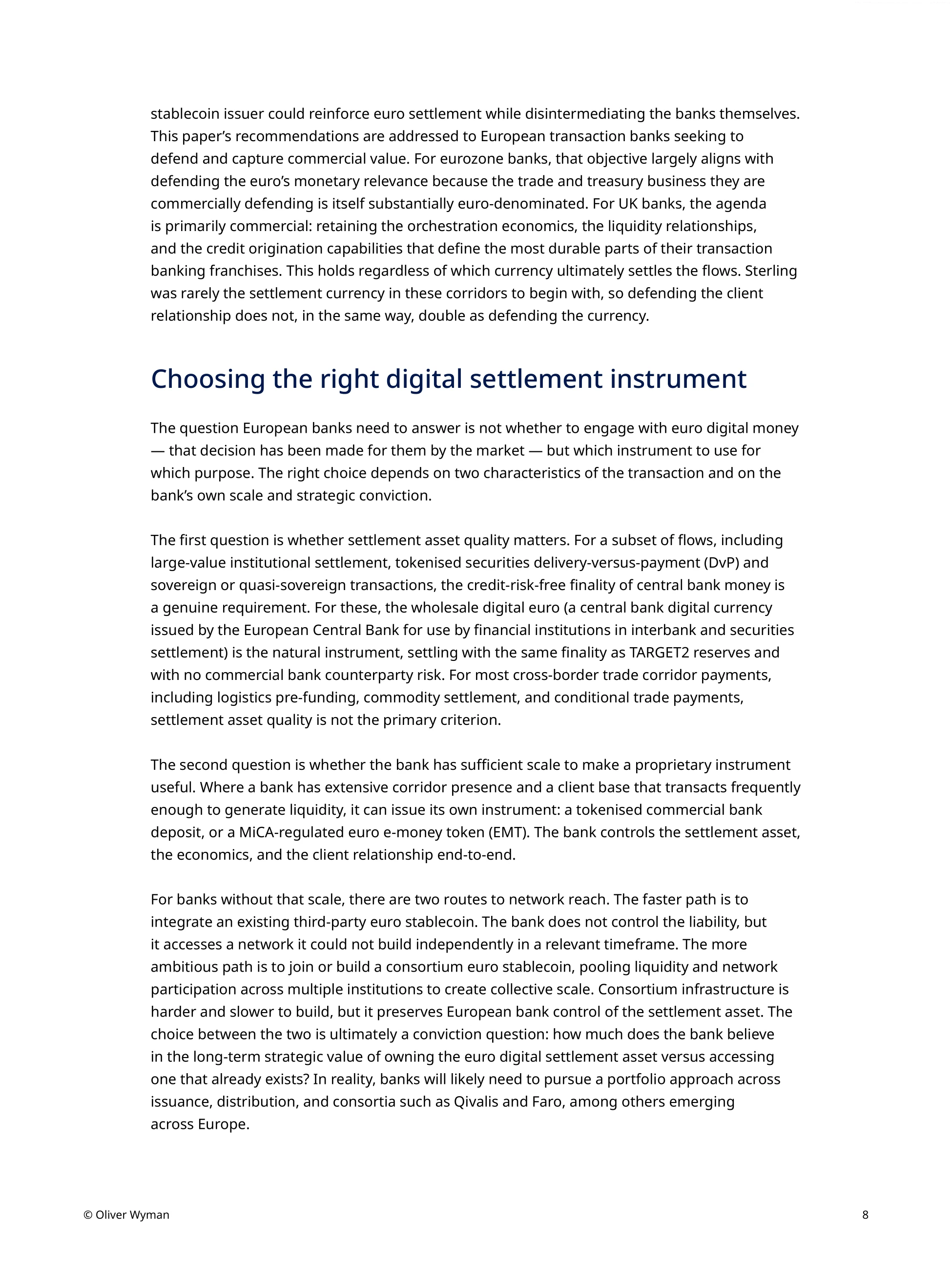
来源:发现报告(www.fxbaogao.com/view?id=5736765)| 引用请注明出处Europe’s digital money momentThe $50 billion question — how will digital assets redefine European transaction banking?来源:发现报告(www.fxbaogao.com/view?id=5736765)| 引用请注明出处© Oliver Wyman2 Executive summary Digital assets will redistribute, not eliminate, Europe’s transaction banking revenue pool. Around $50 billion1 of European transaction banking revenue across trade finance, cross-border payments, transactional foreign exchange, and cash management now intersects with digital rails. Under our three scenarios, $2.2 billion to $8.6 billion of that pool (5%–20%) could redistribute toward digital infrastructure leaders by 2030, with the outcome determined less by market timing than by how quickly banks build competitive digital money infrastructure and embed the orchestration layer into client workflows. Four findings on the future of transaction banking. Europe is more exposed than the US on two separate axes. Extra-EU trade accounts for approximately 43% of EU GDP versus 25% in the US (or approximately 90% for the EU when intra-EU flows are included).2 This concentrates revenue in exactly the activities digital rails target, increasing the commercial exposure of European and UK banks. Separately, the euro’s limited stablecoin footprint compounds this: the euro accounts for 51% of extra-EU invoicing, but the US dollar accounts for over 99% of stablecoin market capitalisation. This creates a structural risk to the euro’s own role in trade, but this currency exposure does not directly impact bank revenue. The two compound each other but defending one does not automatically defend the other. The wallet is the new current account — with the threat mostly coming from other banks, not new entrants. Control is moving from the underlying rails to the wallet and orchestration layer that decides where liquidity sits, which currency settles, and when payments release. We expect banks to retain roughly 70-80% of migrating revenue given their trusted-gateway position, but within that 70-80%, early movers will take the dominant share from slower-moving peers. Banks that own the orchestration layer will keep and grow the client relationship; banks that do not risk losing it, most likely to a faster-moving peer. High-friction corridors move first. Africa, the Middle East, Southeast Asia, and Latin America account for approximately 21% of EU goods exports3 and carry the trapped liquidity and fragmented correspondent banking that make digital rails economically compelling today, not hypothetically. 1 $50 billion represents the share of Europe, Middle East, and Africa corporate and transaction banking revenue most exposed to digital rails adoption by 2030. Source: Coalition Greenwich Competitor Analytics, Oliver Wyman analysis 2 Bank for International Settlements, Bank of England, 2025 3 Eurostat Extr...