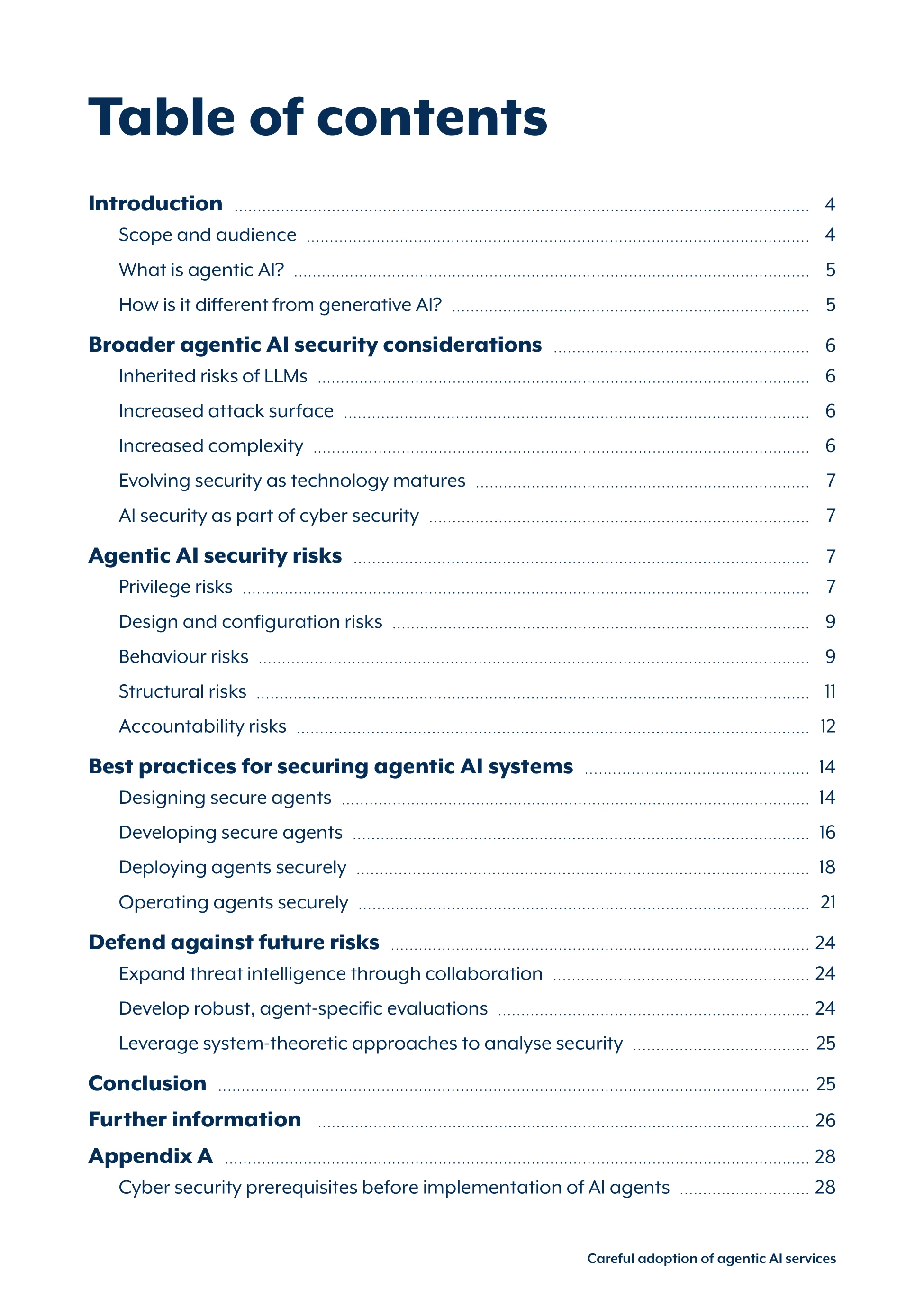
Careful adoption of agentic AI services Careful adoption of agentic AI servicesTable of contentsIntroduction 4Scope and audience 4What is agentic AI? 5How is it different from generative AI? 5Broader agentic AI security considerations 6Inherited risks of LLMs 6Increased attack surface 6Increased complexity 6Evolving security as technology matures 7AI security as part of cyber security 7Agentic AI security risks 7Privilege risks 7Design and configuration risks 9Behaviour risks 9Structural risks 11Accountability risks 12Best practices for securing agentic AI systems 14Designing secure agents 14Developing secure agents 16Deploying agents securely 18Operating agents securely 21Defend against future risks 24Expand threat intelligence through collaboration 24Develop robust, agent-specific evaluations 24Leverage system-theoretic approaches to analyse security 25Conclusion 25Further information 26Appendix A 28Cyber security prerequisites before implementation of AI agents 28Careful adoption of agentic AI services4IntroductionAgentic artificial intelligence (AI) systems increasingly operate across critical infrastructure and defence sectors and support mission-critical capabilities. As agentic AI systems play a growing operational role, it is crucial for defenders to implement security controls to protect national security and critical infrastructure from agentic AI-specific risks.Agentic AI can automate repetitive, well-defined and low-risk tasks. However, these additional opportunities come with additional risks. Like other AI services, agentic AI can be misused or misappropriated, leading to productivity losses, service disruption, privacy breaches or cyber security incidents. Organisations must therefore anticipate what could go wrong, assess how agentic AI risk scenarios might affect operations and establish ongoing visibility and assurance to maintain confidence in their agentic AI investments. Where possible, organisations should also consider a full spectrum of solutions for repetitive tasks, including reducing or eliminating low-value processes, which may be lower risk compared to agentic AI solutions.This guidance was co-authored by the Australian Signals Directorate’s Australian Cyber Security Centre (ASD’s ACSC), the United States Cybersecurity and Infrastructure Security Agency (CISA) and National Security Agency (NSA), the Canadian Centre for Cyber Security (Cyber Centre), the New Zealand National Cyber Security Centre (NCSC-NZ) and the United Kingdom National Cyber Security Centre (NCSC-UK). Throughout this guidance, these organisations are referred to as the ‘authoring agencies’. This guidance discusses key cyber security challenges and risks associated with the introduction of agentic AI into IT environments, as well as best practices for securing agentic AI systems.The authoring agencies strongly recommend aligning agentic AI risks and mitigation strategies with your organisation’s e...