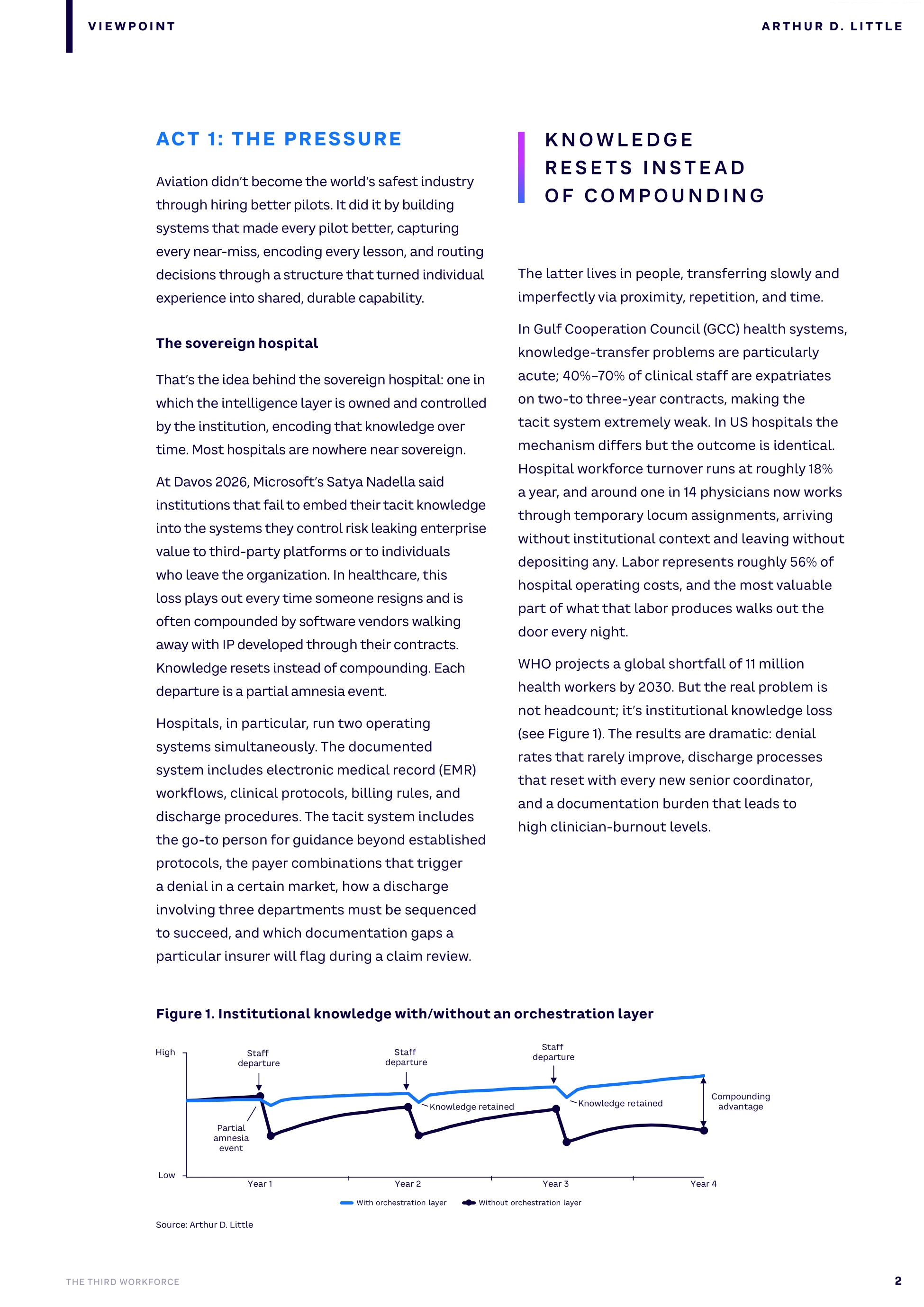
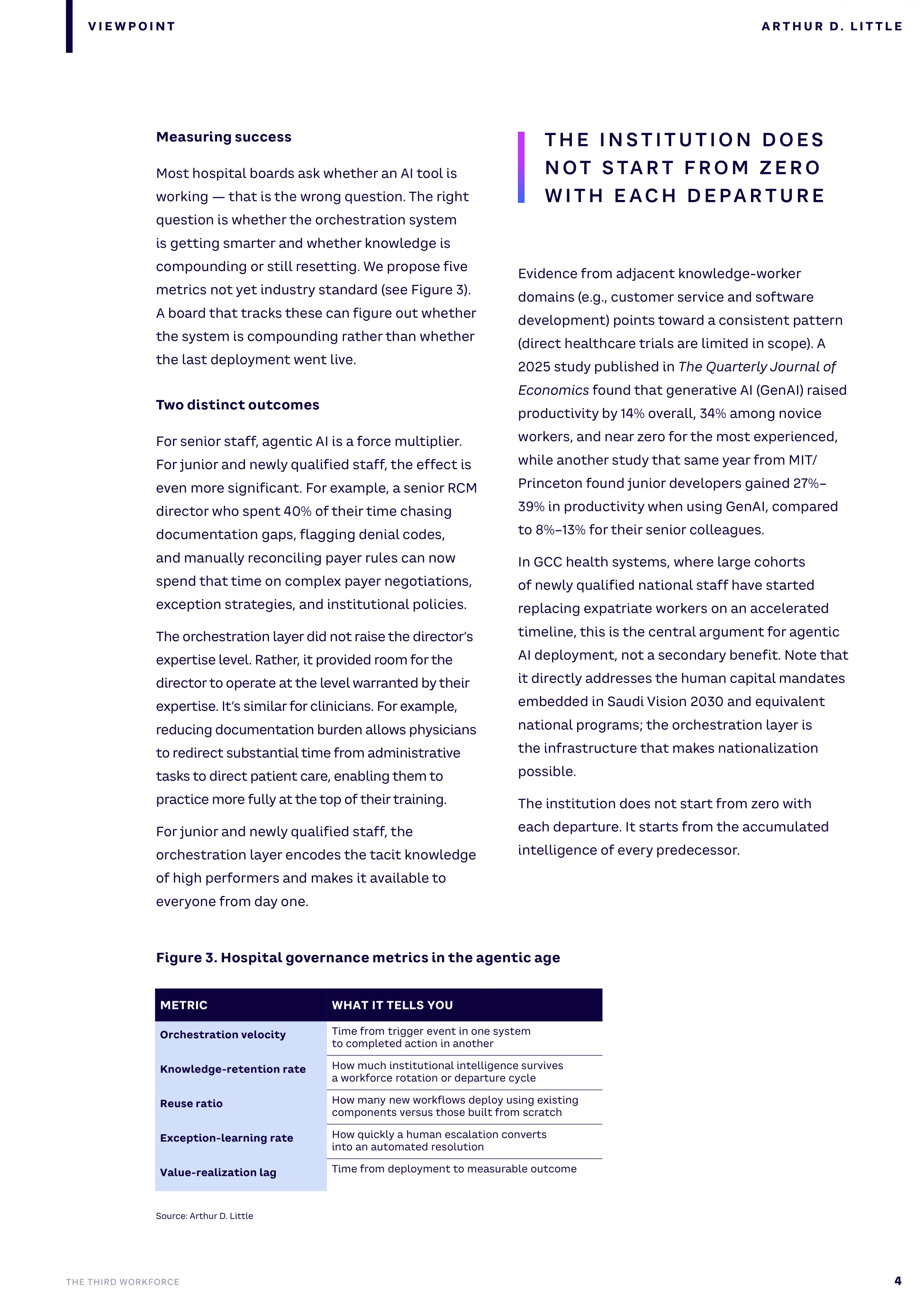
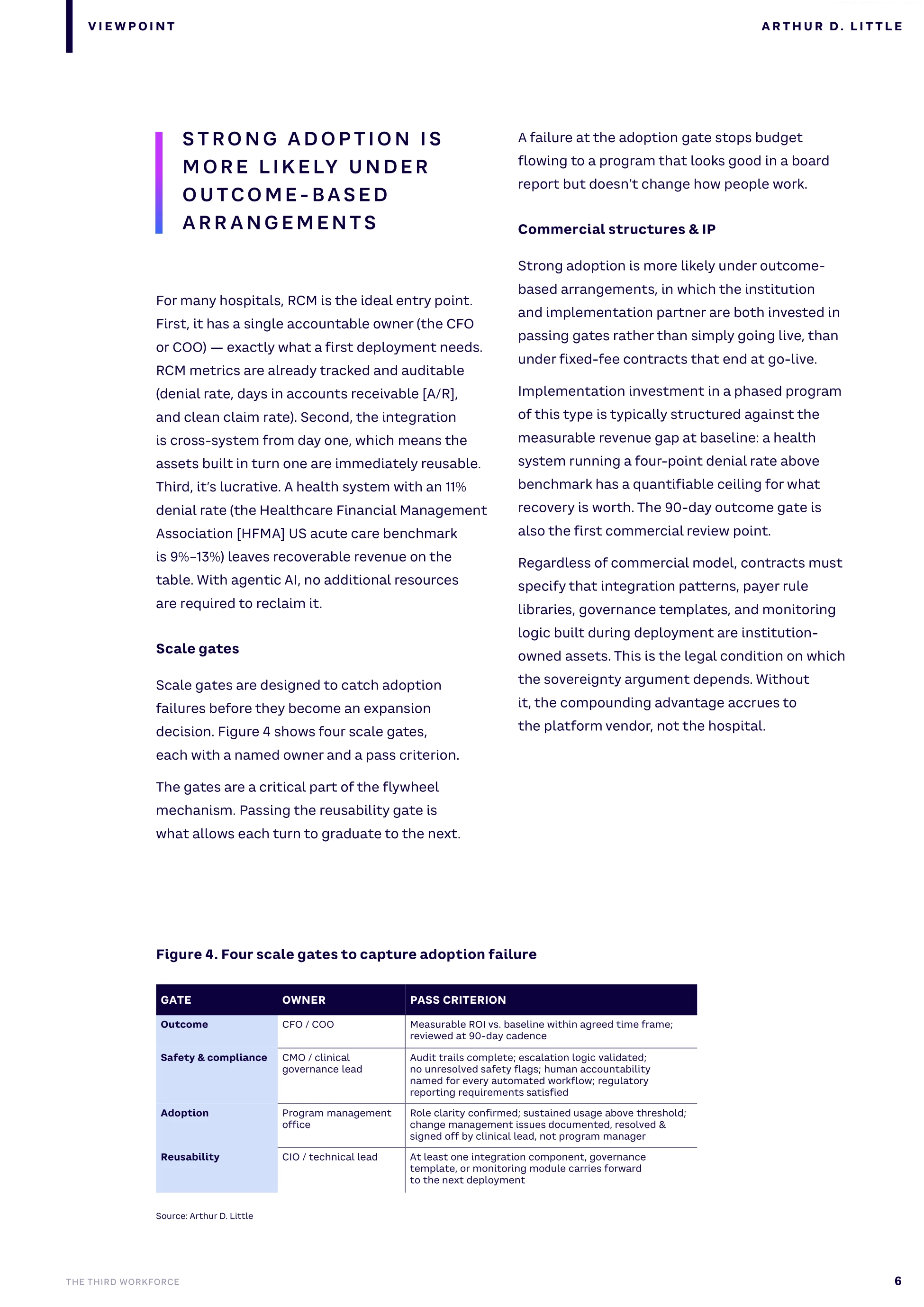

来源:发现报告(www.fxbaogao.com/view?id=5786641)| 引用请注明出处2026AUTHORSJanahan TharmaratnamAvnish GuptaSalim ChedrawiFadi HaddadeenTHE THIRD WORK FORCEHow hospitals can use agentic AI to create an institutional advantageGlobal projections point to a structural shortfall of health workers, even as budgets tighten and technology advances faster than institutions can govern it. Clearly, hospitals cannot hire their way out of their workforce problems. This Viewpoint presents agentic AI — the first technology capable of automating knowledge transfer and compounding institutional advantage over time — as a way forward.VIE WP OINT来源:发现报告(www.fxbaogao.com/view?id=5786641)| 引用请注明出处THE THIRD WORKFORCEK NOWLED GE RESE T S INS TE AD OF COMP OUNDINGThe latter lives in people, transferring slowly and imperfectly via proximity, repetition, and time.In Gulf Cooperation Council (GCC) health systems, knowledge-transfer problems are particularly acute; 40%–70% of clinical staff are expatriates on two-to three-year contracts, making the tacit system extremely weak. In US hospitals the mechanism differs but the outcome is identical. Hospital workforce turnover runs at roughly 18% a year, and around one in 14 physicians now works through temporary locum assignments, arriving without institutional context and leaving without depositing any. Labor represents roughly 56% of hospital operating costs, and the most valuable part of what that labor produces walks out the door every night.WHO projects a global shortfall of 11 million health workers by 2030. But the real problem is not headcount; it’s institutional knowledge loss (see Figure 1). The results are dramatic: denial rates that rarely improve, discharge processes that reset with every new senior coordinator, and a documentation burden that leads to high clinician-burnout levels.ACT 1: THE PRESSUREAviation didn’t become the world’s safest industry through hiring better pilots. It did it by building systems that made every pilot better, capturing every near-miss, encoding every lesson, and routing decisions through a structure that turned individual experience into shared, durable capability. The sovereign hospitalThat’s the idea behind the sovereign hospital: one in which the intelligence layer is owned and controlled by the institution, encoding that knowledge over time. Most hospitals are nowhere near sovereign. At Davos 2026, Microsoft’s Satya Nadella said institutions that fail to embed their tacit knowledge into the systems they control risk leaking enterprise value to third-party platforms or to individuals who leave the organization. In healthcare, this loss plays out every time someone resigns and is often compounded by software vendors walking away with IP developed through their contracts. Knowledge resets instead of compounding. Each departure is a partial amnesia event.Hospitals, in particular, run two o...










































