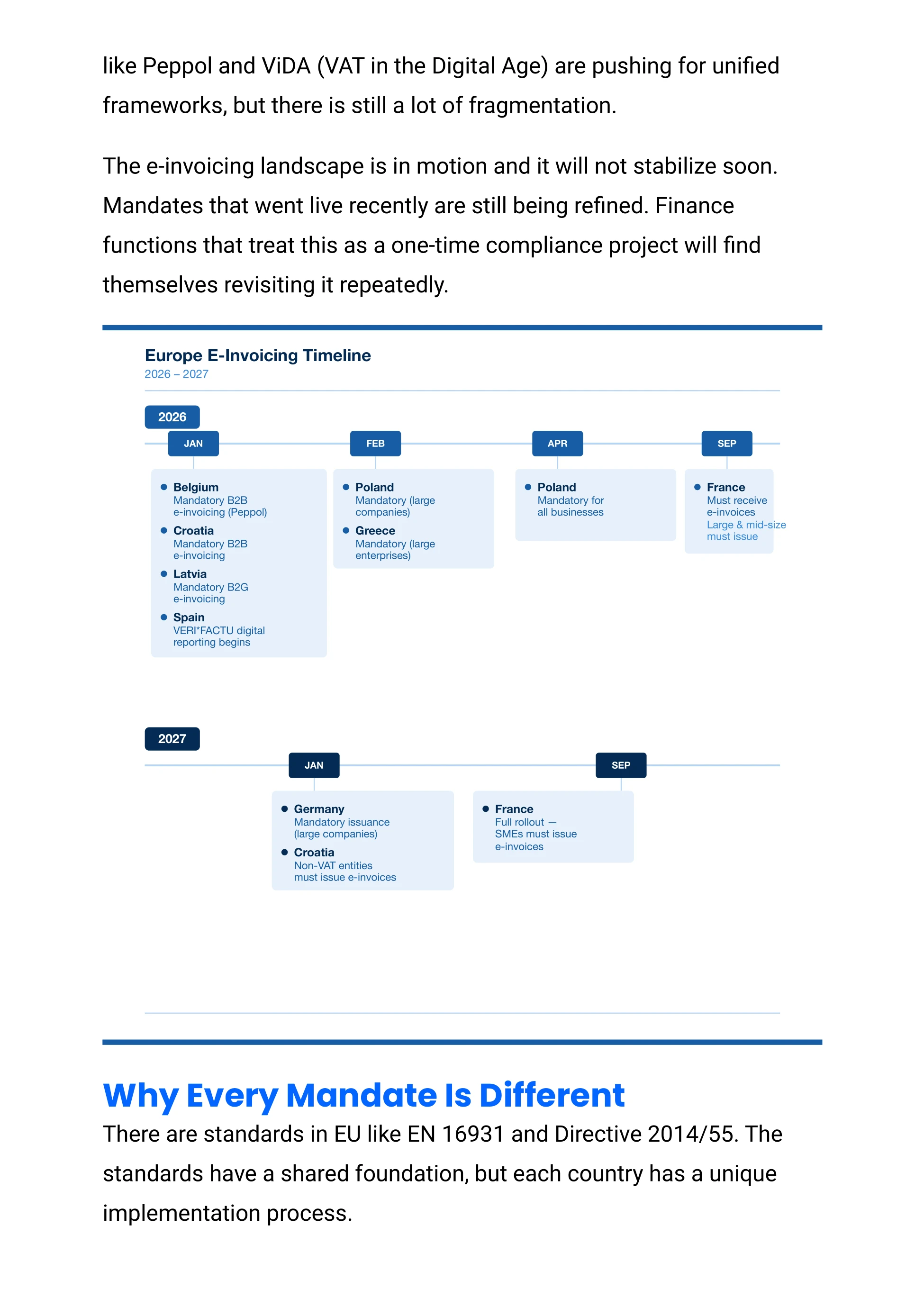
The E-InvoicingDeadlineWhat Every CFO Must Do TodayThe value added tax (VAT) gap in the European Union reached anestimated €128 billion, according to according to the EU’s latesttaxation report. That difference between potential and actual taxrevenue shows money is being left on the table, and the pressure ongovernments to recover that revenue is only growing.They have identified e-invoicing as the primary tool to close it, andmandates are moving faster than most finance teams are ready for. ForCFOs, the exposure is direct: fines, rejected invoices, blocked cash flow,and audit risk.The three most significant mandates for 2026 and early 2027 arecoming from Poland, France and Germany. Poland goes live in twophases — February and April. France follows in September with themost architecturally complex mandate currently active in Europe.Germany's obligation for large businesses to send compliant e-invoicesarrives on 1 January 2027, with all remaining companies required tofollow a year later. These are live deadlines with consequences thatland in the CFO's domain.What E-invoicing Compliance ActuallyRequiresSending and receiving invoices as PDFs by email is not e-invoicecompliance in most European markets today. Full compliance requiresthree things working together: legal conformity — meeting the specificrequirements of national tax law in each jurisdiction; technicalconformity — using the approved formats, data fields, and exchangeprotocols; and procedural conformity — maintaining accurate reportingpractices and audit-ready records. The gap between current practiceand full compliance is often larger than finance teams expect. Aprocess that satisfies requirements in one country may fall short inanother. That is not an edge case. It is the structural reality of Europeane-invoicing.The Scale of What Is HappeningAn estimated 560 billion invoices were processed globally in 2024,according to research by Billentis. Roughly 16% were e-invoices, andthat share is growing at 20% per year. The market value of e-invoicinginfrastructure is expected to nearly triple by 2028.At this scale, enforcement becomes inevitable. Governments aredriving it through continuous transaction controls, which give taxauthorities real-time visibility into transactions. Standardization effortslike Peppol and ViDA (VAT in the Digital Age) are pushing for unifiedframeworks, but there is still a lot of fragmentation.The e-invoicing landscape is in motion and it will not stabilize soon.Mandates that went live recently are still being refined. Financefunctions that treat this as a one-time compliance project will findthemselves revisiting it repeatedly.Europe E-Invoicing Timeline2026 – 20272026JANBelgiumMandatory B2Be-invoicing (Peppol)CroatiaMandatory B2Be-invoicingLatviaMandatory B2Ge-invoicingSpainVERI*FACTU digitalreporting beginsFEBPolandMandatory (largecompanies)GreeceMandatory (largeenterprises)APRPolandMandatory forall busines...










































