
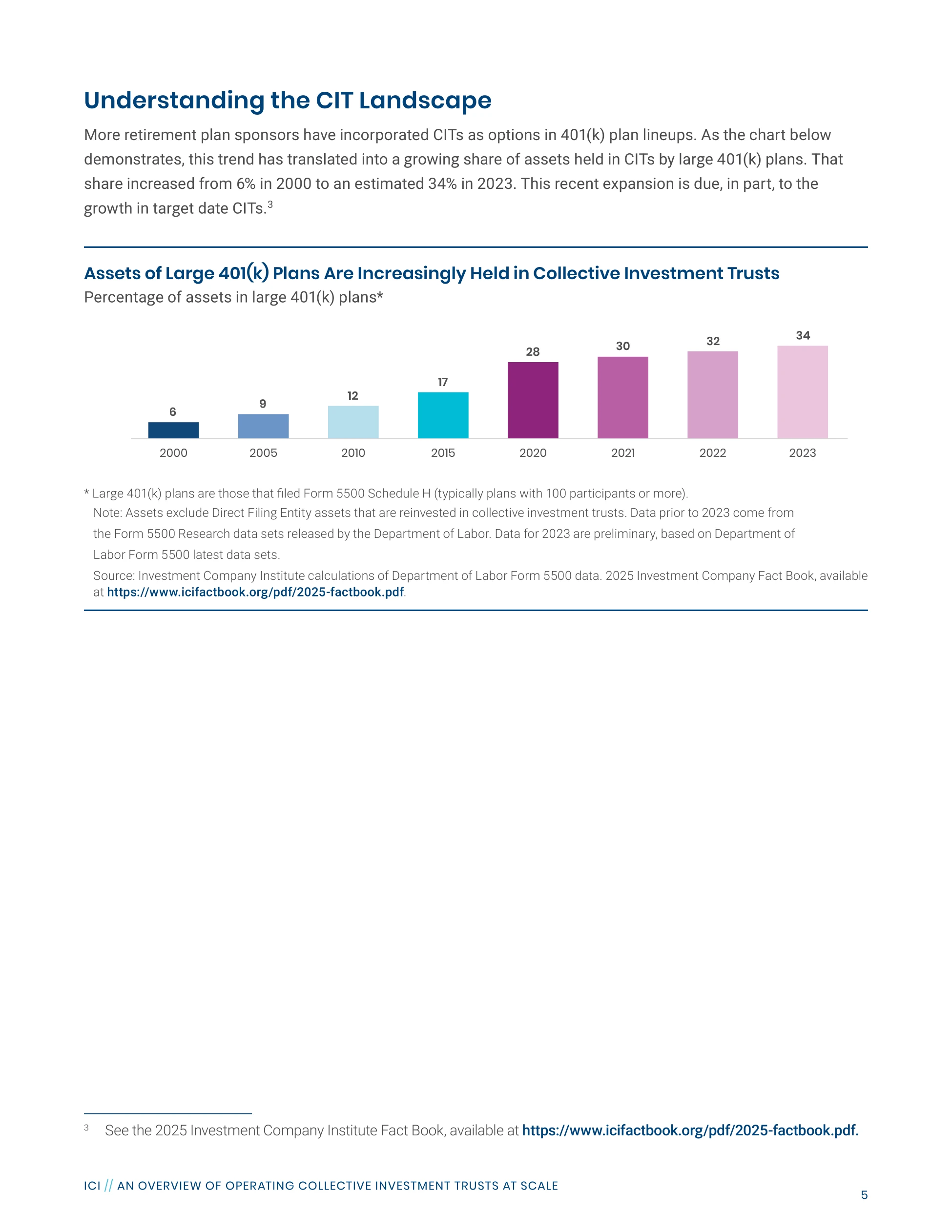
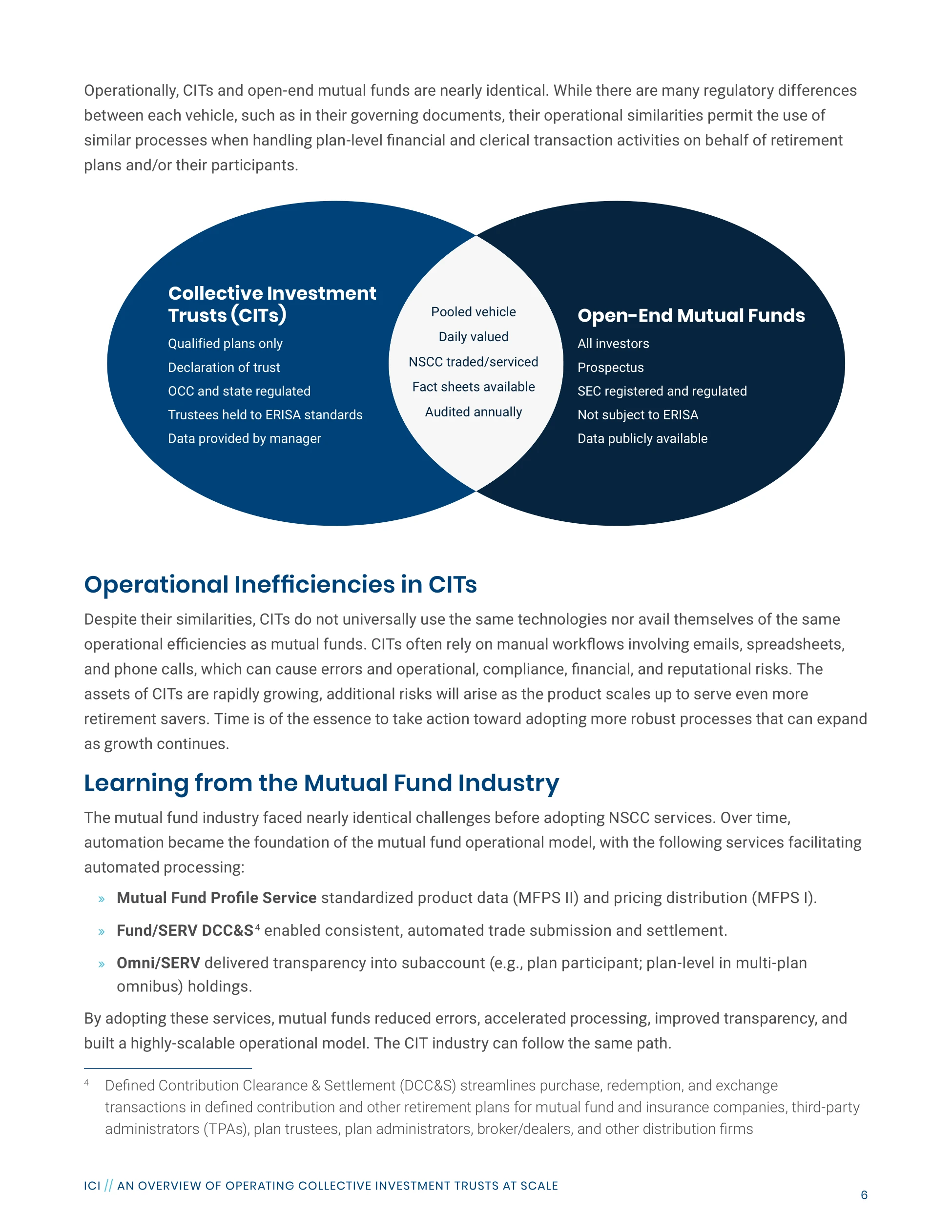
An Overview of Operating Collective Investment Trusts at Scale March 2026AcknowledgementsICI acknowledges and gives special thanks to American Funds, Charles Schwab & Co., DTCC, Reliance Trust (an FIS Company), T. Rowe Price Associates, Inc., and Vanguard for their time, insights, and contributions to this paper.About ICIThe Investment Company Institute (ICI) is the leading association representing regulated investment funds. ICI’s mission is to strengthen the foundation of the asset management industry for the ultimate benefit of the long-term individual investor. Its members include mutual funds, exchange-traded funds (ETFs), closed-end funds, and unit investment trusts (UITs) in the United States, and UCITS and similar funds offered to investors in other jurisdictions. ICI also represents its members in their capacity as investment advisers to collective investment trusts (CITs) and retail separately managed accounts (SMAs). ICI has offices in Washington DC, Brussels, and London. Copyright ©2026 by the Investment Company Institute. All rights reserved.Table of Contents2 Acknowledgements3 Executive Summary5 Understanding the CIT Landscape6 Operational Inefficiencies in CITs6 Learning from the Mutual Fund Industry7 CIT Operating Structures7 Risks and Inefficiencies in Manual Account Onboarding at CITs8 Applying the NSCC Mutual Fund Profile Service to Product Attribute Management8 Data Automation: MFPS II9 New Account Setup: Activities Necessary for the Establishment of an Account in Level 3 (L3) or Omnibus10 Trading and Settlement Automation11 From Manual Pricing to Automated Dissemination11 Reconciliation Enhancements12 Enhancing Plan-Level Transparency Through Omni/SERV12 Regulatory and Fiduciary Considerations for CITs13 Mitigating Risks Through Automation13 The Path Forward for CITs: Building Industry Consensus14 Conclusion14 References and ResourcesICI // AN OVERVIEW OF OPERATING COLLECTIVE INVESTMENT TRUSTS AT SCALE2Executive SummaryCollective investment trusts (CITs) have seen rapid growth in recent years, driven by increasing demand from retirement plan sponsors, advisors, and institutional investors seeking cost-efficient, flexible investment structures. The demand to expand CIT access in retirement plans has reached the Congressional level, with legislation to allow CITs in 403(b) retirement plans currently pending in Congress.1 If passed, this legislation would add to the demand for these products—and increase the need for CITs to operate at scale.However, the operational infrastructure supporting the processing of plan-level transactions for participants within CITs has not kept pace with CIT adoption. In many cases, operational processes remain rooted in manual, fragmented workflows that rely heavily on email exchanges, spreadsheets, manual wires, and phone calls. These methods are inefficient and expose firms to operational, compliance, financial, and reputational r...










































