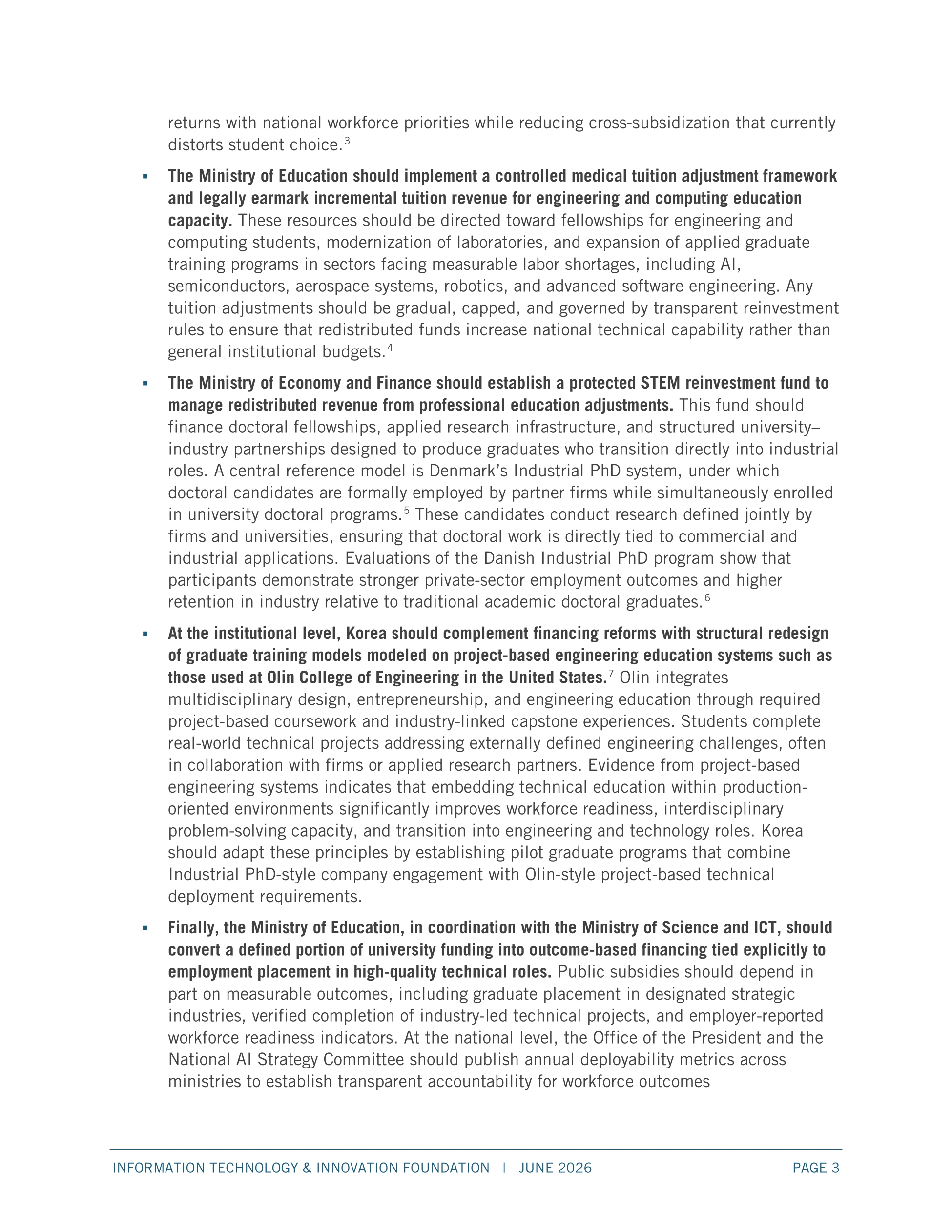
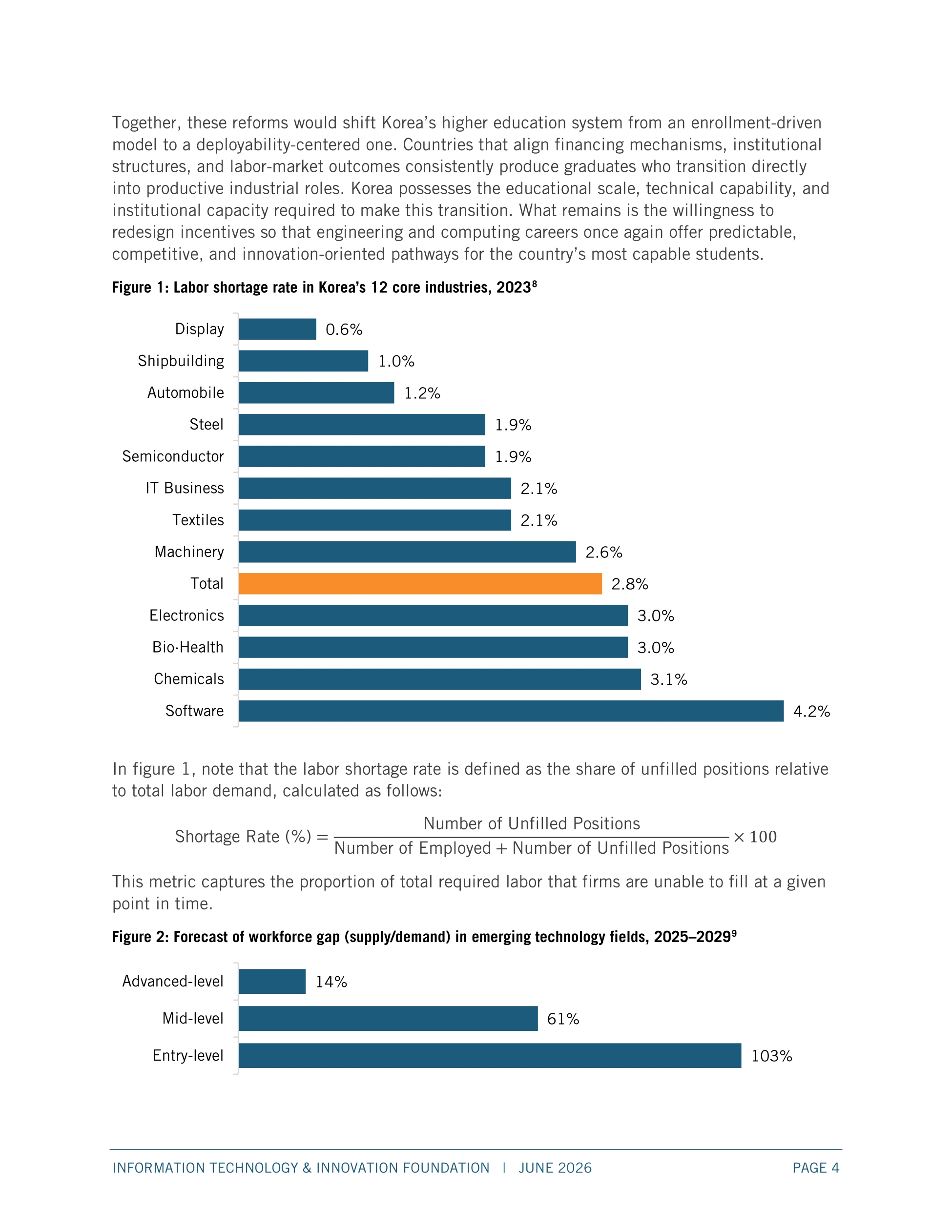
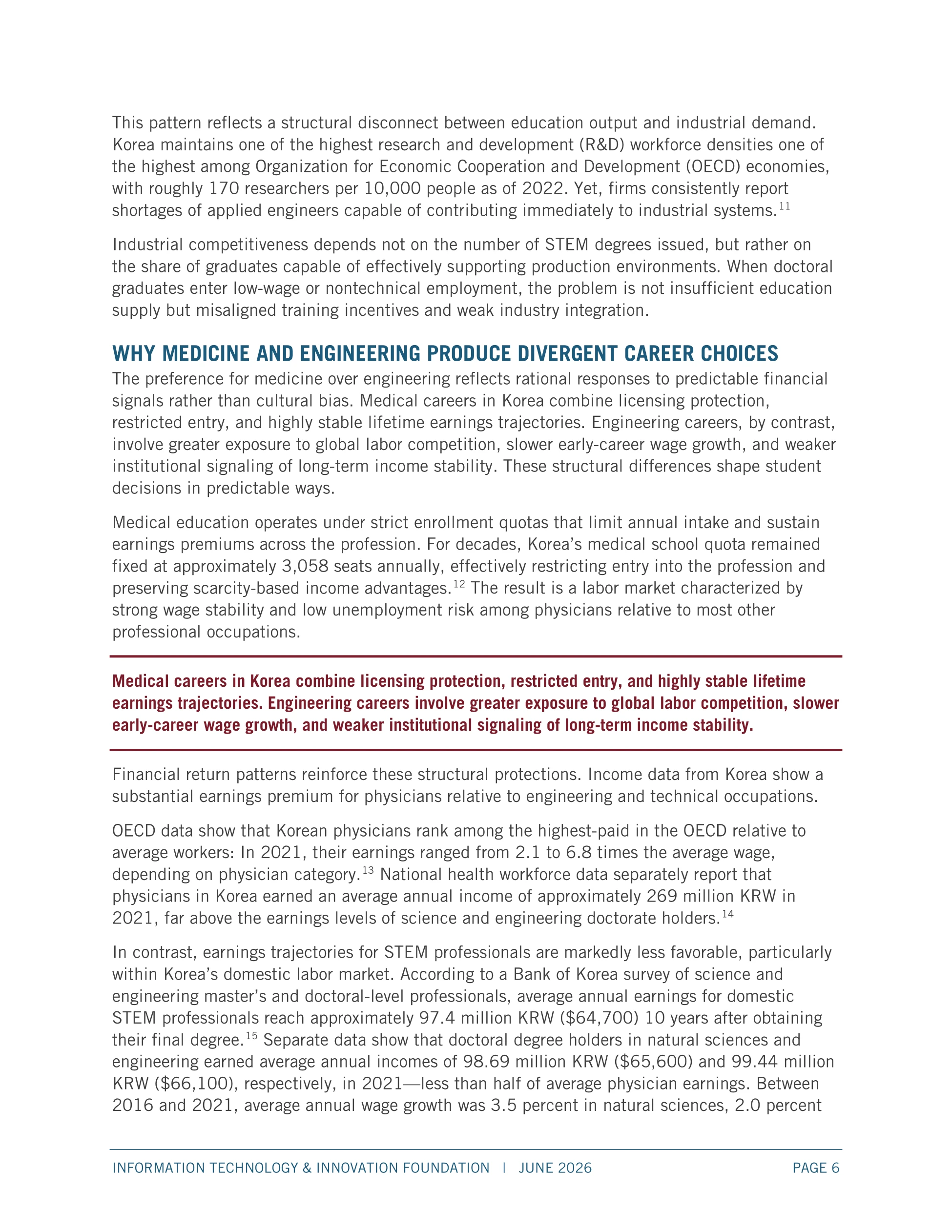
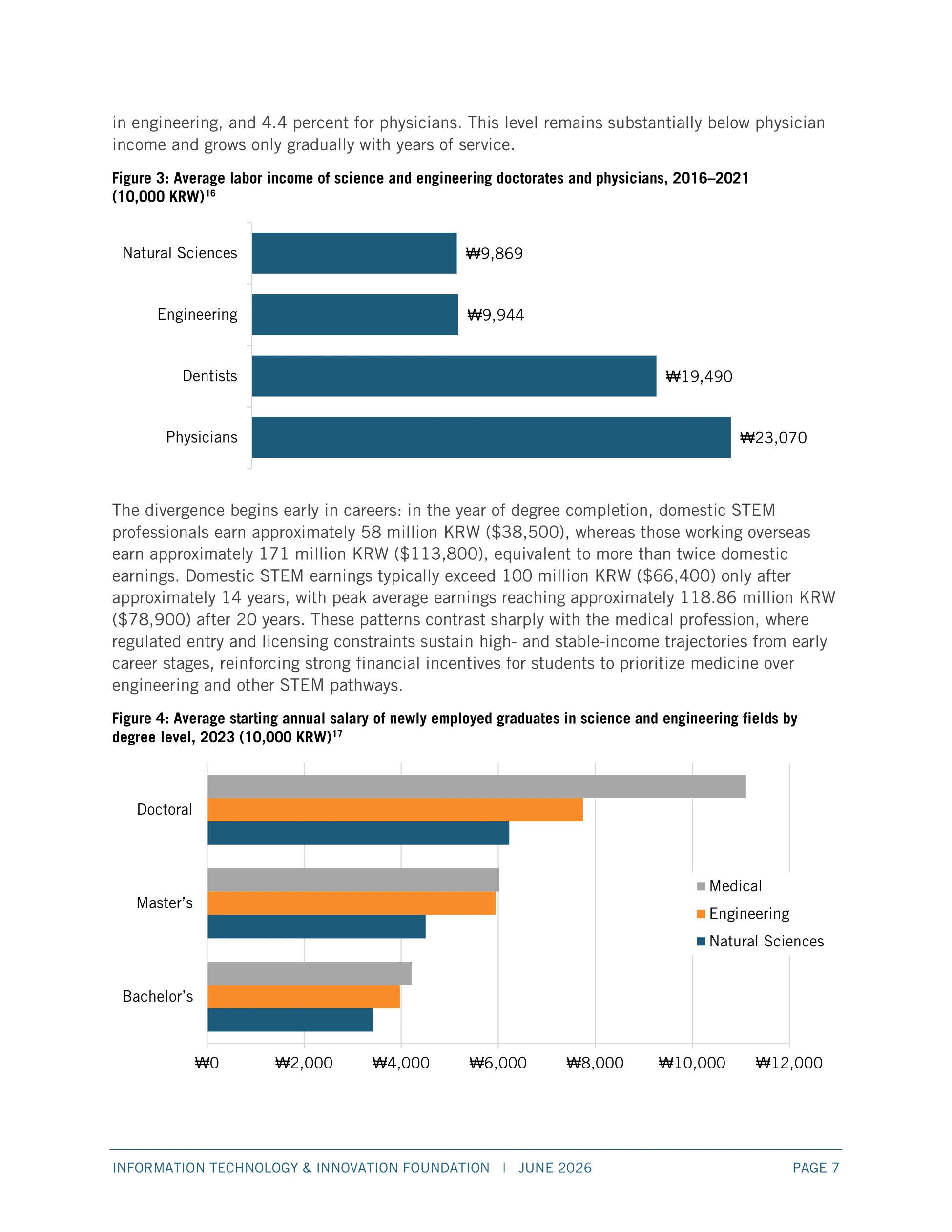
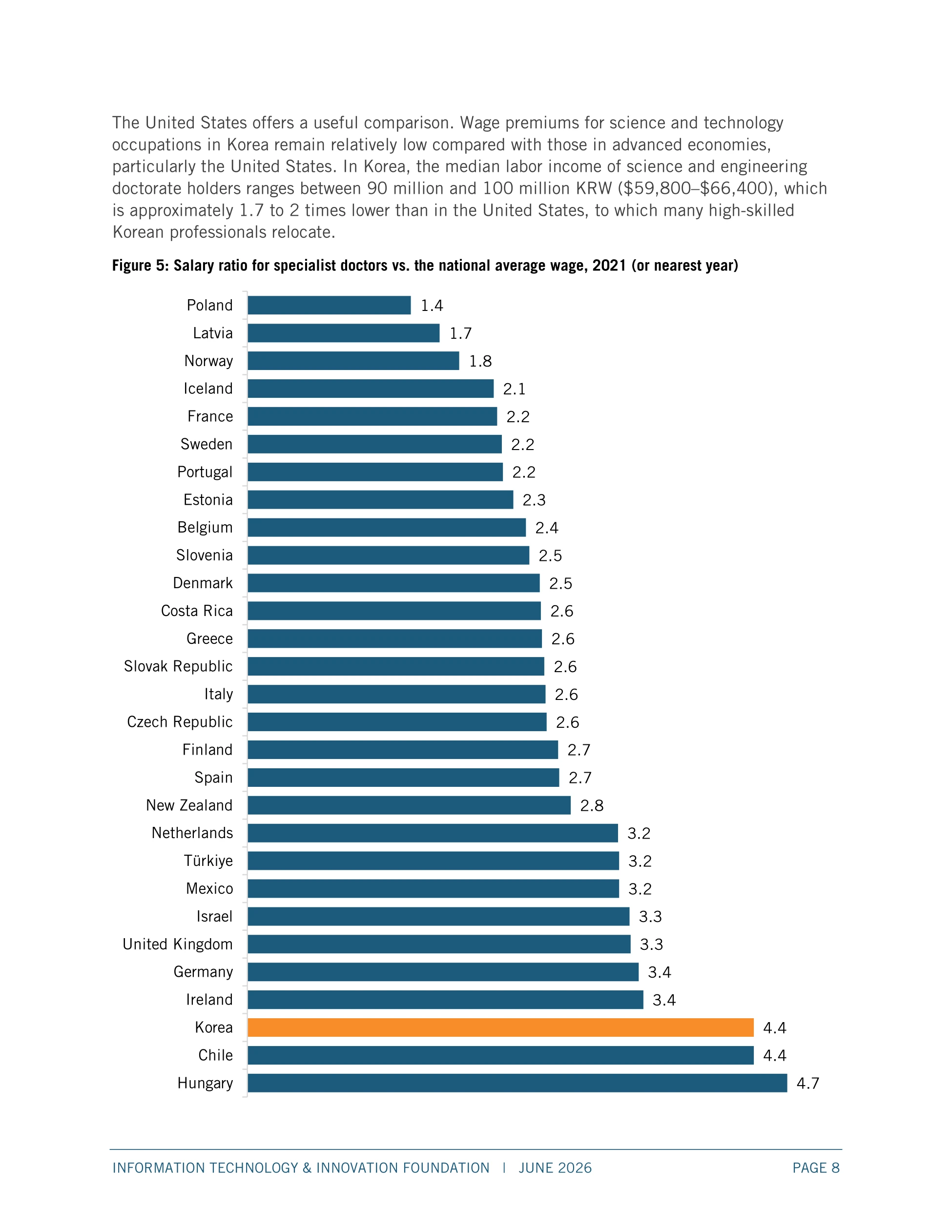
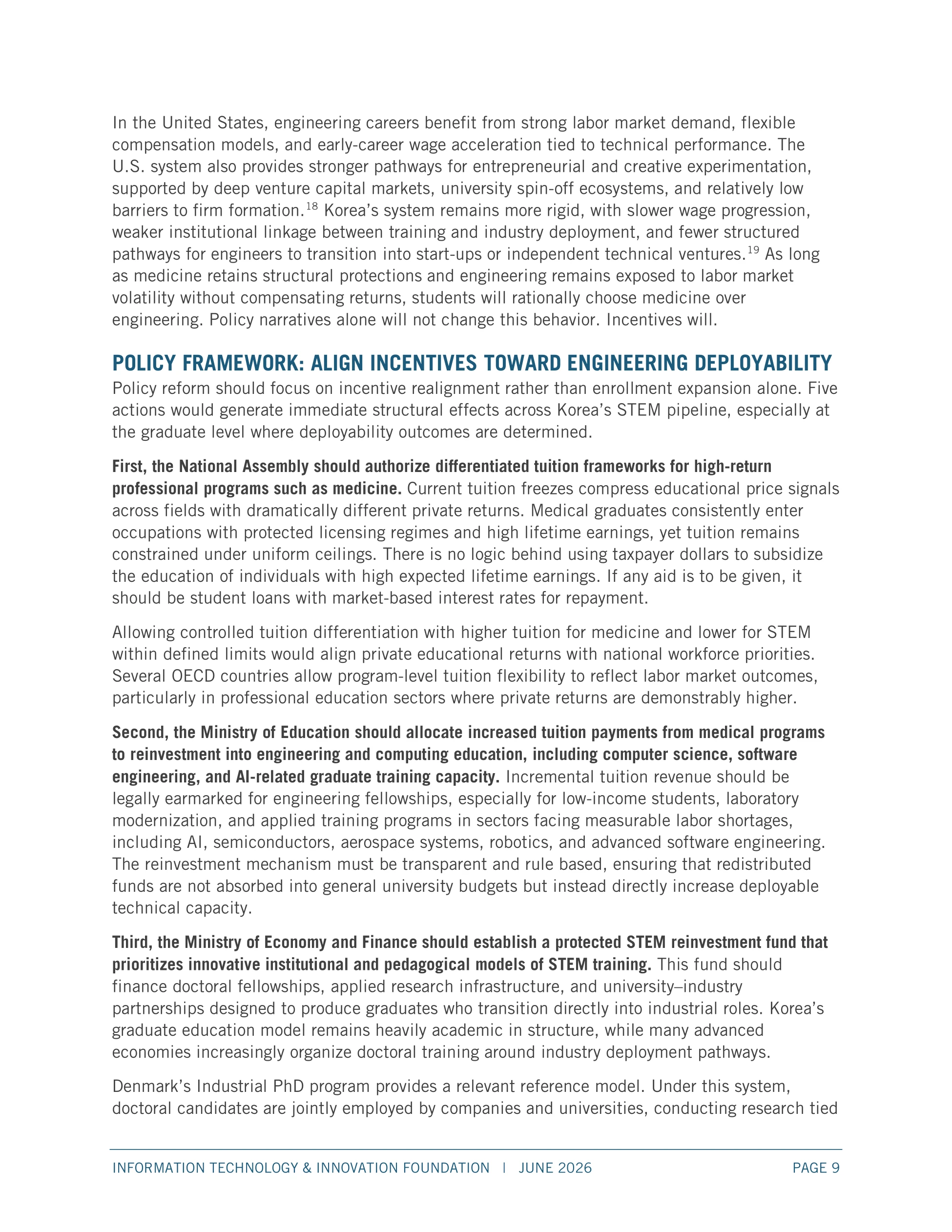
itif.org Korea’s STEM Talent Challenge: Fixing Incentives for Deployability ROBERT D. ATKINSON AND SEJIN KIM | JUNE 2026 South Korea produces large numbers of STEM graduates, but too many are attracted to medicine, and too few go into engineering. Korea should rebalance its education financing and university incentives to ensure that enough engineers are ready to work in advanced industries. KEY TAKEAWAYS Korea’s STEM challenge is not a pipeline shortage but a deployability gap. The countryproduces large numbers of graduates, yet firms still struggle to hire engineers andcomputing specialists who can contribute immediately to advanced industrial work.Korea’s incentive structure favors medicine over engineering. Protected medicallicensing, stable earnings, and regulated tuition create predictable returns, whereasengineering involves slower wage growth and greater early career uncertainty.Korea’s weak engineering ROI strengthens the case for reform. Compared with the UnitedStates, Korea offers weaker wage premiums, slower early career advancement, and fewerapplied career pathways for engineers.Korea should reform professional tuition policy to rebalance talent investment by allowingdifferentiated tuition in high-return fields such as medicine, with mandatory reinvestmentin engineering and applied science.Graduate education should be redesigned around deployability, not academic throughput.Korea should adapt Olin-style project training and Denmark’s Industrial PhD model toconnect STEM training directly to industry needs.INFORMATION TECHNOLOGY & INNOVATION FOUNDATION | JUNE 2026 PAGE 2 CONTENTS Key Takeaways ................................................................................................................. 1 Introduction ..................................................................................................................... 2 Korea’s STEM Shortage Is a Deployability Problem, Not a Degree Problem .............................. 5 Why Medicine and Engineering Produce Divergent Career Choices .......................................... 6 Policy Framework: Align Incentives Toward Engineering Deployability ..................................... 9 Conclusion ..................................................................................................................... 12 Endnotes ....................................................................................................................... 14 INTRODUCTION South Korea does not lack STEM (science, technology, engineering, and math) graduates. It lacks deployable engineers and computing specialists capable of contributing immediately to advanced industrial systems. Each year, Korean universities produce large cohorts of science and engineering graduates, yet firms continue to report persistent cumulative shortages of job-ready technical talent. By 2029, Korea is projected to face a shortage of roughly 580,000 workers in advanced technology sectors, including a...










































