
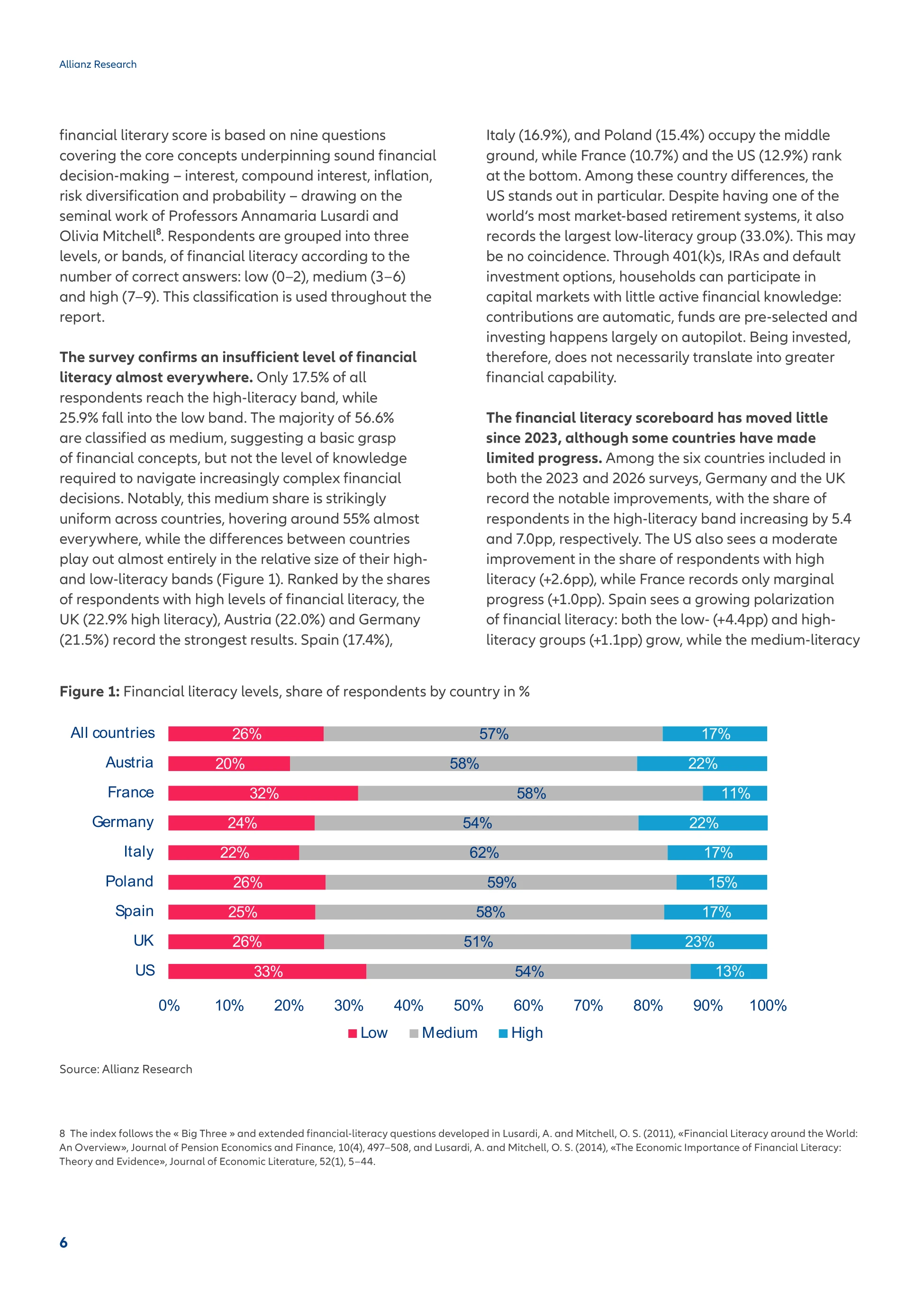
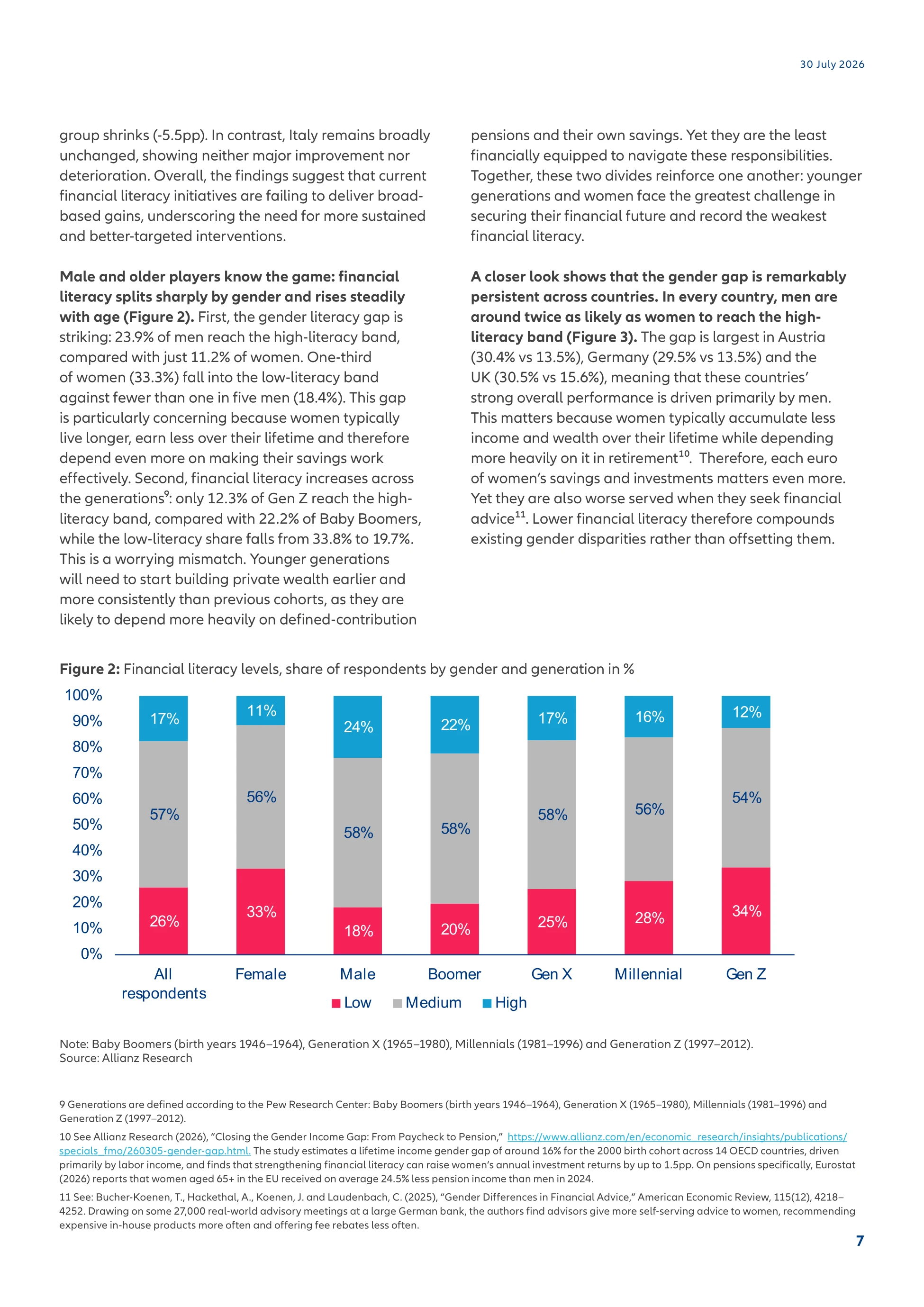
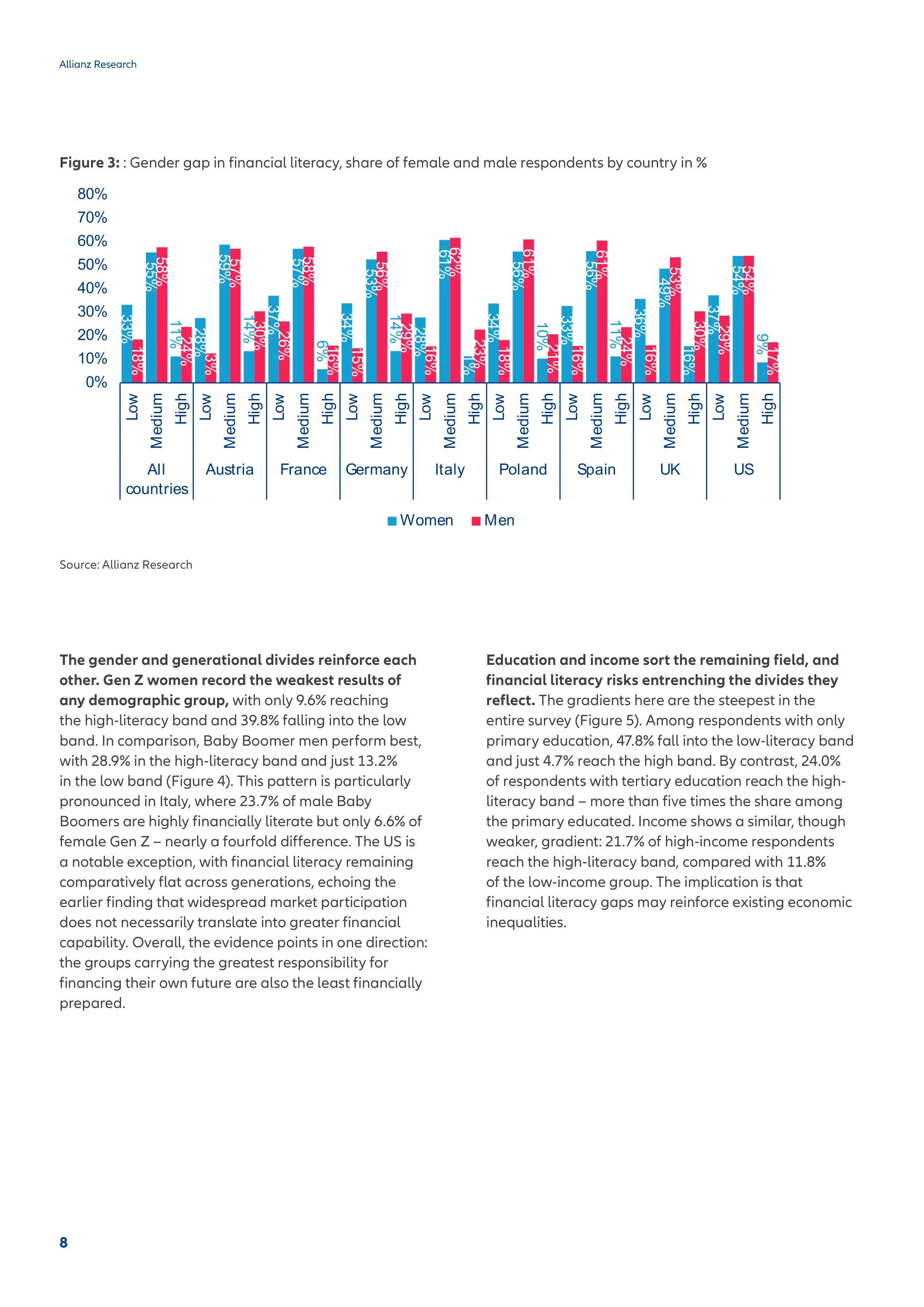
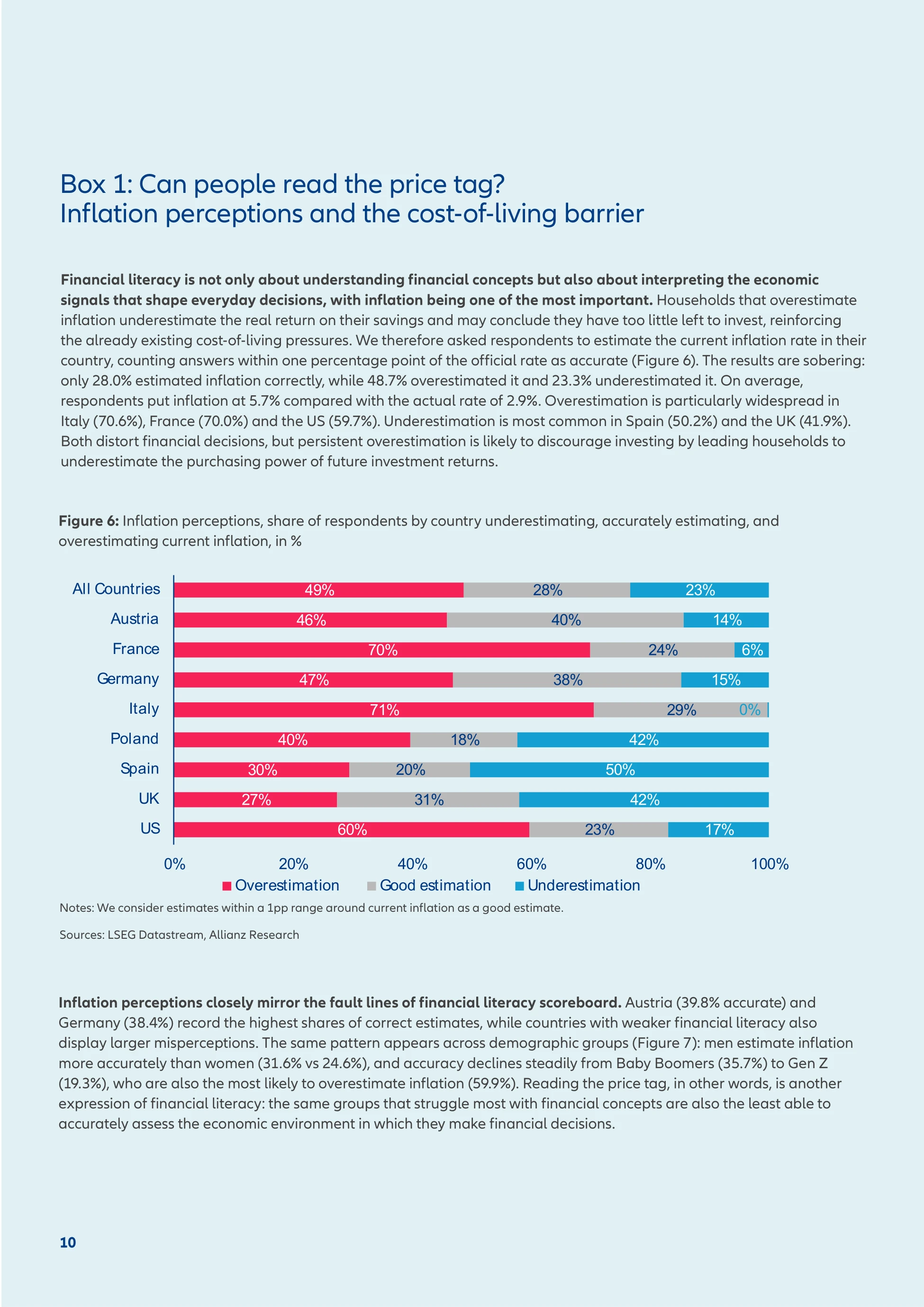
Allianz ResearchFinancial literacy pays: 30 July 2026Smarter investing goes beyond AI Allianz Research2Content Page 3-4 Executive SummaryPage 5-11 The financial literacy scoreboard: failing to reach the topPage 12-13 Financial confidence does not always follow financial competencePage 17-22 The price of not knowing is high Page 23-24 From advisor to algorithm: the new financial advice ecosystem Page 26-27 AppendixPage 25 What can be done: a five-point financial literacy playbookPage 28 Allianz School for LifePage 14-16 Saving intentions are stable, investment choices make the difference30 July 20263SummaryExecutive• Financial literacy is an important foundation for building, protecting and growing wealth over a lifetime, but it remains the exception. From children’s investment accounts in the US to pension reforms in Germany, responsibility for building wealth and financing retirement is increasingly shifting from institutions to individuals. As financial products become more complex and private provision more important, understanding basic financial concepts such as compound interest, inflation, risk and diversification is more important than ever. Yet financial capability is failing to keep pace. The fourth edition of the Allianz Research financial literacy study, questioning more than 8,000 respondents across eight countries, shows little change since our last survey in 2023¹. Literacy remains worryingly low: only 17% scored as highly financially literate, while one in four scored low. The UK (23%), Austria (22%) and Germany (22%) record the highest share of highly financially literate respondents, Spain (17%), Italy (17%) and Poland (15%) occupy the middle ground, while the US (13%) and France (11%) rank at the bottom. The US also records the largest low-literacy group (33%), suggesting that greater capital-market participation does not automatically translate into greater financial capability. • Women, younger respondents and those less educated face the greatest financial challenges, but score lowest on financial literacy – a pattern that is remarkably consistent across countries. Women need to finance longer retirements and accumulate private wealth, yet are only half as likely as men to achieve high literacy (11% vs. 24%). Younger generations also bear greater responsibility for privately funding their retirement as public pension systems come under growing pressure, yet they record the weakest results²: only 12% of Gen Z score as highly literate, compared with 22% of Baby Boomers. At the intersection of both divides, Gen Z women perform worst (10% high; 40% low), while Boomer men perform best (29% high; 13% low). Education is an even stronger divider: just 5% of respondents with primary education achieve high literacy, compared with 24% of those with tertiary education. Confidence and competence are also misaligned: While 17% of respondents...