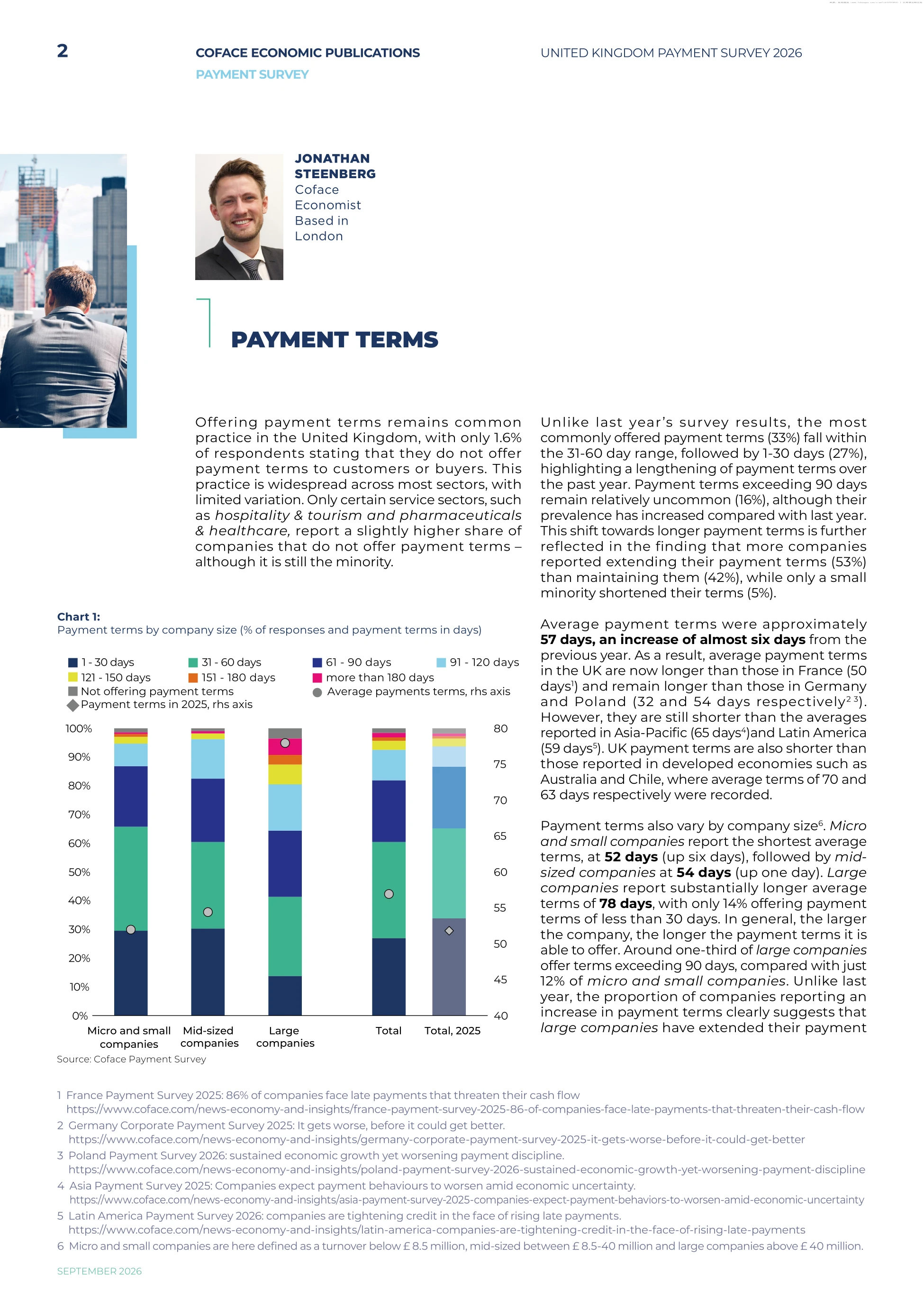
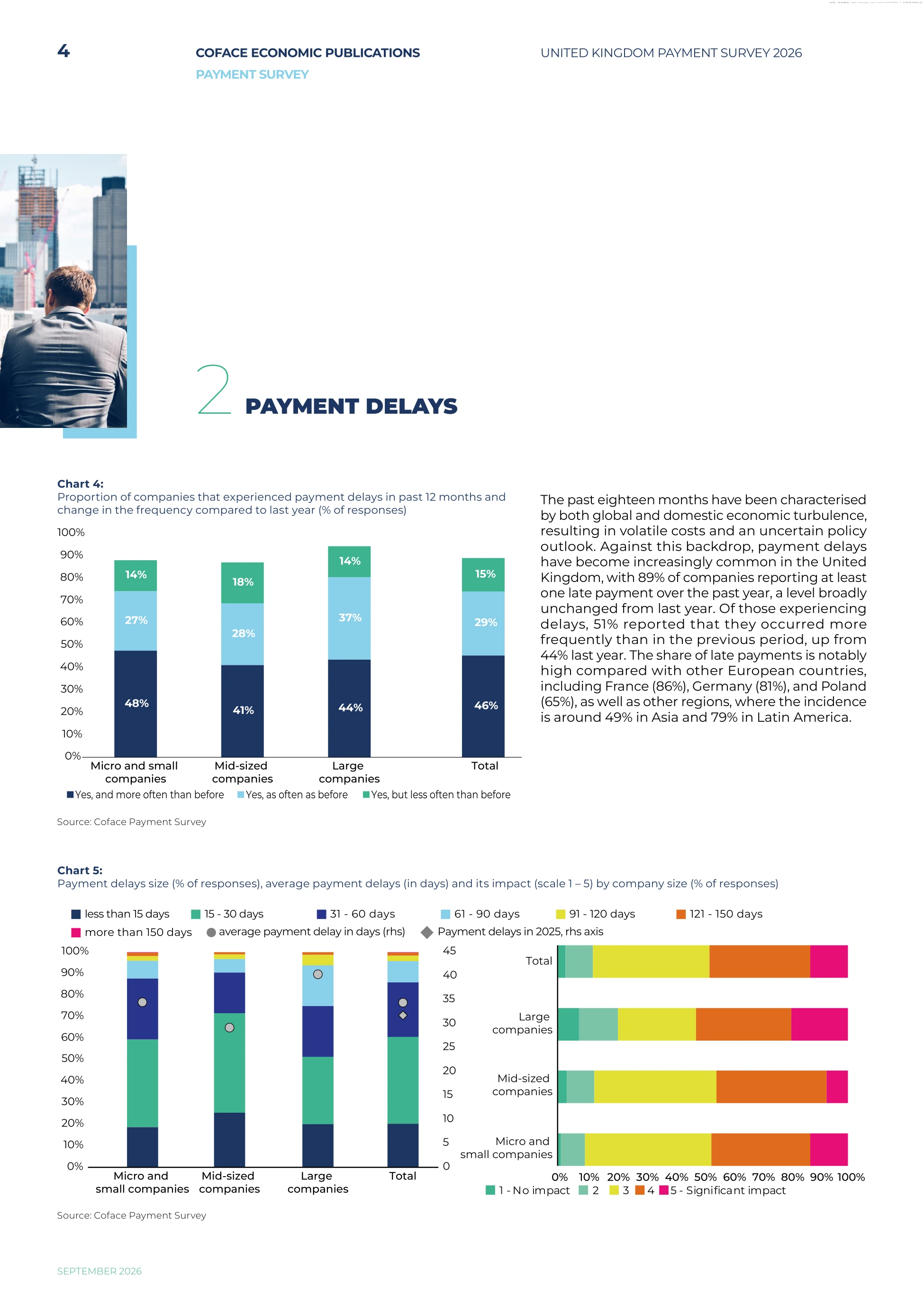
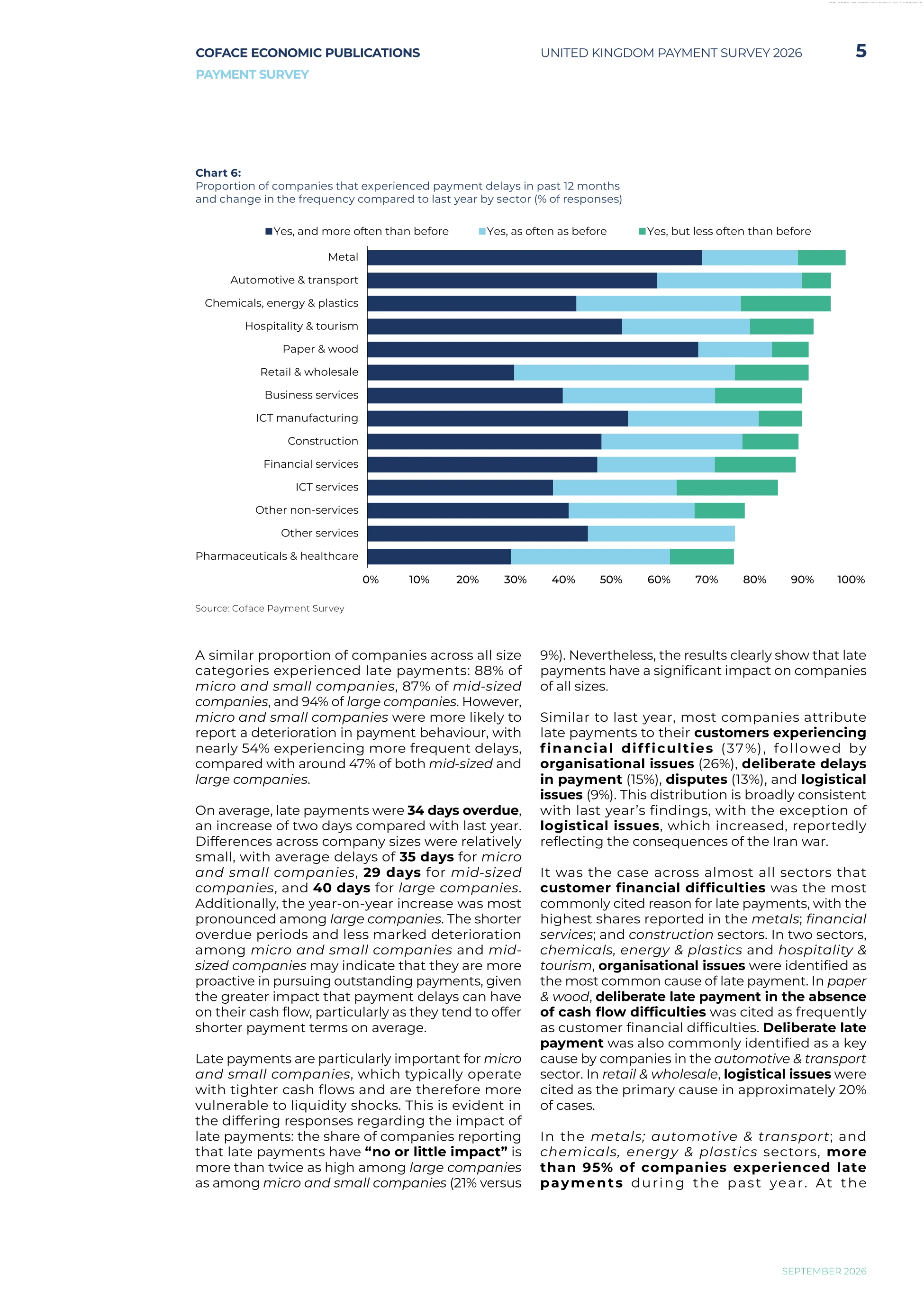
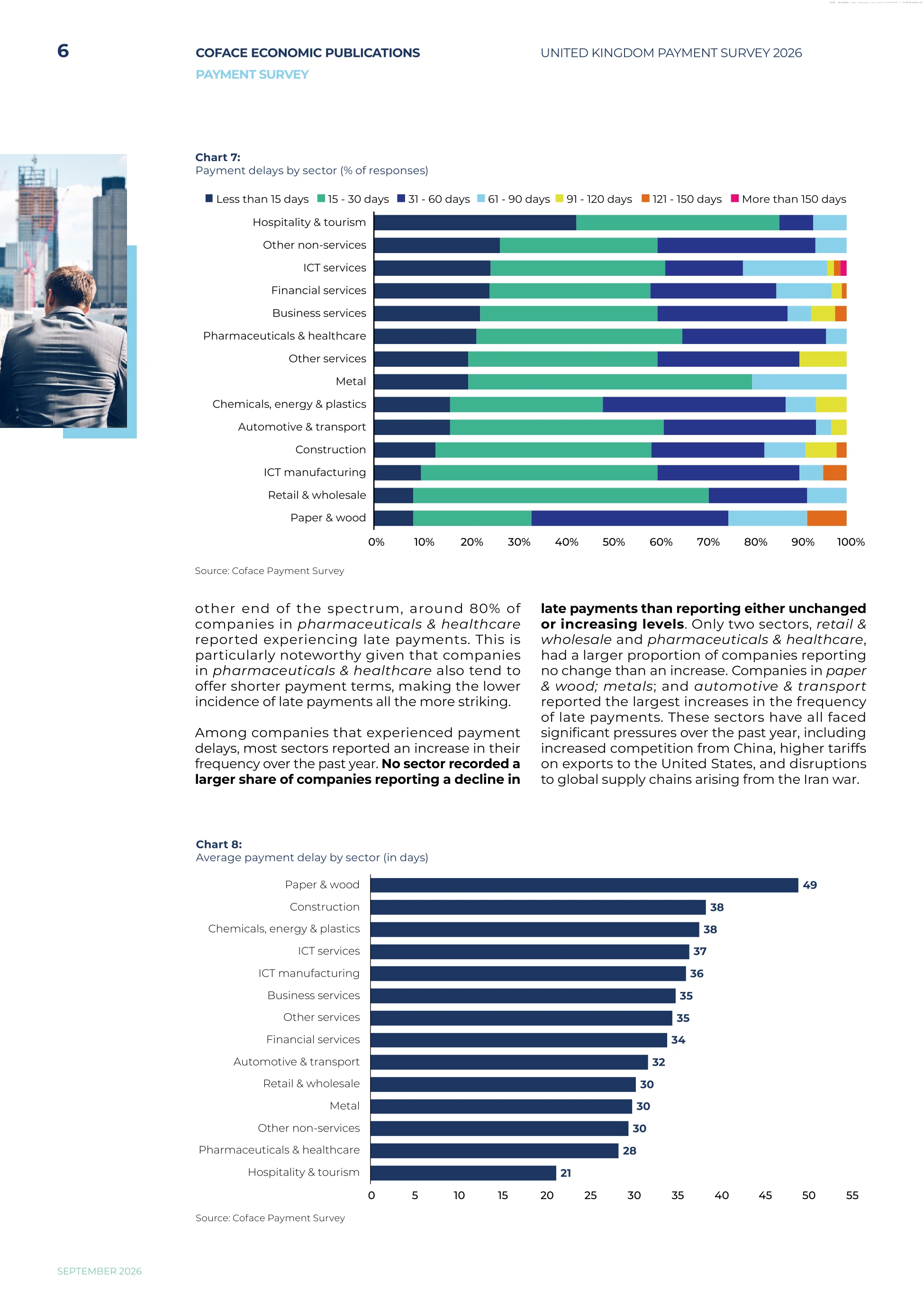
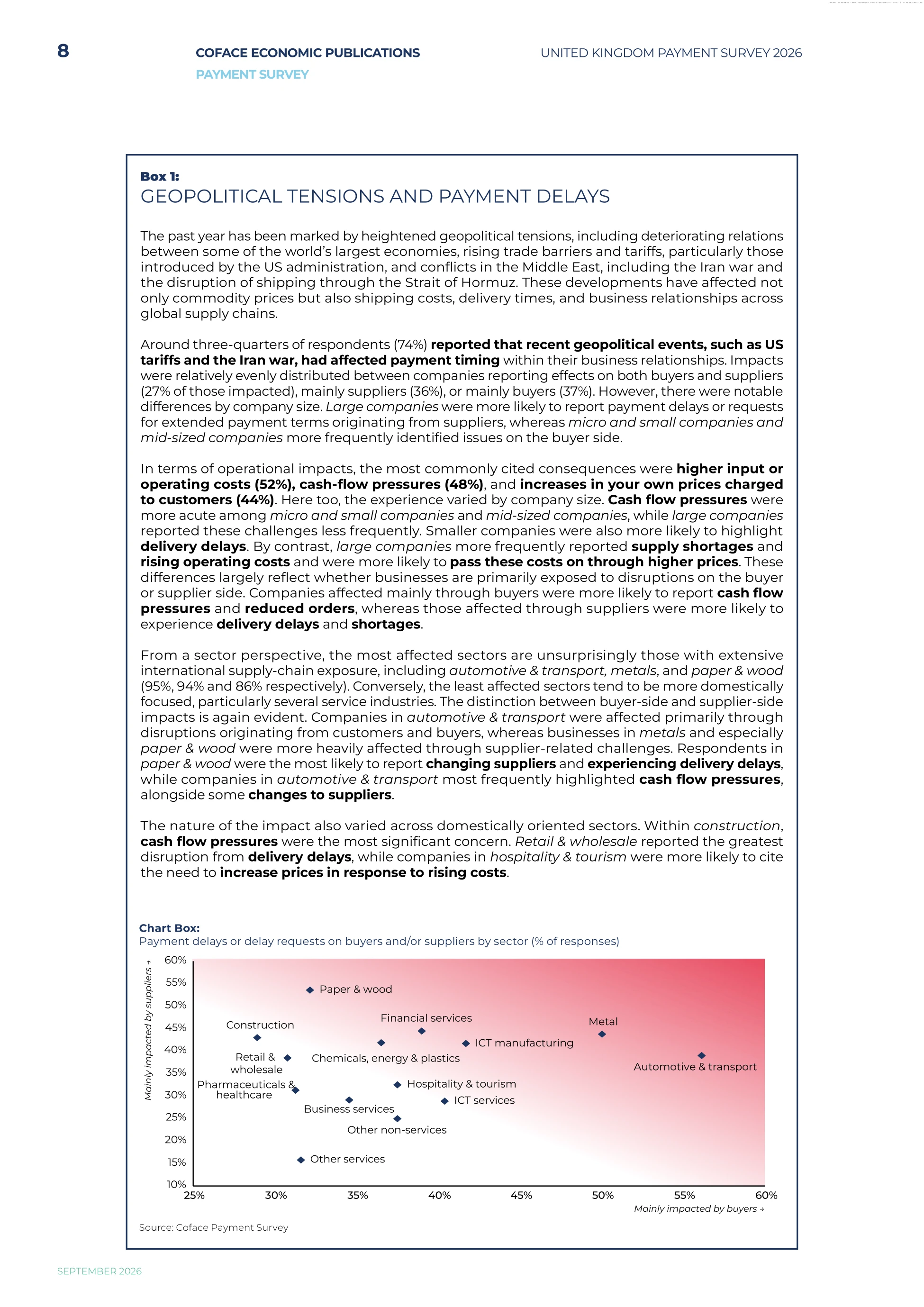
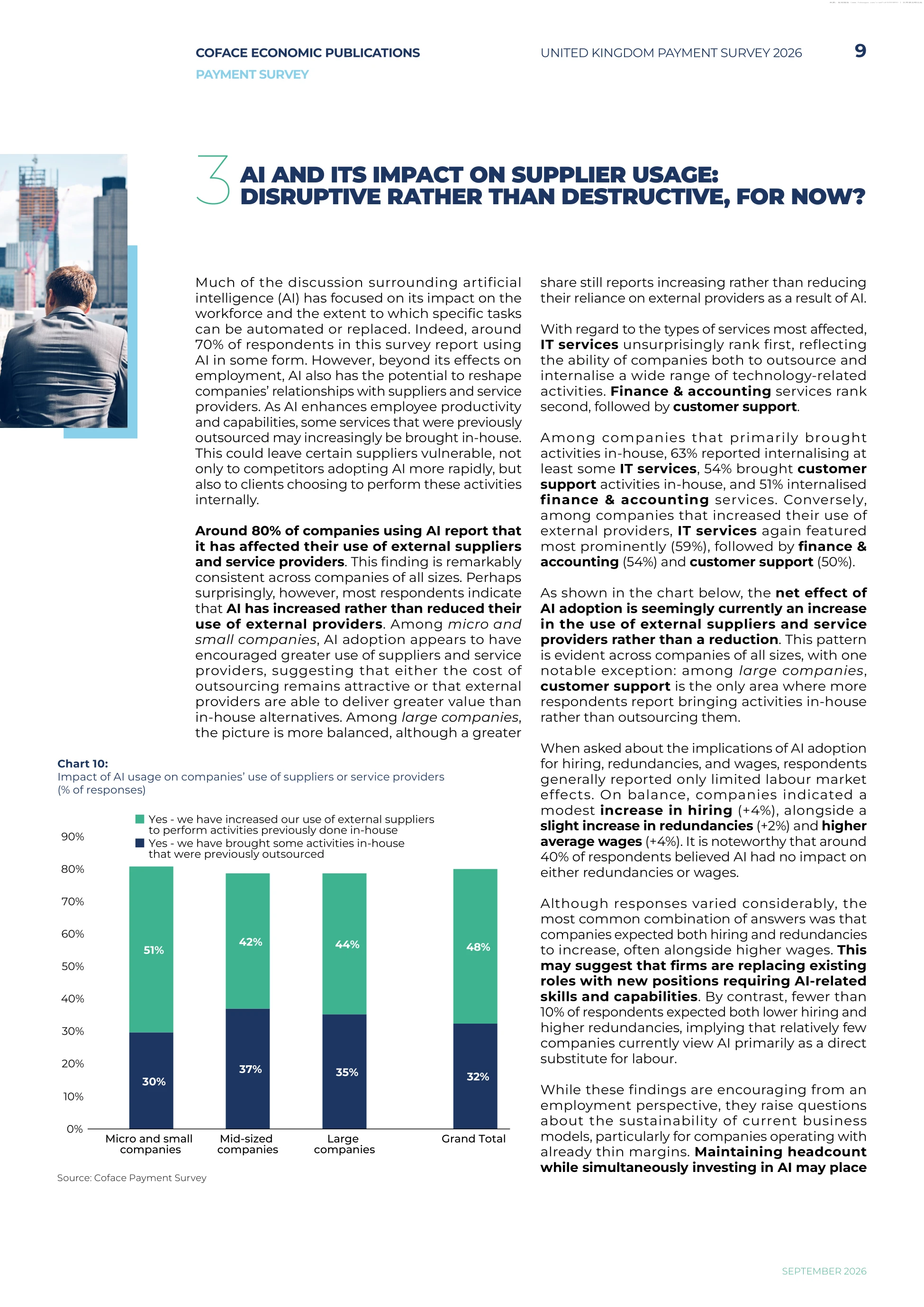
来源:发现报告(www.fxbaogao.com/view?id=5701893)| 引用请注明出处SEPTEMBER 20262026 United Kingdom Payment Survey: Companies expect further rises amid higher payment delaysExecutive summaryThe second edition of our payments survey confirms that offering payment terms remains an integral part of doing business across virtually all sectors in the United Kingdom (UK). Average payment terms have increased to around 57 days, driven primarily by large companies extending the terms they offer. As a result, payment terms in the UK are now longer than those reported in most other European countries covered by Coface surveys.As in last year’s survey, payment delays remain widespread in the UK, with around 90% of companies having experienced at least one late payment during the past 12 months. Payment delays are also more prevalent in the UK than in comparable countries, including France and Germany. On average, late payments were 34 days overdue, an increase of two days compared with last year. Once again, this increase was driven primarily by large companies. While late payments are more common among large companies, their impact is generally more severe for micro & small companies. Customer financial difficulties remain the most commonly cited cause of late payments. The incidence of late payments was highest in sectors facing significant recent pressures, including metals; automotive & transport; and chemicals, energy & plastics.Around 75% of respondents reported that recent geopolitical developments had affected payment timing within their business relationships. The effects were distributed relatively evenly between companies reporting impacts on both buyers and suppliers. In operational terms, the most commonly cited consequences were higher costs, cash-flow pressures, and increases in prices to customers.Roughly 80% of companies using AI reported that it had affected their use of external suppliers and service providers. This finding is remarkably consistent across companies of all sizes. Perhaps surprisingly, most respondents indicated that AI had increased, rather than reduced, their reliance on external providers. Consequently, AI adoption may place pressure on profitability in the near term, with these effects potentially extending into the medium term if the expected productivity gains do not fully materialise.The share of companies expecting the number of late payments to increase over the next 12 months (57%) is substantially higher than the share expecting a decline (15%), pointing to a net deterioration in payment behaviour. This outlook is also more pessimistic than last year’s. Companies are generally pessimistic about the economic outlook, both domestically and globally, and more so than a year ago. However, they remain somewhat more optimistic about their own prospects, particularly with regard to cash flow and profitability. Most companies cont...










































