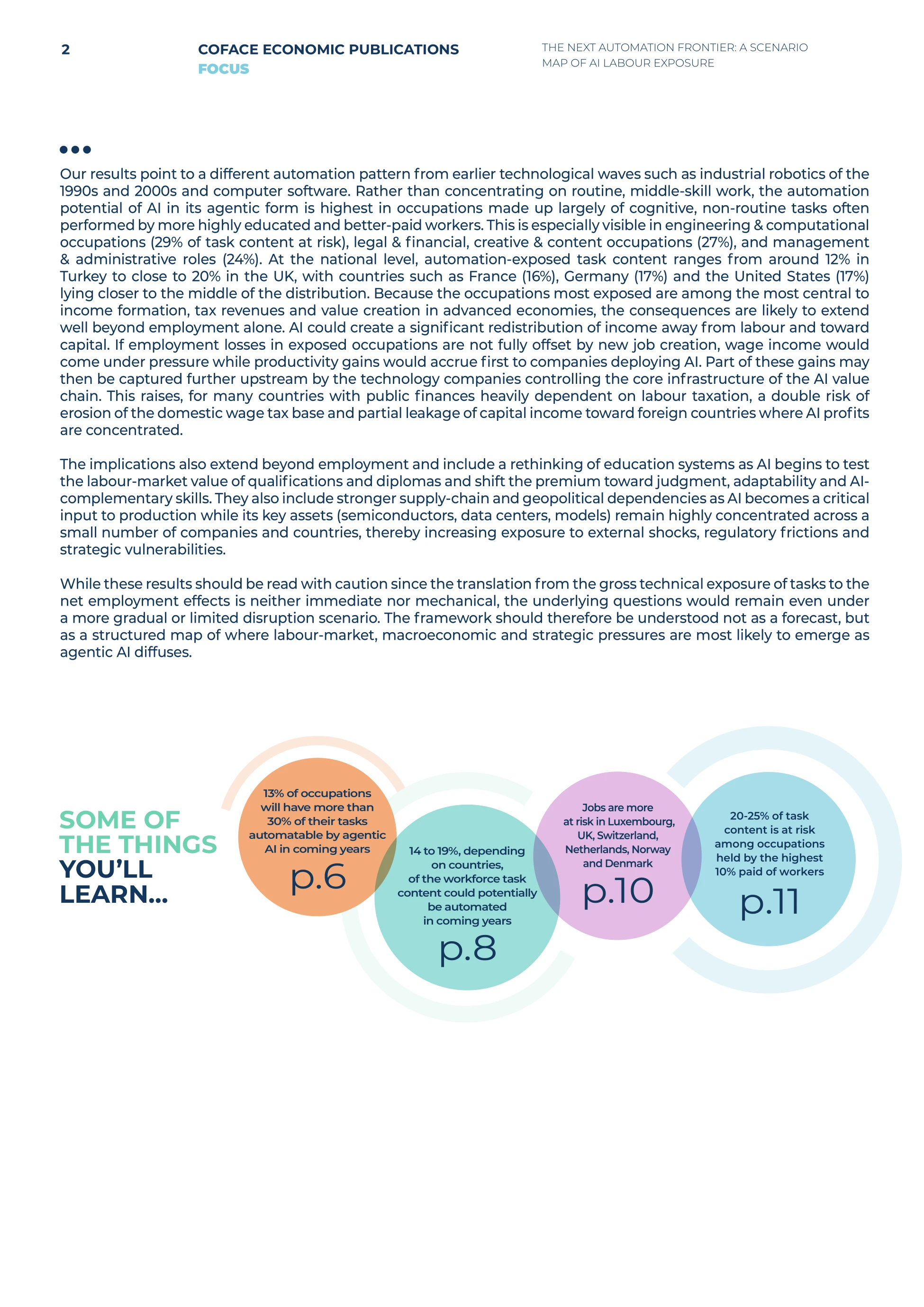
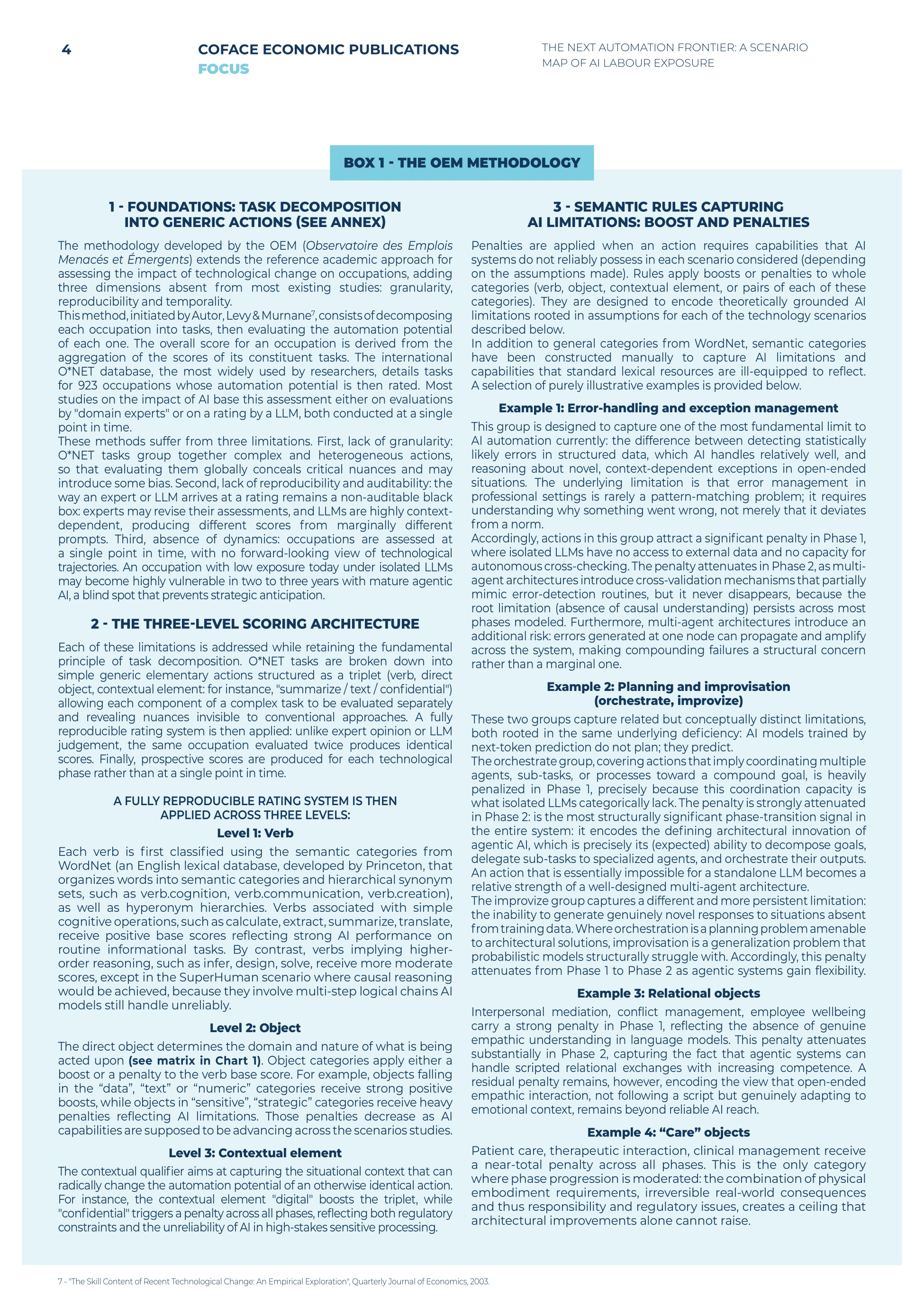
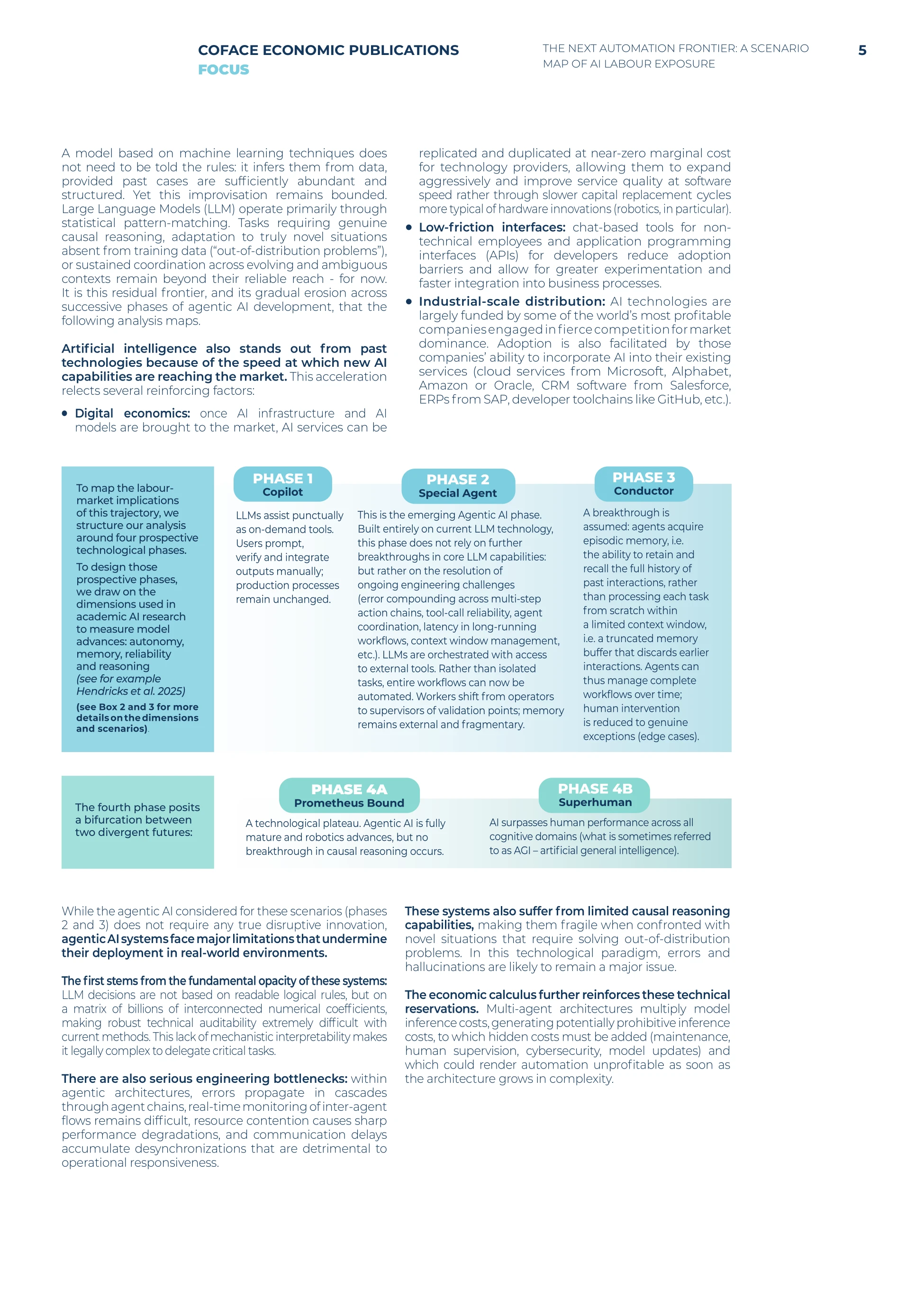
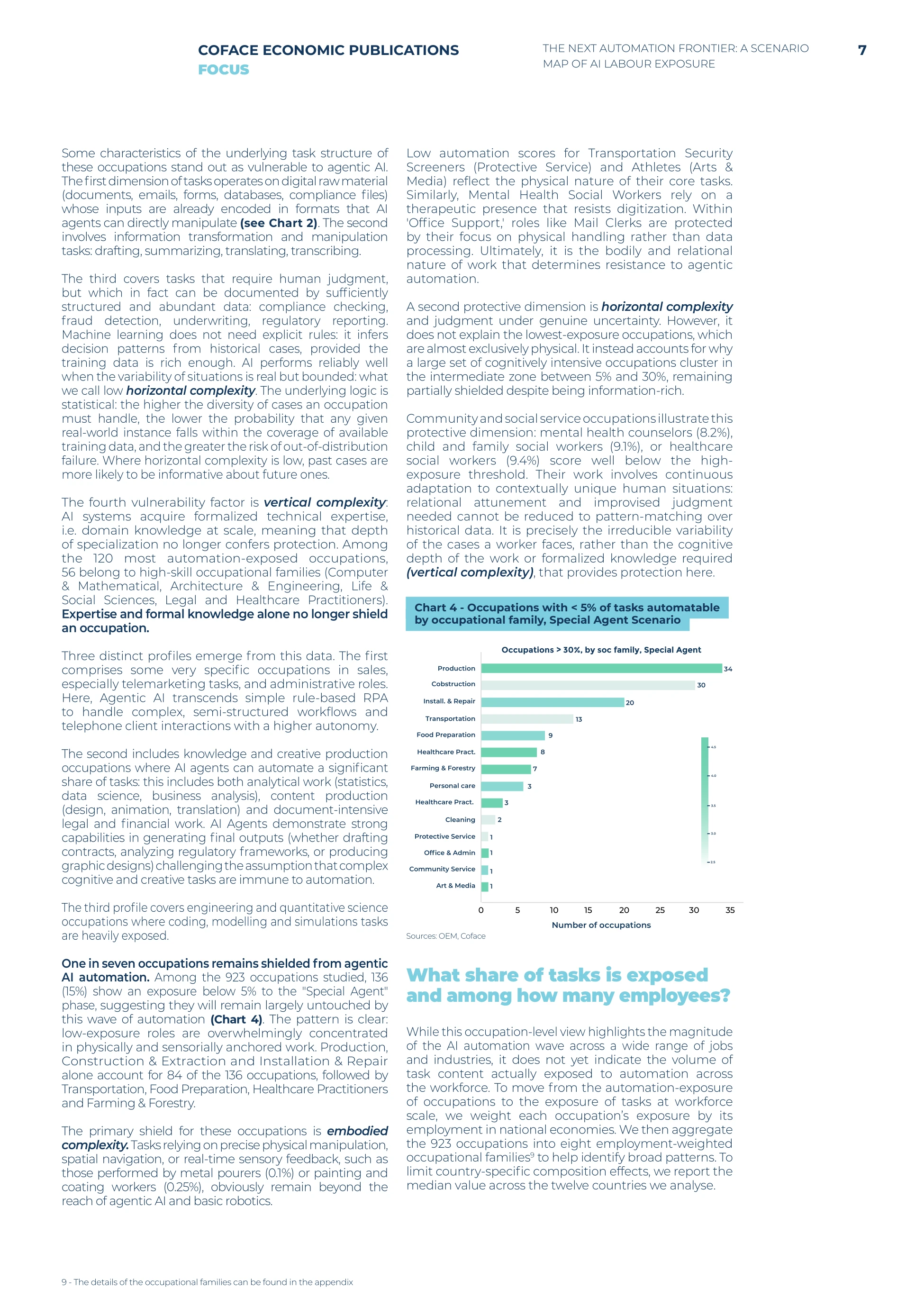
ALL OTHER GROUP ECONOMIC PUBLICATIONS ARE AVAILABLE ON: https://www.coface.com/news-economy-and-insightsFOCUSCOFACE ECONOMIC PUBLICATIONSAPRIL 2026The Next Automation Frontier: A Scenario Map of AI Labour ExposureEXECUTIVE SUMMARYThree years after the release of ChatGPT, AI seems to be everywhere in corporate discourse, and yet still almost nowhere in aggregate labour-market statistics. The first effects are however beginning to appear, mainly at the margins, among the younger, entry-level workers of the most exposed occupations and industries. This apparent paradox may simply reflect timing, with the current phase of AI adoption still largely focused on tools that assist work without reorganizing it, and the current evidence capturing early signals rather than the main shock itself. We believe the rise of agentic AI systems, that is, systems capable of planning, coordinating and executing multi-step workflows, could accelerate and amplify the disruptive impact of AI on labour markets by moving from assistance on isolated tasks to the execution of entire workflows.To move beyond these early signals, the Observatoire des Emplois Menacés et Émergents (OEM) developed a task-based framework to measure the technical exposure of occupations to successive phases of AI development. While many existing studies rely either on expert judgment or one-off assessments produced by large language models, the OEM approach breaks complex tasks into elementary actions, applies explicit and reproducible scoring rules and projects exposures along successive technological phases rather than a single point in time. The result is a granular, reproducible and prospective way to assess how advances in AI could reshape occupations, industries and labour markets. Together with the OEM, Coface contributed to extending this framework by developing a weighting method for tasks, refining further both the prospective automation scenarios and the notation rules elaborated by the OEM, and by broadening the empirical scope of the analysis. This framework is deliberately gross and supply-side: it measures technical exposure to automation, not net job destruction. It abstracts from demand dynamics, from potential new task creation and from frictions that may slow deployment.By Axelle Arquié, Economist and Co-founder of the Observatoire des emplois menacés et émergentsAurélien Duthoit, Senior Sector Economist, based in Paris Galeran Subileau, Junior Economistl l lCOFACE ECONOMIC PUBLICATIONS FOCUS2THE NEXT AUTOMATION FRONTIER: A SCENARIO MAP OF AI LABOUR EXPOSURESOME OF THE THINGS YOU’LL LEARN…13% of occupations will have more than 30% of their tasks automatable by agentic AI in coming yearsp.620-25% of task content is at risk among occupations held by the highest 10% paid of workersp.1114 to 19%, depending on countries, of the workforce task content could potentially be automated in coming...










































