
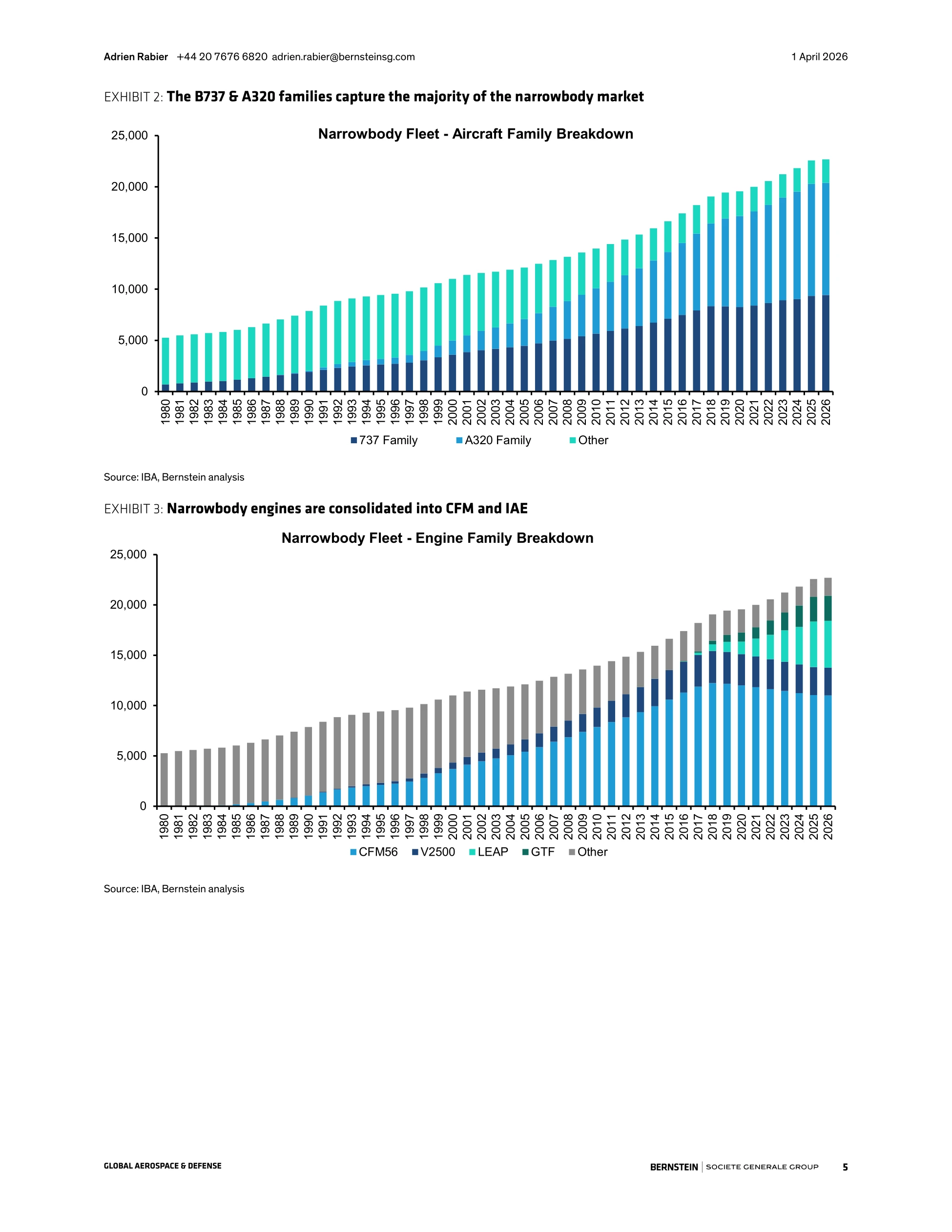
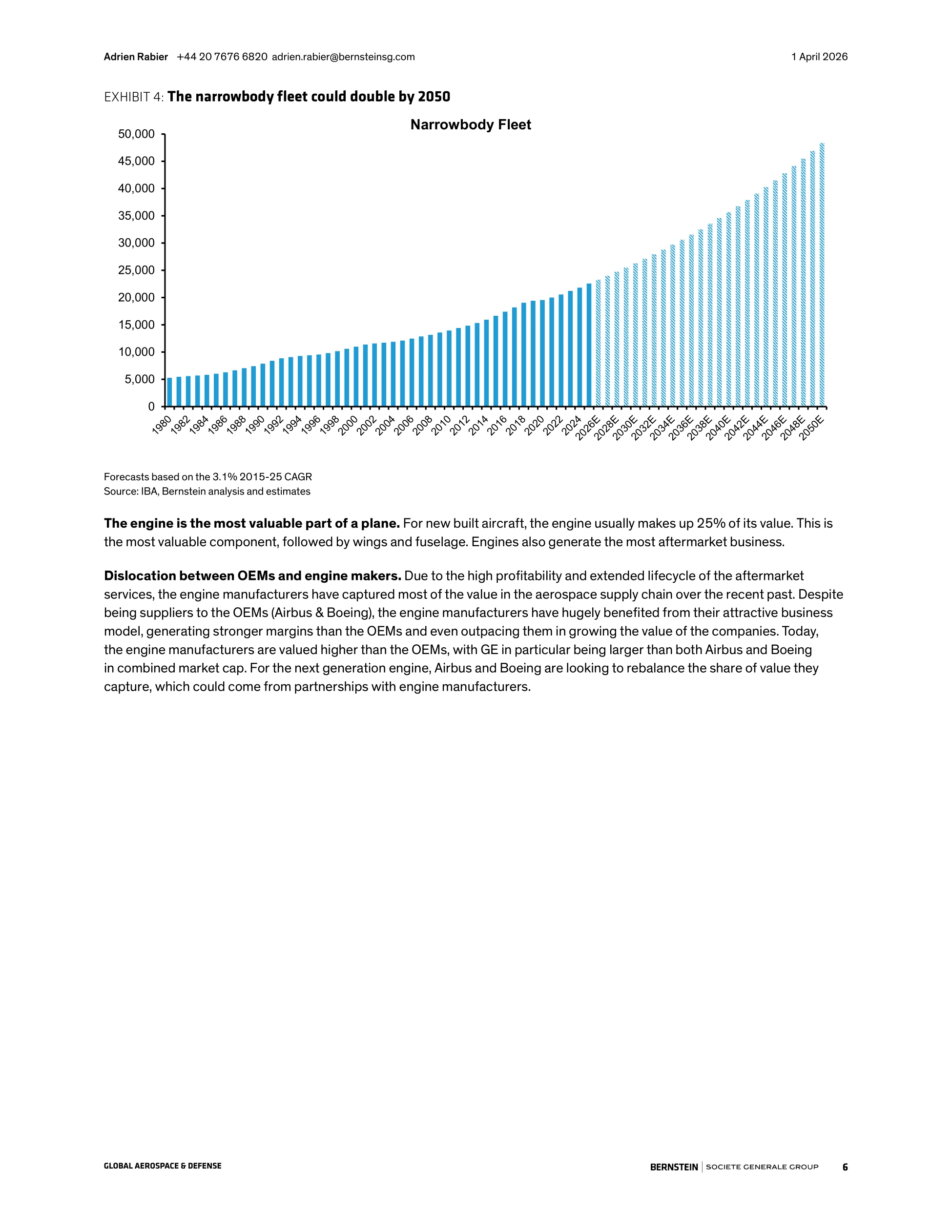
FUTURE OF TECH1 April 2026Global Aerospace & DefenseFuture of Tech: Next Generation Engine… Can the Open-RotorWin?Adrien Rabier+44 20 7676 6820adrien.rabier@bernsteinsg.comDouglas S. Harned, Ph.D.+1 917 344 8430douglas.harned@bernsteinsg.comCyriaque Blanchet+44 20 7676 7342cyriaque.blanchet@bernsteinsg.comJennifer Ma+1 917 344 8408jennifer.ma@bernsteinsg.comSpecialist SalesJames Brady+44 20 7762 5272james.brady@bernsteinsg.comSteve Song+1 917 344 8401steve.song@bernsteinsg.comBernstein will host its Future of Technology conference in London & Paris on April 21 & 22.We’ll host an expert panel dedicated to the future generation of narrowbody engines, with afocus on GE and Safran’s new technology: the RISE.25,000 narrowbody aircraft, doubling by 2050. The narrowbody segment accounts for76% of the total of the aircraft fleet, globally. It is dominated by two programs: Airbus’ A320(48% market share), and Boeing’s B737 (42%). The narrowbody fleet is growing, driven bythe increased affordability of air travel in emerging markets, and the penetration of low-costcarriers, which only use narrowbody jets. We expect the fleet to double by 2050.A profitable duopoly, in a ~$50bn market. Engine manufacturers have positionedthemselves as the largest beneficiaries of the current Aerospace cycle, driven by theshortage of new aircraft. The profitability of the business, especially the aftermarketbusiness, made engine manufacturers some of the best Industrials companies. GE topsthe list, with a market cap larger than Airbus and Boeing combined. The narrowbodyengine market is effectively a duopoly between CFM (GE & Safran) and Pratt & Whitney andpartners (MTU, JAEC). CFM controls ~75% of the market, as it is the sole-source on theB737, and controls a ~60% market share on the A320.Next generation is tomorrow’s technology, but today’s debate. The next generationnarrowbody programs from Airbus & Boeing should not be flying before 2038, at theearliest. But, the engine selection could happen in the coming years and is one of themost important debates for the stocks, because of the many options on the table and theimportance of being selected for the next generation.Safran & GE’s RISE. Announced in 2021, RISE is CFM’s next generation project. RISEstands for Revolutionary Innovation for Sustainable Engines. The project is built around anopen rotor technology (see Exhibit 1). CFM believes the open rotor architecture, combinedwith new materials and more hybridization, is the only path toward the required 20% fuelsaving. That is the threshold for airlines to justify purchasing new aircraft. The RISE couldalso be compatible with100% unblended sustainable aviation fuels (SAF), or hydrogen. Theopen-rotor architecture has existed for decades but never made it to a large commercialprogram. We see several challenges for the adoption of the RISE. Most importantly, theneed to adapt the plane around...










































