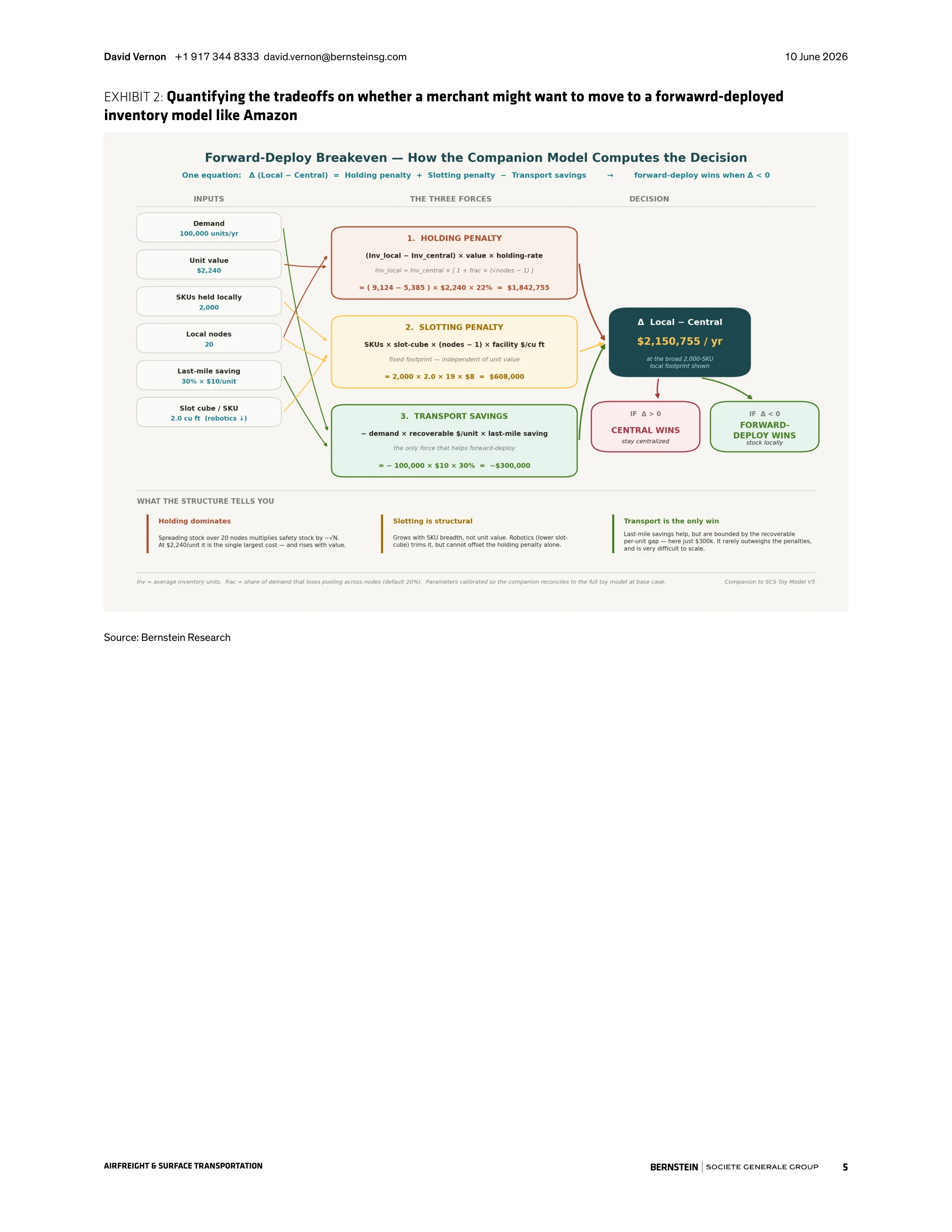
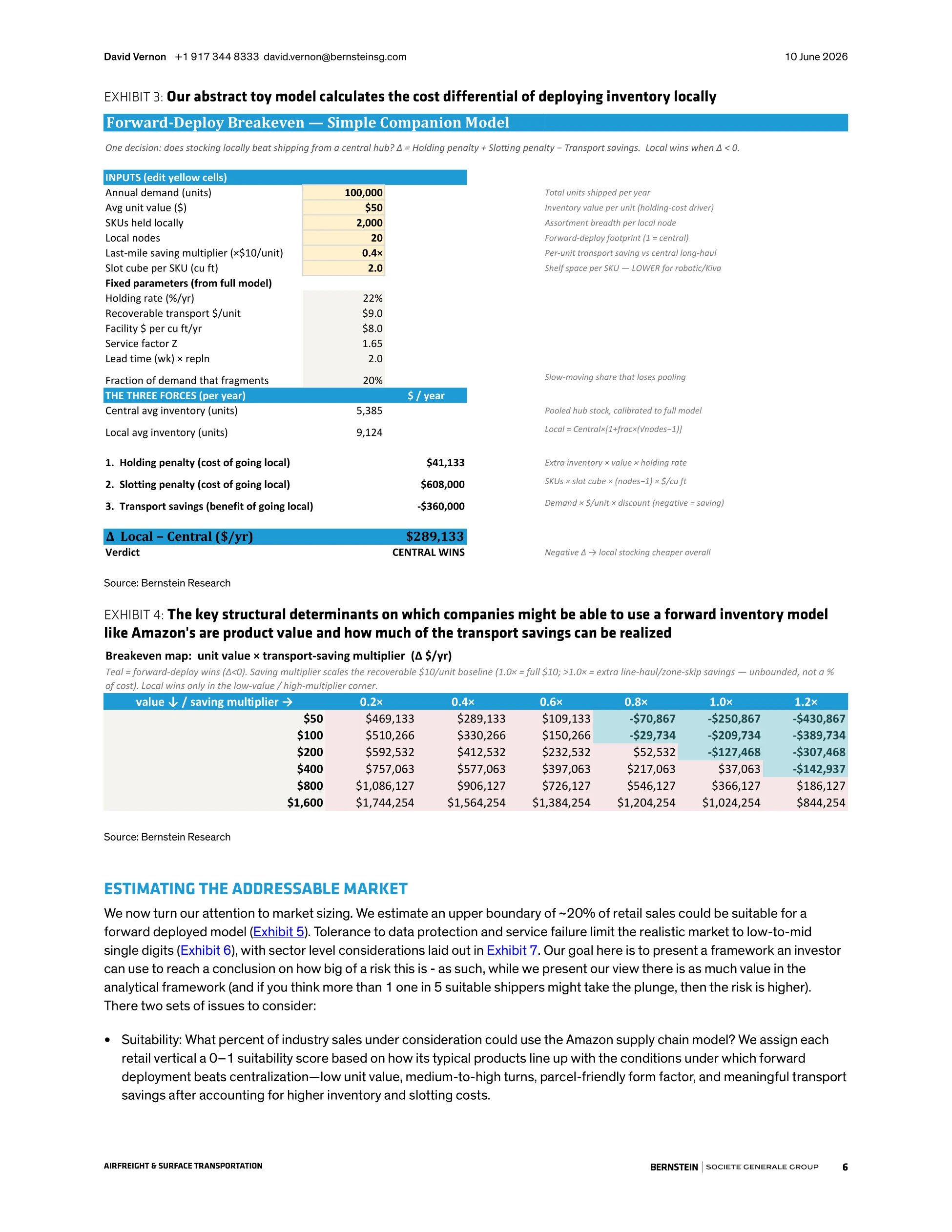
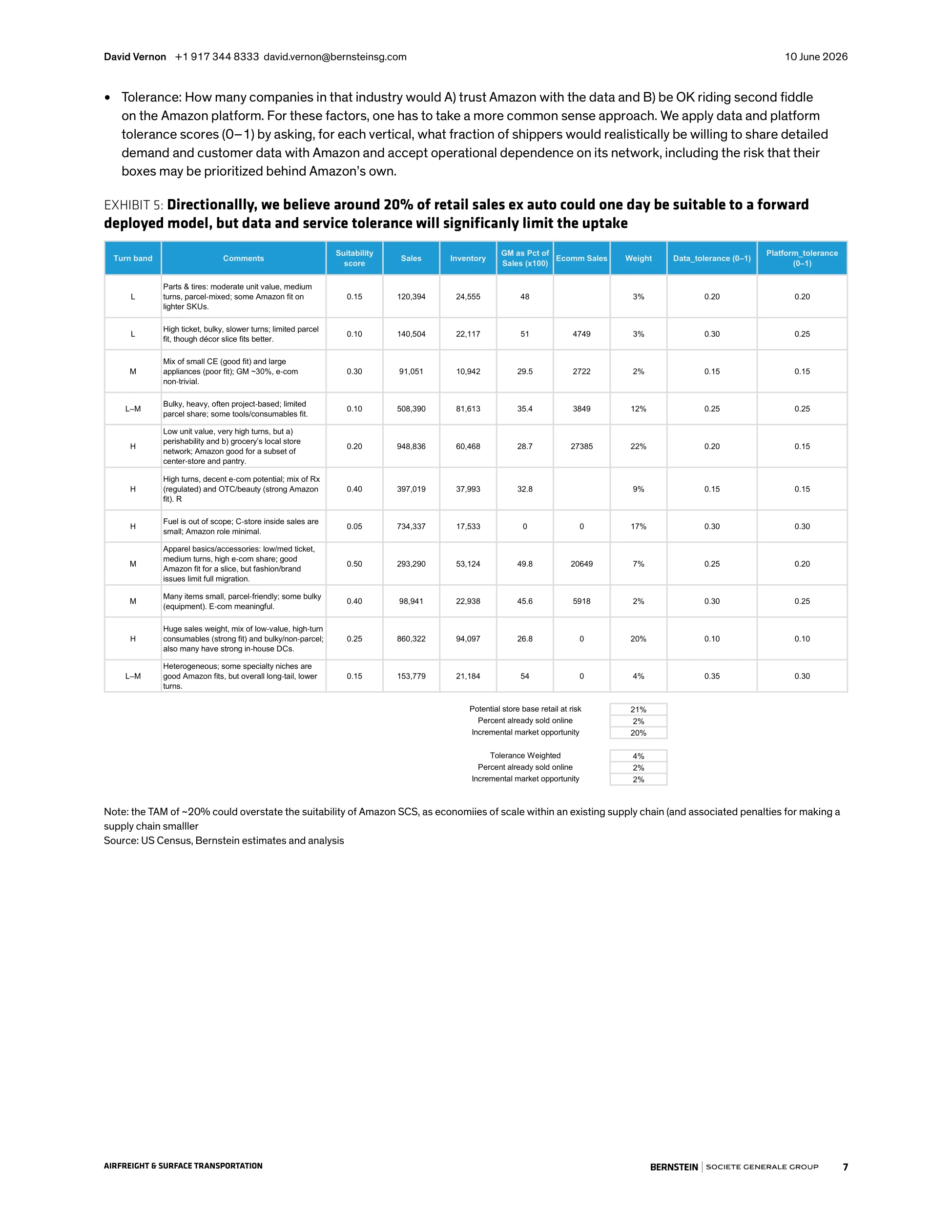
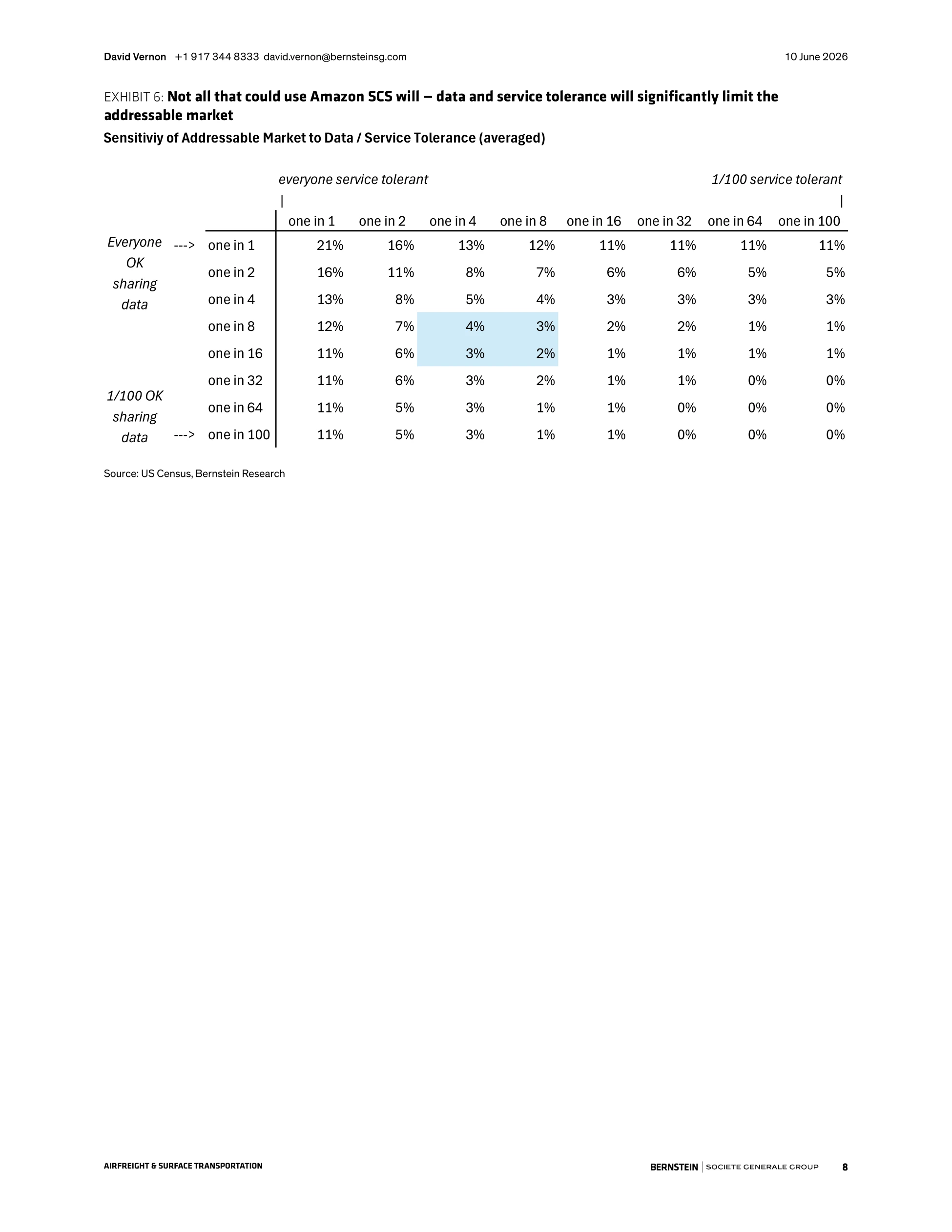
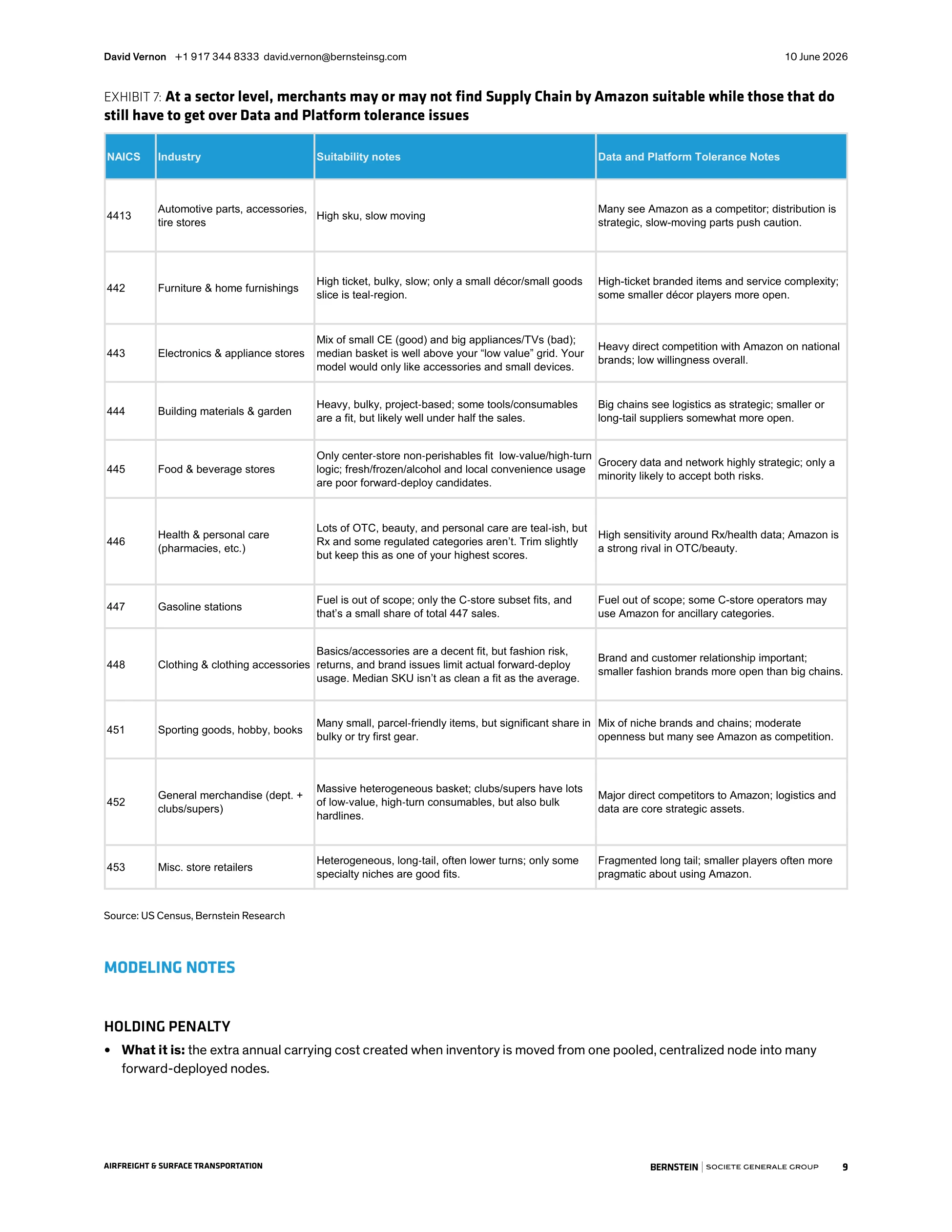
10 June 2026Airfreight & Surface TransportationTransports: An empirical look at how much of the fulfillmentmarket Supply Chain by Amazon could realistically eatDavid Vernon+1 917 344 8333david.vernon@bernsteinsg.comMark Shmulik+1 917 344 8508mark.shmulik@bernsteinsg.comJustine Weiss+1 917 344 8433justine.weiss@bernsteinsg.comDeeksha Pandey+1 917 344 8447deeksha.pandey@bernsteinsg.comWenhuan Chang+1 917 344 8546wenhuan.chang@bernsteinsg.comSpecialist SalesSteve Song+1 917 344 8401steve.song@bernsteinsg.comOver the last several weeks, the market has been trying to gauge the potential for AmazonSupply Chain Services and what it could mean for the shipping market (UPS and FDX). Intoday’s note, we lay out the supply chain math behind the structural limitations of a forwarddeployed inventory model and quantify what percent of the market might realistically use“Supply Chain by Amazon.”Background and context. Supply chains are engineered around specific strategicpriorities that vary greatly across industries. Design choices reflect the product’scharacteristics (value density, shelf life, damage sensitivity, handling requirements),customer requirements (order quantity, speed, reliability, customization, kitting), anddemand patterns (volatility, seasonality, geographic concentration). They are also shapedby cost-to-serve economics, as shippers work to minimize the sum of transport costs,inventory handling costs (including storage and real estate), and soft costs like financing,obsolescence, and markdowns. Because these factors vary across verticals, Amazon’ssupply chain is not suitable for many industries.Our thesis: Amazon's forward-deployed (local-stocking) model is only suitablefor a subset of supply chains. That model wins on “cheap-to-carry, fast-to-sell, low-value-density” assortments where the shipper lacks the volume to extract a strategiccarrier discount. It is structurally uneconomic for “expensive-to-carry, slow-to-sell, high-value-density, heterogeneous” assortments (unless turns are unrealistically high). Thedecision between the two models comes down to the trade-off between Holding Costs,Slotting Costs, and Transport Savings (Exhibit 1). We reached this conclusion by buildinga comprehensive, transparent toy model to pressure-test the thesis and then abstractingthe key findings to package in a more compact, tunable model (Exhibit 2). The key structuraldeterminants on which companies might be able to use a forward inventory modellike Amazon's are product value and how much of the transport savings can be realized(sensitivities in Exhibit 4). The cost wedge that decides it is not transportation, it is inventorycarrying cost plus fixed slotting footprint.We estimate an upper boundary of ~20% of current physical retail sales could besuitable for a forward-deployed model (Exhibit 5). Tolerance to data protection andservice failure limit the realistic market to low-to-mid single digits (Exhibit 6), wi...