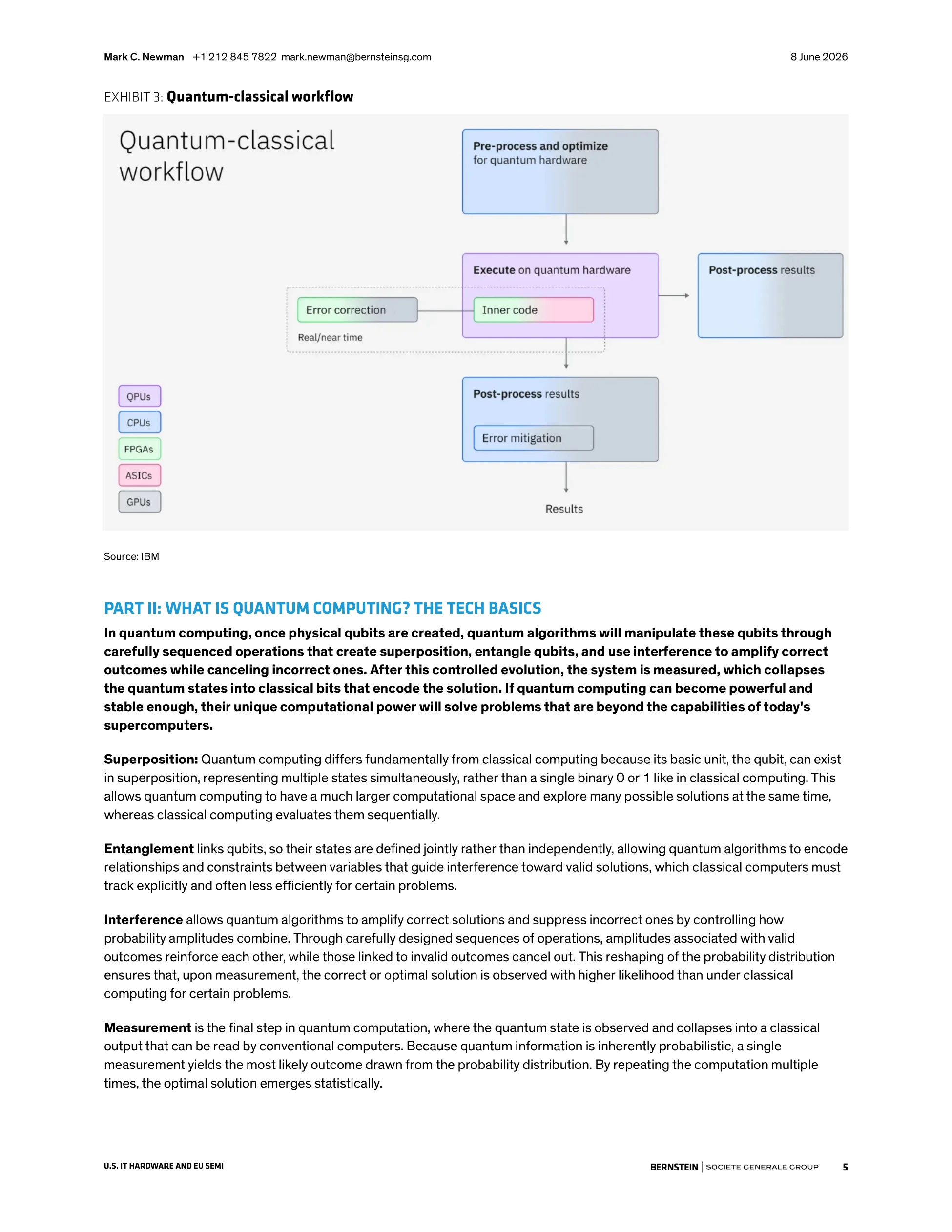
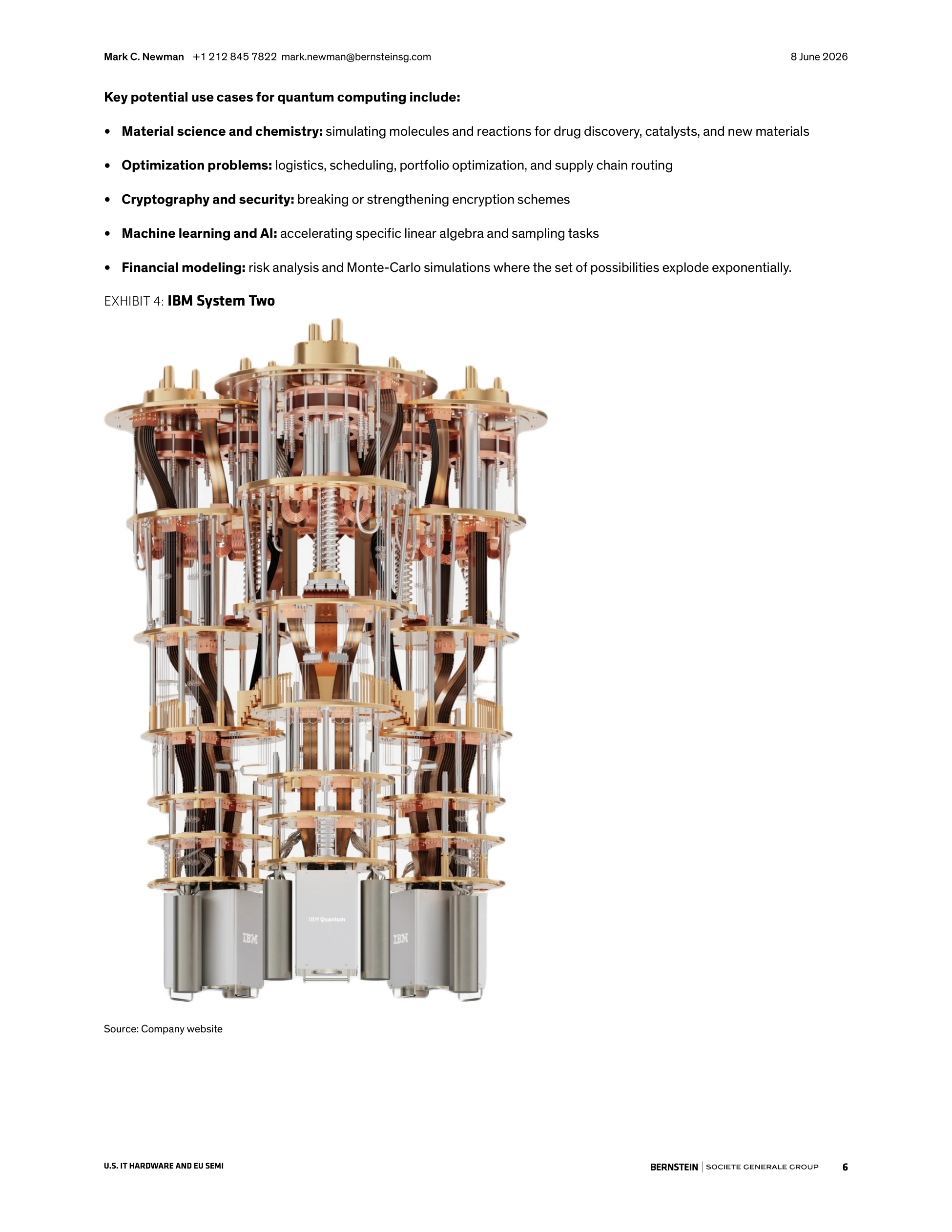
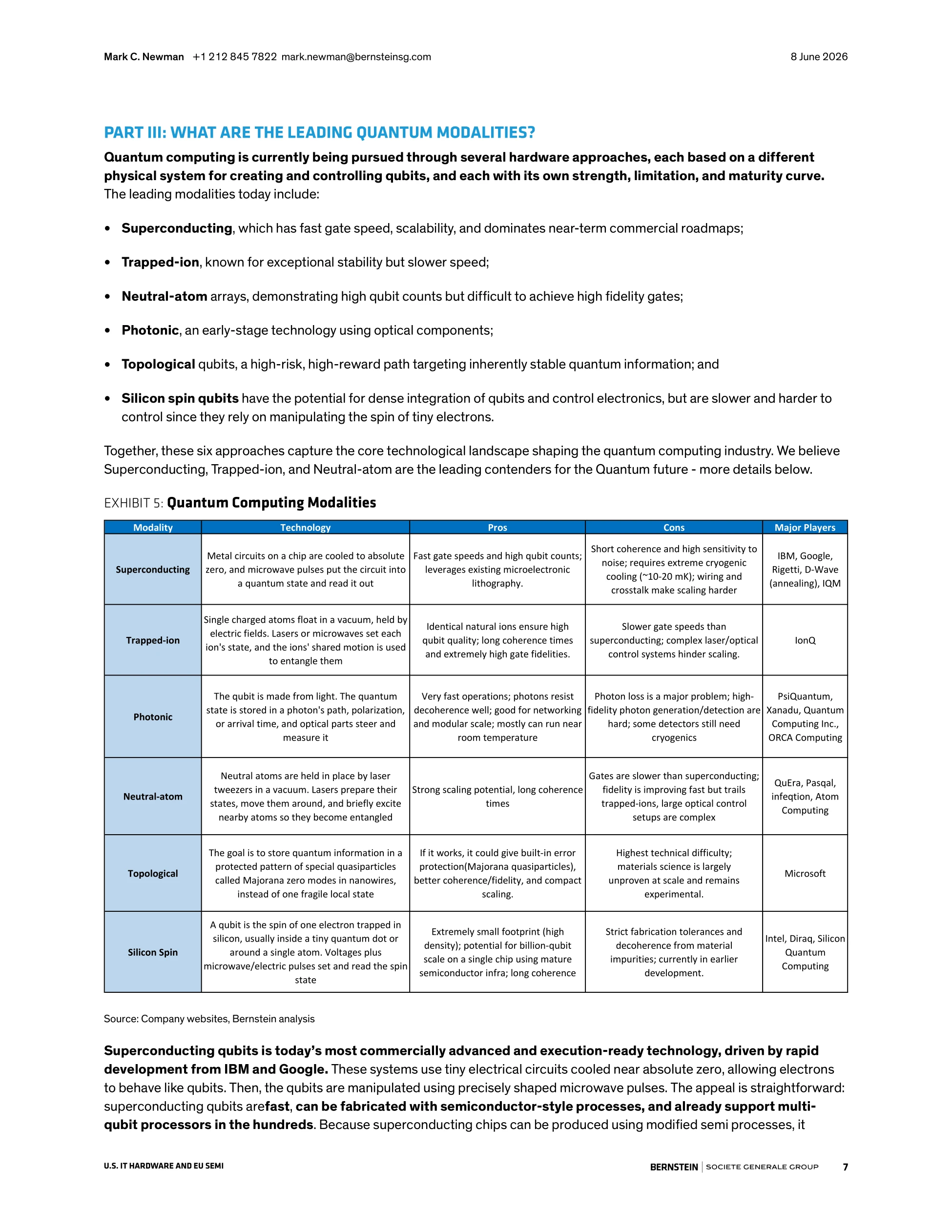
8 June 2026U.S. IT Hardware and EU SemiThe Quantum Leap: Winners & Losers in the Quantum futureMark C. Newman+1 212 845 7822mark.newman@bernsteinsg.comDavid Dai, CFA+852 2918 5704david.dai@bernsteinsg.comQingyuan Lin, Ph.D.+852 2123 2654qingyuan.lin@bernsteinsg.comApril Li+1 917 344 8339april.li@bernsteinsg.comPhoebe Sun+1 917 344 8481phoebe.sun@bernsteinsg.comCarmine Milano, CFA+44 20 7762 1857carmine.milano@bernsteinsg.comThis note is a deep dive into Quantum technology and in particular Quantum Computing andassesses different technical approaches and the playing field.Quantum computing is set to become the next important step in computing.We believe the future of advanced computing will be shaped by a tri-processorarchitecture composed of CPUs, GPUs, and QPUs. In this model, Quantum computingand QPUs will not replace classical hardware (CPUs and GPUs in traditional and AI servers)but operate as a specialized accelerator, tightly integrated into a broader hybrid quantum-classical system. This is similar to how GPUs have not replaced CPUs.How does quantum computing work? In quantum computing, once physical qubits arecreated, quantum algorithms will manipulate these qubits through carefully sequencedoperations that create superposition, entangle qubits, and use interference to amplifycorrect outcomes while canceling incorrect ones. After this controlled evolution, the systemis measured, collapsing quantum states into classical bits that encode the solution.Quantum computing has attracted several big tech companies as well asspecialized pure plays. Among the big tech companies, IBM (rated Market-Perform) isarguably the leader, with Google, Microsoft and Intel with meaningful quantum computinginitiatives. Geographically we see significant activity from companies and nationalgovernments in North America, Europe and China.We analyze 6 quantum modalities and see three approaches as leading contendersfor the Quantum future: 1) Superconducting, arguably today’s most commerciallyadvanced and execution-ready technology, driven by rapid development from IBM andGoogle. 2) Trapped-ion, the modality adopted by the biggest market cap quantum pureplayIONQ, offers the highest precision and stability. Infineon is the leading foundry in trappedions, supplying QPUs to the largest players in this subsector; and 3) Neutral atom, whichprovides a highly flexible architecture capable of scaling. The other approaches we arewatching closely include: Photonic, Topological and Silicon spin.Real economic value in quantum computing is likely to be unlocked only afterquantum advantage is achieved, which is anticipated to be around 2030. To estimatethe implied market share of current quantum pure plays, we discount an estimated $130bnTAM in 2040, apply SOX P/E multiple of 28x, and use a 30% net margin consistent withmature tech peers. This framework implies acombined market share of the 6 publiclylisted pure-plays at 2...










































