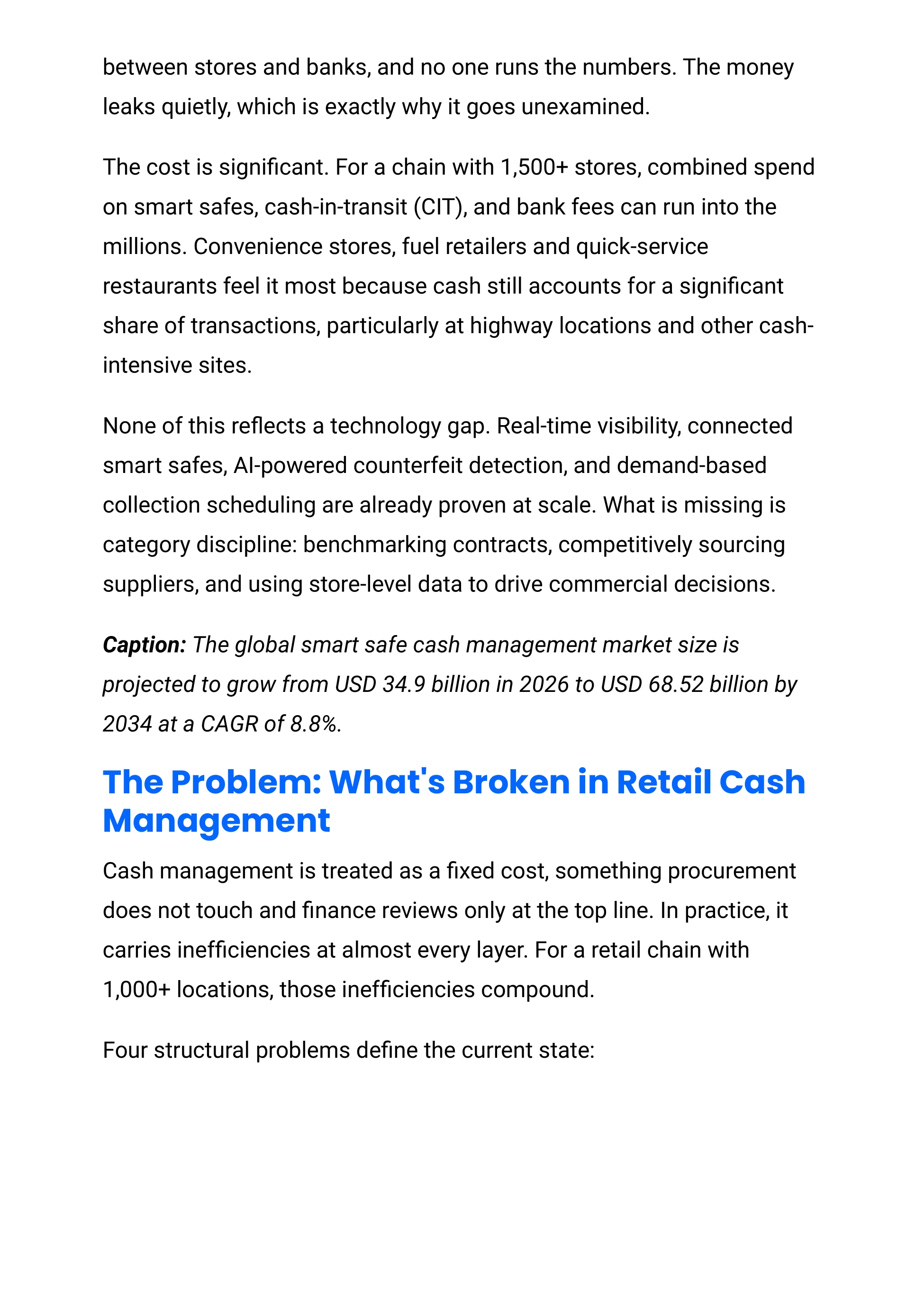
Retail CashManagementHow Procurement Can UnlockHidden Savings and ValueFacilities management has modernized over the past decade. Retailersdeployed IoT sensors to govern building systems and now use AIanalytics and dashboards to track performance across entire chains.The exception is cash management. It is rarely benchmarked, sourced,or optimized, even though it is one of the largest cost categories in thefacilities portfolio. The reason is structural. Smart safe contracts, armored courieragreements, and bank service fees get signed once and left in place foryears. Pricing anomalies build up unnoticed, working capital sits idlebetween stores and banks, and no one runs the numbers. The moneyleaks quietly, which is exactly why it goes unexamined.The cost is significant. For a chain with 1,500+ stores, combined spendon smart safes, cash-in-transit (CIT), and bank fees can run into themillions. Convenience stores, fuel retailers and quick-servicerestaurants feel it most because cash still accounts for a significantshare of transactions, particularly at highway locations and other cash-intensive sites. None of this reflects a technology gap. Real-time visibility, connectedsmart safes, AI-powered counterfeit detection, and demand-basedcollection scheduling are already proven at scale. What is missing iscategory discipline: benchmarking contracts, competitively sourcingsuppliers, and using store-level data to drive commercial decisions. Caption: The global smart safe cash management market size isprojected to grow from USD 34.9 billion in 2026 to USD 68.52 billion by2034 at a CAGR of 8.8%.The Problem: What's Broken in Retail CashManagementCash management is treated as a fixed cost, something procurementdoes not touch and finance reviews only at the top line. In practice, itcarries inefficiencies at almost every layer. For a retail chain with1,000+ locations, those inefficiencies compound.Four structural problems define the current state:1. Limited Operational Visibility and WeakAccountabilityConvenience stores, fuel stations and quick-service restaurants areamong the most cash-dependent businesses in retail, yet many still relyon standalone safes, manual counting and fixed courier pickups. Theyoften operate overnight and early morning with minimal staff. Theresult is little visibility into cash movement, making theft, shrinkage,counterfeit currency, and reconciliation errors difficult to detect andinvestigate.Business Impact:2. Working Capital Sitting Idle Between the Storeand the BankEvery day that cash sits in a safe waiting for an armored pickup is a daywhen working capital is unavailable to the business. Under a standardCIT arrangement, cash is collected, transported to a vault, andHigher shrinkage: Losses are often absorbed, and the underlyinggap left unfixed, allowing the same problem to recur.⚬Weak accountability: Without a digital record, there is no way toestablish when a disc...










































