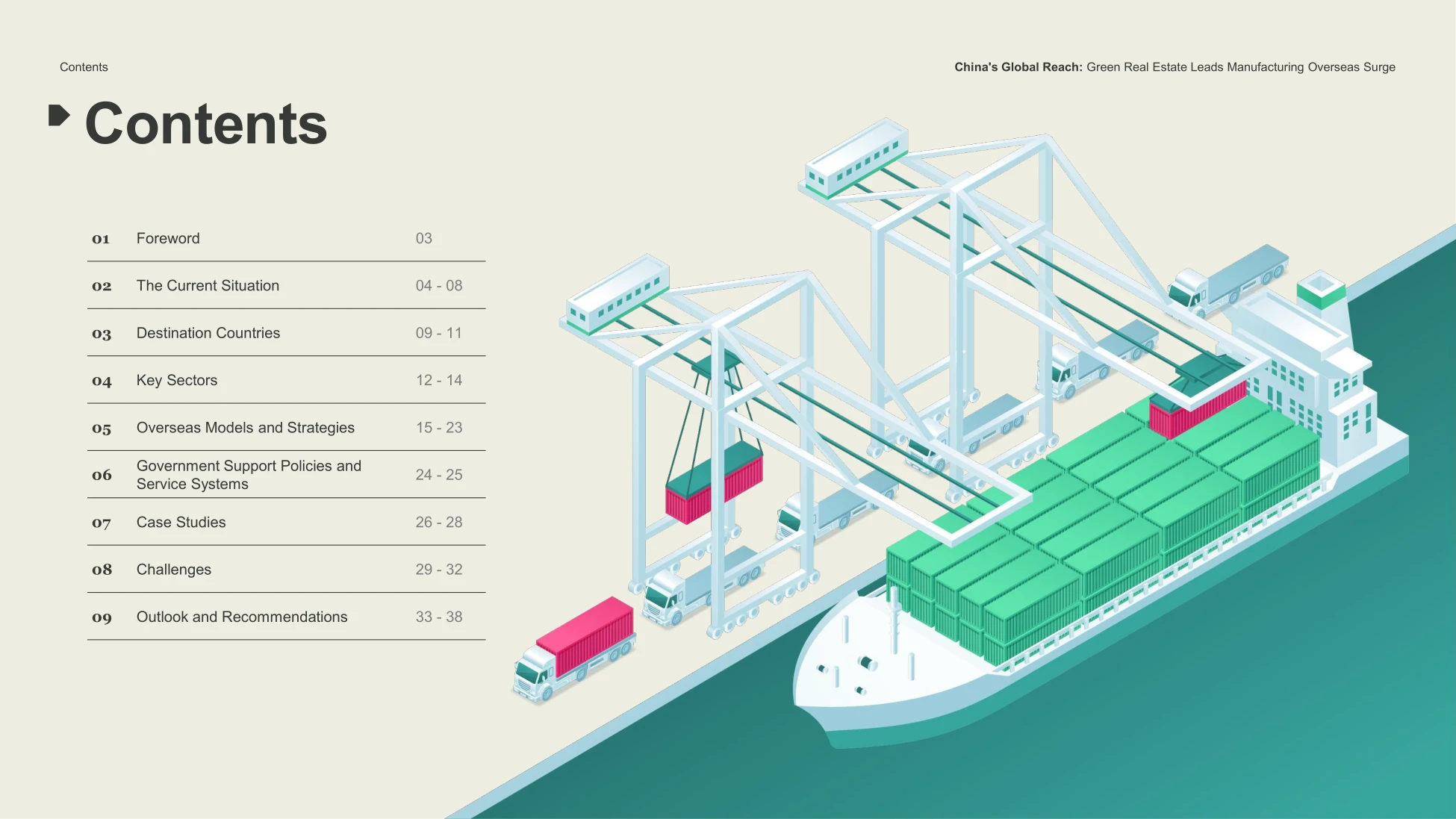
China’s Global Reach: Green Real Estate Leads Manufacturing Overseas Surge This white paper systematically analyses the development status, paths, challenges and new globalisation opportunities for Chinese enterprises going overseas, focusing on the core logic and practical path of enterprises' overseas real estate strategies.January 15 2026Knight Frankknightfrank.com/researchContents01Foreword0302The Current Situation04 - 0803Destination Countries09 - 1104Key Sectors12 - 1405Overseas Models and Strategies15 - 2306Government Support Policies and Service Systems24 - 2507Case Studies26 - 2808Challenges29 - 3209Outlook and Recommendations33 - 38China's Global Reach: Green Real Estate Leads Manufacturing Overseas SurgeContentsChina's Global Reach: Green Real Estate Leads Manufacturing Overseas SurgeForewordIn 2025, the global economic landscape has undergone profound adjustment, the Sino-US strategic rivalry will enter a new stage of complexity, and the global industrial and supply chain will accelerate the shift toward regionalisation, nearshoring, and diversification. In this context, going overseas for Chinese enterprises has shifted from an optional "multiple-choice question" to a "compulsory course" that is critical to their viability and long-term development, and has become a core pathway of "China's power sweeping the world". According to the data, as of 2024, the overseas revenue of Chinese listed companies exceeded the RMB10 trillion mark for the first time, accounting for 13.8% of total revenue, while domestic revenue experienced its first negative growth in 10 years.The overseas expansion of Chinese enterprises is the result of the combined action of internal and external drivers and regional opportunities, and it is also an inevitable choice for green transformation and industrial synergy. In 2024, steel, photovoltaic, real estate and other industries witnessed significant adjustments, with the net profit of the photovoltaic equipment industry falling by 126.34% and the profit of the steel industry falling by 54.6%. At the same time, under the requirements of high-quality economic development, enterprises need to obtain advanced technology and international brands through internationalisation, empower industrial upgrading with green technology, and accelerate the transformation from "Made in China" to "Made Globally" with the early deployment of overseas industrial and logistics real estate providing a solid platform for this transformation. On the external front, the protracted nature of China-US trade frictions is forcing strategic adjustments. Although the two sides entered a tariff "truce" in November 2025, the rivalry has extended to the technological blockade and restructuring of rules, making "nearshoring footprint" and green real estate in Southeast Asia, Mexico and other places a pragmatic choice to avoid barriers. As the core of the regional economy, ASEAN ...