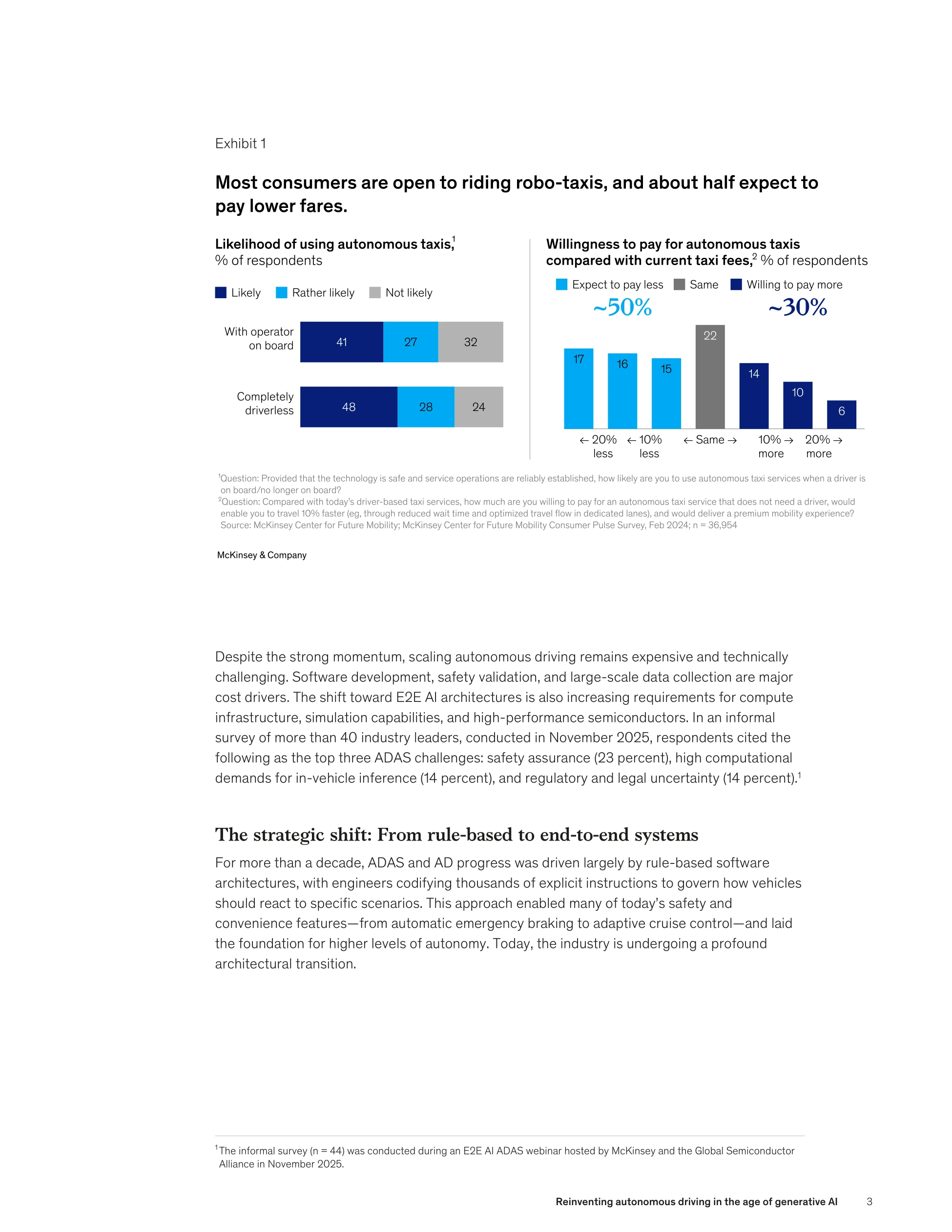
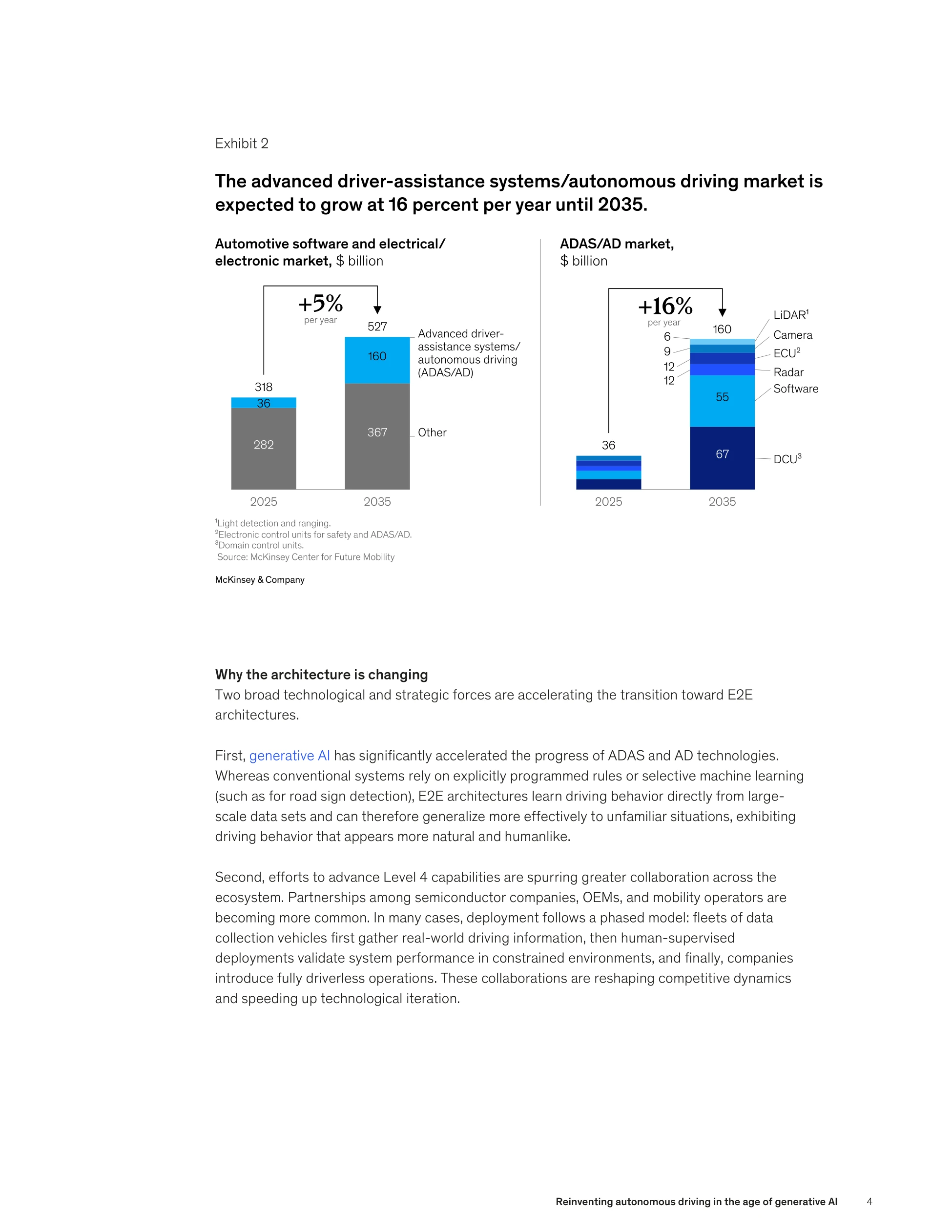
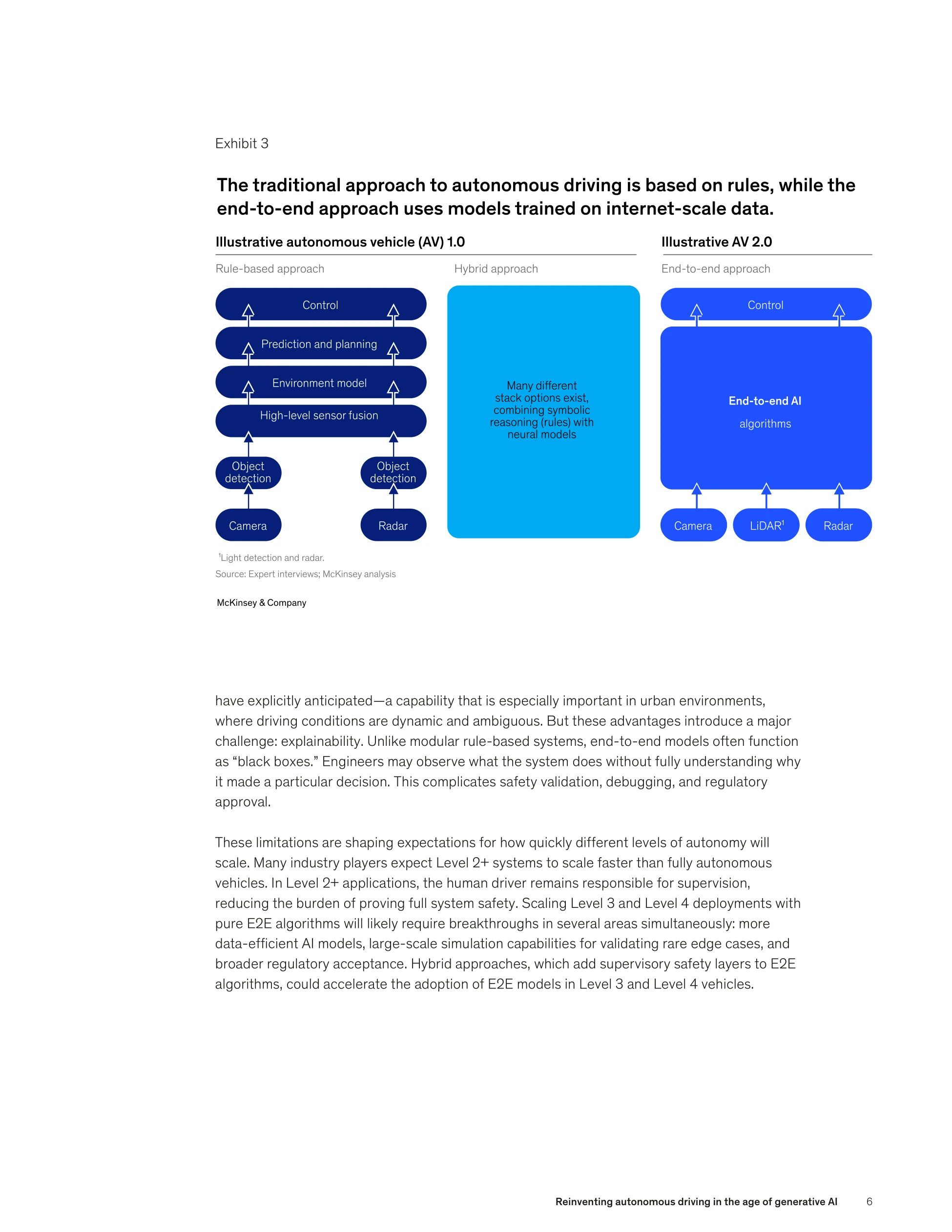
Automotive & Assembly PracticeReinventing autonomous driving in the age of generative AIAs AI-native systems take hold, autonomous driving is becoming a race for compute power, software, data, and semiconductors.This article is a collaborative effort by Dominik Hepp, Marc de Jong, and Martin Kellner, with Annette Hafemann, Martina Vennettilli, and Michael Guggenheimer, representing views from McKinsey’s Semiconductors and Automotive & Assembly Practices.June 2026The automotive industry is entering a new phase in the evolution of advanced driver-assistance systems (ADAS) and autonomous driving (AD)—one increasingly defined by generative AI. Today, generative AI is accelerating the shift toward AI-native, end-to-end (E2E) architectures capable of learning driving behavior directly from massive data sets. E2E systems can adapt more effectively to unfamiliar environments, handle greater driving complexity, and improve far more quickly as they process more data.These developments are changing ADAS/AD economics. It’s no longer just about engineering a better vehicle; competitive advantage is now shifting toward companies that can combine expertise in AI models, semiconductors, cloud infrastructure, large-scale data collection, and the efficient validation of integrated hardware–software systems. The transition is unfolding amid growing consumer interest and rising investment in autonomous driving.In this report, we look at how consumer attitudes and technological advances are creating market momentum. We then examine the ways in which AI is transforming the ADAS/AD landscape—from E2E software architectures and in-vehicle compute to hyperscale data center requirements and the reconfiguration of the automotive value chain. What’s clear is that autonomous driving is becoming as much an AI infrastructure challenge as an automotive engineering one.Consumer attitudes and market momentumWill most cars be fully driverless by 2035? That’s what a majority of Chinese consumers—and about one in four Western consumers—expect, according to the latest McKinsey Center for Future Mobility Consumer Pulse survey. Indeed, ADAS and AD are rapidly moving into the mainstream, and ADAS capabilities are increasingly influencing vehicle purchase decisions, particularly in the premium segment.Consumers are also open to riding in autonomous vehicles (AVs) that they don’t own, as the fast-growing robo-taxi market shows. Across the globe, consumer openness toward autonomous-mobility services is rising. More than 60 percent of surveyed consumers say they would consider using robo-taxis, with roughly half expecting ride fares to decline in the coming years (Exhibit 1).Consumers, however, foresee faster progress than industry experts do. Most AV experts surveyed believe Level 2+ systems will dominate the mass market through 2035, while Level 3 and higher systems will likely remain limited to select use...