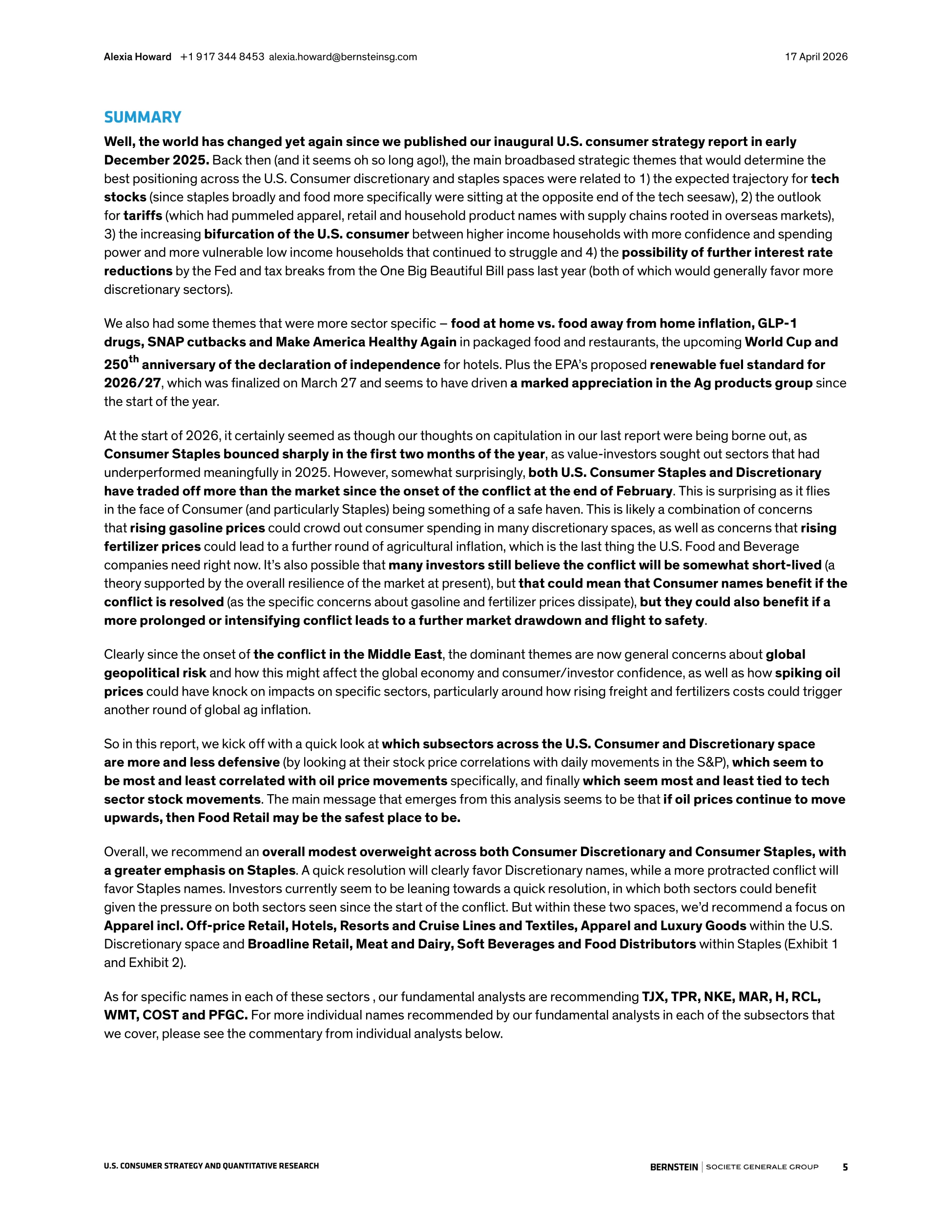
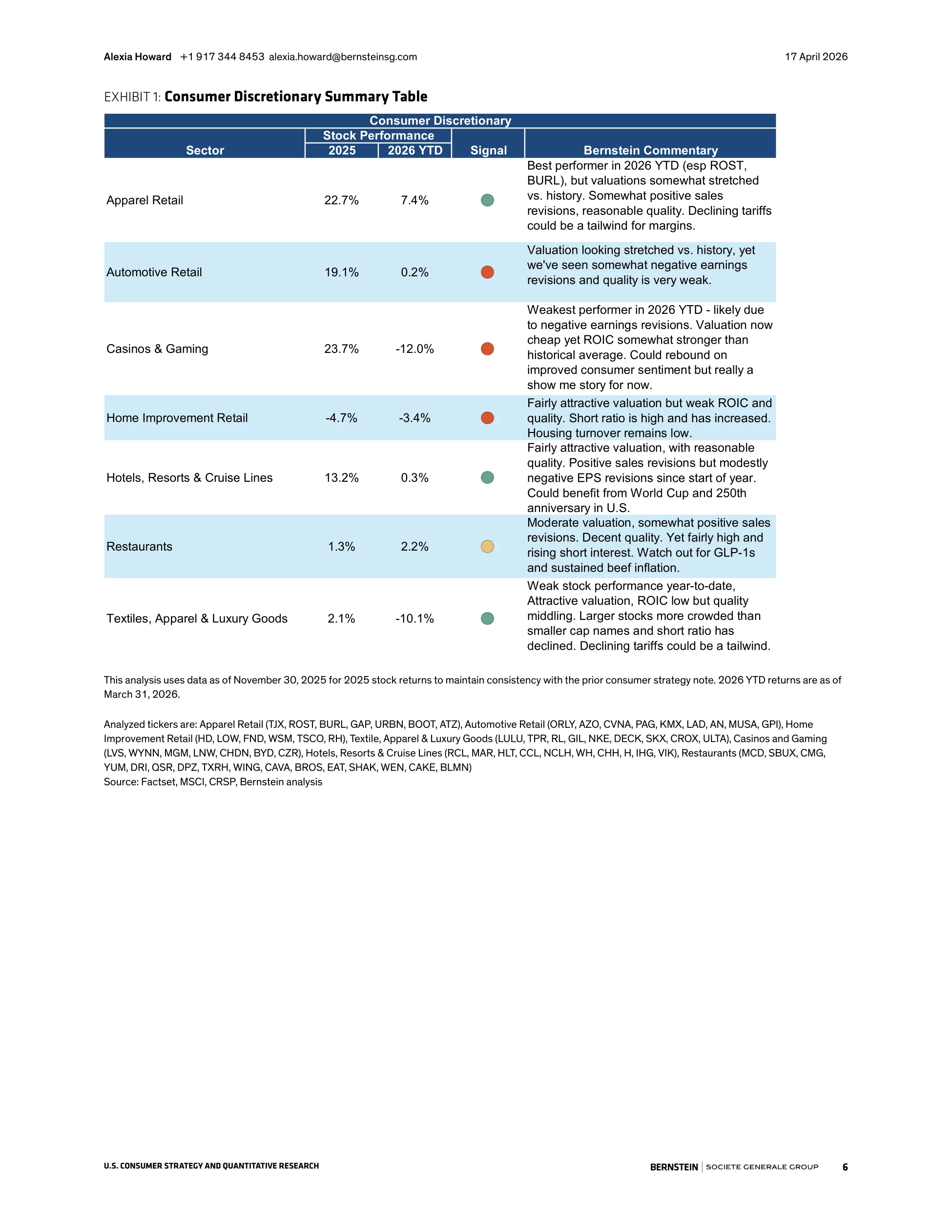
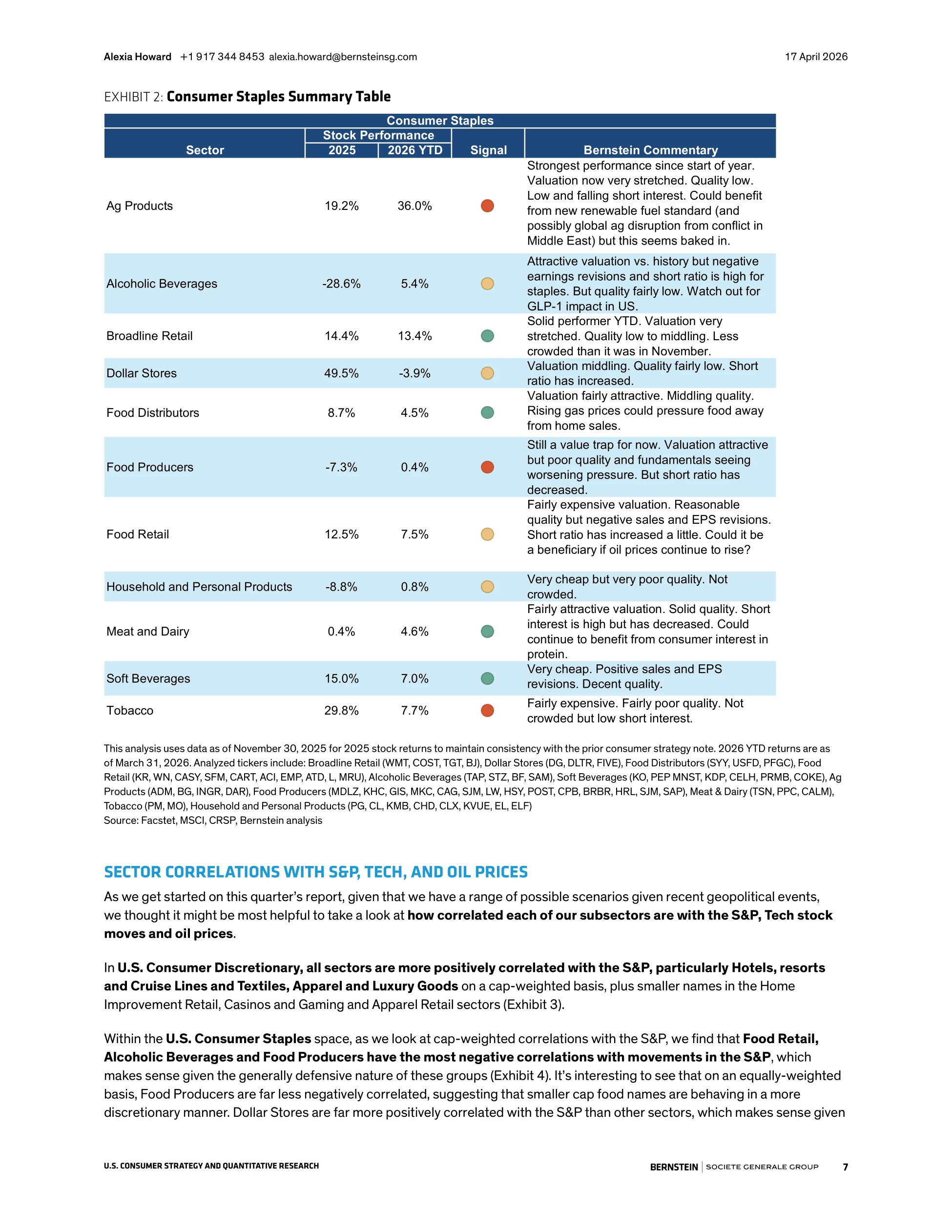
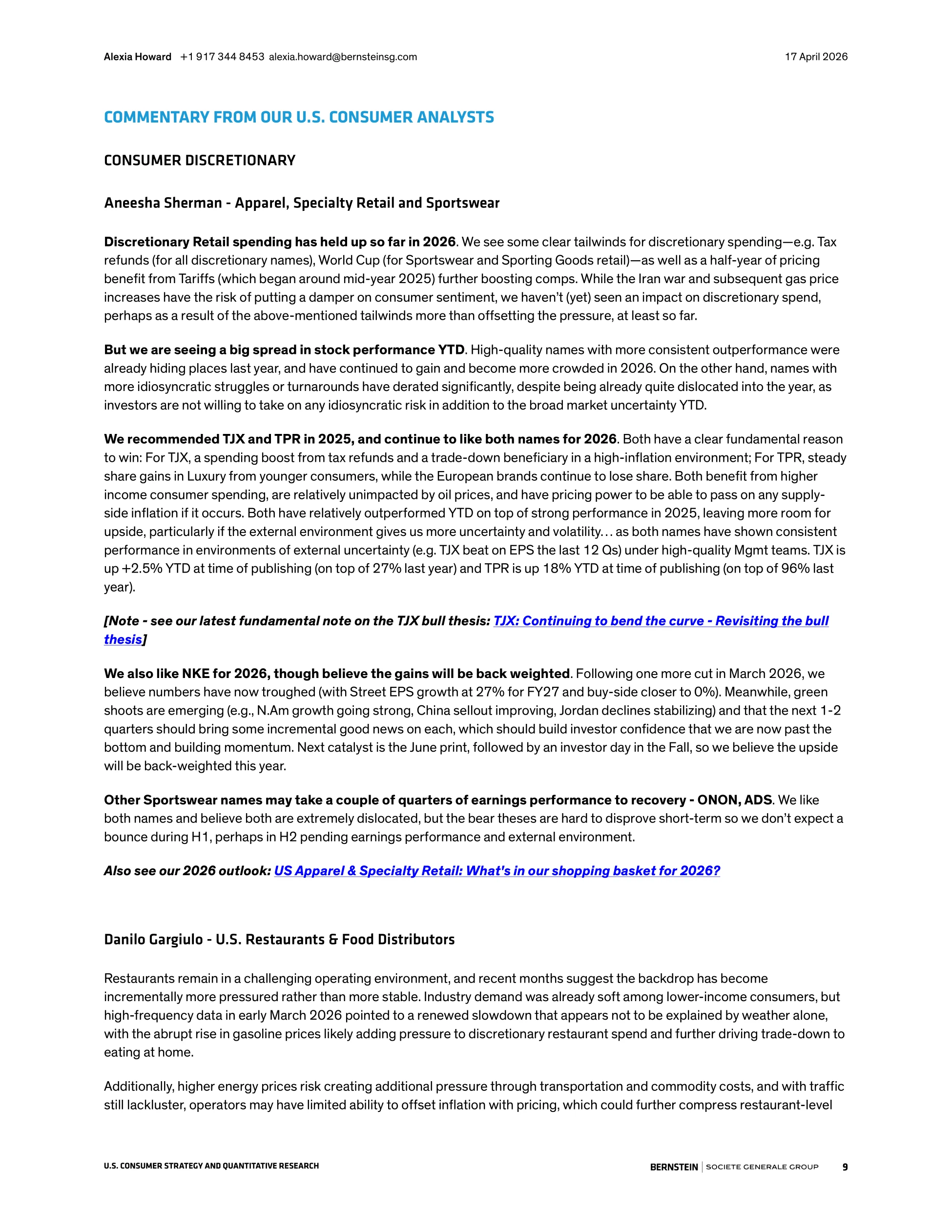
17 April 2026U.S. Consumer Strategy and Quantitative ResearchU.S. Consumer Strategy: In the face of geopolitical conflict, U.S.Consumer has not been a safe haven - Where to from here?Alexia Howard+1 917 344 8453alexia.howard@bernsteinsg.comRichard J. Clarke, FCA+44 20 7676 6850richard.clarke@bernsteinsg.comCallum Elliott, CFA, ACA+44 20 7676 7183callum.elliott@bernsteinsg.comDanilo Gargiulo+1 917 344 8475danilo.gargiulo@bernsteinsg.comZhihan Ma, CFA+1 917 344 8303zhihan.ma@bernsteinsg.comNadine Sarwat, CFA+44 20 7676 6849nadine.sarwat@bernsteinsg.comAneesha Sherman+1 917 344 8457aneesha.sherman@bernsteinsg.comTrevor Stirling+44 20 7676 7521trevor.stirling@bernsteinsg.comRyan Dou+1 917 344 8451ryan.dou@bernsteinsg.comCinnie Lin+1 917 344 8567cinnie.lin@bernsteinsg.comWell, the world has changed yet again since we published our inaugural U.S.consumer strategy report in early December 2025. Back then (and it seems oh so longago!), the main broadbased strategic themes that would determine the best positioningacross the U.S. Consumer discretionary and staples spaces were related to 1) the expectedtrajectory for tech stocks, 2) the outlook for tariffs, 3) the increasing bifurcation of theU.S. consumer, and 4) the possibility of further interest rate reductions.We also had some themes that were more sector specific – food at home vs. food awayfrom home inflation, GLP-1 drugs, SNAP cutbacks, and Make America Healthy Againin packaged food and restaurants, the upcoming World Cup and 250th anniversary ofthe Declaration of Independence for hotels. Plus the EPA’s proposed Renewable FuelStandard for 2026/27.At the start of 2026, it certainly seemed as though our thoughts on capitulation in ourlast report were being borne out, as Consumer Staples bounced sharply in the firsttwo months of the year, as value-investors sought out sectors that had underperformedmeaningfully in 2025. However, somewhat surprisingly, both U.S. Consumer Staplesand Discretionary have traded off more than the market since the onset of theconflict at the end of February. This is surprising as it flies in the face of Consumer(and particularly Staples) being something of a safe haven. The dominant themes are nowglobal geopolitical risk & how this might affect the global economy & consumer/investorconfidence, as well as how spiking oil prices could have affect specific sectors.So in this report, we kick off with a quick look at which subsectors across the U.S.Consumer and Discretionary space are more and less defensive, which seem to bemost correlated with oil price movements, and finally which seem tied to tech sectorstock movements. The main message that emerges from this analysis seems to be that ifoil prices continue to move upwards, then Food Retail may be the safest place to be,but if the conflict is resolved, smaller cap names will likely outperform larger names.Overall, we recommend an overall modest overweigh...