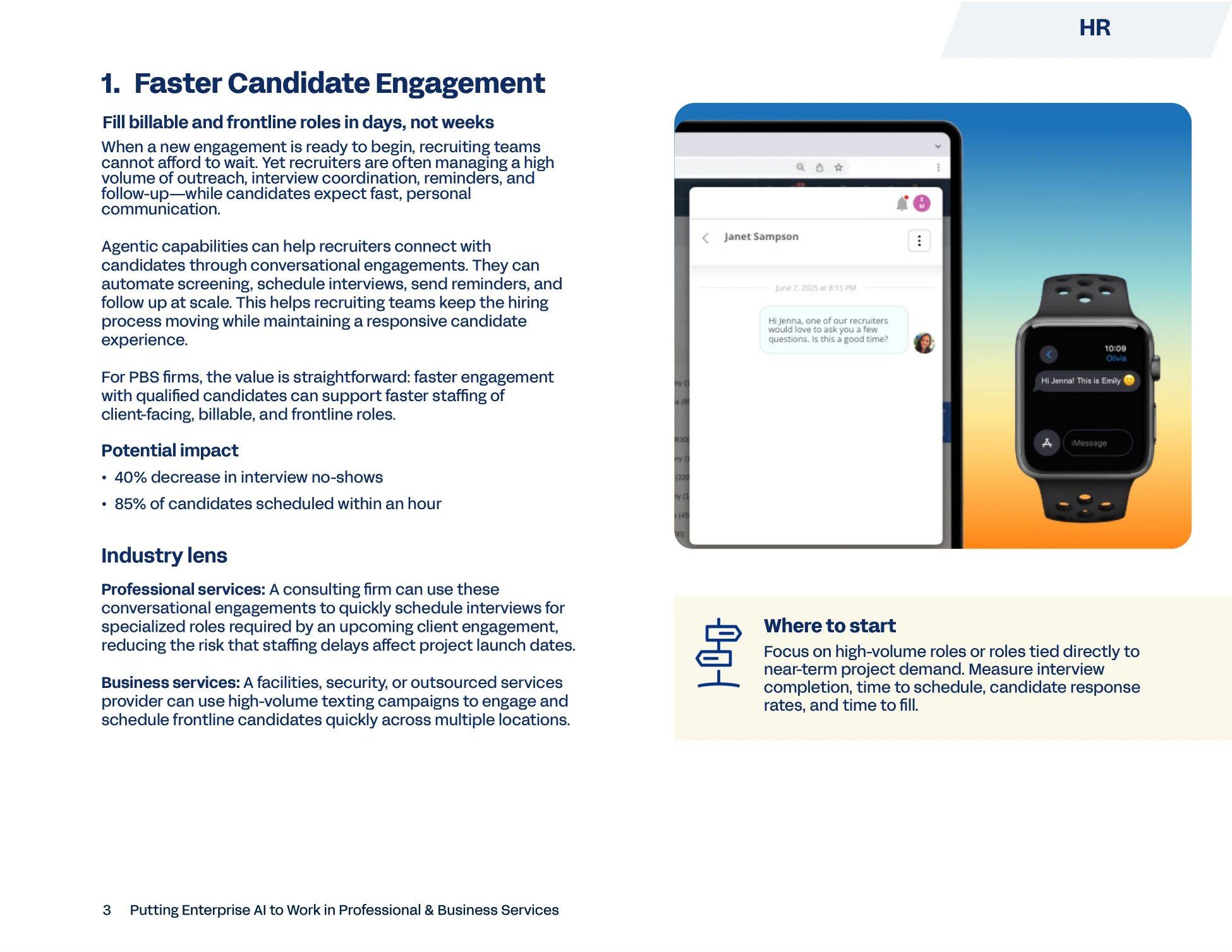
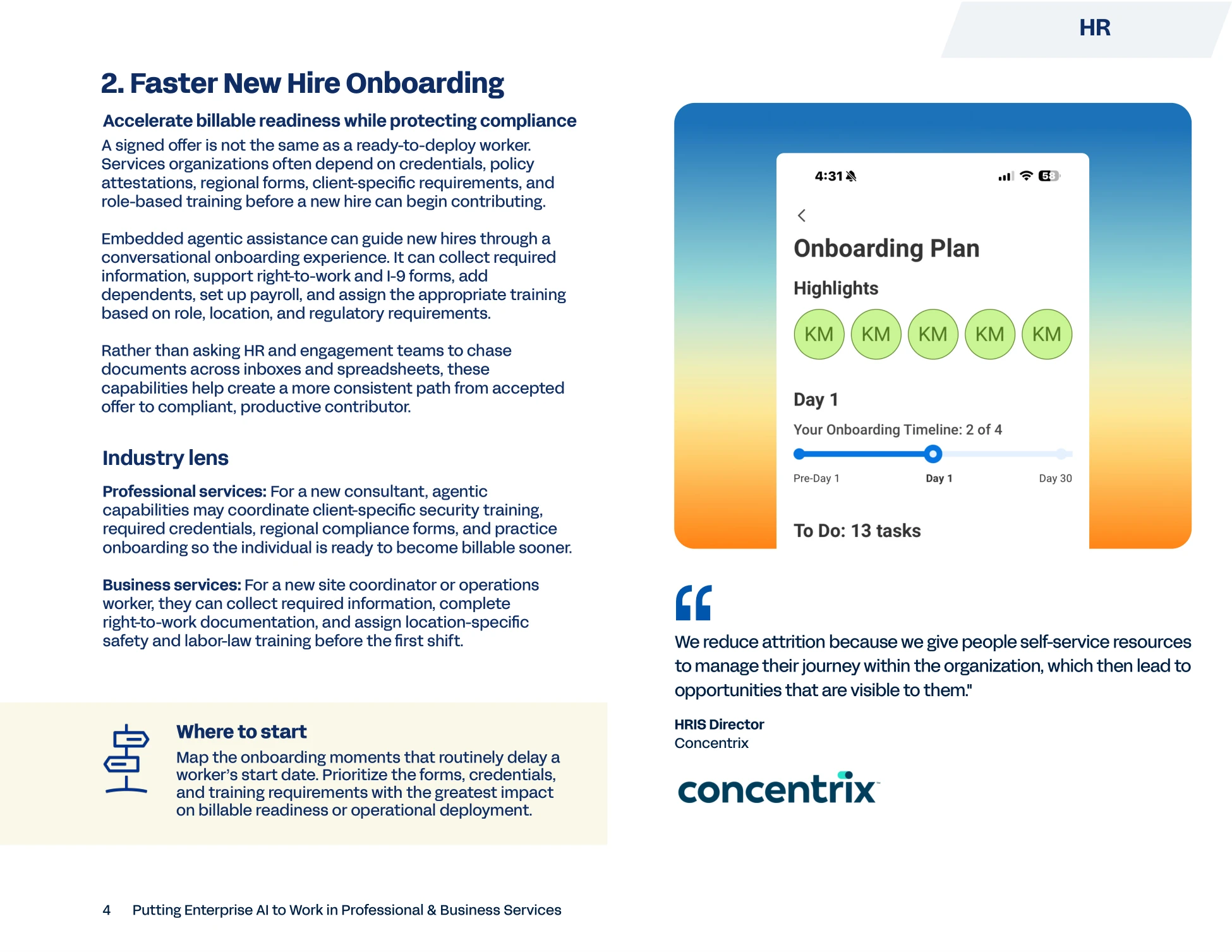
Putting Enterprise AI to Work in Professional & Business Services eBook10 Agentic Capabilities For Scaling Teams, Services, and Profits 2 Putting Enterprise AI to Work in Professional & Business ServicesHow agentic capabilities can help firms turn people, projects, and financial operations into a competitive advantageProfessional and business services firms operate in a world where time, talent, and margin are deeply connected. A delayed hire can put a client engagement at risk. Incomplete onboarding can slow billable readiness. A missed contract term can erode margin. A payroll issue can damage worker trust. And every hour spent navigating internal administration is an hour not spent serving clients or supporting operations.Agentic capabilities can offer a new way to tackle these challenges. By understanding business context, guiding action, surfacing risks, and automating routine work, they can help organizations connect the processes that turn demand into delivery—and delivery into profitable growth.This eBook explores 10 high-impact agentic capabilities for Professional & Business Services (PBS). These capabilities are designed to help firms attract, develop, and support talent while improving commercial discipline, financial visibility, operational efficiency, and technology adoption.One industry, two operating modelsProfessional services and business services organizations share many challenges, but the value of agentic AI can look different in practice.• Professional services firms often focus on deploying specialized talent, managing complex client engagements, accelerating billable readiness, and protecting project-level margin.• Business services firms frequently manage larger and more distributed workforces, high-volume hiring, location-based compliance, site operations, and service continuity.Many organizations operate across both models. For example, a real estate company may rely on specialized professionals to advise clients and manage complex projects while also delivering facilities management services that require a distributed, operational workforce. In these organizations, agentic capabilities can support the distinct needs of each model while helping create a more connected operating environment.The agentic capabilities in this eBook support both models. Examples in each chapter show how their impact can differ based on the operating environment.Note: Performance figures referenced in this eBook are modeled estimates based on early Workday customer usage of its agentic capabilities and related assumptions, unless otherwise noted. Actual results will vary based on organizational context, process design, data readiness, and deployment scope.1. Faster Candidate EngagementWhen a new engagement is ready to begin, recruiting teams cannot afford to wait. Yet recruiters are often managing a high volume of outreach, interview coordination, reminders, and follow-up—while...










































