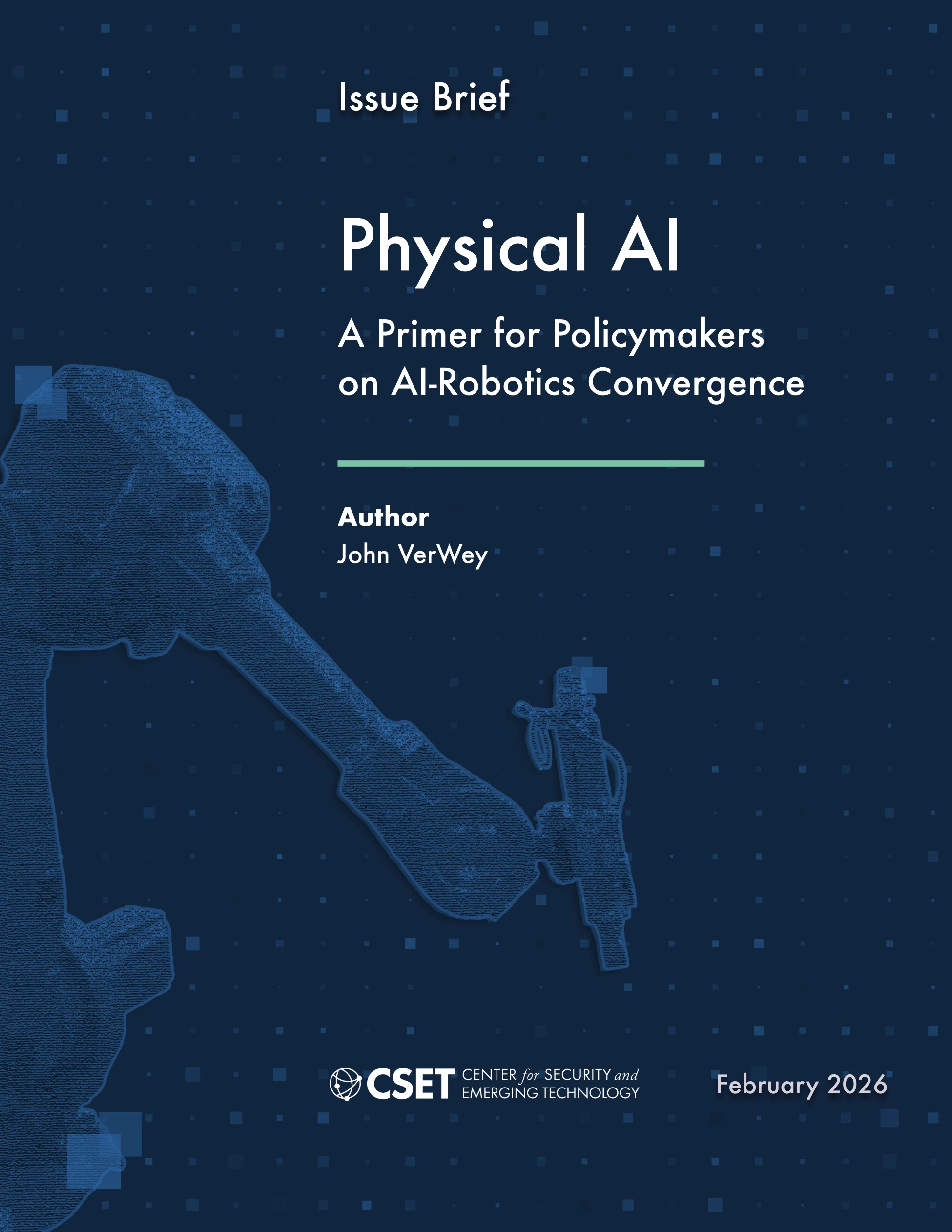
Issue BriefFebruary 2026Physical AIA Primer for Policymakers on AI-Robotics ConvergenceAuthorJohn VerWeyPhysical AIA Primer for Policymakers on AI-Robotics ConvergenceAuthorJohn VerWey Center for Security and Emerging Technology | 1 Executive Summary While the world has focused its attention for the last three years on generative artificial intelligence, chatbots, and new model releases coming from frontier AI labs, a quieter revolution is taking place that many believe represents the next stage in AI development: the arrival of Physical AI. Like the iPhone’s introduction in 2007, AlexNet’s victory in the 2012 ImageNet competition, and ChatGPT’s release in 2022, analysts and industry representatives believe a similar breakthrough is imminent. Physical AI “lets autonomous systems like robots, self-driving cars, and smart spaces perceive, understand, and perform complex actions in the real (physical) world.”1 NVIDIA has declared “in the near future, everything that moves, or that monitors things that move, will be autonomous robotic systems.”2 OpenAI reportedly re-opened its robotics division in early 2025 to capitalize on the convergence of AI and robotics, while startups from Shanghai to Silicon Valley building the “brains” of robots are raising hundreds of millions of dollars.3 Electric vehicle makers Tesla and XPeng are racing to develop humanoid robots of their own.4 Meanwhile Amazon, which reports having one million robots in operation today, believes “Physical AI is about to change everything for robotics [including] autonomy, manipulation, sortation, and computer vision.”5 Adding to this enthusiasm, analysts at Morgan Stanley assert the market for humanoid robots will grow from tens of millions of dollars today to reach $5 trillion by 2050.6 Yet the convergence of AI and robotics is so new that the field lacks a shared name, to say nothing of a mature technology stack. Some companies call this convergence “embodied AI” while others prefer “physical AI,” “embodied machine intelligence,” or “generative physical AI.”7 It is not at all clear if the hype around AI progress can translate into robots finding their way through the physical world: autonomous three-dimensional navigation of dynamic environments requires a mature software, hardware, and data ecosystem that simply does not exist at scale today. NVIDIA states part of the problem plainly: “Large language models are one-dimensional, able to predict the next token, in modes like letters or words. Image- and video-generation models are two-dimensional, able to predict the next pixel. None of these models can understand or interpret the 3D world.”8 The primary challenges facing Physical AI are the same ones that have troubled the robotics industry for generations: technology barriers and economic barriers. Parts of the robotics supply chain remain in their industrial infancy,...










































