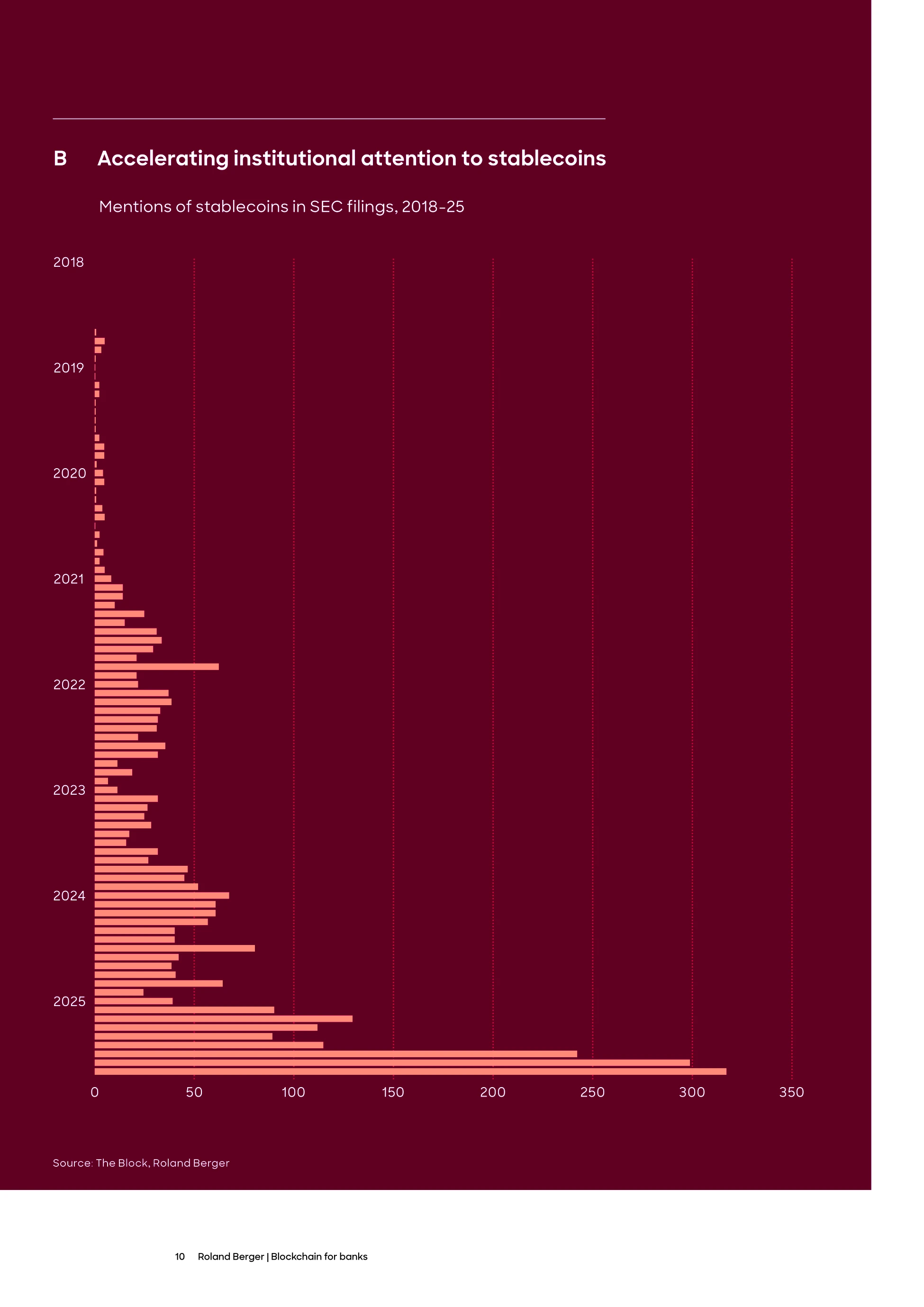
Blockchain for banksREPORTIs the financial system ready for an upgrade?Cover: JuSun/iStockManagement summaryToday's banking system presents itself as fully digital, yet its core settlement architecture remains rooted in systems designed decades ago. Customers experience seamless mobile interfaces and continuous access, but behind the screen transactions are still constrained by operating-hour windows and reconciliation cycles that reflect a different technological era. International payments can take several days to clear, and capital remains tied up in buffers that compensate for delayed synchronization between institutions. The system functions reliably, but in a market increasingly shaped by real-time expectations, its built-in constraints are becoming harder to ignore.Blockchain technology enables shared-ledger settlement in real time at costs and speeds suitable for production volumes, and could provide the structural upgrade that banking infrastructure requires. At the same time, competitive pressure is intensifying. The American Banking Association has claimed that as much as USD 6.6 trillion in bank deposits could be at risk if adoption of stablecoins continues unabated. Many banks have begun experimenting with blockchain, yet most activity remains confined to pilots and token gestures. The strategic challenge is therefore to move beyond experimentation while remaining compliant and managing risk.Meeting that challenge calls for disciplined execution. Banks must focus on areas where settlement friction has a clear economic cost. They should consider building dedicated digital assets capability with senior sponsorship. The transition must move from contained pilots to scalable implementation. Technology choice needs to follow strategic intent and regulatory context. In other words, rewiring settlement for a real-time economy requires treating blockchain not as experimentation, but as infrastructure. 2 Roland Berger | Blockchain for banksContents 1 2 3 Banking infrastructure under strain A model built for a different eraHow blockchain reshapes settlement architecture A structural responseTurning blockchain into value A playbook for banks ConclusionFastfacts481214Page~300 mentions of stablecoins in SEC filings during 2025.~~90 The cost reduction achievable with stablecoin-based transfers vs. conventional wire transfers.~%Bank deposits worth an estimated USD 6.6 trillion are at risk if stablecoin adoption continues.3 Roland Berger | Blockchain for banksBanking infrastructure under strainA model built for a different eraFor all the innovation visible in mobile apps and digital channels, the core infrastructure of banking still runs on settlement architecture designed in previous decades. Clients experience instant payments and continuous access, yet the underlying systems continue to rely on operating-hour constraints and batch reconciliation. These mechanisms were built to ensure...










































