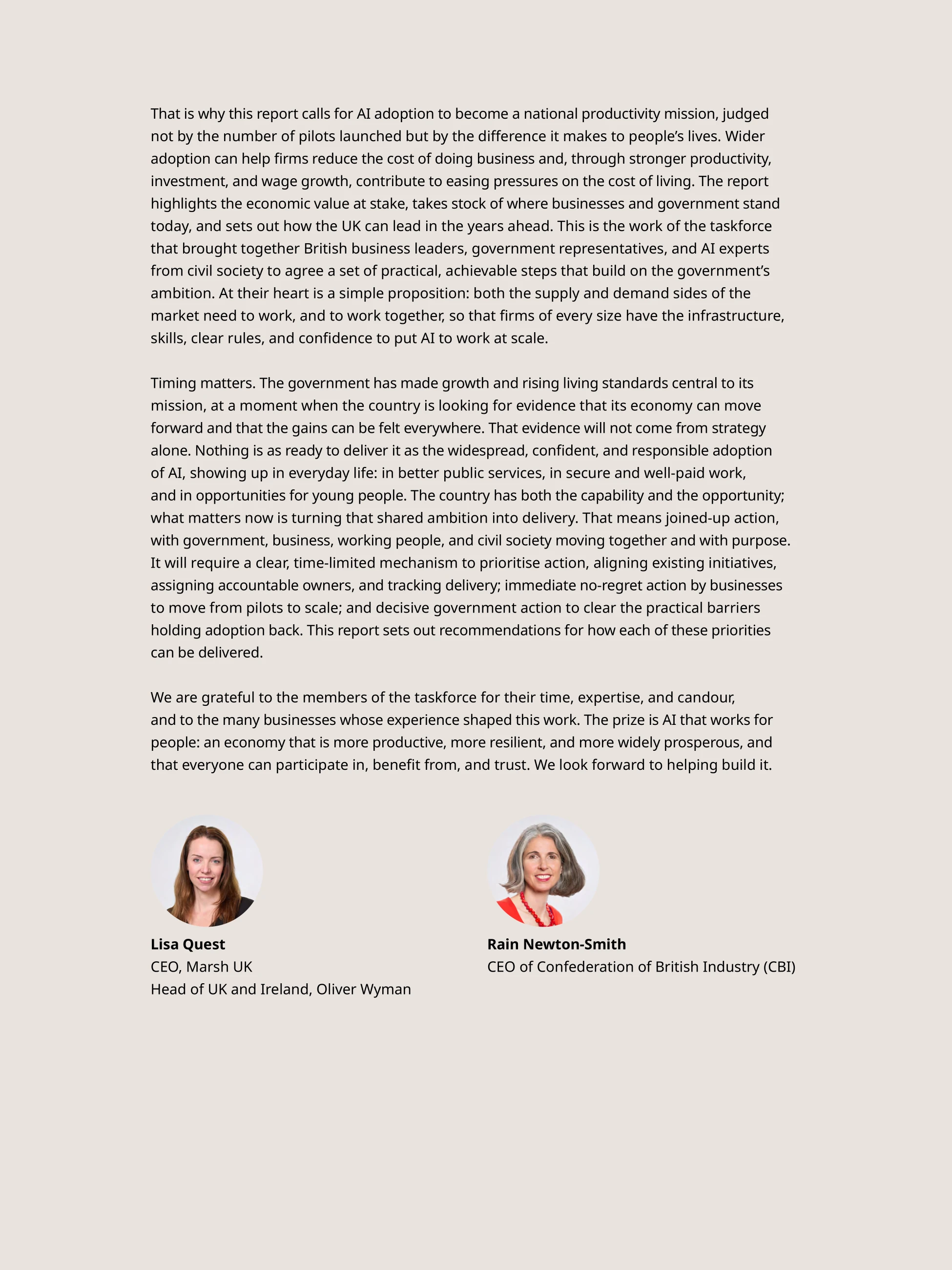
Closing the execution divide and making AI work for BritainThe adoption decade Co-chair foreword The United Kingdom starts from a position of real strength. It has world-class universities, one of the deepest pools of AI research and talent anywhere, and an enviable technology sector. That strength is not in doubt, and it is a genuine reason for confidence. Every few generations, a technology changes not only what an economy produces, but how it competes. Steam power, electrification, and the internet were each such a moment. Artificial intelligence is creating the next. History shows that invention alone is never enough. The largest gains come when a technology spreads through firms, workflows, infrastructure, and skills, reaching businesses of every size, in every sector. Adoption on that scale also opens a route to reindustrialise Britain, combining AI with advanced manufacturing to strengthen domestic supply chains, raise productivity, and create high-quality jobs in the places that need them most. Both prizes are well within reach. Reaching them is a matter of execution. The question this report sets out to answer is a practical one: how does Britain turn its advantage in AI into prosperity that is felt in every place and by every person? Today, an execution divide is opening between firms that are redesigning workflows, establishing governance, and measuring returns, and those still experimenting and piloting. The barriers are practical, including an unclear business case, fragmented guidance, shortages of skills and confidence, uncertain regulatory routes, and concerns about data, suppliers, and service continuity. They are also solvable. Throughout this work, we heard from businesses already turning ambition into results: a medical technology company whose AI now acts as a GPS for surgeons, guiding them through minimally invasive repairs; a construction group teaching AI to identify the early warning signs of a safety incident before anyone is hurt; and a telecoms company that has taken a thousand of its people through AI apprenticeships in six months and opened its levy funding so smaller firms can do the same. Even in fire and rescue services, frontline employees far from any traditional technology function are retraining and building AI tools for their own operations. These examples show both the breadth of AI’s potential and how its benefits are already beginning to be realised in Britain today. That is why this report calls for AI adoption to become a national productivity mission, judged not by the number of pilots launched but by the difference it makes to people’s lives. Wider adoption can help firms reduce the cost of doing business and, through stronger productivity, investment, and wage growth, contribute to easing pressures on the cost of living. The report highlights the economic value at stake, takes stock...