首页研究报告机构研究投资金融2026年投资展望报告:在复杂环境中捕捉新契机(英文版)-高盛
天问

文档

5930

关注

0

好评

0
PDF

2026年投资展望报告:在复杂环境中捕捉新契机(英文版)-高盛

阅读 883 下载 27 大小 8.61M 总页数 57 页 2025-11-28 分享
价格:¥ 9.90
下载文档
/ 57
全屏查看
2026年投资展望报告:在复杂环境中捕捉新契机(英文版)-高盛
还有 57 页未读 ,您可以 继续阅读 或 下载文档
1、本文档共计 57 页,下载后文档不带水印,支持完整阅读内容或进行编辑。
2、当您付费下载文档后,您只拥有了使用权限,并不意味着购买了版权,文档只能用于自身使用,不得用于其他商业用途(如 [转卖]进行直接盈利或[编辑后售卖]进行间接盈利)。
3、本站所有内容均由合作方或网友上传,本站不对文档的完整性、权威性及其观点立场正确性做任何保证或承诺!文档内容仅供研究参考,付费前请自行鉴别。
4、如文档内容存在违规,或者侵犯商业秘密、侵犯著作权等,请点击“违规举报”。
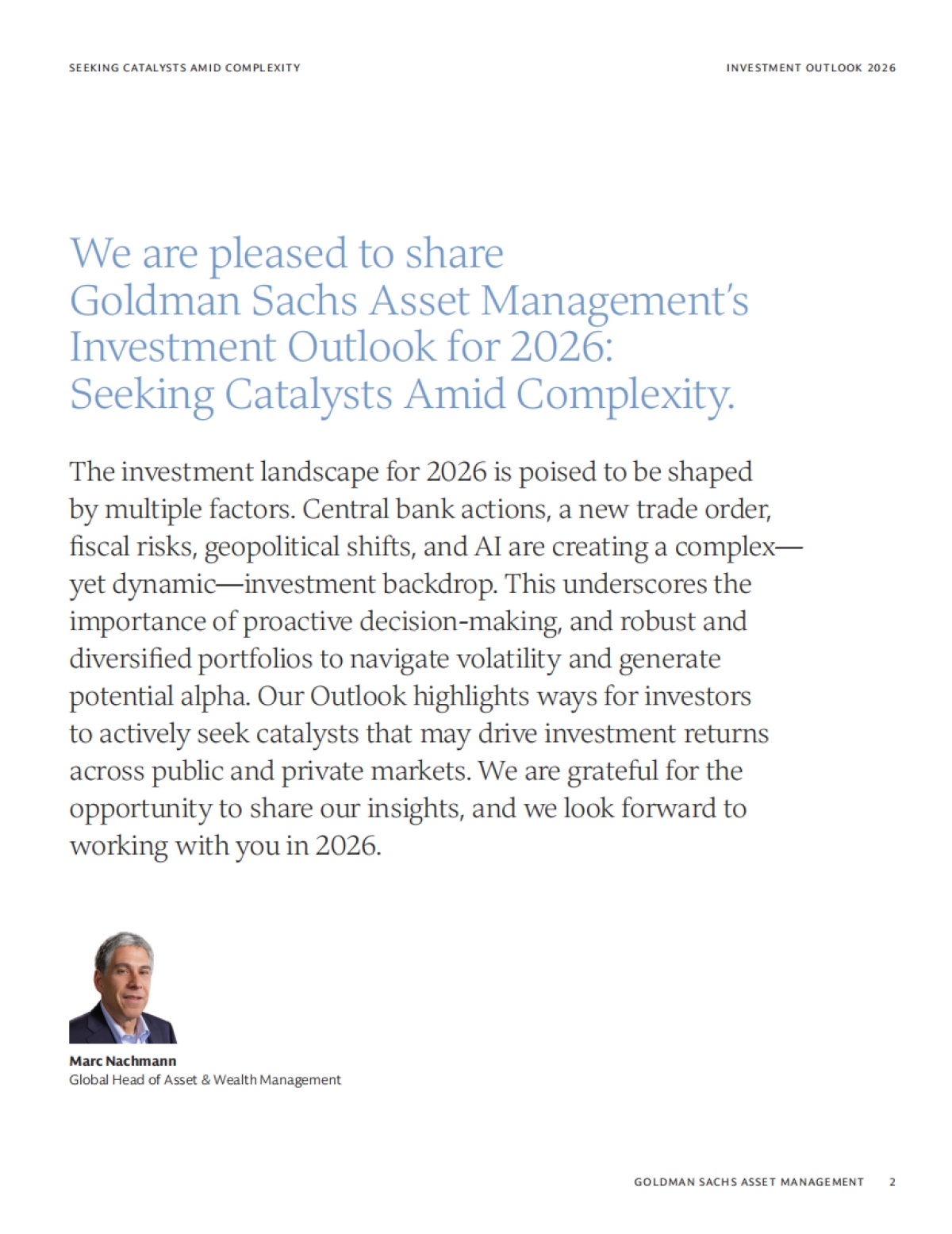
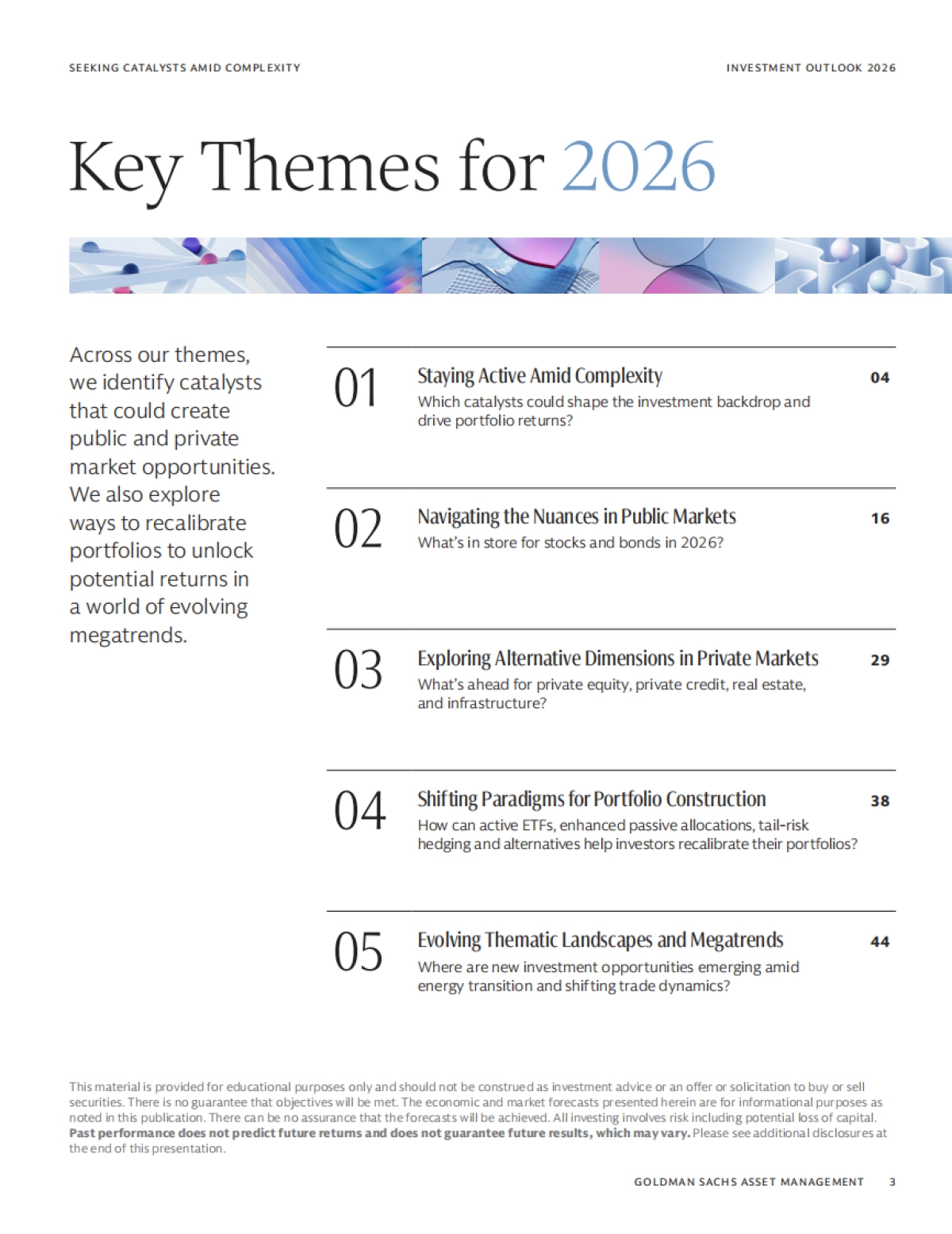
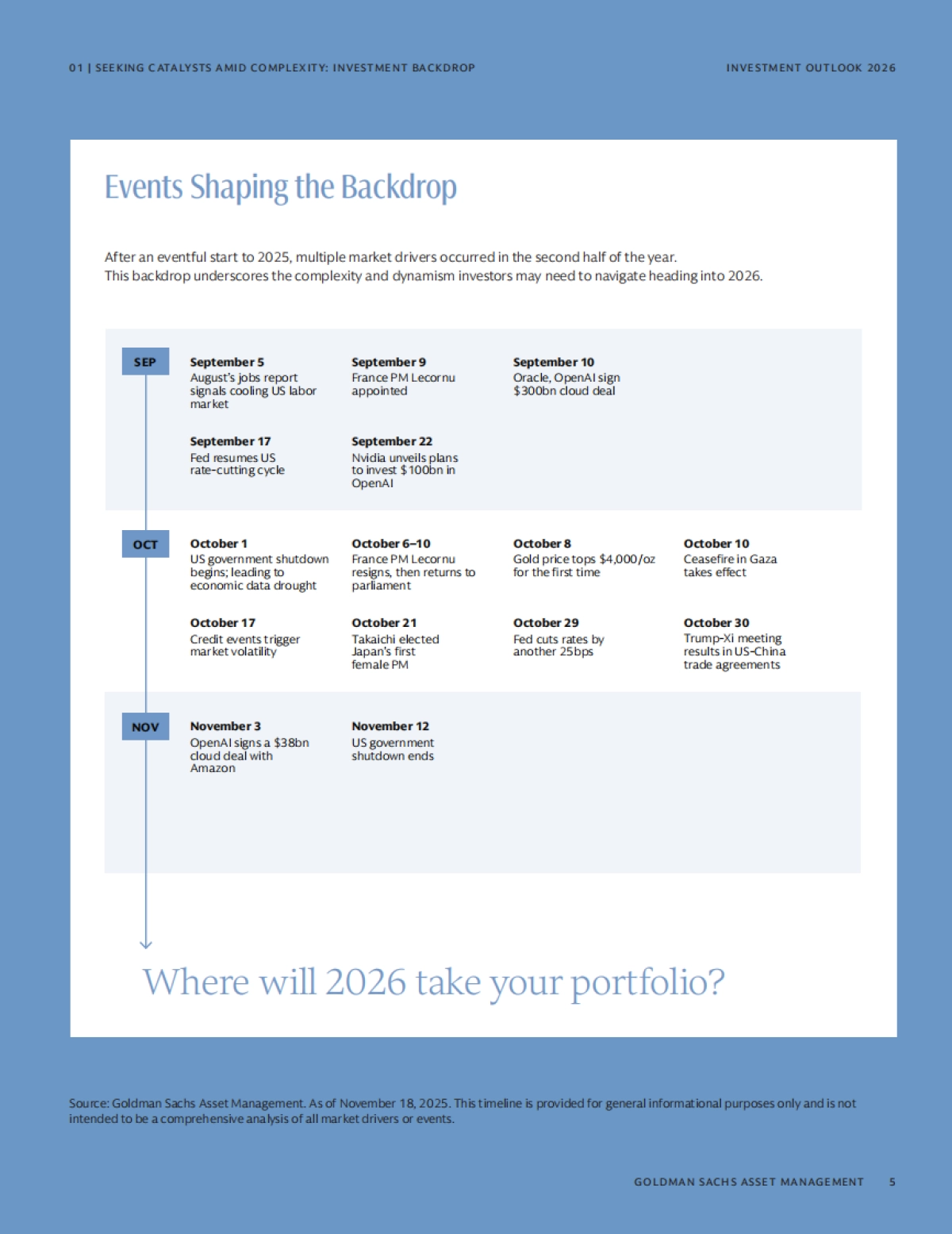
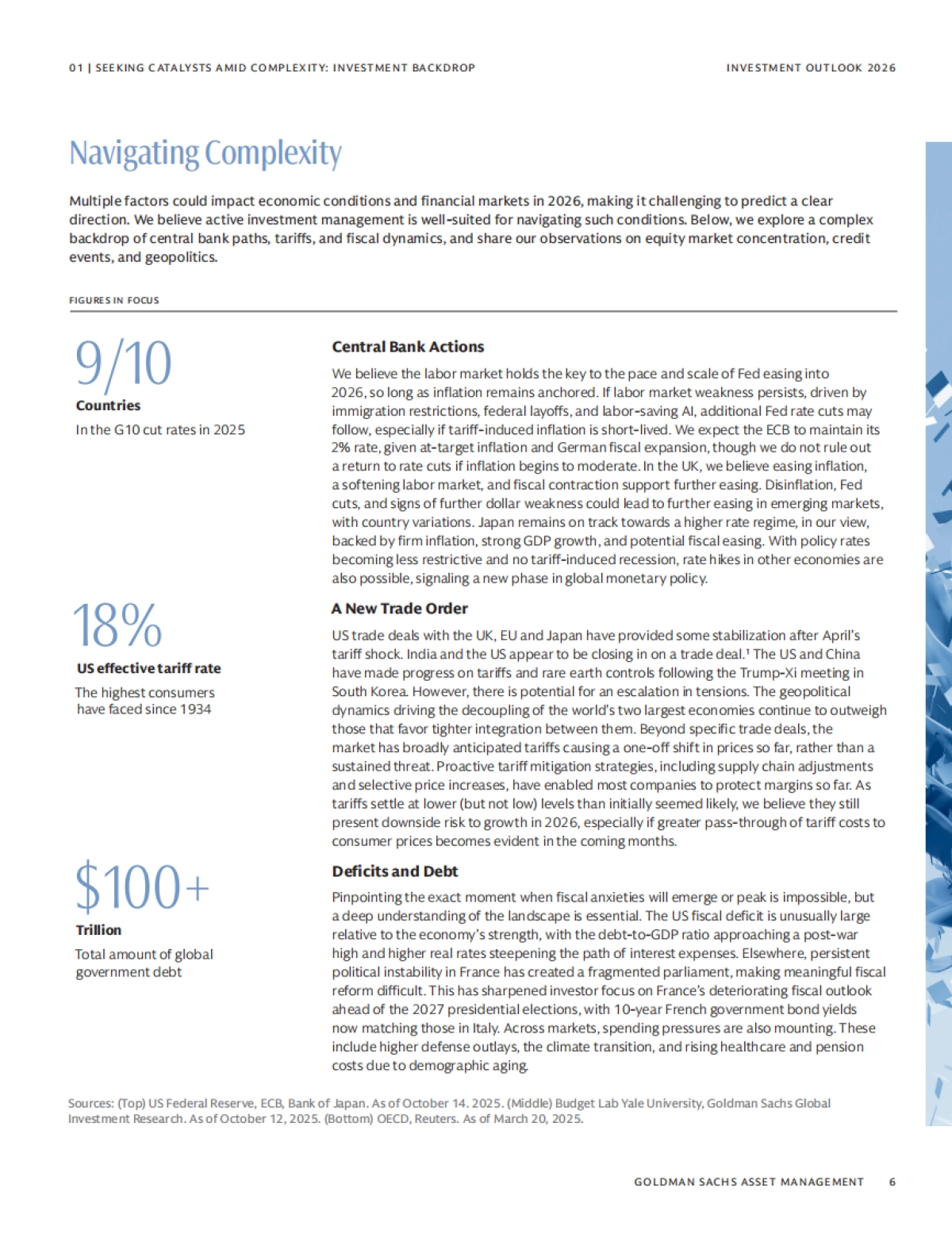
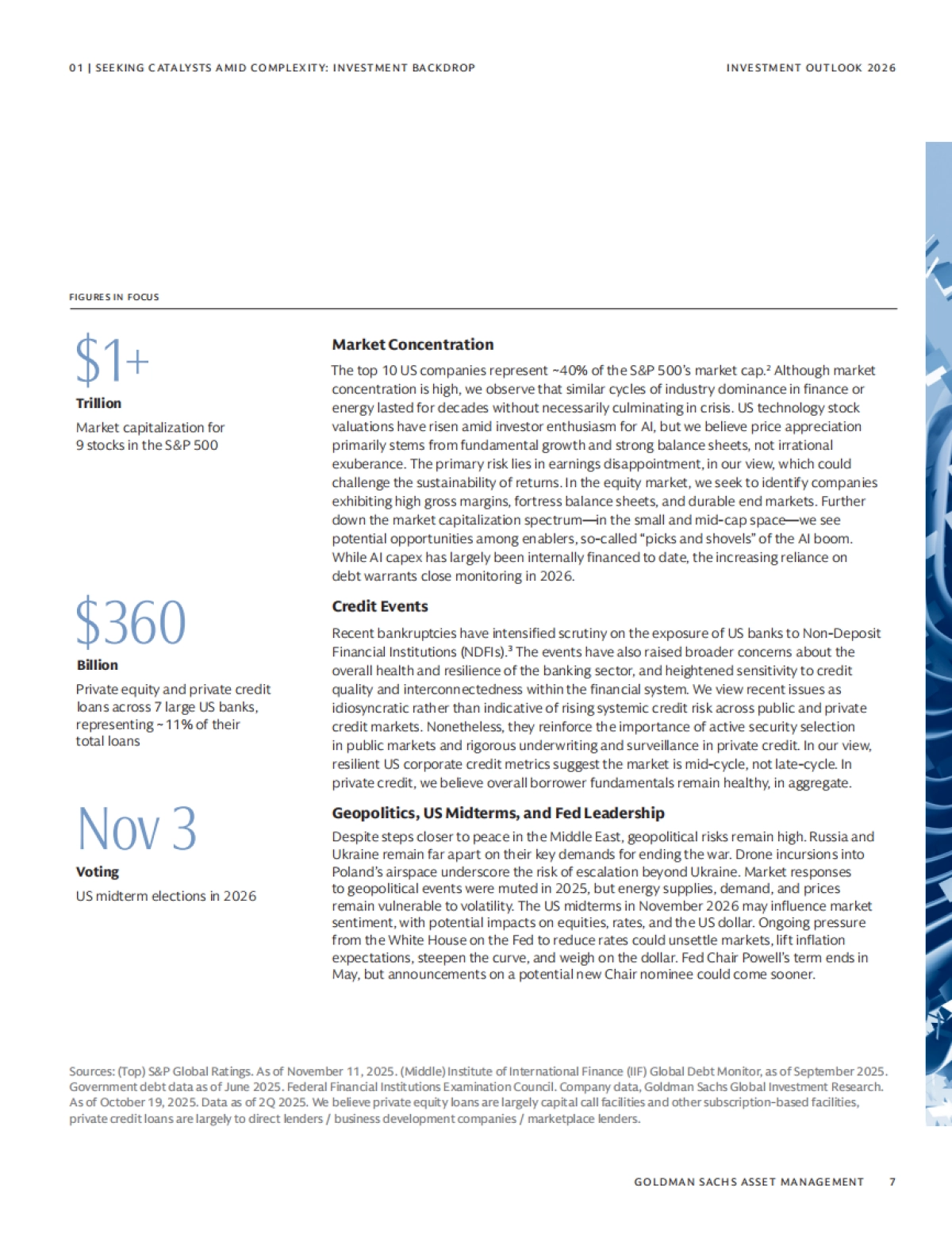
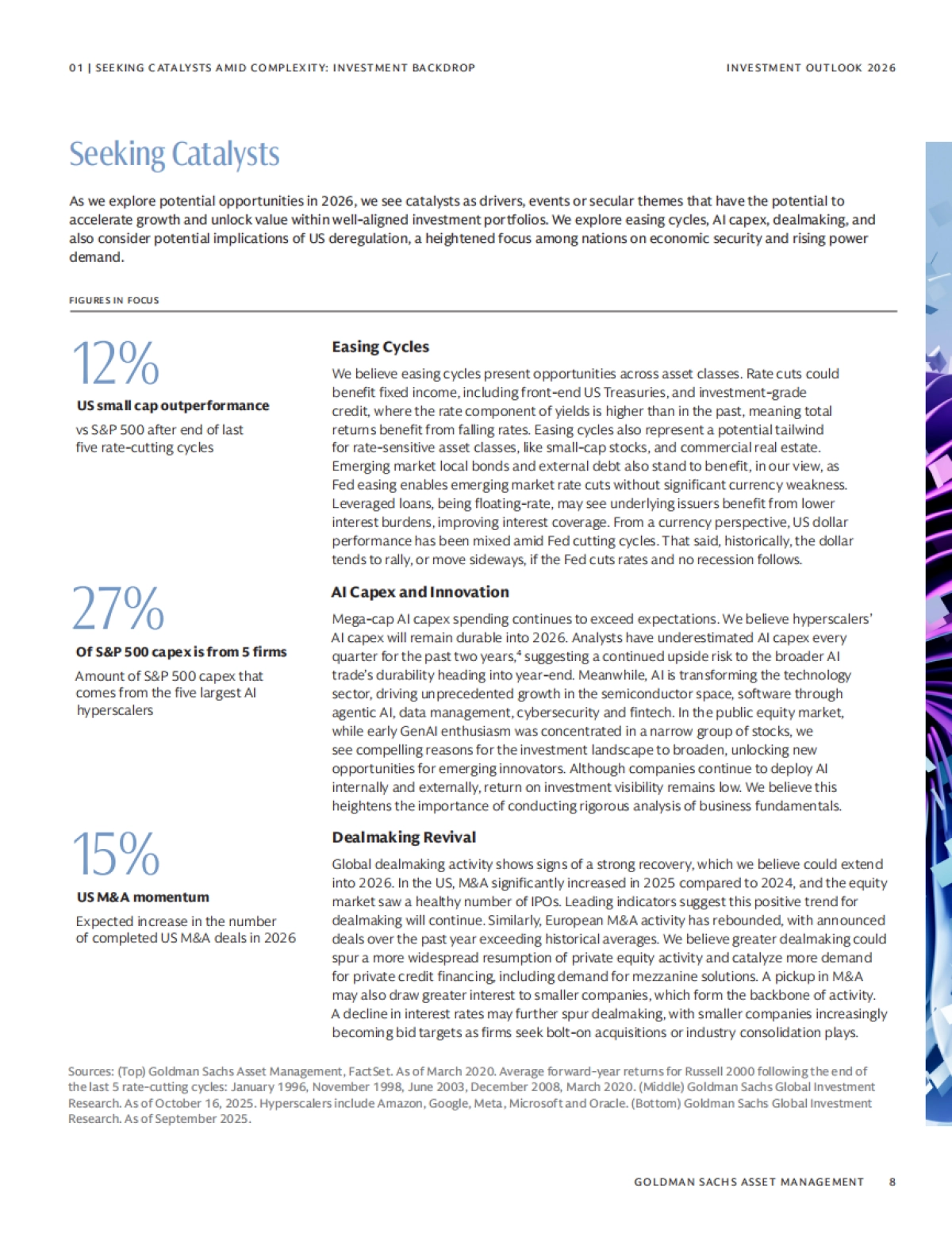
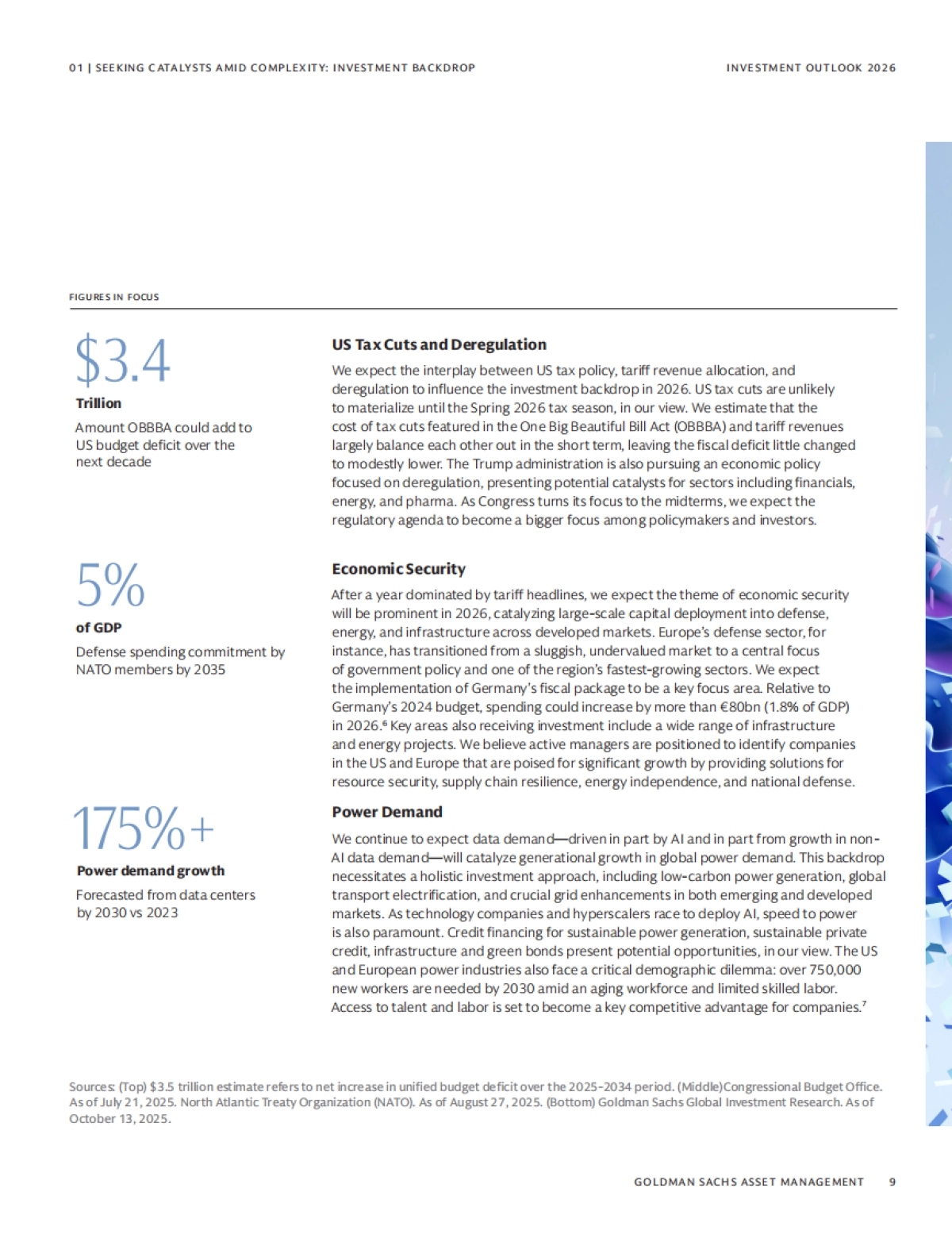
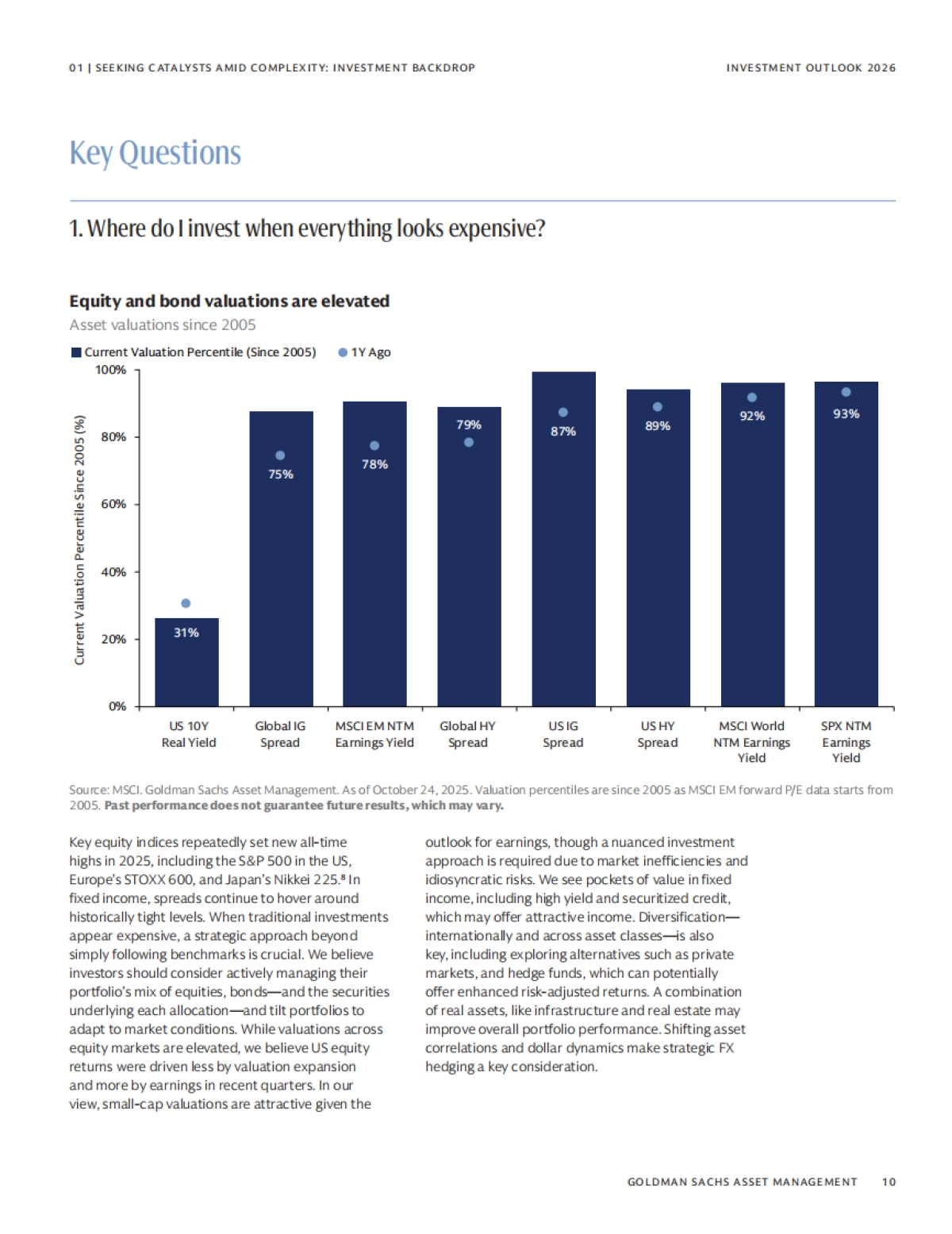
GoldmanAssetSachsManagementSeeking CatalystsAmid ComplexityInvestmentOutlook2026ENT B.SEEKING CATALYSTS AMID COMPLEXITYINVESTMENT OUTLOOK 2026We are pleased to shareGoldman Sachs Asset Management'sInvestment Outlook for 2026:Seeking Catalysts Amid ComplexityThe investment landscape for 2026 is poised to be shapedby multiple factors.Central bank actions,a new trade order,fiscal risks,geopolitical shifts,and AI are creating a complex-yet dynamic-investment backdrop.This underscores theimportance of proactive decision-making,and robust anddiversified portfolios to navigate volatility and generatepotential alpha.Our Outlook highlights ways for investorsto actively seek catalysts that may drive investment returnsacross public and private markets.We are grateful for theopportunity to share our insights,and we look forward toworking with you in 2026.Marc NachmannGlobal Head of Asset Wealth ManagementGOLDMAN SACHS ASSET MANAGEMENTSEEKING CATALYSTS AMID COMPLEXITYINVESTMENT OUTLOOK 2026Key Themes for 2026Across our themes,we identify catalystsStaying Active Amid Complexity04that could createWhich catalysts could shape the investment backdrop anddrive portfolio returns?public and privatemarket opportunities.We also exploreways to recalibrateNavigating the Nuances in Public Markets16portfolios to unlock02What's in store for stocks and bonds in 2026?potential returns ina world of evolvingmegatrends.03Exploring Alternative Dimensions in Private Markets29What's ahead for private equity,private credit,real estate,and infrastructure?04Shifting Paradigms for Portfolio Construction38How can active ETFs,enhanced passive allocations,tail-riskhedging and alternatives help investors recalibrate their portfolios?Evolving Thematic Landscapes and Megatrends44Where are new investment opportunities emerging amidenergy transition and shifting trade dynamics?This material is provided for educational purposes only and should not be construed as investment advice or an offer or solicitation to buy or sellsecurities.There is no guarantee that objectives will be met.The economic and market forecasts presented herein are for informational pur poses asnoted in this publication.There can be no assurance that the forecasts will be achieved.All investing involves risk including potential loss of capital.Past performance does not predict future retums and does not guarantee future results,which may vary.Please see additional disclosures atthe end of this presentation.GOLDMAN SACHS ASSET MANAGEMENT3Staying ActiveAmid ComplexityActive,disciplined investing is key given central bank shifts,newtrade dynamics,and idiosyncratic credit events.We pinpointeasing cycles,Al,and dealmaking as catalysts,and remainfocused on strategically positioning portfolios to seek returns.This material is provided for educational purposes only and should not be construed as investment advice or an offer or solicitationbuy or sellsecurities.There is no guarantee that objectives will be met.The economic and market forecasts presented erein are for informationoted in this publication.There can be no assurance that the forecasts will be achieved.All investing involves risk including potential oof capital.Past performance does not predict future retums and does not guarantee future results,which may vary.Please see additional obclosures atthe end of this presentation01 SEEKING CATALYSTS AMID COMPLEXITY:INVESTMENT BACKDROPINVESTMENT OUTLOOK 2026Events Shaping the BackdropAfter an eventful start to 2025,multiple market drivers occurred in the second half of the year.This backdrop underscores the complexity and dynamism investors may need to navigate heading into 2026.SEPSeptember 5September 9September 10August's jobs reportFrance PM LecornuOracle,OpenAl signsignals cooling US laborappointed$300bn cloud dealmarketSeptember 17September 22Fed resumes USNvidia unveils plansrate-cutting cycleto invest $100bn inOpenAlOctober 1October 6-10October 8October 10US government shutdownFrance PM LecornuGold price tops $4,000/ozCeasefire in Gazabegins;leading toresigns,then returns tofor the first timetakes effecteconomic data droughtparliamentOctober 17October 21October 30Credit events triggerTakaichi electedFed cuts rates byTrump-Xi meetingmar ket volatilityJapan's firstanother 25bpsresults in US-Chinafemale PMtrade agreementsNOVNovember 3November 12OpenAl signs a $38bnUS governmentcloud deal withshutdown endsAmazonWhere will 2026 take your portfolio?Source:Goldman Sachs Asset Management.As of November 18,2025.This timeline is provided for general informational purposes only and is notintended to be a comprehensive ana lysis of all market drivers or events.GOLDMAN SACHS ASSET MANAGEMENT01 I SEEKING CATALYSTS AMID COMPLEXITY:INVESTMENT BACKDROPINVESTMENT OUTLOOK 2026Navigating ComplexityMultiple factors could impact economic conditions and financial markets in 2026,making it challenging to predict a cleardirection.We believe active investment management is well-suited for navigating such conditions.Below,we explore a complexbackdrop of central bank paths,tariffs,and fiscal dynamics,and share our observations on equity market concentration,creditevents,and geopolitics.FIGURES IN FOCUS9/10Central Bank ActionsWe believe the labor market holds the key to the pace and scale of Fed easing into2026,so long as inflation remains anchored.If labor market weakness persists,driven byCountriesimmigration restrictions,federal layoffs,and labor-saving Al,additional Fed rate cuts mayIn the G10 cut rates in 2025follow,especially if tariff-induced inflation is short-lived.We expect the ECB to maintain its2%rate,given at-target inflation and German fiscal expansion,though we do not rule outa return to rate cuts if inflation begins to moderate.In the UK,we believe easing inflation,a softening labor market,and fiscal contraction support further easing.Disinflation,Fedcuts,and signs of further dollar weakness could lead to further easing in emerging markets,with country variations.Japan remains on track towards a higher rate regime,in our view,backed by firm inflation,strong GDP growth,and potential fiscal easing.With policy ratesbecoming less restrictive and no tariff-induced recession,rate hikes in other economies arealso possible,signaling a new phase in global monetary policy.18%A New Trade OrderUS trade deals with the UK,EU and Japan have provided some stabilization after April'stariff shock.India and the US appear to be closing in on a trade deal.The US and ChinaUS effective tariff ratehave made progress on tariffs and rare earth controls following the Trump-Xi meeting inThe highest consumersSouth Korea.However,there is potential for an escalation in tensions.The geopoliticalhave faced since 1934dynamics driving the decoupling of the world's two largest economies continue to outweighthose that favor tighter integration between them.Beyond specific trade deals,themarket has broadly anticipated tariffs causing a one-off shift in prices so far,rather than asustained threat.Proactive tariff mitigation strategies,including supply chain adjustmentsand selective price increases,have enabled most companies to protect margins so far.Astariffs settle at lower (but not low)levels than initially seemed likely,we believe they stillpresent downside risk to growth in 2026,especially if greater pass-through of tariff costs toconsumer prices becomes evident in the coming months.$100+Deficits and DebtPinpointing the exact moment when fiscal anxieties will emerge or peak is impossible,buta deep understanding of the landscape is essential.The US fiscal deficit is unusually largeTrillionrelative to the economy's strength,with the debt-to-GDP ratio approaching a post-warTotal amount of globalhigh and higher real rates steepening the path of interest expenses.Elsewhere,persistentgovernment debtpolitical instability in France has created a fragmented parliament,making meaningful fiscalreform difficult.This has sharpened investor focus on France's deteriorating fiscal outlookahead of the 2027 presidential elections,with 10-year French government bond yieldsnow matching those in Italy.Across markets,spending pressures are also mounting.Theseinclude higher defense outlays,the climate transition,and rising healthcare and pensioncosts due to demographic agingSources:(Top)US Federal Reserve,ECB,Bank of Japan.As of October 14.2025.(Middle)Budget Lab Yale University,Goldman Sachs GlobalInvestment Research.As of October 12,2025.(Bottom)OECD,Reuters.As of March 20,2025.GOLDMAN SACHS ASSET MANAGEMENT01|SEEKING CATALYSTS AMID COMPLEXITY:INVESTMENT BACKDROPINVESTMENT OUTLOOK 2026FIGURES IN FOCUS$1+Market ConcentrationThe top 10 US companies represent ~40%of the S&P 500's market cap.2 Although marketconcentration is high,we observe that similar cycles of industry dominance in finance orTrillionenergy lasted for decades without necessarily culminating in crisis.US technology stockMarket capitalization forvaluations have risen amid investor enthusiasm for Al,but we believe price appreciationprimarily stems from fundamental growth and strong balance sheets,not irrationalexuberance.The primary risk lies in earnings disappointment,in our view,which couldchallenge the sustainability of returns.In the equity market,we seek to identify companiesexhibiting high gross margins,fortress balance sheets,and durable end markets.Furtherdown the market capitalization spectrum-in the small and mid-cap space-we seepotential opportunities among enablers,so-called"picks and shovels"of the Al boom.While Al capex has largely been internally financed to date,the increasing reliance ondebt warrants close monitoring in 2026.$360Credit EventsRecent bankruptcies have intensified scrutiny on the exposure of US banks to Non-DepositFinancial Institutions(NDFIs).3 The events have also raised broader concerns about theBillionoverall health and resilience of the banking sector,and heightened sensitivity to creditPrivate equity and private creditquality and interconnectedness within the financial system.We view recent issues asloans across 7 large US banks,diosyncratic rather than indicative of rising systemic credit risk across public and privaterepresenting~11%of theircredit markets.Nonetheless,they reinforce the importance of active security selectiontotal loansin public markets and rigorous underwriting and surveillance in private credit.In our view,resilient US corporate credit metrics suggest the market is mid-cycle,not late-cycle.Inprivate credit,we believe overall borrower fundamentals remain healthy,in aggregate.Nov 3Geopolitics,US Midterms,and Fed LeadershipDespite steps closer to peace in the Middle East,geopolitical risks remain high.Russia andUkraine remain far apart on their key demands for ending the war.Drone incursions intoVotingPoland's airspace underscore the risk of escalation beyond Ukraine.Market responsesUS midterm elections in 2026to geopolitical events were muted in 2025,but energy supplies,demand,and pricesremain vulnerable to volatility.The US midterms in November 2026 may influence marketsentiment,with potential impacts on equities,rates,and the US dollar.Ongoing pressurefrom the White House on the Fed to reduce rates could unsettle markets,lift inflationexpectations,steepen the curve,and weigh on the dollar.Fed Chair Powell's term ends inMay,but announcements on a potential new Chair nominee could come sooner.Sources:(Top)S&P Global Ratings.As of November 11,2025.(Middle)Institute of International Finance (IIF)Global Debt Monitor,as of September 2025Government debt data as of June 2025.Federal Financial Institutions Examination Council.Company data,Goldman Sachs Global Investment Research.As of October 19,2025.Data as of 2Q 2025.We believe private equity loans are largely capital call facilities and other subscription-based facilities,private credit loans are largely to direct lenders/business development companies marketplace lenders.GOLDMAN SACHS ASSET MANAGEMENT01 I SEEKING CATALYSTS AMID COMPLEXITY:INVESTMENT BACKDROPINVESTMENT OUTLOOK 2026Seeking CatalystsAs we explore potential opportunities in 2026,we see catalysts as drivers,events or secular themes that have the potential toaccelerate growth and unlock value within well-aligned investment portfolios.We explore easing cycles,Al capex,dealmaking,andalso consider potential implications of US deregulation,a heightened focus among nations on economic security and rising powerdemand.FIGURES IN FOCUS12%Easing CyclesWe believe easing cycles present opportunities across asset classes.Rate cuts couldbenefit fixed income,including front-end US Treasuries,and investment-gradeUS small cap outperformancecredit,where the rate component of yields is higher than in the past,meaning totalvs S&P 500 after end of lastreturns benefit from falling rates.Easing cycles also represent a potential tailwindfive rate-cutting cyclesfor rate-sensitive asset classes,like small-cap stocks,and commercial real estate.Emerging market local bonds and external debt also stand to benefit,in our view,asFed easing enables emerging market rate cuts without significant currency weaknessLeveraged loans,being floating-rate,may see underlying issuers benefit from lowerinterest burdens,improving interest coverage.From a currency perspective,US dollarperformance has been mixed amid Fed cutting cycles.That said,historically,the dollartends to rally,or move sideways,if the Fed cuts rates and no recession follows.27%Al Capex and InnovationMega-cap Al capex spending continues to exceed expectations.We believe hyperscalers'Al capex will remain durable into 2026.Analysts have underestimated Al capex everyOf S&P 500 capexis from 5 firmsquarter for the past two years,suggesting a continued upside risk to the broader AlAmount of S&P 500 capex thattrade's durability heading into year-end.Meanwhile,Al is transforming the technologycomes from the five largest Alsector,driving unprecedented growth in the semiconductor space,software throughhyperscalersagentic Al,data management,cybersecurity and fintech.In the public equity market,while early GenAl enthusiasm was concentrated in a narrow group of stocks,wesee compelling reasons for the investment landscape to broaden,unlocking newopportunities for emerging innovators.Although companies continue to deploy Alinternally and externally,return on investment visibility remains low.We believe thisheightens the importance of conducting rigorous analysis of business fundamentals.15%Dealmaking RevivalGlobal dealmaking activity shows signs of a strong recovery,which we believe could extendinto 2026.In the US,M&A significantly increased in 2025 compared to 2024,and the equityUS M&A momentummarket saw a healthy number of IPOs.Leading indicators suggest this positive trend forExpected increase in the numberdealmaking will continue.Similarly,European M&A activity has rebounded,with announcedof completed US M&A deals in 2026deals over the past year exceeding historical averages.We believe greater dealmaking couldspur a more widespread resumption of private equity activity and catalyze more demandfor private credit financing,including demand for mezzanine solutions.A pickup in M&Amay also draw greater interest to smaller companies,which form the backbone of activity.A decline in interest rates may further spur dealmaking,with smaller companies increasinglybecoming bid targets as firms seek bolt-on acquisitions or industry consolidation plays.Sources:(Top)Goldman Sachs Asset Management,FactSet.As of March 2020.Average forward-year returns for Russell 2000 following the end ofthe last 5 rate-cutting cycles:January 1996,November 1998,June 2003,December 2008,March 2020.(Middle)Goldman Sachs Global InvestmentResearch.As of October 16,2025.Hyperscalers include Amazon,Google,Meta,Microsoft and Oracle.(Bottom)Goldman Sachs Global InvestmentResearch.As of September 2025GOLDMAN SACHS ASSET MANAGEMENT01 SEEKING CATALYSTS AMID COMPLEXITY:INVESTMENT BACKDROPINVESTMENT OUTLOOK 2026FIGURES IN FOCUS$3.4US Tax Cuts and DeregulationWe expect the interplay between US tax policy,tariff revenue allocation,andderegulation to influence the investment backdrop in 2026.US tax cuts are unlikelyTrillionto materialize until the Spring 2026 tax season,in our view.We estimate that theAmount OBBBA could add tocost of tax cuts featured in the One Big Beautiful Bill Act (OBBBA)and tariff revenuesUS budget deficit over thelargely balance each other out in the short term,leaving the fiscal deficit little changednext decadeto modestly lower.The Trump administration is also pursuing an economic policyfocused on deregulation,presenting potential catalysts for sectors including financials,energy,and pharma.As Congress turns its focus to the midterms,we expect theregulatory agenda to become a bigger focus among policymakers and investors.5%Economic SecurityAfter a year dominated by tariff headlines,we expect the theme of economic securitywill be prominent in 2026,catalyzing large-scale capital deployment into defenseof GDPenergy,and infrastructure across developed markets.Europe's defense sector,forDefense spending commitment byinstance,has transitioned from a sluggish,undervalued market to a central focusNATO members by 2035of government policy and one of the region's fastest-growing sectors.We expectthe implementation of Germany's fiscal package to be a key focus area.Relative toGermany's 2024 budget,spending could increase by more than E80bn(1.8%of GDP)in 2026.6 Key areas also receiving investment include a wide range of infrastructureand energy projects.We believe active managers are positioned to identify companiesin the US and Europe that are poised for significant growth by providing solutions forresource security,supply chain resilience,energy independence,and national defense.175%+Power DemandWe continue to expect data demand-driven in part by Al and in part from growth in non-Al data demand-will catalyze generational growth in global power demand.This backdropPower demand growthnecessitates a holistic investment approach,including low-carbon power generation,globalForecasted from data centerstransport electrification,and crucial grid enhancements in both emerging and developedby2030vs2023markets.As technology companies and hyperscalers race to deploy Al,speed to poweris also paramount.Credit financing for sustainable power generation,sustainable privatecredit,infrastructure and green bonds present potential opportunities,in our view.The USand European power industries also face a critical demographic dilemma:over 750,000new workers are needed by 2030 amid an aging workforce and limited skilled labor.Access to talent and labor is set to become a key competitive advantage for companies."Sources:(Top)$3.5 trillion estimate refers to net increase in unified budget deficit over the 2025-2034 period.(Middle)Congressional Budget Office.As of July 21,2025.North Atlantic Treaty Organization (NATO).As of August 27,2025.(Bottom)Goldman Sachs Global Investment Research.As ofGOLDMAN SACHS ASSET MANAGEMENT01 SEEKING CATALYSTS AMID COMPLEXITY:INVESTMENT BACKDROPINVESTMENT OUTLOOK 2026Key Questions1.Where do I invest when everything looks expensive?Equity and bond valuations are elevatedAsset valuations since 2005Current Valuation Percentile(Since 2005)1YAgo100%●●●93%79%92%80%87%89%●●78%75%60%40%20%31%0%US 10YGlobal IGMSCIEM NTMGlobal HYUSIGUSHYMSCI WorldSPX NTMReal YieldSpreadEarnings YieldSpreadSpreadSpreadNTM EarningsEarningsYieldYieldSource:MSCI.Goldman Sachs Asset Management.As of October 24,2025.Valuation percentiles are since 2005 as MSCI EM forward P/E data starts from2005.Past performance does not guarantee future results,which may vary.Key equity in dices repeatedly set new all-timeoutlook for earnings,though a nuanced investmentapproach is required due to market inefficiencies andEurope's STOXX 600,and Japan's Nikkei 225.s Inidiosyncratic risks.We see pockets of value in fixedfixed income,spreads continue to hover aroundincome,including high yield and securitized credit,historically tight levels.When traditional investmentswhich may offer attractive income.Diversification-appear expensive,a strategic approach beyondinternationally and across asset classes-is alsosimply following benchmarks is crucial.We believekey,including exploring alternatives such as privateinvestors should consider actively managing theirmarkets,and hedge funds,which can potentiallyportfolio's mix of equities,bonds-and the securitiesoffer enhanced risk-adjusted returns.A combinationunderlying each allocation-and tilt portfolios toof real assets,like infrastructure and real estate mayadapt to market conditions.While valuations acrossimprove overall portfolio performance.Shifting assetequity markets are elevated,we believe US equitycorrelations and dollar dynamics make strategic FXreturns were driven less by valuation expansionhedging a key consideration.and more by earnings in recent quarters.In ourview,small-cap valuations are attractive given theGOLDMAN SACHS ASSET MANAGEMENT01 I SEEKING CATALYSTS AMID COMPLEXITY:INVESTMENT BACKDROPINVESTMENT OUTLOOK 20262.What are the potential investment implications from central bank actions in 2026?Divergent central bank paths present opportunities to diversify duration exposuresCentral bank meeting calendar for 2026FedECBBoEBoJJanuary2823February55March18191819April29303028MayJune17111816July29233031AugustSeptember161018October282930NovemberDecember9171719Sources:Fed,European Central Bank(ECB),Bank of England(BoE),Bank of Japan(BoJ).Latest scheduled meetingcalendars.As of October 20,2025.Central bank actions provide fixed income investorsimproved inflation,a relatively weak labor market,with potential opportunities to express views inand potential tax hikes.The Bank of Japan is likelydifferent sovereigns across the curve and diversifyto hike rates,in our view,due to high inflation andtheir duration exposures.In the US,we believe therobust growth.We believe other G10 easing cyclesFed may cut rates twice in 2026,given its stancevary:Sweden's may conclude and Norway's easingon labor market weakness.In Europe,resiliencepace will likely continue.A Swiss return to negativein the European economy and a hawkish ECBrates is unlikely.Australia's cuts could pause,andreaction function point to an extended pause inNew Zealand's rates may fall further.Emergingthe easing cycle.However,the market may bemarkets anticipate continued easing,supported byunderestimating the probability of easing resuminga subdued US dollar and lower oil prices.if inflation undershoots target.In the UK,the Bank ofEngland could resume cuts in December,driven byGOLDMAN SACHS ASSET MANAGEMENT1101 SEEKING CATALYSTS AMID COMPLEXITY:INVESTMENT BACKDROPINVESTMENT OUTLOOK 20263.How could consumer spending be impacted by tariffs?US consumption is a tale of two spending realitiesThe wealthiest 20%of US households account for 40%of total consumption45%40%35%30%25%20%15%10%5%0%0-2020-4040-6060-8080-100Income QuintileSources:Bureau of Labor Statistics,Macrobond.Data from 2023.Historical analysis indicates that the underlying shares of expenditure have remainedUS consumer confidence,while generally robust,showschallenging given potential labor market weakness andemerging signs of weakness among lower-incomerising unemployment.Although US auto and credithouseholds.However,this demographic has a limitedcard loan delinguencies have increased,particularlyimpact on overall spending as the wealthiest 20%ofamong subprime consumers,this is primarily attributedhouseholds account for 40%of total consumption,to"credit score migration effects"from the pandemicwhile lower-income groups spend less than 10%.and larger auto loan sizes,rather than widespreadDespite this,consumer spending increasinglyhousehold credit stress.prioritizes value,price,choice,and convenience.Iftariff cost pass-through was merely delayed in 2025,a period of more moderate spending could followin 2026.Nevertheless,strong household balancesheets,high savings rates,and accumulated wealth areexpected to buffer spending.Anticipated Fed easingand US fiscal stimulus also suggest a sharp slowdownis unlikely.A critical factor will be the extent to whichcompanies can pass on tariff costs,which may beGOLDMAN SACHS ASSET MANAGEMENT1201 SEEKING CATALYSTS AMID COMPLEXITY:INVESTMENT BACKDROPINVESTMENT OUTLOOK 20264.Is fiscal friction here to stay for government bond investors?Rising 30-year yields partially reflect concerns over debt sustainabilityLong-end yields are more susceptible to fiscal concerns and inflation expectations6%-France -UK Japan-Germany-US5%3%2%JeaA-081%0%-1%202020212022202320242025Sources:Goldman Sachs Asset Management,Macrobond.As of October 15,2025.Past performance does not guarantee future results,whichmay vary.For investors in government bonds,we believe the fiscal backdropduring economic weakening.Conversely,long-end yields areis a critical concern that could trigger significant market volatility.more susceptible to fiscal concerns and inflation expectations,We believe government bonds can still mitigate downside growthwhich can drive them higher,leading to curve steepening.risks,especially in an era of positive real yields.Recent yearsUnderstanding these dynamics also allows investors to exploithave seen bonds rally during periods of economic uncertainty.yield curve views which seek to optimize their portfolio'sThis occurred during the regional banking crisis in March 2023,defensive characteristics.in response to weak labor market data in 2024 and 2025,aswell as during periods of heightened geopolitical risk.However,Context is also key.There is no single debt-to-GDP ratio thatin our view,investors must dynamically adjust their allocationautomatically triggers a fiscal crisis;Japan's debt-to-GDP ratiobetween risk assets and government bonds.The correlationhas exceeded 200%for over a decade without catastrophe.Whatbetween bonds and risk assets can shift from negative to positive,matters more,in our view,are the surrounding conditions.Theespecially if inflation or fiscal concerns intensify,potentiallycurrent environment of slowing growth and higher interest rates,diminishing bonds'hedging effectiveness.Front-end yieldsparticularly with central banks no longer engaging in large-scaleare more sensitive to central bank policy and have tended tobond purchases,is what fuels concern.offer strong counter-cyclical properties,acting as a hedgeGOLDMAN SACHS ASSET MANAGEMENT1301 SEEKING CATALYSTS AMID COMPLEXITY:INVESTMENT BACKDROPINVESTMENT OUTLOOK 20265.What policy proof points in Europe should investors monitor?European companies showing more willingness to investCapex-to-sales ratio has reached a 10-year high,marking a move towards more asset-intensive strategies10%9%8%Current Capex-to-Sales ratio at the7%highest level since the GFC6%5%1995199719992001200320052007200920112013201520172019202120232025Sources:Goldman Sachs Global Investment Research.Datastream.Global Financial Crisis(GFC).As of October 23,2025.Across Europe,stimulus is already driving a capexif the implementation of higher defense spendingrevival.Companies that have underinvested for twois gradual and complex,we believe it represents adecades are making renewed investment in capital-potentially significant medium-term boost for growthintensive sectors-driven by energy transitionGermany is also reviewing government functions forand security,defense,reshoring,infrastructureefficiency,utilizing Al and digitalization.In our view,aupgrades,digitalization,and Al.After a period ofreliance on globaltrade,high energy prices,and tooweak growth post-pandemic,higher governmentmuch red tape remain growth headwinds.spending on infrastructure and defense is forecastto boost German GDP growth to 1.4%in 2026 and1.8%the following year.We believe investors shouldmonitor the speed and execution of Germany'sfiscal package in 2026,given its recent track recordof underdelivering on budgeted investments.WithGermany's 2025 budget and the infrastructure fundlaw passed in late September,spending may pick upmeaningfully in 2026 in areas such as defense.EvenGOLDMAN SACHS ASSET MANAGEMENT01 I SEEKING CATALYSTS AMID COMPLEXITY:INVESTMENT BACKDROPINVESTMENT OUTLOOK 20266.What factors could cause differentiation among the Mag 7 in the context of Al capex?The market has underestimated hyperscaler Al capex for the past two yearsConsensus capex growth estimates for Al hyperscalers90%1■Start of Year☐Realized/Current80%70%64%60%54%50%40%30%22%19%19%20%10%0%202420252026Sources:FactSet,Goldman Sachs Global Investment Research.As of October 17,2025.Hyperscalers included:Amazon,Google,Meta,Microsoft,and OracleThe size and speed of recent Al investmentdifferentiation will hinge on whether these companiesannouncements among hyperscalers have raisedpossess access to competitive,proprietary Alquestions around the sustainability of Al capex.Intechnology,or if they will need to forge durableour view,we are closer to the early innings of Alpartnerships with model builders to sustain theircapex and expect increased Al competition betweencompetitive edge.More broadly,as fundamentalhyperscalers and countries to drive spending globally.investors,we believe it is crucial that core businessesThis includes markets that offer a combination ofremain robust,particularly as companies aggressivelycapital and power generation capabilities,includinginvest in Al technology.Beyond the Mag 7,the Middle East and Asia.We believe differentiationenterprise adoption is broadening,driving effortsamong the Mag 7 companies,despite the durableto clean,structure,and secure data so it can beAl capex,will be primarily driven by two criticalused effectively by Al systems.Al applications arefactors.Firstly,it depends on whether a company'sexpanding fast,especially in areas like automation,Al investment is motivated by the pursuit of newcustomer engagement,and operational intelligence-markets or by the strategic desire to enhance ancreating opportunities for platforms that seek to helpalready existing market-leading position.Secondly,businesses navigate Al integration.GOLDMAN SACHS ASSET MANAGEMENT15
文档评分
    请如实的对该文档进行评分
  • 0
发表评论

特惠

限量优惠活动

正在火热进行

站长

添加站长微信

领取新人礼包

下载

便携运营智库

立即下载APP

工具

运营导航

工具推荐

帮助

帮助中心

常见问题

分销

50%直推收益

30%间推分成

AI

智能对话

办公助手

顶部