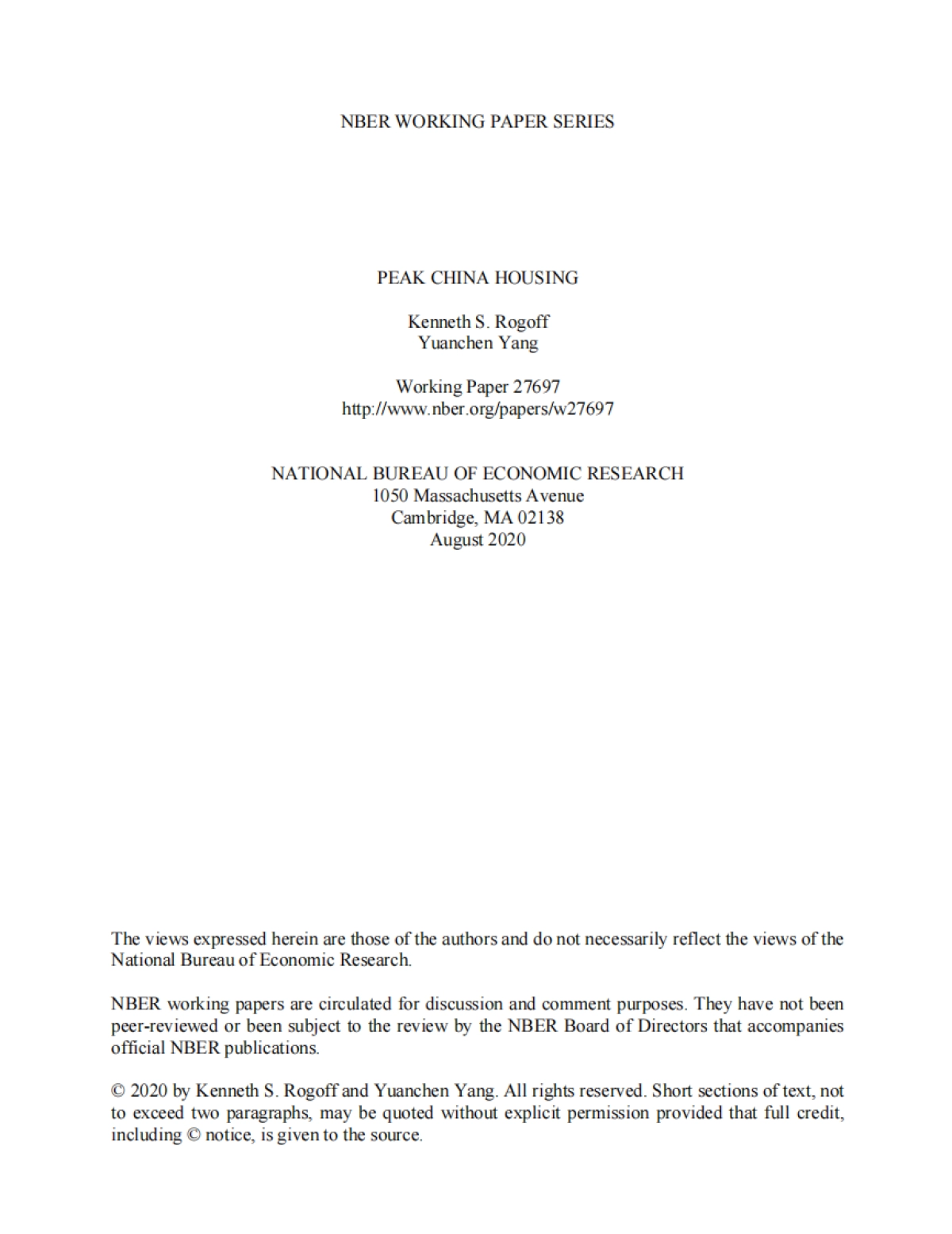
NBERWORKINGPAPERSERIESPEAKCHINAHOUISINGKennethS.RogoffYuanchenYangWorkingPaper27697htp/ww.nber org/papers/w27697NATIONALBUREAUOFECONOMICRESEARCH1050MassachusettsAvenue,Cambridge,MA02138August2020The views expressed herein are those of the authors and do not necessarily reflect the views of theNational Bureau of Economic ResearchNBER working papers are circulaed for disusion and comment purposes. They have not bern per-reviewed or been subject to te review by the NBFER Board of Directors that acompaniesofficialNBER publications.0 2020 by Kenneth S. Rogof and Yuanchen Yang. Al rights reserved. Short sections of text, notto exceed two paragraphs, may be quoted without explicit permission provided that full creditincluding @ notice. is given to the source.
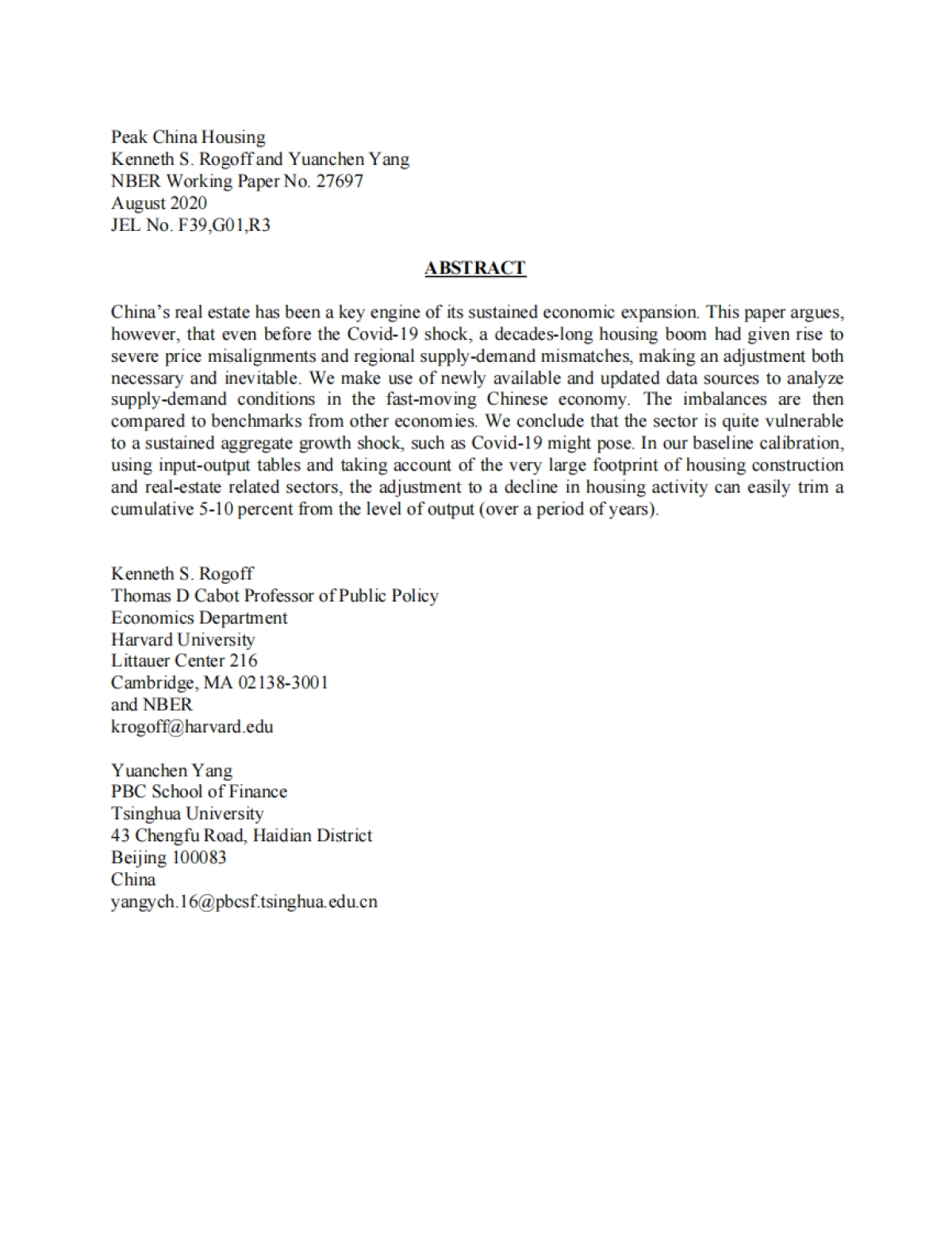
Peak ChinaHousingKennethS.Rogoff and YuanchenYangNBER Working PaperNo.27697August2020JELNo.F39,G01,R3 China 's real estae has been a key engine of ts sustained economic expansion This paper argues however, that even before the Covid-19 shock, a decades-long housing boom had given rise tosevere price misalignments and regional supply-dem and mismatches, m aking an adjustment bothincessry and ineviable. We make se of newly available and updated data sources to analyzaesupply-demand conditions in the fast-movingooononyThe imbalancesare ther compared to benchmarks from other economies. We conclude that the sector is quite vulnerableose In our baseline calibration,to a sustained aggregate growth shock. suchusing input-output tables and taking account of the very large footprint of housing constructionand real-estate related sectors. the adiustmenta decline in housing activity can easily trim acumulative 5-10 percent from the level of output (over a period of years,KennethS.RogoffThomas DCabot ProfessorofPublicPalicyEconomics DepartmentHarvard UniversityLittauerCenter216Cambridge,MA02138-3001and NBERkrogoff@harvard.eduYuanchenYangPBC School of FinanceTsinghua University43ChengfuRoad, Haidian DistrictBeijing100083Chinayangych.16@pbcsf tsinghua.edu.cn
1.Introduction It has long been arsued that desnite China's truly epic real estate boom over the pastthree decades (as documented in a number of previous papers), the central government'sability to tighly monitor the financial system, and to resolve insolvencies quickly in the eventof a crisis, makes it relatively im mune to conventional housing-related financial crises. At thesame time. however. this view has been largely untested thanks to the country's extraordinary growth performance, with expectations of fur ther ast growth underpining ever higherhousing prices. How much ofa vulnerability might the real estate sector prove in the wake oftheCovid-19shock?This paner s contribution is threefold First. we make use of newly available sources, toextend and significantly update earlier work on the size and scale of China's housing market We esnecially take advantase of the digitization of China's statistics, which has help...